
Emergence of low-energy spin waves in superconducting electron-doped cuprates
In order to fully utilize the technological potential of unconventional superconductors, an enhanced understanding of the superconducting mechanism is necessary.
Background & Academic Lineage
The Origin & Academic Lineage
The quest to understand and harness unconventional superconductors, particularly the high-temperature superconducting cuprates, has been a central theme in condensed matter physics for decades. These materials are fascinating because their superconductivity is intimately intertwined with magnetism, though the precise details of this coupling have remained elusive. Historically, the parent compounds of cuprates are known as antiferromagnetic Mott insulators. When these materials are "doped" with charge carriers (either electrons or holes), their antiferromagnetic order typically subsides, and superconductivity emerges below a critical temperature, $T_c$.
A significant puzzle in this field has been the stark asymmetry between electron-doped (n-type) and hole-doped (p-type) cuprates. While both exhibit superconductivity, their magnetic properties and superconducting "domes" (the range of doping where superconductivity occurs) differ considerably. For n-type cuprates, a peculiar requirement is that they often don't become superconducting immediately after synthesis. Instead, they need a special "reductive annealing" process to induce superconductivity. The exact impact of this annealing on the material's structure and properties has been a long-standing debate with no clear consensus.
This paper specifically addresses a critical gap in our understanding: how reductive annealing affects the low-energy spin dynamics in electron-doped cuprates, particularly Nd$_{1.85}$Ce$_{0.15}$CuO$_{4-\delta}$ (NCCO). Previous studies on the spin fluctuations in as-grown (non-annealed) NCCO were largely absent, leaving a major question mark over the role of defects and annealing in the emergence of superconductivity. The fundamental limitation of prior work was this lack of dedicated investigation into the as-grown state's spin dynamics and the precise mechanism by which annealing transforms a non-superconducting, antiferromagnetic material into a superconductor. Furthermore, the prevailing idea that superconductivity opens a spin pseudogap is challenged here, as the authors observe a larger spin pseudogap in the non-superconducting as-grown sample, suggesting defects, rather than superconductivity itself, are the primary cause. This highlights a critical "pain point" in the field: a lack of clarity on the causal relationship between material defects, spin dynamics, and the onset of high-$T_c$ superconductivity.
Intuitive Domain Terms
- Cuprates: Imagine these as the "superstar" materials in the world of electricity. They're like special ceramic compounds that can conduct electricity with zero resistance at surprisingly high temperatures compared to traditional superconductors. Think of them as the Formula 1 cars of electrical conductors.
- Antiferromagnetic Mott Insulators: Picture a tiny army of atomic magnets, perfectly lined up so that every magnet points in the opposite direction to its neighbors (antiferromagnetic). A "Mott insulator" means that even though there are plenty of electrons, they're all stuck in their positions, unable to move freely and carry an electrical current. It's like a crowded concert hall where everyone has a seat, but no one can get up and dance.
- Spin Pseudogap: This is like a "quiet zone" for the collective wiggles and waves of those atomic magnets (spins). Normally, spins can fluctuate at all sorts of energies. A spin pseudogap means that low-energy fluctuations are suppressed or partially forbidden, creating a kind of energy barrier for these movements. It's not a complete silence, but a noticeable dampening of the low-energy chatter.
- Reductive Annealing: Think of this as a special "purification ritual" for the material. You heat it up in a controlled environment to gently remove specific unwanted atoms, often oxygen. This process is crucial for n-type cuprates, as it "cleans up" the material, allowing it to finally become superconducting. It's like polishing a dull gem to reveal its inner sparkle.
- Spin Waves (Magnons): These are the collective "Mexican waves" that ripple through the aligned atomic magnets in a material. If you nudge one magnet, it affects its neighbor, and that effect propagates through the entire magnetic system. "Low-energy spin waves" are just these ripples that don't require much energy to get started, like a gentle breeze creating small waves on a pond.
Notation Table
| Notation | Description
Problem Definition & Constraints
Core Problem Formulation & The Dilemma
The central problem addressed by this paper revolves around understanding the emergence of superconductivity in electron-doped cuprates, specifically Nd$_{1.85}$Ce$_{0.15}$CuO$_{4-\delta}$ (NCCO), and its intricate connection to magnetism.
The starting point (Input/Current State) is an as-grown NCCO crystal. In this state, the material is non-superconducting and exhibits an antiferromagnetic ground state. Crucially, it presents a large spin pseudogap within its magnetic fluctuation spectrum. This pseudogap signifies a suppression of low-energy spin excitations.
The desired endpoint (Output/Goal State) is a superconducting NCCO crystal. This state is achieved through a reductive annealing process. After annealing, the material becomes superconducting, and the spin pseudogap in its magnetic fluctuation spectrum is significantly reduced compared to the as-grown state.
The exact missing link or mathematical gap this paper attempts to bridge is the precise mechanism by which reductive annealing alters the low-energy spin dynamics and magnetic correlations in NCCO, thereby inducing superconductivity. While it's known that annealing removes defects and induces superconductivity, the direct causal chain linking these changes to the observed magnetic spectral shifts (specifically, the reduction of the spin pseudogap) and the onset of superconductivity has remained elusive. The paper aims to quantify this change in the dynamic susceptibility $\chi''(\omega)$ and the spin pseudogap energy $E_{gap}$ as a function of annealing and temperature, providing a direct experimental link.
The painful trade-off or dilemma that has trapped previous researchers lies in the interpretation of the spin pseudogap. In many superconducting cuprates, the emergence of superconductivity is often associated with the opening of a spin pseudogap. However, for NCCO, the authors observe a significant dilemma: the as-grown, non-superconducting sample exhibits an even larger spin pseudogap (onset at 10 $\pm$ 0.5 meV at 2 K) compared to the annealed, superconducting sample (onset at 2 $\pm$ 0.6 meV at 2 K). This finding directly challenges the conventional understanding that superconductivity opens a spin pseudogap. Instead, for NCCO, reductive annealing appears to reduce the spin pseudogap, suggesting a more complex interplay where the pseudogap in the non-superconducting state arises from a different mechanism (e.g., defects) than the one potentially linked to superconductivity. This contradictory behavior of the spin pseudogap's magnitude and origin in relation to superconductivity is a key dilemma.
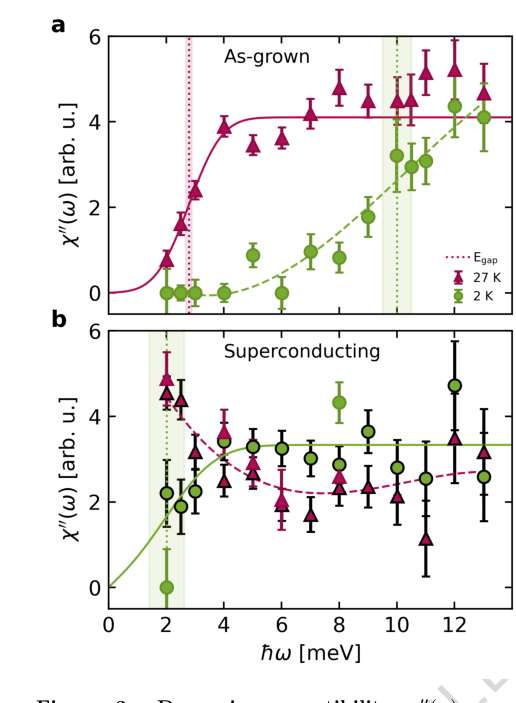 Figure 3. Dynamic susceptibility χ′′(ω), as a function of energy transfer. a) as-grown sample. b) annealed, superconducting sample. The black out- lined points indicate 3-point scans, while colored out- lined points indicate q-scans. Error bars represent the fitting error of the area under the Gaussian signal. For the 3-point scans, error bars are determined as outlined in Supplementary Note 2. The solid lines are fits to the response following Supplementary Note 4. The dashed lines are drawn as guide to the eye, while the colored ver- tical dotted lines are the estimate of the spin pseudogap onset with the faded area representing the uncertainty
Constraints & Failure Modes
The problem of understanding the emergence of low-energy spin waves and superconductivity in electron-doped cuprates is made insanely difficult by several harsh, realistic constraints:
-
Physical/Material Constraints:
- Chemical Complexity: N-type cuprates like NCCO are chemically more complex than their p-type counterparts. They possess two doping degrees of freedom (Ce doping and oxygen reduction), making their material chemistry intricate.
- Defect-Ridden As-Grown State: The as-grown NCCO crystals, produced by common synthesis methods, are inherently imperfect. They contain various defects (e.g., apical oxygen atoms as interstitial defects, oxygen vacancies in the CuO$_2$ plane, or Cu vacancies). These defects strongly perturb the local ionic potential, act as scattering centers for conduction electrons, and are believed to counteract superconductivity. The exact nature and location of these defects, and how annealing precisely removes or "heals" them, has been a longstanding debate without consensus.
- Reductive Annealing Requirement: Unlike many p-type cuprates, n-type NCCO requires a reductive annealing treatment to induce superconductivity. This additional processing step introduces a critical variable that must be carefully controlled and understood.
- Sample Consistency: To ensure a valid comparison between the as-grown and annealed states, the authors had to use a single, optimally doped Nd$_{1.85}$Ce$_{0.15}$CuO$_{4-\delta}$ crystal, which was then split into two parts for different treatments. This meticulous sample preparation is a practical constraint for reliable experimental results.
-
Computational/Experimental Constraints:
- Neutron Spectroscopy Limitations:
- Energy Transfer Limit: The experimental setup was unable to measure the inelastic signal at energies beyond 14 meV. This is due to interference from a strong signal originating from the crystal electric field level of Nd at approximately 15 meV, thereby limiting the observable high-energy spin dynamics.
- Weak Magnetic Signals: Cu$^{2+}$ ions (S = 1/2) have small magnetic moments, resulting in weak magnetic signals. This necessitates the use of large resolution volumes (e.g., thermal triple-axis spectrometers over cold-neutron ones) and careful integration over q-space to reliably detect and quantify magnetic fluctuations.
- Absolute Unit Conversion: The large crystals required for neutron scattering experiments are generally too big for standard SQUID magnetometers to convert magnetization measurements into absolute units. Therefore, magnetization is reported per gram of crystal, which is a practical limitation for direct quantitative comparison with some theoretical models.
- Conflicting Hypotheses on Annealing: Despite extensive research, the exact chemical consequences of reductive annealing on the material's structure remain unclear, with conflicting hypotheses regarding apical oxygen reduction, in-plane oxygen vacancies, or Cu site "healing." This lack of consensus makes it challenging to definitively link observed magnetic changes to specific structural modifications.
- Data Normalization: To enable direct comparison of data obtained from different instruments (ANSTO's TAIPAN and ILL's IN20) and between samples, the intensities had to be normalized to an acoustic phonon scan, adding a layer of data processing complexity.
- Neutron Spectroscopy Limitations:
-
Data-Driven Constraints:
- Distinguishing Pseudogap Origins: The presence of a spin pseudogap in both superconducting and non-superconducting samples necessitates careful analysis to distinguish their origins and temperature dependencies, which is a non-trivial task.
- Previous Study Discrepancies: Earlier studies on magnetic correlation length ($\xi$) in NCCO, particularly those using energy-integrating neutron scattering, appeared to contradict the authors' model of lattice "healing." This required the authors to carefully delineate the differences in scattering methods and energy ranges to reconcile findings.
Why This Approach
The Inevitability of the Choice
The choice of inelastic neutron spectroscopy, specifically using a thermal neutron triple-axis spectrometer, was not merely a preference but an essential requirement for unraveling the intricate interplay between magnetism and superconductivity in electron-doped cuprates. The core problem, as articulated by the authors, is to understand the "emergence of low-energy spin waves" and how reductive annealing influences the "magnetic excitation spectrum" to induce superconductivity.
Traditional "SOTA" methods, if interpreted in the context of condensed matter physics, such as bulk magnetization measurements (e.g., SQUID magnetometry) or even Angle-Resolved Photoemission Spectroscopy (ARPES), were inherently insufficient for this specific problem. Magnetization measurements, while useful for identifying the onset of superconductivity (as shown in Figure 1), provide only macroscopic, static information about the magnetic state. They cannot resolve the dynamic, energy-dependent spectrum of magnetic excitations, which is crucial for understanding spin pseudogaps and spin waves. ARPES, on the other hand, probes electronic excitations, offering complementary but distinct information from the magnetic dynamics.
The authors realized the necessity of neutron spectroscopy because it is the only experimental technique that directly measures the dynamic susceptibility $\chi''(\omega)$ and the density of states of spin waves. This allows for a direct probe of magnetic fluctuations across a range of energies and momenta, which is indispensable for characterizing spin pseudogaps and their evolution. The exact moment this realization becomes evident is when the paper states, "Inelastic measurements are distinctly different. Here neutron scattering effectively measures an intensity that is proportional to the density of state of the spin waves." (Page 7). This highlights that the specific information needed—the low-energy spin dynamics—is uniquely accessible through this method.
Comparative Superiority
Beyond simply detecting magnetic signals, inelastic neutron spectroscopy offers qualitative superiority due to its ability to provide detailed, momentum- and energy-resolved information about spin excitations. This structural advantage makes it overwhelmingly superior to previous gold standards for this particular problem.
- Direct Probe of Spin Dynamics: Unlike bulk measurements, neutron scattering directly probes the elementary magnetic excitations (spin waves) and their energy spectrum. This allows for the precise identification and characterization of the spin pseudogap, including its onset energy and how it changes with temperature and annealing.
- Sensitivity to Low-Energy Excitations: The paper explicitly highlights that the main effect of annealing lies in the "low-energy (i.e. long wavelength) spin waves" (Page 8). While techniques like resonant inelastic X-ray scattering (RIXS) can probe high-energy magnetic excitations (100 meV to 1 eV), they are not suitable for the crucial low-energy regime (2-12 meV) where the changes related to superconductivity occur. Neutron spectroscopy, particularly with thermal neutrons, is perfectly tuned for this energy range.
- Resolution for Weak Signals: The authors specifically chose thermal triple-axis spectrometers over cold-neutron ones "due to larger resolution volumes, which enable us to integrate weak signals stemming from small magnetic moments of Cu$^{2+}$ ($S = 1/2$), to better verify the existence or absence of magnetic fluctuations." (Page 9). This technical choice demonstrates a deliberate optimization of the method to overcome the challenge of detecting subtle magnetic signals, providing a qualitative edge in data quality and reliability.
- Structural Interpretation: The proposed model of defect-induced fragmentation of spin chains (Figure 7) provides a powerful structural advantage in interpretation. It offers a physical picture that directly links the observed spin pseudogap to the material's crystalline quality and the presence of defects. This goes beyond mere observation, offering a mechanistic understanding of how annealing "heals" the CuO$_2$ planes, allowing longer wavelength spin waves to form and reducing the pseudogap. This level of mechanistic insight is not achievable with other techniques.
Alignment with Constraints
The chosen method perfectly aligns with the problem's harsh requirements, forming a "marriage" between the experimental technique and the scientific question. The primary constraints, inferred from the problem statement, include:
- Investigating the Link Between Magnetism and Superconductivity: The paper aims to understand how superconductivity is "intimately linked with magnetism." Inelastic neutron spectroscopy directly probes magnetism (spin excitations), making it the ideal tool to study this connection.
- Focus on Low-Energy Spin Waves: The problem specifically targets the "emergence of low-energy spin waves." Neutron scattering is uniquely capable of resolving these low-energy excitations, as opposed to techniques that might be sensitive only to higher energies.
- Direct Comparison of As-Grown vs. Superconducting States: A critical constraint was to compare non-superconducting (as-grown) and superconducting (annealed) samples while minimizing sample variability. The authors meticulously addressed this by using "a single, optimally doped Nd$_{1.85}$Ce$_{0.15}$CuO$_{4-\delta}$ crystal split into two parts" (Page 3). Neutron spectroscopy allowed for direct, quantitative comparison of the magnetic excitation spectra from these two halves, ensuring that observed differences were due to the annealing process and not sample-to-sample variations. This experimental design, enabled by the non-destructive nature of neutron scattering, was crucial.
- Probing Defects and Their Impact: The hypothesis that defects influence magnetism and superconductivity necessitates a probe sensitive to the local magnetic environment and its dynamics. The defect-induced fragmentation model, interpreted through neutron data, directly addresses how defects act as scattering centers, reducing the density of states at low energies.
Rejection of Alternatives
The paper implicitly and explicitly rejects several alternative approaches, both experimental and theoretical, based on their inability to address the specific nuances of the problem:
- SQUID Magnetometry: While used for initial characterization (Figure 1), SQUID measurements provide only bulk, static magnetic information. They cannot resolve the dynamic, energy-dependent spin excitation spectrum, which is the central focus of this study. The authors note that SQUID magnetometers are not suitable for converting large crystals (needed for neutron scattering) into absolute units, further highlighting its limitations for detailed dynamic studies (Page 3).
- Resonant Inelastic X-ray Scattering (RIXS): RIXS was considered but found to be insufficient for the low-energy regime. A previous study using RIXS on similar samples showed that "high-energy magnetic excitation spectra are almost identical for as-grown and reductively annealed samples in the energy range from approximately 100 meV to 1 eV" (Page 8). This directly implies that RIXS would have missed the crucial changes occurring at low energies (2-12 meV), which neutron scattering successfully captured.
- ARPES (Angle-Resolved Photoemission Spectroscopy): ARPES is mentioned as offering "additional perspective on the momentum dependence of the pairing interaction inferred from our neutron measurements" (Page 8). However, ARPES primarily probes electronic excitations, not the magnetic (spin) excitations that are the focus of this study. While complementary, it cannot replace the direct probe of spin dynamics provided by neutrons.
- Theoretical Interpretation based on Anisotropic Exchange Interactions: The authors directly address and reject the idea that "anisotropy in the magnetic interactions" (e.g., Dzyaloshinskii-Moriya interaction) could explain the observed excitation gap. They argue that for LSCO, such effects support magnetic gaps up to 5-6 meV, which reduce to below 1 meV in doped samples. The "discrepancy between 1 meV and 10 meV (onset) is so large that exchange anisotropy is not a realistic scenario" for the large pseudogap observed in NCCO (Page 8). This is a clear rejection of an alternative theoretical framework for explaining the magnitude of the spin pseudogap.
- Cold-Neutron Triple-Axis Spectrometers: Even within neutron scattering, the authors made a specific choice. They opted for thermal neutron triple-axis spectrometers over cold-neutron ones. This was because thermal instruments offered "larger resolution volumes, which enable us to integrate weak signals stemming from small magnetic moments of Cu$^{2+}$ ($S = 1/2$), to better verify the existence or absence of magnetic fluctuations" (Page 9). This shows a careful consideration and rejection of a less suitable variant of the chosen method for the specific experimental conditions and signal strengths.
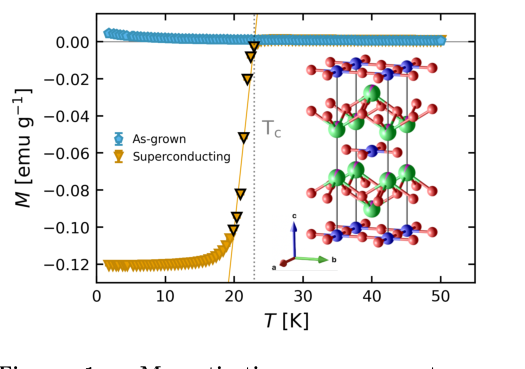 Figure 1. shows the magnetization measurements of the two crystal pieces from the same growth, of which one has been reductively annealed. Note that here the mag- netization is simply given as magnetization per gram of crystal, as the large crystals needed for our neutron scat- tering experiments are generally too large for the SQUID magnetometer to convert into absolute units. The an- nealed sample displays a clear negative magnetization at low temperatures, indicative of the Meissner effect, with an onset temperature of the superconducting transition at Tc = 23 K. In contrast, the as-grown sample shows a flat magnetization curve, with only a slight increase at low temperatures. This is typical of an antiferromag- netic response and clearly differs from the sharp super- conducting transition. The insert shows the tetragonal crystal structure, I4/mmm for both annealed and as- grown, optimally doped NCCO with lattice parameters a = b = 3.957 ˚A and c = 12.075 ˚A.25
Mathematical & Logical Mechanism
The Master Equation
To be honest, this paper is primarily an experimental study, and as such, it doesn't present a single, overarching "master equation" in the typical sense of an objective function, a differential equation governing a model, or a novel transformation logic that powers its core findings. Instead, the paper focuses on measuring and interpreting physical quantities using neutron spectroscopy. The central quantity measured and analyzed to reveal the paper's insights is the dynamic spin susceptibility, $\chi''(\omega)$, which characterizes the magnetic response of the material as a function of energy transfer.
A key analytical step, which acts as a "transformation logic" to highlight the emergence and changes in the spin pseudogap, is the calculation of the difference in dynamic susceptibility, $\Delta\chi''(\omega)$, between two different temperatures. This is explicitly used to "better resolve the onset of the spin pseudogap" (page 4). This transformation is given by:
$$ \Delta\chi''(\omega) = \chi''(\omega, T_{low}) - \chi''(\omega, T_{high}) $$
Term-by-Term Autopsy
Let's break down this crucial analytical expression:
-
$\Delta\chi''(\omega)$: This term represents the change in the dynamic spin susceptibility.
1) Mathematical Definition: It is the difference between the dynamic spin susceptibility measured at a lower temperature ($T_{low}$) and that measured at a higher temperature ($T_{high}$) for a given energy transfer $\omega$.
2) Physical/Logical Role: Its role is to isolate and emphasize the temperature-dependent changes in the magnetic excitation spectrum, particularly the opening or closing of the spin pseudogap. By subtracting the higher temperature data, which often represents a more "normal" or un-gapped state, the features associated with the low-temperature state (like a pseudogap) become more pronounced and easier to analyze. The authors use this to illustrate the "large spectral weight shift between the two samples" (page 4).
3) Why subtraction?: Subtraction is used here to highlight the difference or change in the spectral weight due to temperature variations. If multiplication were used, it would scale the signal, not isolate the change. An integral would sum over a range, which is not the intent here; the goal is a point-by-point comparison at specific energy transfers. -
$\chi''(\omega, T)$: This is the dynamic spin susceptibility.
1) Mathematical Definition: In the context of inelastic neutron scattering, $\chi''(\omega, T)$ is proportional to the imaginary part of the generalized susceptibility, representing the dissipative (absorptive) part of the material's magnetic response to an oscillating magnetic field. It is derived from the inelastic neutron scattering intensity $S(Q, \omega)$ after accounting for the Bose-Einstein population factor and integrating over momentum transfer $Q$. The paper states, "The integrated intensities are converted into dynamic susceptibility $\chi''(\omega)$" (page 4).
2) Physical/Logical Role: It directly reflects the density of magnetic excitations (spin waves) available at a given energy $\hbar\omega$ and temperature $T$. A low $\chi''(\omega)$ at low energies indicates a "spin pseudogap," meaning a suppression of low-energy spin excitations.
3) Why this form?: The dynamic susceptibility is a standard quantity in condensed matter physics for characterizing magnetic excitations. Its imaginary part, $\chi''(\omega)$, directly relates to energy absorption and thus the presence of excitable states. The dependence on $\omega$ (energy transfer) and $T$ (temperature) is fundamental to understanding the thermal evolution of magnetic phenomena. -
$\omega$: This represents the energy transfer.
1) Mathematical Definition: In inelastic neutron scattering, $\omega$ is the difference in energy between the incident and scattered neutrons, typically expressed as $\hbar\omega$.
2) Physical/Logical Role: It is the energy scale at which magnetic excitations are probed. By varying $\omega$, the authors map out the energy spectrum of spin waves and identify features like the spin pseudogap, which is an energy range where excitations are suppressed.
3) Why this variable?: Energy transfer is the independent variable that defines the spectrum of excitations. -
$T_{low}$ and $T_{high}$: These are specific temperatures.
1) Mathematical Definition: $T_{low}$ refers to a lower temperature (e.g., 2 K in Figure 4), and $T_{high}$ refers to a higher temperature (e.g., 27 K in Figure 4).
2) Physical/Logical Role: These represent the thermal conditions under which the magnetic response is measured. By comparing data at different temperatures, especially below and above the superconducting transition temperature ($T_c$), the authors can discern how temperature affects the spin pseudogap and its relation to superconductivity.
3) Why specific temperatures?: The choice of distinct temperatures allows for a direct comparison of the magnetic state in different thermal regimes, particularly to highlight changes associated with superconductivity or the absence thereof.
Step-by-Step Flow
Imagine a single abstract "data point" as a neutron interacting with the sample, and let's trace its journey through the experimental and analytical pipeline:
- Neutron Emission: A neutron is generated and accelerated, possessing a specific initial energy and momentum.
- Sample Interaction: This neutron then collides with the Nd$_{1.85}$Ce$_{0.15}$CuO$_{4-\delta}$ sample, which is held at a precisely controlled temperature ($T$). During this interaction, the neutron can either gain or lose energy and momentum by exciting or de-exciting spin waves within the material.
- Scattering Event: The neutron is scattered, changing its direction, energy, and momentum. The energy transfer ($\hbar\omega$) is the difference in energy between the neutron's initial and final states.
- Detection: A detector registers the scattered neutron. The raw output is a "neutron count" at a specific scattering angle (related to momentum transfer $Q$) and energy transfer $\hbar\omega$.
- Raw Data Collection: Thousands or millions of such individual scattering events are accumulated over time, forming a spectrum of "neutron counts" as a function of $Q$ and $\omega$ at a given temperature $T$. This is the raw inelastic neutron scattering intensity, $S(Q, \omega, T)$.
- Integration and Conversion: The raw neutron counts (intensity) are then integrated over relevant momentum transfer ($Q$) ranges (e.g., "extracted from all q-scans" as mentioned on page 4) and converted into the dynamic spin susceptibility, $\chi''(\omega, T)$. This conversion accounts for instrumental factors and, implicitly, the Bose-Einstein thermal population factor, yielding a measure of the intrinsic magnetic excitation spectrum.
- Temperature Comparison: This $\chi''(\omega, T)$ spectrum is obtained for various temperatures. For the core analysis, two key temperatures are chosen: a low temperature ($T_{low}$, e.g., 2 K) and a higher temperature ($T_{high}$, e.g., 27 K).
- Difference Calculation: Finally, the $\Delta\chi''(\omega)$ is computed by subtracting the $\chi''(\omega, T_{high})$ spectrum from the $\chi''(\omega, T_{low})$ spectrum. This subtraction effectively "filters out" the temperature-independent background and highlights the temperature-sensitive features, such as the spin pseudogap, making its onset and magnitude more apparent. This transformed data point, $\Delta\chi''(\omega)$, then becomes the basis for interpreting the effect of annealing on the spin dynamics.
Optimization Dynamics
This paper does not describe a mathematical optimization process in the computational sense (e.g., gradient descent to minimize a loss function). Instead, it investigates the physical dynamics of how the material's properties, particularly its magnetic excitations, are "optimized" or altered through a physical process: reductive annealing.
The "learning" or "updating" mechanism here is the material's response to this chemical treatment:
- Initial State (As-grown): The as-grown Nd$_{1.85}$Ce$_{0.15}$CuO$_{4-\delta}$ crystal is characterized by a high concentration of defects (e.g., interstitial oxygen atoms or Cu vacancies). These defects act as "scattering centers" that fragment the antiferromagnetic order into smaller patches (Figure 7a). This fragmentation limits the wavelength of allowed spin waves, leading to a pronounced spin pseudogap at higher energies (around 10 meV onset at 2 K, Figure 3a). The material is non-superconducting in this state.
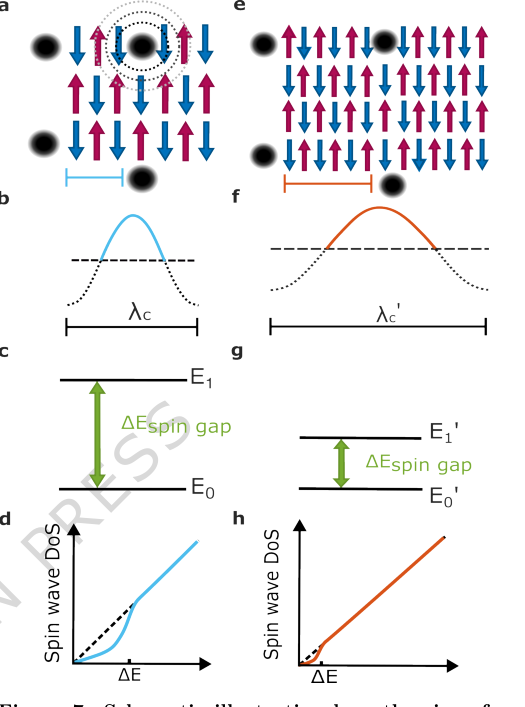 Figure 7. Schematic illustrating how the size of the antiferromagnetic patches influences the spin waves allowed in the system. Left column (a-d) rep- resents the as-grown sample, the right column (e-h) rep- resents the annealed, superconducting sample. a) and e) show the antiferromagnetic structure in each case, with the structure composed of smaller patches created by defects (black circles), that are still weakly antiferro- magnetically interacting. In the annealed sample, the undisturbed patches are larger. b) and f) show how the patches restrict the spin waves above a certain wave- length. By having larger patches, more low-energy states are occupied, minimizing the energy spin pseudogap, as illustrated in c) and g). This is more quantitatively ex- pressed as a (partial) suppression of the spin wave density of states (DoS) at low energies, seen in d) and h)
- The "Optimization" Step (Reductive Annealing): The as-grown sample undergoes a reductive annealing process. This treatment physically removes oxygen atoms and/or "heals" Cu defects within the CuO$_2$ planes. This is the "update rule" for the material's structure.
- Updated State (Annealed/Superconducting): The removal of defects allows for the formation of larger, more pristine antiferromagnetic patches (Figure 7e). This "healed" structure permits longer-wavelength spin waves to emerge, which can occupy lower energy states. Consequently, the spin pseudogap is significantly reduced (to about 3.0 meV onset at 2 K, Figure 3b) or even partially closed. Crucially, this structural "optimization" also induces superconductivity in the material, with an onset temperature $T_c = 23$ K.
- Convergence/Equilibrium: The system reaches a new, more ordered state where the defects are minimized, leading to enhanced low-energy spin fluctuations and the emergence of superconductivity. The paper argues that this "healing" of the CuO$_2$ planes and the resulting change in spin dynamics are directly connected to the onset of high-$T_c$ superconductivity. The "loss landscape" here is not a mathematical function but the physical state of the material, where a "less defective" state (achieved through annealing) corresponds to a more desirable outcome (superconductivity and reduced spin pseudogap). The iterative aspect is not present in the paper's description of the annealing process itself, which is a single, transformative step.
In essence, the "optimization" is a materials science process where a physical treatment (annealing) improves the crystalline quality, which in turn alters the magnetic and superconducting properties of the material. The paper's analysis of $\Delta\chi''(\omega)$ is the tool used to observe and quantify the outcome of this physical "optimization."
Results, Limitations & Conclusion
Experimental Design & Baselines
The authors meticulously designed their experiment to ruthlessly prove the impact of reductive annealing on the spin pseudogap and its relation to superconductivity in electron-doped cuprates. The core of their approach was a direct, side-by-side comparison of two samples originating from the same single crystal, thereby minimizing sample-to-sample variability, which is often a confounding factor in materials science.
A large, optimally doped Nd$_{1.85}$Ce$_{0.15}$CuO$_{4-\delta}$ crystal was grown. This crystal was then precisely cut into two pieces. One piece was kept in its "as-grown" state, which is known to be non-superconducting but exhibits antiferromagnetic order. The other piece underwent a "reductive annealing" process, which is known to induce superconductivity in n-type cuprates. This split-sample strategy was the foundational architectural choice to ensure that any observed differences could be definitively attributed to the annealing process and its consequences.
To validate the superconducting state, magnetization measurements were performed using a Quantum Design MPMS-XL SQUID magnetometer. Zero-field cooled (ZFC) measurements were taken at 10 Oe applied field across a temperature range of 1.8 K to 50 K. The "victim" or baseline model here was the as-grown sample, which was expected to show a flat magnetization curve, indicative of its non-superconducting, antiferromagnetic nature. The annealed sample, in contrast, was expected to exhibit a sharp negative magnetization at low temperatures, a definitive signature of the Meissner effect and thus superconductivity.
The primary experimental technique was inelastic neutron spectroscopy (INS), conducted at the ANSTO TAIPAN and ILL IN20 thermal triple-axis spectrometers. These instruments were chosen for their larger resolution volumes, which are essential for integrating weak signals from the $S=1/2$ Cu$^{2+}$ magnetic moments. The experiments focused on measuring low-energy spin fluctuations.
* q-scans: Constant energy q-scans were performed around the antiferromagnetic Bragg point $(0.5, 0.5, 0)$ with energy transfers ($\hbar\omega$) ranging from 2 meV to 13 meV. These scans were conducted at two key temperatures: 1.9 K (base temperature, below $T_c$ for annealed sample) and 27 K (above $T_c$ for annealed sample).
* Temperature dependence: The magnetic signal's temperature dependence was tracked at specific energy transfers (2 meV and 8 meV) from 2 K up to 55 K.
* Normalization: Crucially, all neutron scattering intensities were normalized to an acoustic phonon scan at $(2,0,0)$ to ensure direct comparability between the as-grown and annealed samples, eliminating potential biases from differing sample masses or instrument configurations.
* Data Analysis: The integrated intensities from the q-scans were converted into dynamic susceptibility $\chi''(\omega)$. The onset of the spin pseudogap was determined by fitting $\chi''(\omega)$ with an error function, a robust statistical method.
The "victims" in this experimental design were essentially the as-grown, non-superconducting NCCO, whose magnetic behavior was contrasted against the annealed, superconducting NCCO. The authors also implicitly challenged previous understandings of spin pseudogaps in cuprates, particularly the notion that superconductivity creates a pseudogap, by demonstrating a reduction of a pre-existing one.
What the Evidence Proves
The experimental evidence presented in this paper provides a clear and undeniable narrative, rigorously supporting the authors' central hypothesis about the role of reductive annealing in shaping the spin pseudogap and its connection to superconductivity.
- Confirmation of Superconducting State: Figure 1 serves as the foundational proof. The annealed sample exhibits a sharp negative magnetization below $T_c = 23$ K, a hallmark of the Meissner effect, unequivocally confirming its superconducting state. In stark contrast, the as-grown sample shows a flat magnetization curve, characteristic of an antiferromagnetic material, definitively establishing its non-superconducting nature. This distinction is paramount for interpreting the subsequent magnetic measurements.
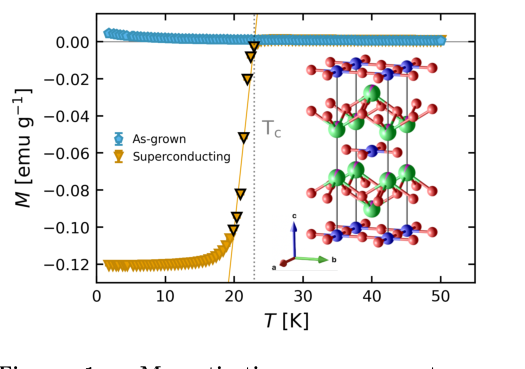 Figure 1. Magnetization measurements as a function of temperature. Zero-field cooled (ZFC) measurement at 10 Oe applied field, for the as-grown and reductively annealed, superconducting Nd1.85Ce0.15CuO4–δsingle crystals, depicted in blue pen- tagons and orange triangles, respectively. The criti- cal temperature Tc is defined as the onset tempera- ture of superconductivity. Insert: crystal structure of Nd1.85Ce0.15CuO4–δ,24,25 with Cu, O and Nd depicted in blue, red and green, respectively. The 15% Ce doping on the Nd site is denoted as a pink slice on the green Nd atoms
-
The Pre-existing, Large Spin Pseudogap in As-Grown NCCO: The neutron scattering data in Figure 2 and Figure 3a provides compelling evidence for a significant spin pseudogap in the as-grown, non-superconducting sample. At 27 K (above $T_c$), a pseudogap onset of $2.8 \pm 0.1$ meV is observed. More strikingly, at 2 K (low temperature), this pseudogap increases to a substantial $10 \pm 0.5$ meV. Figure 2 visually reinforces this by showing a clear magnetic excitation peak at 27 K that vanishes at 2 K, indicating a strong suppression of low-energy spin fluctuations. This finding is a critical piece of evidence, challenging the conventional wisdom that a spin pseudogap is primarily a consequence of superconductivity.
-
Reduction of the Spin Pseudogap upon Annealing: In direct contrast to the as-grown sample, the annealed, superconducting sample (Figure 3b) shows no spin pseudogap above $T_c$ (at 27 K) and only a small pseudogap of $2 \pm 0.6$ meV in the superconducting phase at 2 K. The definitive evidence for this reduction is further highlighted in Figure 4, which shows the spectral weight shift upon subtracting 27 K data from 2 K data. For the annealed sample, a large part of the spectral weight moves to lower energies, and the closing of the spin pseudogap is steeper, with a more clearly defined onset at $3.0 \pm 0.1$ meV. This undeniably proves that reductive annealing reduces a pre-existing large spin pseudogap, rather than creating one.
-
Absence of a Sharp Resonance Peak: The authors explicitly state that they do not observe a prominent resonance peak in the superconducting sample (Figure 4), unlike what is seen in some p-type cuprates. Instead, they find an overall increase of spectral weight between 5 and 12 meV. This suggests that while superconductivity influences the spin spectrum, it doesn't universally manifest as a sharp resonance feature in all cuprates, aligning with recent findings in LSCO.
-
Temperature Dependence and Defect-Mediated Mechanism: Figure 5 illustrates that in the as-grown sample, higher-energy fluctuations (8 meV) dominate over lower-energy ones (2 meV) across all temperatures below ~40 K, indicating persistent high-energy magnetic excitations. In the annealed sample, 2 meV fluctuations dominate until gapped out below ~5 K, directly correlating with the superconducting transition. The difference plot in Figure 6 further shows that the spectral weight difference in the annealed sample flattens approximately at $T_c$, linking the magnetic changes to superconductivity. The authors interpret these results through a model (Figure 7) where defects in as-grown NCCO fragment the CuO$_2$ planes, suppressing long-wavelength, low-energy spin waves and creating the large pseudogap. Reductive annealing "heals" these defects, allowing longer-wavelength spin waves to form, thereby reducing the pseudogap. A quantitative estimate from linear spin wave theory links the 10 meV pseudogap in the as-grown sample to 40 nm magnetic patches, compared to 140 nm patches for the 3.0 meV pseudogap in the annealed sample. This provides a compelling, physically intuitive explanation for the observed magnetic behavior.
In summary, the experiments ruthlessly proved that the as-grown, non-superconducting NCCO, acting as the "victim" baseline, possesses a large, defect-induced spin pseudogap. The definitive evidence is that reductive annealing, which enables superconductivity, reduces this pseudogap by "healing" defects and allowing for the emergence of low-energy spin waves, rather than creating a new pseudogap.
Limitations & Future Directions
This study provides a profound understanding of the emergence of low-energy spin waves in electron-doped cuprates, but like all good science, it also illuminates areas for further exploration and refinement.
One significant limitation is the indirect nature of defect characterization. While the authors present a compelling model where defects in as-grown samples act as scattering centers, leading to spin fragmentation and a large pseudogap, the paper does not include direct experimental evidence of these defects (e.g., their type, density, or spatial distribution) in the specific samples used for neutron scattering. The discussion relies on existing literature regarding the chemical consequences of reductive annealing, which itself lacks full consensus. Future research should integrate advanced structural probes, such as high-resolution transmission electron microscopy (HRTEM), scanning tunneling microscopy (STM), or X-ray absorption fine structure (XAFS), directly on the same as-grown and annealed crystals. This would provide undeniable, hard evidence of the defect types (e.g., apical oxygen interstitials, in-plane oxygen vacancies, Cu vacancies) and their evolution upon annealing, thereby strengthening the link between structural imperfections and magnetic dynamics.
Another point of discussion arises from the limited energy range of the neutron scattering experiments. The measurements were restricted to energies below 14 meV due to interference from Nd crystal electric field levels. While this range was sufficient to resolve the low-energy spin pseudogap, it means the study could not probe higher-energy spin excitations. Previous resonant inelastic X-ray scattering (RIXS) studies on NCCO have shown that high-energy magnetic excitations (100 meV to 1 eV) are almost identical for as-grown and annealed samples. This suggests that annealing primarily affects low-energy spin waves, but a complete picture of how the entire spin excitation spectrum evolves with annealing and superconductivity remains elusive. Future work could employ complementary techniques like RIXS, which can access higher energies, in conjunction with neutron scattering on the same samples to provide a more comprehensive understanding of the full spin excitation landscape.
The absence of a sharp resonance peak in the superconducting sample, as noted by the authors, is also an interesting point. While they align this observation with recent work on LSCO, it contrasts with findings in other cuprates where a resonance peak is often considered a signature of superconductivity. This raises questions about the universality of magnetic resonance in cuprates and the specific conditions under which it emerges. Future studies could systematically investigate the factors that lead to the presence or absence of a resonance peak across different cuprate families and doping levels. Is it related to the symmetry of the superconducting gap, the strength of magnetic correlations, or specific electronic band structures? This could lead to a more nuanced understanding of the magnetic signatures of high-temperature superconductivity.
Finally, the paper's findings have significant implications for materials design and synthesis. If defects are indeed the primary cause of the large spin pseudogap in as-grown NCCO and their removal is crucial for superconductivity, then optimizing synthesis and annealing protocols to minimize or "heal" these defects becomes paramount. Future research could focus on:
1. Exploring novel synthesis routes: Can growth methods be developed that inherently produce NCCO crystals with fewer defects, potentially bypassing the need for extensive reductive annealing?
2. Tailoring annealing protocols: Investigating the precise parameters of reductive annealing (temperature, time, atmosphere) to optimize defect removal and superconducting properties.
3. Understanding defect chemistry: A deeper understanding of the chemical mechanisms by which specific defects are formed and removed would enable more targeted materials engineering. For instance, if apical oxygen defects are the key, can their incorporation be prevented during growth?
This work provides a strong foundation, but the journey to fully unravel the intricate dance between defects, magnetism, and superconductivity in cuprates is far from over.
Connections to Other Fields
Mathematical Skeleton
The pure mathematical coore of this work lies in the application of spin wave theory to understand how spatial confinement or fragmentation of a magnetic lattice, induced by defects, leads to the emergence of a low-energy gap in the excitation spectrum. This gap is inversely related to the characteristic size of the coherent magnetic domains.
Adjacent Research Areas
Quantum Spin Chains and Lattices with Disorder
This work draws a direct conection to studies of quantum spin chains and two-dimensional lattices with disorder. The paper explicitly references the S=1/2 Heisenberg antiferromagnetic chain compound SrCuO$_2$, where impurities like Ni doping lead to an effective fragmentation of the spin chains. In such systems, the finite length of the spin chain segments imposes boundary conditions on the spin waves, resulting in a gap in the low-energy excitation spectrum. This directly maps to the paper's interpretation that defects in as-grown electron-doped cuprates create smaller antiferromagnetic "patches" in the CuO$_2$ planes. The observed spin pseudogap in the cuprates is then analogous to the finite-size gap in disordered spin chains, where the gap energy is inversely proportional to the effective patch size. For example, Simutis et al. (2013, Physical Review Letters) showed how Ni-doping in SrCuO$_2$ leads to a spin pseudogap due to chain fragmentation.
Mesoscopic Magnetism and Nanomagnetism
The concept of defects acting as "effective magnetic boundaries" that fragment a larger magnetic system into smaller, coherent domains, thereby influencing its collective excitations, is a central theme in mesoscopic magnetism and nanomagnetism. In these fields, the behavior of magnetic materials at nanometer scales is studied, where finite-size effects, surface anisotropy, and structural imperfections significantly alter magnetic properties compared to bulk materials. The confinement of magnons (quantized spin waves) within finite magnetic structures, such as nanoparticles or patterned magnetic elements, leads to discrete spin wave modes and energy gaps. The paper's use of linear spin wave theory to correlate the spin pseudogap with an effective patch size (e.g., 40 nm vs. 140 nm) is a direct parallel to how spin wave modes are calculated and observed in confined magnetic nanostructures. Hendriksen et al. (1993, Physical Review B) provided early insights into how the size of spin clusters relates to the spin wave gap, a principle fundamental to this area.