
Power-efficient ultra-broadband soliton microcombs in resonantly-coupled microresonators
The drive to miniaturize optical frequency combs for practical deployment has spotlighted microresonator solitons as a promising chip-scale candidate.
Background & Academic Lineage
The Origin & Academic Lineage
The problem addressed in this paper precisely originates from the ongoing drive to miniaturize optical frequency combs for practical, real-world deployment. Optical frequency combs, first invented about two decades ago, have been transitioning from specialized laboratory settings to broader applications, as highlighted by references 1-3. This shift necessitates significant reductions in both device size and power consumption. Soliton microcombs, generated in high-quality (high-Q) nonlinear microresonators, emerged as a promising chip-scale solution due to their ability to produce stable, phase-coherent "teeth" (discrete frequencies) equally spaced in the spectral domain.
However, a fundamental limitation quickly became apparent: these soliton microcombs are inherently power-hungry, especially when attempting to achieve a wide spectral span (bandwidth) with fine comb spacings. The core "pain point" of previous approaches, particularly conventional waveguide-coupled designs, is the "long-standing pump-power bottleneck." This bottleneck makes it exceedingly difficult, if not impossible, to simultaneously optimize key performance metrics—spectral span, central-tooth power, and repetition rate—under limited pump power, a challenge the authors refer to as the "impossible trinity" (Fig. 1b). Specifically, achieving an octave-spanning comb (where the highest frequency is at least double the lowest) at microwave repetition rates, crucial for direct optical-microwave linkage and photonic integration, was deemed unfeasible due to the high power requirements. Equation (1) in the paper, $P_c \Delta f_{3dB}^2 / f_r < 3.1 \times \eta_{NR} P_{in}$, mathematically encapsulates this constraint, showing that the desired comb characteristics scale quadratically with bandwidth, making improvements in this area particularly challenging without a substantial increase in input pump power. This limitation forced the authors to explore novel architectures to overcome the pump-power constraint.
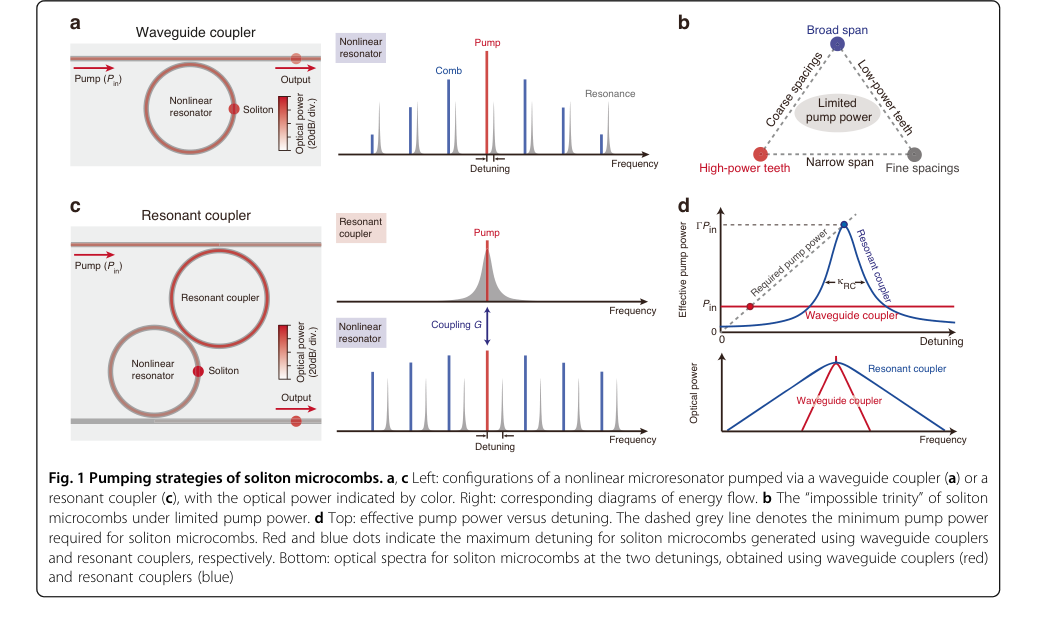 Figure 1. Pumping strategies of soliton microcombs. a, c Left: configurations of a nonlinear microresonator pumped via a waveguide coupler (a) or a resonant coupler (c), with the optical power indicated by color. Right: corresponding diagrams of energy flow. b The “impossible trinity” of soliton microcombs under limited pump power. d Top: effective pump power versus detuning. The dashed grey line denotes the minimum pump power required for soliton microcombs. Red and blue dots indicate the maximum detuning for soliton microcombs generated using waveguide couplers and resonant couplers, respectively. Bottom: optical spectra for soliton microcombs at the two detunings, obtained using waveguide couplers (red) and resonant couplers (blue)
Intuitive Domain Terms
Here are a few specialized terms from the paper, translated into more intuitive analogies for a beginner:
- Soliton Microcomb: Imagine a tiny, chip-sized device that acts like a super-precise, miniature light "ruler." Instead of measuring length, it measures frequency, emitting a perfectly spaced series of laser beams (the "teeth" of the comb) that are all in perfect sync. It's like having a compact, stable rainbow generator for various applications.
- Octave-spanning: Think of a musical instrument that can play notes across a very wide range, from the lowest bass to the highest treble, covering at least a full "octave" (where the highest note has double the frequency of the lowest). In the context of light, an octave-spanning microcomb produces a spectrum of light so broad that its highest frequency is at least twice its lowest frequency, covering a vast range of colors or wavelengths.
- Resonantly-coupled microresonators: Picture two connected bathtubs. One is the main tub where you want to create a big, stable wave (the soliton microcomb). The other is a smaller, auxiliary tub. Instead of just pouring water directly into the main tub, you pour it into the auxiliary tub first. If you pour at just the right rhythm, the auxiliary tub acts like a "booster," amplifying the water flow and making it much easier to create a huge, stable wave in the main tub with less initial effort. This is the core innovation of this paper.
- Kerr nonlinearity: This is a fascinating optical phenomenon where the refractive index of a material changes in proportion to the intensity of the light passing through it. It's like light being so powerful that it subtly changes the very path it travels on, a bit like a heavy object bending spacetime. This effect is crucial for forming the stable light pulses (solitons) in the microcomb.
- Anomalous dispersion: Normally, in a transparent material, shorter wavelengths of light (like blue) travel slower than longer wavelengths (like red). Anomalous dispersion is the opposite: shorter wavelengths travel faster than longer ones. This counter-intuitive effect is a key ingredient, alongside Kerr nonlinearity, that allows the light pulses to maintain their shape and stability as "solitons" within the microresonator.
Notation Table
| Variable/Parameter | Description | Unit |
|---|---|---|
| $P_{in}$ | Input pump power delivered to the microresonator | W (or mW) |
| $\Delta f_{3dB}$ | 3-dB bandwidth of the optical frequency comb | Hz (or THz) |
| $P_c$ | Central-tooth power of the optical frequency comb | W (or dBm) |
| $f_r$ | Repetition rate of the optical frequency comb | Hz (or GHz) |
| $\eta_{NR}$ | Loading factor of the Nonlinear Resonator (NR) | Dimensionless |
| $\Gamma$ | Enhancement factor of effective pump power delivered to the NR | Dimensionless |
| $G$ | Inter-resonator coupling rate between the Resonant Coupler (RC) and NR | Hz (or GHz) |
| $\kappa_{RC}$ | Total dissipation rate of the Resonant Coupler (RC) | Hz |
| $\kappa_{NR}$ | Total dissipation rate of the Nonlinear Resonator (NR) | Hz |
| $\delta\omega$ | Pump-NR detuning (frequency difference between the pump and NR resonance) | Hz (or GHz) |
Problem Definition & Constraints
Core Problem Formulation & The Dilemma
The core problem this paper addresses stems from the long-standing challenge of miniaturizing optical frequency combs for practical, chip-scale deployment. While soliton microcombs are a promising candidate, their widespread adoption has been hampered by significant power consumption, particularly when aiming for broad spectral spans and fine comb spacings.
Input/Current State:
The current state involves conventional soliton microcombs generated in high-Q nonlinear microresonators (NRs) pumped by continuous-wave lasers. In this traditional architecture, the NR is evanescently coupled to a bus waveguide. A critical limitation is that achieving an octave-spanning comb at microwave repetition rates, which is highly desirable for direct optical-microwave linkage, is considered unfeasible for photonic integration due to the prohibitively high power requirements. The relationship governing the key performance metrics (central-tooth power $P_c$, 3-dB bandwidth $\Delta f_{3dB}$, and repetition rate $f_r$) under limited pump power $P_{in}$ in conventional waveguide-coupled designs is given by:
$$ \frac{P_c \Delta f_{3dB}^2}{f_r} < 3.1 \times \eta_{NR} P_{in} $$
where $\eta_{NR}$ is the loading factor of the NR. This equation highlights a quadratic scaling law, meaning that increasing the bandwidth or reducing the repetition rate becomes disproportionately more challenging than increasing the tooth power.
Desired Endpoint (Output/Goal State):
The primary goal is to develop "power-efficient ultra-broadband soliton microcombs" that significantly reduce pump consumption. Specifically, the aim is to achieve octave-spanning combs at microwave repetition rates using only a continuous-wave pump, a feat previously deemed impossible for photonic integration. The authors target a threefold increase in spectral span for high-power combs and up to a tenfold reduction in repetition frequency for octave-spanning operation. Ultimately, this innovation seeks to eliminate the pump-power bottleneck, making microcombs readily available for portable optical clocks, massively parallel data links, and field-deployable spectrometers.
Missing Link/Mathematical Gap:
The exact missing link is a mechanism to efficiently deliver sufficient pump power to the nonlinear microresonator to overcome the limitations imposed by the quadratic scaling law (Equation 1) without requiring an excessively high input pump power $P_{in}$. The paper proposes to bridge this gap by introducing a "resonant-coupling" concept. This involves interposing an auxiliary microresonator (RC) between the bus waveguide and the NR. This RC provides a resonant enhancement of the pump power delivered to the NR, effectively multiplying the pump power by a factor $\Gamma$ on the order of:
$$ \Gamma = \frac{4G^2}{\kappa_{RC} \kappa_{NR}} $$
where $G$ is the coupling rate between the resonators, $\kappa_{RC}$ is the RC's dissipation rate, and $\kappa_{NR}$ is the NR's dissipation rate. By increasing this effective pump power, the system can achieve broader spectral spans and lower repetition rates for the same actual input power, thereby relaxing the constraint in Equation (1).
Painful Trade-off or Dilemma:
The central dilemma, termed the "impossible trinity" by the authors, is that the key performance metrics of a comb source—its span, power, and spacing—are inherently coupled. Improving one aspect typically degrades another under limited pump power. For instance, achieving a broad spectral span (octave-spanning) and fine comb spacing (microwave repetition rates, desirable for direct electrical detection) simultaneously requires high pump power. However, high pump power is a major impediment to chip-scale integration and portability. Previous researchers were trapped by this trade-off, finding that while stable soliton formation requires red-detuned pump and additional power, the quadratic scaling law made it exceedingly difficult to achieve broad, low-repetition-rate combs without an unmanageable power budget. This made the prospect of integrated octave-spanning combs at microwave rates seem unattainable.
Figure 1. Pumping strategies of soliton microcombs. a, c Left: configurations of a nonlinear microresonator pumped via a waveguide coupler (a) or a resonant coupler (c), with the optical power indicated by color. Right: corresponding diagrams of energy flow. b The “impossible trinity” of soliton microcombs under limited pump power. d Top: effective pump power versus detuning. The dashed grey line denotes the minimum pump power required for soliton microcombs. Red and blue dots indicate the maximum detuning for soliton microcombs generated using waveguide couplers and resonant couplers, respectively. Bottom: optical spectra for soliton microcombs at the two detunings, obtained using waveguide couplers (red) and resonant couplers (blue)
Constraints & Failure Modes
Solving this problem is insanely difficult due to several harsh, realistic walls the authors hit, encompassing physical, computational, and operational constraints.
1. Physical & Design Constraints:
- High-Q Resonator Requirements: Soliton microcombs fundamentally rely on high-quality factor (Q) nonlinear microresonators to minimize optical losses and enable strong Kerr nonlinearities. Maintaining these high Q-factors while integrating multiple components is challenging.
- Dispersion Management: The balance between Kerr nonlinearity and anomalous dispersion is crucial for generating stable, repetitive pulse trains. Achieving specific dispersion profiles across a broad wavelength range, especially for octave-spanning combs, is complex and requires precise waveguide engineering.
- Unwanted Parametric Oscillations: The introduction of a resonant coupler (RC) can lead to parasitic parametric oscillations within the RC itself. These must be suppressed, for example, by carefully designing the RC's intrinsic Q or its coupling to the bus waveguide (e.g., setting $\kappa_{RC} > \kappa_{NR}$).
- Parasitic Mode Coupling: Undesired coupling between non-pumped resonances in the NR and RC can cause comb power leakage, reducing efficiency. Mitigating this requires engineering the NR-RC coupling to be significant only near the pump resonances.
- Precision Fabrication: Achieving the desired generalized critical-coupling condition and minimizing direct pump transmission through the bus waveguide requires extremely precise control over the parameters of both the RC and NR during fabrication. Minor deviations can lead to suboptimal performance or failure.
- Raman Self-Frequency Shift and Higher-Order Dispersion: These physical phenomena intrinsically limit the maximum achievable comb span and cause shifts in the spectral-envelope center. These effects must be carefully balanced and managed to realize broader combs, adding complexity to the design.
- Modulational Instability: While increasing detuning can broaden the comb span, exceeding a certain limit can cause modulational instability in the RC, which destabilizes the soliton. This limits the maximum accessible detuning and thus the comb span, unless the RC's Q-factor is further reduced.
2. Computational & Power Constraints:
- Pump Power Bottleneck: This is the most significant constraint. Conventional designs demand very high pump power for broad, fine-spaced combs. For instance, achieving the performance of the resonant-coupled device with a conventional waveguide-coupled setup would require "more than 1.5 W and 2 W" of pump power, underscoring a 10-fold pump power enhancement needed. This makes such systems impractical for portable or integrated applications.
- Quadratic Scaling Law: The inherent quadratic scaling of pump power with bandwidth (Equation 1) means that even small increases in desired bandwidth or decreases in repetition rate lead to exponentially higher power demands, making the problem computationally expensive in terms of energy.
3. Operational & Data-Driven Constraints:
- Turnkey Operation: For practical deployment, the system must enable "reliable, turnkey soliton generation" without complex, manual tuning protocols. This requires robust and deterministic soliton initiation.
- Laser Integration Compatibility: For a truly chip-scale solution, the microcomb must be compatible with on-chip lasers. This introduces challenges like managing light backscattered from the microresonator re-entering the laser cavity, which can perturb tuning. While self-injection locking can be leveraged, it requires precise adjustment of the feedback phase for stable soliton formation.
- Real-time Latency: While not explicitly detailed as a failure mode, the context of "massively parallel data links" and "field-deployable spectrometers" implies a need for stable, real-time operation, which can be jeopardized by unstable soliton generation or high power consumption leading to thermal issues.
Why This Approach
The Inevitability of the Choice
The adoption of the resonantly-coupled microresonator (RC) architecture was not merely an incremental improvement but a necessary paradigm shift driven by the inherent limitations of conventional soliton microcomb designs. The authors pinpointed the exact moment traditional "state-of-the-art" (SOTA) methods, primarily standard waveguide-coupled nonlinear resonators (NRs), became insufficient when confronted with the ambitious goal of achieving octave-spanning combs at microwave repetition rates.
The core realization stemmed from the "impossible trinity" constraint, mathematically expressed by Equation (1): $P_c \Delta f_{3dB}^2 / f_r < 3.1 \times \gamma N_R P_{in}$. This equation reveals a quadratic scaling law, indicating that increasing the spectral bandwidth ($\Delta f_{3dB}$) or reducing the repetition rate ($f_r$) becomes exponentially more power-intensive than simply increasing the central-tooth power ($P_c$). For conventional waveguide-coupled NRs, this meant that achieving a broad spectral span (octave-spanning) while maintaining low repetition rates (microwave frequencies) for direct optical-microwave linkage was deemed "not possible for photonic integration due to the high power requirements." The traditional approach, where a bus waveguide evanescently couples pump power into a single NR, simply could not deliver the necessary effective pump power to overcome this bottleneck without demanding impractically high input powers from on-chip lasers. The resonant-coupling scheme emerged as the only viable solution to circumvent this fundamental power limitation.
Our architecture, illustrated in Fig. 1c, interposes an auxiliary microresonator (RC) between the bus waveguide and the NR. In this configuration, the RC provides a resonant enhancement of the pump power, which is then delivered to the pump resonance of the NR via inter-resonator coupling.
Figure 1. Pumping strategies of soliton microcombs. a, c Left: configurations of a nonlinear microresonator pumped via a waveguide coupler (a) or a resonant coupler (c), with the optical power indicated by color. Right: corresponding diagrams of energy flow. b The “impossible trinity” of soliton microcombs under limited pump power. d Top: effective pump power versus detuning. The dashed grey line denotes the minimum pump power required for soliton microcombs. Red and blue dots indicate the maximum detuning for soliton microcombs generated using waveguide couplers and resonant couplers, respectively. Bottom: optical spectra for soliton microcombs at the two detunings, obtained using waveguide couplers (red) and resonant couplers (blue)
Comparative Superiority
The resonant-coupling approach offers a qualitative and structural advantage that makes it overwhelmingly superior to the previous gold standard of waveguide-coupled designs. This superiority isn't just about better numbers; it's about fundamentally altering the power delivery mechanism.
The key structural innovation is the interposition of an auxiliary microresonator (the RC) between the bus waveguide and the nonlinear resonator (NR). This RC acts as a resonant pump enhancer. When the pump laser is tuned to the RC's resonance, it provides a significant resonant enhancement of the pump power delivered to the NR. This enhancement is quantified by a factor $\Gamma = 4G^2 / (K_{RC}K_{NR})$, where $G$ is the inter-resonator coupling rate and $K_{RC}$ and $K_{NR}$ are the dissipation rates of the RC and NR, respectively.
This resonant enhancement allows for two critical qualitative improvements:
1. Increased Accessible Detuning: The maximum accessible detuning in a microcomb system scales with the effective pump power. By resonantly enhancing the pump, the RC architecture enables access to much larger detunings (as shown in Fig. 1d). Since the soliton span scales approximately as $\sqrt{\delta\omega}$ (where $\delta\omega$ is the detuning), this directly translates to dramatically broader comb spectra.
2. Dramatic Power Efficiency: The most striking advantage is the elimination of the "pump-power bottleneck." The paper demonstrates a threefold increase in spectral span for high-power combs and, crucially, up to a tenfold reduction in repetition frequency for octave-spanning operation compared to conventional designs. Benchmarking results (Fig. 2h) show that to achieve similar 3-dB bandwidths, conventional waveguide-coupled devices would require more than 1.5 W to 2 W of pump power, whereas the RC architecture achieves this with just 125 mW to 290 mW – an order of magnitude less. Furthermore, the figure of merit $P_{in} \times f_r^2$ for octave-spanning combs is improved by two orders of magnitude, reaching values around $10^5 \text{ mW} \cdot \text{GHz}^2$, an unparalled level of efficiency.
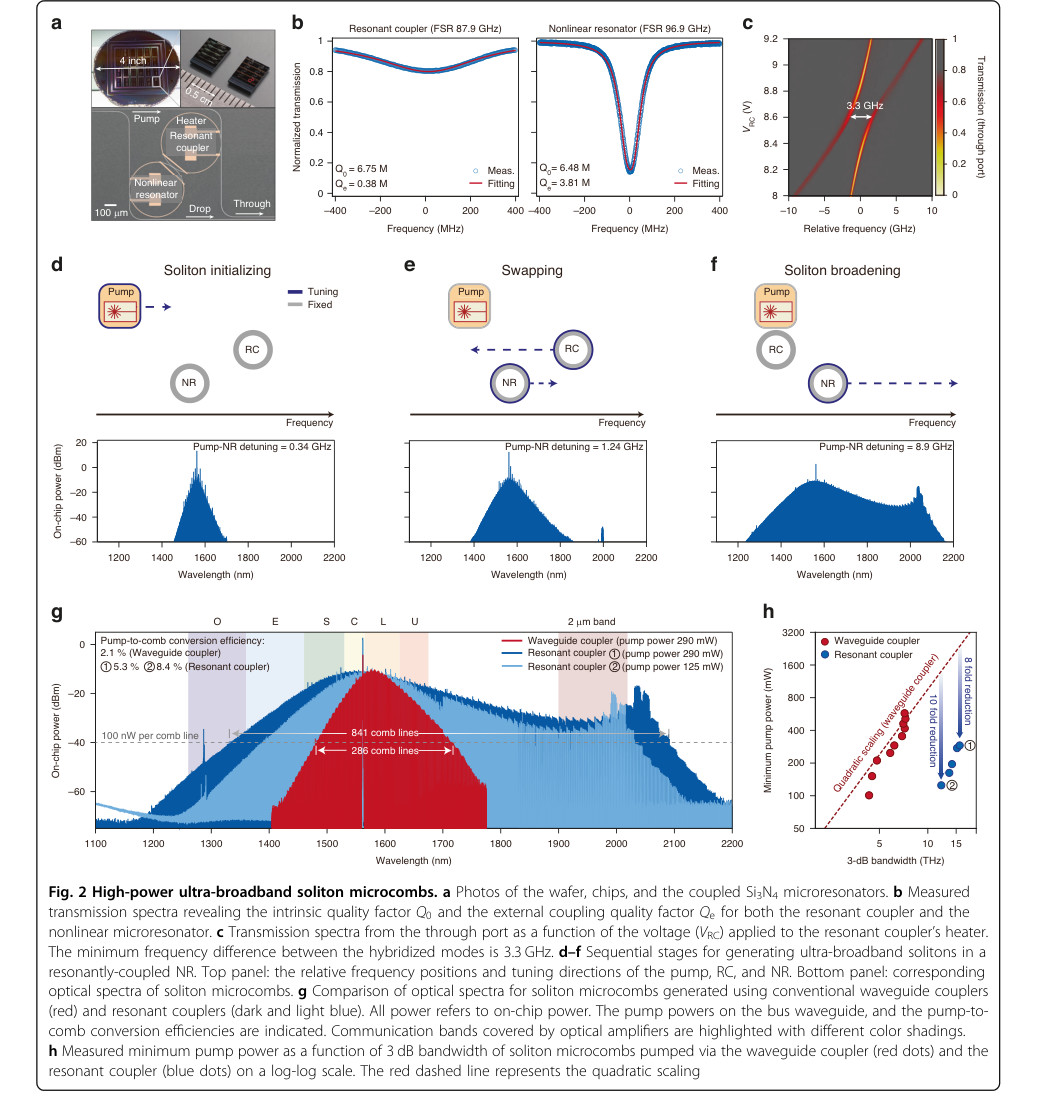 Figure 2. High-power ultra-broadband soliton microcombs. a Photos of the wafer, chips, and the coupled Si3N4 microresonators. b Measured transmission spectra revealing the intrinsic quality factor Q0 and the external coupling quality factor Qe for both the resonant coupler and the nonlinear microresonator. c Transmission spectra from the through port as a function of the voltage (VRC) applied to the resonant coupler’s heater. The minimum frequency difference between the hybridized modes is 3.3 GHz. d–f Sequential stages for generating ultra-broadband solitons in a resonantly-coupled NR. Top panel: the relative frequency positions and tuning directions of the pump, RC, and NR. Bottom panel: corresponding optical spectra of soliton microcombs. g Comparison of optical spectra for soliton microcombs generated using conventional waveguide couplers (red) and resonant couplers (dark and light blue). All power refers to on-chip power. The pump powers on the bus waveguide, and the pump-to- comb conversion efficiencies are indicated. Communication bands covered by optical amplifiers are highlighted with different color shadings. h Measured minimum pump power as a function of 3 dB bandwidth of soliton microcombs pumped via the waveguide coupler (red dots) and the resonant coupler (blue dots) on a log-log scale. The red dashed line represents the quadratic scaling
This structural advantage fundamentally decouples the stringent power requirements from the desired spectral performance, allowing for the generation of ultra-broadband, low-repetition-rate microcombs that were previously unattainable. The paper does not discuss memory complexity or high-dimensional noise handling, as these are not the primary challenges addressed in this optical system.
Alignment with Constraints
The chosen resonant-coupling method perfectly aligns with the harsh requirements outlined for practical, chip-scale optical frequency combs. It represents a "marriage" between the problem's demands and the solution's unique properties:
- Miniaturization and Chip-Scale Deployment: The RC architecture is fully compatible with photonic integration. The authors implement their design in 786 nm-thick Si3N4 microresonators fabricated via subtractive processing on a wafer, demonstrating a compact, chip-scale solution (Fig. 2a, 3a, 4a).
- Overcoming the Pump-Power Bottleneck: This was the most critical constraint. The resonant enhancement mechanism directly addresses the high power requirements for achieving octave-spanning combs with fine comb spacings. By significantly reducing the necessary pump power (e.g., a 10-fold reduction for comparable bandwidths), the method makes these advanced microcombs viable for on-chip integration with low-power lasers.
- Achieving Octave-Spanning Bandwidth and Low Repetition Rates: The RC enables "up to threefold wider bandwidths and the first octave-spanning soliton combs at microwave repetition rates." This directly fulfills the performance targets that were previously limited by the "impossible trinity." The ability to access larger detunings due to enhanced pump power is key to achieving these broad spans.
- Reliable, Turnkey Soliton Generation: The abstract states that this configuration "yields reliable, turnkey soliton generation." The paper further demonstrates hybrid-integrated turnkey soliton microcombs using self-injection locking, where the feedback phase is optimized to deterministically form single solitons, even with low pump powers (e.g., 20 mW). This ensures practical usability and stability, crucial for real-world applications.
Rejection of Alternatives
The paper implicitly and explicitly rejects "conventional waveguide-coupled designs" as viable alternatives for achieving the desired performance metrics. The reasoning behind this rejection is rooted in the fundamental physical limitations of these traditional setups:
- The "Impossible Trinity" Constraint: As discussed, conventional waveguide-coupled NRs are subject to the "impossible trinity" (Fig. 1b), where it's impossible to simultaneously optimize comb span, power, and spacing under limited pump power. The quadratic scaling law (Eq. 1) means that achieving broad bandwidths or low repetition rates with these methods would necessitate impractically high pump powers, making them unsuitable for integrated, power-efficient applications.
- Inefficient Pump Delivery: In conventional architectures, pump power is delivered via evanescent coupling from a bus waveguide. While effective for initiating four-wave mixing, stable soliton formation requires red-detuned pump and additional power. This direct coupling mechanism lacks the resonant power enhancement provided by the RC, leading to significantly lower effective pump power inside the NR.
- Benchmarking Evidence: The authors provide direct comparative benchmarking (Fig. 2h), showing that a waveguide-coupled NR (even with identical geometry and Q-factor) caps at 7.2 THz bandwidth with 600 mW pump, whereas the RC device achieves 15.8 THz with 290 mW. Extrapolating the quadratic scaling, the conventional device would require "more than 1.5 W and 2 W" to match the RC's performance at much lower pump powers (125 mW and 290 mW, respectively). This stark difference in power requirements clearly demonstrates the failure of conventional methods to meet the power-efficiency demands of the problem.
The paper focuses on optical microcomb generation and does not discuss other popular approaches from different fields, such as GANs or Diffusion models, as they are not relevant alternatives for this specific problem in photonics. The "alternatives" considered and rejected are the established, but ultimately insufficient, methods within the microcomb community.
Mathematical & Logical Mechanism
The Master Equation
The fundamental dynamics of soliton microcombs, which this paper aims to enhance, are governed by the Lugiato-Lefever equation (LLE). This partial differential equation describes the evolution of the intracavity field amplitude within a nonlinear microresonator. The paper's core contribution, however, lies in introducing a resonant coupling mechanism that significantly modifies the effective pump power driving this LLE. This enhancement is quantified by the factor $\Gamma$.
Therefore, the two absolut core equations powering this paper are:
-
The Lugiato-Lefever Equation (LLE), describing the intracavity field dynamics:
$$ \frac{\partial A}{\partial T} = -\frac{\kappa_{NR}}{2} A - i\delta\omega A + i\frac{D_2}{2}\frac{\partial^2 A}{\partial\phi^2} + ig|A|^2A + \sqrt{\frac{\kappa_{e,NR}P_{in}}{\hbar\omega_0}} \quad (3) $$ -
The Resonant Coupling Enhancement Factor ($\Gamma$), which boosts the effective pump power:
$$ \Gamma = \frac{4G^2}{\kappa_{RC}\kappa_{NR}} \quad (2) $$
The resonant coupling mechanism effectively transforms the input pump power $P_{in}$ into an enhanced power $\Gamma P_{in}$ that then drives the nonlinear resonator, thereby relaxing the "impossible trinity" constraint (Eq. 9 in the paper) which is directly proportional to the effective pump power.
Term-by-Term Autopsy
Let's dissect the Lugiato-Lefever Equation (Eq. 3) first, as it describes the underlying physics of soliton microcombs, and then the Enhancement Factor (Eq. 2), which is the paper's key innovation.
Autopsy of the Lugiato-Lefever Equation (Eq. 3):
$$ \frac{\partial A}{\partial T} = -\frac{\kappa_{NR}}{2} A - i\delta\omega A + i\frac{D_2}{2}\frac{\partial^2 A}{\partial\phi^2} + ig|A|^2A + \sqrt{\frac{\kappa_{e,NR}P_{in}}{\hbar\omega_0}} $$
-
$\frac{\partial A}{\partial T}$:
- Mathematical Definition: This is the partial derivative of the slowly varying field amplitude $A$ with respect to slow time $T$.
- Physical/Logical Role: It represents the rate of change of the intracavity field amplitude over time. This term dictates how the optical field inside the microresonator evolves.
- Why addition/subtraction: All terms on the right-hand side are added or subtracted because they represent distinct physical processes (loss, detuning, dispersion, nonlinearity, pumping) that independently contribute to the overall change in the field amplitude.
-
$A$:
- Mathematical Definition: The complex-valued, slowly varying envelope of the electric field inside the nonlinear resonator. It is normalized such that $|A|^2$ corresponds to the intracavity photon number.
- Physical/Logical Role: This is the central quantity whose evolution we are tracking. It represents the light circulating within the microresonator.
-
$T$:
- Mathematical Definition: Slow time, often referred to as "lab time."
- Physical/Logical Role: This is the macroscopic timescale over which the field envelope changes, distinct from the rapid optical oscillation period.
-
$\phi$:
- Mathematical Definition: The angular coordinate in the moving frame of reference, typically along the circumference of the ring resonator.
- Physical/Logical Role: This spatial coordinate allows us to describe the shape and propagation of the optical pulse (soliton) within the resonator. The $\frac{\partial^2 A}{\partial\phi^2}$ term describes how the field varies spatially.
-
$-\frac{\kappa_{NR}}{2} A$:
- Mathematical Definition: A linear term proportional to the field amplitude, with $\kappa_{NR}$ being the total decay rate of the nonlinear resonator. $\kappa_{NR} = \kappa_{0,NR} + \kappa_{e,NR}$, where $\kappa_{0,NR}$ is the intrinsic decay rate (due to material absorption, scattering) and $\kappa_{e,NR}$ is the coupling rate to the bus waveguide (energy leaving the resonator).
- Physical/Logical Role: This term represents the linear optical losses within the microresonator. It acts as a damping force, causing the intracavity field to decay if no power is supplied. The division by 2 is a convention for field amplitude decay.
- Why subtraction: It's a loss term, meaning it removes energy from the system, hence the negative sign.
-
$-i\delta\omega A$:
- Mathematical Definition: A linear term proportional to the field amplitude, with $\delta\omega$ being the pump-NR detuning (the difference between the pump laser frequency and the nearest microresonator resonance frequency).
- Physical/Logical Role: This term accounts for the frequency mismatch between the pump laser and the resonator's mode. It primarily introduces a phase shift to the intracavity field, which is crucial for soliton formation. A red-detuned pump ($\delta\omega < 0$) is typically required for stable soliton generation.
- Why subtraction and imaginary unit: The imaginary unit $i$ indicates that this term causes a phase shift rather than an an amplitude change. The sign depends on the detuning direction.
-
$i\frac{D_2}{2}\frac{\partial^2 A}{\partial\phi^2}$:
- Mathematical Definition: A term involving the second spatial derivative of the field amplitude, with $D_2$ being the second-order dispersion coefficient.
- Physical/Logical Role: This term describes the effect of group-velocity dispersion (GVD) on the optical pulse. In anomalous dispersion ($D_2 < 0$), it causes different frequency components of a pulse to travel at different speeds, leading to pulse broadening or compression. For soliton formation, anomalous dispersion is essential to balance the Kerr nonlinearity.
- Why imaginary unit: Dispersion primarily affects the phase relationship between frequency components, hence the $i$.
-
$ig|A|^2A$:
- Mathematical Definition: A nonlinear term, where $g$ is the nonlinear coefficient and $|A|^2$ is the intracavity photon number. The nonlinear coefficient $g = \frac{\hbar\omega_0 c n_2}{n_{eff}^2 V_{eff}}$, where $n_2$ is the nonlinear refractive index, $n_{eff}$ is the effective refractive index, and $V_{eff}$ is the effective mode volume.
- Physical/Logical Role: This term represents the Kerr nonlinearity, where the refractive index of the material changes with the intensity of the light. This leads to self-phase modulation (SPM) and four-wave mixing (FWM), which are fundamental to generating new frequency components and forming solitons.
- Why imaginary unit: Kerr nonlinearity primarily induces a phase shift proportional to intensity.
-
$\sqrt{\frac{\kappa_{e,NR}P_{in}}{\hbar\omega_0}}$:
- Mathematical Definition: The pump driving term, where $\kappa_{e,NR}$ is the coupling rate to the waveguide, $P_{in}$ is the input pump power, $\hbar$ is the reduced Planck constant, and $\omega_0$ is the pump angular frequency.
- Physical/Logical Role: This term represents the continuous-wave pump laser injecting energy into the microresonator. It is the source of energy that sustains the intracavity field against losses and drives the nonlinear processes.
- Why addition: It's an energy input term, adding to the field amplitude.
Autopsy of the Resonant Coupling Enhancement Factor (Eq. 2):
$$ \Gamma = \frac{4G^2}{\kappa_{RC}\kappa_{NR}} $$
-
$\Gamma$:
- Mathematical Definition: The enhancement factor.
- Physical/Logical Role: This dimensionless factor quantifies how much the effective pump power delivered to the nonlinear resonator (NR) is increased when using the resonant coupler (RC) compared to direct waveguide coupling. A higher $\Gamma$ means more efficient pump delivery.
-
$G$:
- Mathematical Definition: The coupling rate between the resonant coupler (RC) and the nonlinear resonator (NR).
- Physical/Logical Role: This term represents the strength of the optical connection that allows power to transfer from the RC to the NR. A stronger coupling ($G$) facilitates more efficient power transfer, contributing positively to the enhancement. It is squared because power transfer is proportional to the square of the coupling coefficient.
-
$\kappa_{RC}$:
- Mathematical Definition: The total dissipation rate of the resonant coupler (RC). Similar to $\kappa_{NR}$, it includes intrinsic and external coupling losses for the RC.
- Physical/Logical Role: This term represents the total rate at which energy is lost from the RC. Higher losses in the RC reduce the overall enhancement, hence it appears in the denominator.
-
$\kappa_{NR}$:
- Mathematical Definition: The total dissipation rate of the nonlinear resonator (NR), as defined previously for the LLE.
- Physical/Logical Role: This term represents the total rate at which energy is lost from the NR. It appears in the denominator because the overall efficiency of delivering power to the NR is inversely related to its own losses.
-
$4$:
- Mathematical Definition: A numerical constant.
- Physical/Logical Role: This factor of 4 is characteristic of resonant enhancement in coupled systems, often arising from the maximum power transfer condition at critical coupling. It signifies the peak enhancement achievable when the system is optimally tuned.
-
Why multiplication/division: The equation is a ratio of squared coupling strength to the product of dissipation rates. This multiplicative and divisive structure naturally arises from the physics of coupled resonators, where the efficiency of energy transfer and storage is determined by the interplay of coupling strengths and losses.
Step-by-Step Flow
Imagine a single abstract "packet" of pump light entering this system. Here's its journey:
-
Initial Input: A continuous-wave pump laser emits light with power $P_{in}$. This light is guided towards the microcomb system.
-
Entry into the Resonant Coupler (RC): Instead of directly entering the nonlinear resonator (NR), the pump light first couples into an auxiliary microresonator, the RC. This is the first point of divergence from conventional waveguide-coupled designs.
-
Resonant Enhancement in RC: As the pump light circulates within the RC, if the pump laser's frequency is precisely tuned to one of the RC's resonant modes, the optical power inside the RC builds up significantly. This resonant buildup is the key to the enhancement. The RC acts like a temporary energy reservoir, accumulating pump photons.
-
Inter-Resonator Coupling to NR: The enhanced optical power within the RC then couples into the adjacent nonlinear resonator (NR). This transfer occurs via the inter-resonator coupling rate $G$. The effective power delivered to the NR is now $\Gamma P_{in}$, where $\Gamma$ is the enhancement factor. This is where the paper's mechanism directly impacts the LLE, effectively increasing the pump term $\sqrt{\frac{\kappa_{e,NR}P_{in}}{\hbar\omega_0}}$ by a factor of $\sqrt{\Gamma}$.
-
Intracavity Dynamics in NR (LLE in action): Once inside the NR, the now-enhanced pump power drives the complex interplay of physical phenomena described by the Lugiato-Lefever equation:
- Loss: A portion of the light is continuously lost due to intrinsic material absorption and scattering, and also by coupling out to the bus waveguide ($\kappa_{NR}$ term).
- Detuning: The pump's frequency detuning ($\delta\omega$) from the NR's resonance influences the phase of the intracavity field.
- Dispersion: The light experiences group-velocity dispersion ($D_2$), which affects the temporal spreading or compression of pulses.
- Nonlinearity: The high intensity of the light inside the NR induces a Kerr nonlinearity ($g|A|^2A$), causing the refractive index to change with intensity. This leads to self-phase modulation and four-wave mixing, generating new frequencies.
-
Soliton Formation: If the effective pump power is above a certain threshold and the pump is appropriately red-detuned, the Kerr nonlinearity and anomalous dispersion ($D_2 < 0$) balance each other. This delicate balance leads to the formation of stable, self-sustaining optical pulses known as dissipative Kerr solitons. These solitons circulate within the NR.
-
Optical Frequency Comb Generation: The circulating solitons manifest in the frequency domain as a series of phase-coherent, equally spaced spectral lines, forming an optical frequency comb. The enhanced pump power allows for broader comb spans and lower repetition rates than previously possible.
-
Output: The generated optical frequency comb, now with its enhanced properties, couples out of the NR back into the bus waveguide, ready for various applications.
Optimization Dynamics
The "optimization" in this context refers to the careful design, fabrication, and active tuning of the physical system to achieve stable, high-performance soliton microcombs, rather than an iterative learning algorithm. The goal is to maximize the effective pump power delivered to the nonlinear resonator (NR) and control the comb properties.
-
Design-Phase Optimization (Structural Parameters):
- Resonator Quality Factors (Q-factors): The intrinsic ($Q_0$) and external ($Q_e$) quality factors of both the resonant coupler (RC) and the NR are critical. For the RC, a high $Q_0$ is desirable for strong resonant enhancement, but its external coupling $Q_e$ must be carefully chosen to allow efficient pump delivery to the NR while suppressing unwanted parametric oscillations within the RC itself (e.g., by setting $\kappa_{RC} > \kappa_{NR}$).
- Coupling Rates ($G$, $\kappa_{e,NR}$): The inter-resonator coupling rate $G$ between the RC and NR is a key design parameter. A larger $G$ generally leads to a higher enhancement factor $\Gamma$. Similarly, the coupling rate $\kappa_{e,NR}$ of the NR to the bus waveguide affects the output efficiency and the overall $\kappa_{NR}$.
- Waveguide Geometry: The width and height of the waveguides in both resonators are optimized to control the group-velocity dispersion ($D_2$) and the nonlinear coefficient ($g$). For instance, widening the NR waveguide reduces its group-velocity dispersion, which facilitates a broader comb span.
-
Active Tuning and Operational Optimization:
- Pump Laser Detuning ($\delta\omega$): This is the most critical active tuning parameter. The pump laser frequency must be precisely tuned relative to the RC resonance for maximum enhancement, and then the RC resonance itself is tuned relative to the NR resonance. The paper highlights that the resonant coupler allows accessing "larger detunings" for the NR, which directly translates to a broader soliton comb span (scaling as $\sqrt{\delta\omega}$). This tuning is often achieved by thermal heaters integrated with the resonators.
- Pump Power ($P_{in}$): While the goal is to reduce the required $P_{in}$ for a given performance, the input pump power must still exceed the threshold for four-wave mixing and be sufficient to sustain solitons. The resonant coupling effectively multiplies this input power.
- Feedback Phase (for Hybrid Integration): In hybrid-integrated systems using self-injection locking, the phase of the light fed back from the microresonator to the laser cavity must be carefully adjusted. This feedback phase biases the system towards stable single-soliton generation and narrows the laser linewidth, acting as an active stabilization and optimization step for turnkey operation.
-
Loss Landscape Analogy: While not a mathematical loss landscape in the machine learning sense, one can conceptualize the parameter space (pump power, detuning, coupling strengths) as having regions where stable soliton microcombs exist. The resonant coupling mechanism effectively reshapes this "soliton existence landscape," expanding the region where high-performance (broadband, low repetition rate) solitons can be generated with significantly lower external pump power. The "optimization" is the process of navigating this landscape through design and tuning to reach these desirable operating points. The system converges to a stable soliton state when the physical conditions (pump power, detuning, dispersion, nonlinearity, and coupling) are appropriately balanced.
Results, Limitations & Conclusion
Experimental Design & Baselines
The authors meticulously architected their experiments to provide undeniable evidence for the advantages of resonant coupling in soliton microcombs. Their core claim revolves around significantly reducing pump power consumption while simultaneously increasing spectral span, a challenge previously deemed an "impossible trinity" in conventional designs.
To rigorously test this, they fabricated silicon nitride (Si$_3$N$_4$) microresonators using subtractive processing. The experimental setup primarily compared two distinct configurations:
1. Conventional Waveguide-Coupled Design: This served as the primary baseline, where a nonlinear microresonator (NR) was evanescently coupled directly to a bus waveguide. This configuration is represented by Device 1 in their characterization.
2. Resonantly-Coupled (RC) Architecture: This is the novel approach, where an auxiliary microresonator (RC) is interposed between the bus waveguide and the NR. This design aims to resonantly enhance pump power delivery to the NR. Devices 2-5 were implemented with this architecture, featuring varying NR waveguide widths (e.g., 1.8 µm, 3.4 µm, 3.8 µm, 2.5 µm) to achieve different free-spectral ranges (FSRs) and dispersion characteristics.
Integrated heaters were incorporated into the devices, allowing for precise thermal tuning of the resonator resonances. This tuning was crucial for observing avoided crossings between modes, which in turn enabled the determination of inter-resonator coupling rates (G/2π).
The "victims" (baseline models) against which the RC architecture was ruthlessly benchmarked were:
* Conventional waveguide-coupled microresonators: Explicitly shown in direct comparisons of optical spectra (Fig. 2g) and minimum pump power versus 3-dB bandwidth (Fig. 2h).
* Previously reported octave-spanning soliton microcombs: For the specific case of octave-spanning comb generation at microwave and millimeter-wave rates, the authors compared their results against a compilation of data from various continuous-wave (CW)-pumped waveguide-coupled platforms found in existing literature (Fig. 3f).
Key performance metrics measured included:
* Optical spectra: To assess comb span and line count (e.g., Fig. 2d-g, Fig. 3b, d, Fig. 4c).
* Pump-to-comb conversion efficiency: Quantifying how effectively input pump power is converted into useful comb power (Fig. 2g).
* 3-dB bandwidth: A direct measure of the comb's spectral width (Fig. 2h).
* Minimum pump power: Especially for achieving specific bandwidths or octave-spanning operation (Fig. 2h, Fig. 3f).
* Phase noise: Characterized for both the pump laser and the generated repetition rates of the microcombs using a multi-frequency delayed self-heterodyne interferometer, to assess coherence (Fig. 3e).
* Turnkey operation reliability: Demonstrated by modulating the laser current and observing consistent soliton formation (Fig. 4b).
For the hybrid-integrated turnkey demonstration, a distributed-feedback (DFB) laser was directly coupled to the Si$_3$N$_4$ chip. Self-injection locking was employed, where light backscattered from the microresonator re-enters the laser cavity, narrowing the laser's linewidth and biasing the system towards stable soliton microcomb generation. This setup aimed to prove the practical viability of the RC design with on-chip laser integration.
What the Evidence Proves
The experimental evidence definitively proves that the resonant-coupling (RC) architecture overcomes the long-standing pump-power bottleneck in soliton microcombs, enabling significantly broader spectral spans and lower power consumption, particularly for octave-spanning operation at microwave repetition rates.
Here's the undeniable evidence:
- Dramatic Increase in Spectral Span and Efficiency:
- Figure 2g showcases a direct comparison: at 290 mW on-chip pump power, the conventional waveguide-coupled device achieved a pump-to-comb conversion efficiency of 2.1%, while the RC device (Device 2) reached 15.3%. Even at a lower pump power of 125 mW, the RC device still achieved 8.3% efficiency.
- Figure 2h provides a stark contrast in bandwidth. For the same 290 mW pump power, the conventional waveguide-coupled device yielded a 3 dB bandwidth of 6.2 THz with 286 comb lines. In contrast, the RC device achieved a remarkable 15.8 THz 3 dB bandwidth with 841 comb lines. This represents a threefold increase in spectral span for high-power combs.
- Extrapolating from the quadratic pump-span scaling (Eq. 1), the authors estimate that a conventional waveguide-coupled device would require over 1.5 W to 2 W of pump power to match the RC's performance at 125 mW and 290 mW, respectively. This underscores an up to tenfold pump power enhancement afforded by the resonant coupling mechanism.
Figure 2. High-power ultra-broadband soliton microcombs. a Photos of the wafer, chips, and the coupled Si3N4 microresonators. b Measured transmission spectra revealing the intrinsic quality factor Q0 and the external coupling quality factor Qe for both the resonant coupler and the nonlinear microresonator. c Transmission spectra from the through port as a function of the voltage (VRC) applied to the resonant coupler’s heater. The minimum frequency difference between the hybridized modes is 3.3 GHz. d–f Sequential stages for generating ultra-broadband solitons in a resonantly-coupled NR. Top panel: the relative frequency positions and tuning directions of the pump, RC, and NR. Bottom panel: corresponding optical spectra of soliton microcombs. g Comparison of optical spectra for soliton microcombs generated using conventional waveguide couplers (red) and resonant couplers (dark and light blue). All power refers to on-chip power. The pump powers on the bus waveguide, and the pump-to- comb conversion efficiencies are indicated. Communication bands covered by optical amplifiers are highlighted with different color shadings. h Measured minimum pump power as a function of 3 dB bandwidth of soliton microcombs pumped via the waveguide coupler (red dots) and the resonant coupler (blue dots) on a log-log scale. The red dashed line represents the quadratic scaling
- Octave-Spanning Combs at Microwave Rates with Unprecedented Low Power:
- The paper demonstrates the first octave-spanning soliton combs at microwave repetition rates using only a continuous-wave pump. Specifically, Device 3 (100 GHz FSR) achieved an octave spectrum (1007 to 2130 nm) with only 126 mW pump power (Fig. 3b). Device 4 (25 GHz FSR) generated an octave spectrum (1098 to 2250 nm) with 139 mW pump power (Fig. 3d).
- Figure 3f presents a compelling comparison of the figure of merit $P_{in} \times f_r^2$ (on-chip pump power multiplied by the square of the repetition rate) for octave-spanning combs. The RC architecture achieves values around $10^5 \text{ mW} \cdot \text{GHz}^2$, which is two orders of magnitude lower than the best results reported in conventional waveguide-coupled configurations. This is definitive proof of the RC's superior power efficiency for generating broad, low-repetition-rate combs.
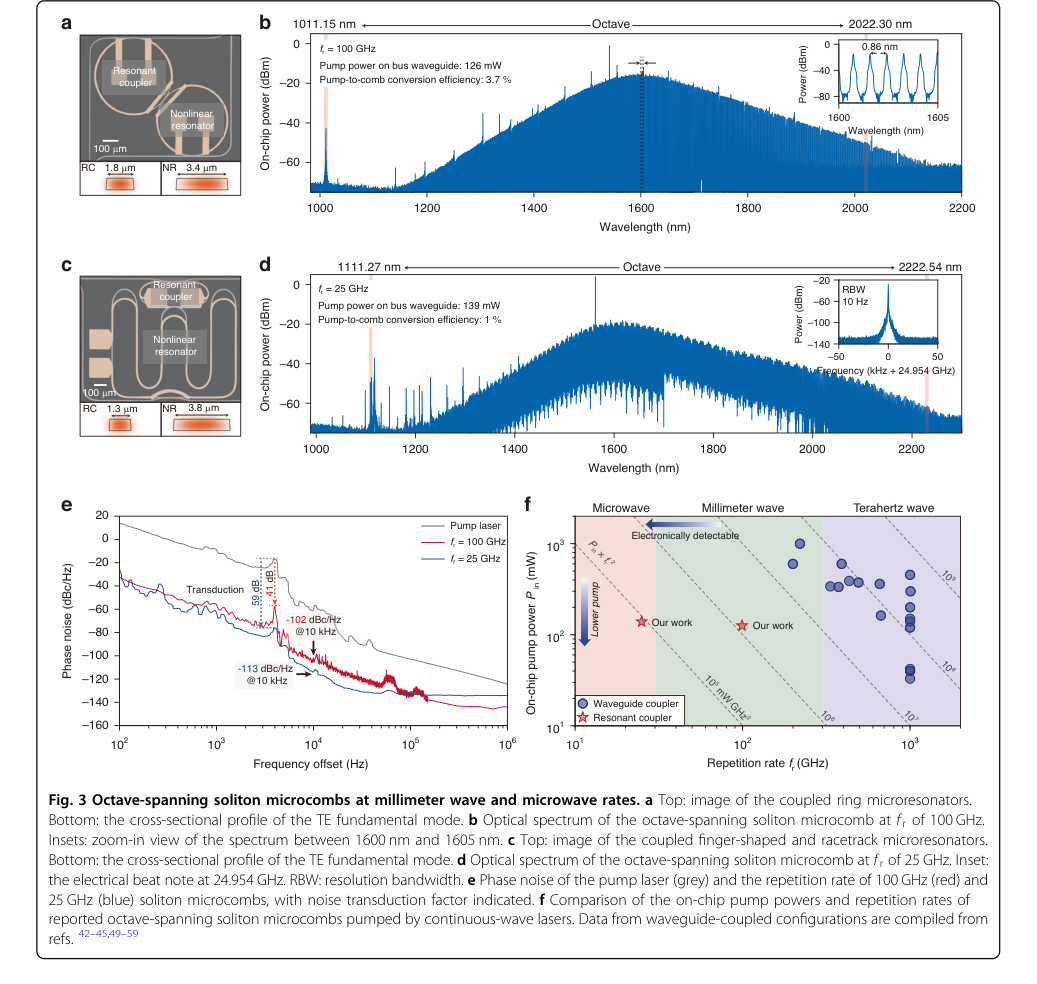 Figure 3. Octave-spanning soliton microcombs at millimeter wave and microwave rates. a Top: image of the coupled ring microresonators. Bottom: the cross-sectional profile of the TE fundamental mode. b Optical spectrum of the octave-spanning soliton microcomb at f r of 100 GHz. Insets: zoom-in view of the spectrum between 1600 nm and 1605 nm. c Top: image of the coupled finger-shaped and racetrack microresonators. Bottom: the cross-sectional profile of the TE fundamental mode. d Optical spectrum of the octave-spanning soliton microcomb at f r of 25 GHz. Inset: the electrical beat note at 24.954 GHz. RBW: resolution bandwidth. e Phase noise of the pump laser (grey) and the repetition rate of 100 GHz (red) and 25 GHz (blue) soliton microcombs, with noise transduction factor indicated. f Comparison of the on-chip pump powers and repetition rates of reported octave-spanning soliton microcombs pumped by continuous-wave lasers. Data from waveguide-coupled configurations are compiled from refs. 42–45,49–59
-
High Coherence Maintained:
- Despite the enhanced performance, the coherence of the combs is preserved. Phase noise measurements (Fig. 3e) show -102 dBc/Hz for the 100 GHz comb and -113 dBc/Hz for the 25 GHz comb at a 10 kHz offset. These values are comparable to the lowest reported for free-running integrated soliton microcombs, indicating that the RC mechanism does not introduce significant additional noise.
-
Reliable, Turnkey Soliton Generation:
- The hybrid-integrated setup (Device 5) with a directly coupled DFB laser demonstrates reliable, turnkey soliton generation. Figure 4b shows that by modulating the laser current, a single-soliton state deterministically forms in the NR each time the current is switched to a predetermined setpoint. This eliminates the need for complex external tuning protocols.
- This turnkey operation achieved a 99 GHz FSR and an optical bandwidth exceeding 300 nm with 171 comb lines above 100 nW, using a mere 22.7 mW pump power (Fig. 4c).
In essence, the evidence unequivocally demonstrates that resonant coupling is a game-changer, enabling microcombs to break free from the "impossible trinity" by simultaneously achieving ultra-broadband operation, low repetition rates, and significantly reduced pump power, all while maintaining coherence and enabling turnkey operation.
Limitations & Future Directions
While the resonant-coupling architecture presents a significant leap forward for soliton microcombs, the authors candidly acknowledge several limitations and propose clear avenues for future development.
Current Limitations Identified in the Paper:
- Parametric Oscillations in the RC: The auxiliary resonant coupler (RC) itself can experience unwanted parametric oscillations. To suppress these, the authors suggest narrowing the RC waveguide to reduce its intrinsic quality factor ($Q_0$), or increasing its coupling to the bus waveguide to reduce its external coupling quality factor ($Q_e$).
- Parasitic Mode Coupling: Unwanted mode coupling between non-pumped resonances in the NR and RC can lead to additional comb power leakage through the through port. Future designs should engineer the NR-RC coupling to be significant only in the vicinity of the pump resonances.
- Precision Control of Resonator Parameters: Achieving the desired generalized critical-coupling condition requires precise control over the parameters of both the RC and NR to minimize direct pump transmission through the bus waveguide. This highlights a fabrication and design challenge that needs continuous refinement.
- Detuning Limit and Soliton Stability: The maximum accessible detuning is currently limited by modulational instability in the RC, which can destabilize the soliton. Reducing the $Q$ of the RC is proposed as a way to overcome this.
- Raman Self-Frequency Shift and Dispersive-Wave Recoil: These nonlinear effects cause shifts in the spectral-envelope center from the pump wavelength, limiting the maximum comb span. Balancing these effects is crucial for achieving even broader combs.
Future Development & Evolution Discussion Topics:
The findings in this paper open up a plethora of exciting directions for further research and development, stimulating critical thinking across various disciplines:
-
Advanced Microresonator Engineering:
- Dispersion Management: How can we engineer NRs with even larger dispersion within the RC architecture to deliver higher numbers of high-power, high-signal-to-noise ratio comb teeth? This is crucial for advanced telecom formats and could potentially eliminate the need for external optical amplification.
- Dispersive-Wave Control: What novel designs or active feedback mechanisms can provide precise control over dispersive-wave generation? This is paramount for robust f-2f self-referencing, a key requirement for optical clocks and frequency synthesizers.
- Output Spectrum Sculpting: Beyond enhancing pump delivery, how can we actively sculpt the output spectrum using wavelength-selective couplers? This could tailor comb properties for specific applications, such as flattening the spectrum for high-capacity wavelength-division multiplexing (WDM) communications or creating custom spectral profiles for spectroscopy.
-
Enhanced Integration and Miniaturization:
- Monolithic Integration: The hybrid integration with a DFB laser is a significant step. What are the next steps towards fully monolithic integration of the pump laser, microresonators, and control electronics on a single chip? This would further reduce size, power consumption, and improve robustness for portable and field-deployable applications.
- Alternative Material Platforms: While Si$_3$N$_4$ is excellent, what other material platforms (e.g., lithium niobate, AlN, or novel hybrid materials) could offer even higher intrinsic Q factors, stronger nonlinearities, or better thermal properties? Could these materials enable even lower pump powers or broader comb spans?
-
Intelligent Control and Stability:
- AI/ML-driven Soliton Management: Can machine learning algorithms be employed for real-time, autonomous control of soliton formation and stability? This could move beyond simple heater tuning or self-injection locking, adapting to environmental fluctuations and optimizing performance for long-term operation.
- Environmental Robustness: How can these devices be made more robust to temperature variations, vibrations, and other environmental factors? This is critical for their deployment in real-world scenarios like space-borne metrology or mobile optical clocks.
-
Expanding Application Horizons:
- Next-Generation Optical Clocks and Frequency Synthesizers: With the pump-power bottleneck relaxed, what are the ultimate limits for on-chip optical frequency division and synthesis? Can we achieve even higher precision and stability, rivaling laboratory-scale systems?
- Ultra-High-Capacity Communications: How can the demonstrated 100-GHz-rate microcombs, with their low comb-tooth power variation, be fully leveraged for aggregate data rates exceeding 64 Tb/s? This involves optimizing modulation formats, channel spacing, and integration with other photonic components.
- Advanced Spectroscopy and Sensing: The ability to generate ultra-broadband combs at low power opens doors for highly sensitive, compact spectrometers for environmental monitoring, medical diagnostics, and astronomical observations. What new spectroscopic techniques can be enabled by these enhanced microcombs?
- Quantum Technologies: Could these highly coherent, low-power microcombs find applications in quantum information processing, such as generating entangled photon pairs or serving as local oscillators for quantum sensing?
-
Fundamental Physics Exploration:
- Nonlinear Dynamics: The ability to precisely control and generate solitons under such diverse conditions offers a unique platform for exploring fundamental aspects of nonlinear optics, soliton dynamics, and light-matter interactions in microresonators. What new physical phenomena might be discovered or better understood?
By addressing these limitations and exploring these forward-looking discussion topics, the field can further develop and evolve these findings, pushing microcomb technology towards even more widespread and impactful applications.
Connections to Other Fields
Mathematical Skeleton
The pure mathematical core of this work lies in the analysis of dissipative Kerr solitons within a modified Lugiato-Lefever equation framework, where a resonant coupling mechanism effectively enhances the pump term. This enhancement allows for the generation of ultra-broadband frequency combs with reduced pump power requirements, fundamentally altering the system's parameter space for stable soliton existence.
Adjacent Research Areas
Nonlinear Optics and Dissipative Solitons
The Lugiato-Lefever equation (LLE), presented as Eq. 3 in this paper, is a foundational model in nonlinear optics for describing the formation and dynamics of dissipative Kerr solitons in optical resonators. The resonant coupling introduced here effectively modifies the pump term in the LLE, allowing for more efficient energy injection into the nonlinear resonator. This mathematical framework is widely used to study various phenomena in driven-dissipative systems, including optical bistability, pattern formation in broad-area lasers, and the generation of ultrashort pulses in mode-locked lasers. The principles of balancing nonlinearity, dispersion, driving, and dissipation are central to understanding these diverse systems. (Lugiato, L. A. & Lefever, R. Spatial dissipative structures in passive optical systems. Phys. Rev. Lett. 58, 2209-2211 (1987)).
Coupled Mode Theory in Resonant Systems
The architecture of resonantly-coupled microresonators is a direct application of coupled mode theory, a versatile mathematical tool used across many fields of physics and engineering. The enhancement factor $\Gamma = \frac{4G^2}{K_{RC}K_{NR}}$ (Eq. 2) quantifies the efficiency of energy transfer between the resonant coupler (RC) and the nonlinear resonator (NR), where $G$ is the inter-resonator coupling rate and $K_{RC}, K_{NR}$ are their respective dissipation rates. This same theoretical skeleton is employed in designing high-Q filters in microwave engineering, optimizing energy transfer in wireless power systems, and understanding light-matter interactions in photonic crystals and metamaterials, where precise control over resonant frequencies and coupling strengths is paramount. (Yariv, A. Coupled-mode theory for guided-wave optics. IEEE J. Quantum Electron. 9, 919-933 (1973)).
General Soliton Physics
While the paper specifically addresses optical solitons, the underlying concept of solitons as stable, self-reinforcing wave packets that propagate without dispersion or change in shape is a ubiquitous phenomenon in physics. The stability and dynamics of these self-localized structures, including their formation, interaction, and robustness against perturbations, share conceptual similarities with solitons observed in other physical domains. For example, the Korteweg-de Vries (KdV) equation describes shallow water waves, and the Gross-Pitaevskii equation models matter-wave solitons in Bose-Einstein condensates. The study of dissipative Kerr solitons in microresonators contributes to the broader understanding of nonlinear wave phenomena and self-organization in complex systems. (Drazin, P. G., & Johnson, R. S. Solitons: An Introduction. Cambridge University Press (1989)).