
Contractive unitary and classical shadow tomography
Here's a breakdown of the abstract, designed for a zero-base reader:
Background & Academic Lineage
The Origin & Academic Lineage
The core problem addressed in this paper originates from the fundamental challenge of characterizing complex quantum many-body states, a necessity driven by the rapid advancements in quantum technology. Historically, a complete description of a quantum state, known as full quantum state tomography, demands an exponential number of measurements relative to the system's size. This exponential scaling makes it practically impossible to use for modern quantum devices that can involve hundreds of qubits.
A significant breakthrough in this field was the development of classical shadow tomography. This technique dramatically reduced the "sample complexity"—the number of measurements needed—to estimate various properties of a quantum state. It achieved this by performing random Clifford rotations before measurements. However, even with this advancement, a persistent painpoint remained: reducing the sample complexity below $2^k$ for extracting properties of non-successive local operators of size $k$ (where $k$ is the number of qubits in the subsystem) continued to be a significant hurdle. Previous classical shadow tomography protocols, particularly those relying on maximally scrambled random unitaries (like random Clifford gates), typically resulted in a shadow norm that scaled as $2^k$. This scaling, while better than full tomography, still presented a limitation for achieving truly efficient characterization of larger quantum systems. The authors' motivation for this work is to overcome this specific limitation by finding alternative global unitaries that can outperform the $2^k$ scaling.
Intuitive Domain Terms
To help a zero-base reader grasp the concepts, here are some specialized terms from the paper, translated into everyday analogies:
-
Quantum State Tomography (QST): Imagine you have a very complex, constantly changing sculpture made of light. Full QST is like trying to create a perfect, atom-by-atom blueprint of that sculpture at a specific moment. It's incredibly precise but requires an immense amount of effort and resources, making it practically impossible for large sculptures.
-
Classical Shadow Tomography: Instead of a full blueprint, classical shadow tomography is like taking many quick, different-angled "snapshots" of the light sculpture. Each snapshot is a "shadow" that, on its own, doesn't tell you everything. But by collecting a diverse set of these shadows, you can later answer specific questions about the sculpture (like its overall shape or how bright certain parts are) without needing the full, impossible blueprint. It's a much more efficient way to gain useful information.
-
Sample Complexity: This term refers to the "cost" of an experiment in terms of how many times you need to repeat a measurement or take a "sample" to get a reliable answer. If a method has low sample complexity, it means you need fewer tries, saving time and computational resources. The goal is always to make this number as small as possible.
-
Pauli String Operator: Think of this as a very specific "question" you can ask about a quantum system, like "Is this particular light beam spinning clockwise or counter-clockwise?" A "string" means you're asking a series of these questions about different parts (qubits) of your light sculpture simultaneously. The "size" of the string is how many parts you're asking a non-trivial question about.
-
Contractive Unitary: This is a special "pre-processing step" or a "smart filter" for your quantum system. Before you even ask your question (Pauli string operator) or take a measurement, the contractive unitary acts on the system to simplify the question. It effectively "contracts" or reduces the complexity of the operator, making it easier and faster to get an answer with fewer measurements. It's like simplifying a complex math problem before solving it.
Notation Table
| Notation | Description |
|---|---|
| $\hat{\rho}$ | Density matrix |
| $\hat{O}$ | Pauli string operator |
| $\hat{U}$ | Global unitary operation |
| $\hat{U}_{ct}$ | Contractive unitary |
| $\mathcal{E}_U$ | Unitary ensemble |
| $||\hat{O}||^2_{\mathcal{E}_U}$ | Shadow norm squared |
| $w(\hat{O}_U)_{\mathcal{E}_U}$ | Pauli weight of evolved operator |
| $\pi(m)_{\mathcal{E}_U}$ | Operator size distribution |
| $k$ | Operator size |
| $N_{XY}$ | Number of X and Y operators |
| $N$ | Total number of qubits |
Problem Definition & Constraints
Core Problem Formulation & The Dilemma
The fundamental problem this paper addresses is the inefficient characterization of complex quantum many-body states in large-scale quantum devices.
-
Input/Current State: We begin with an unknown complex quantum many-body state, typically represented by a density matrix $\hat{\rho}$. The current state-of-the-art for characterizing properties of such states, specifically the expectation values of Pauli string observables $\hat{O}$ of size $k$, relies on classical shadow tomography. While a significant improvement over full quantum state tomography (which requires an exponential number of measurements in system size), existing classical shadow protocols, particularly those employing random Clifford rotations, achieve a sample complexity that scales as $\sim 2^k$. This means that to accurately estimate properties of a size-$k$ operator, approximately $2^k$ measurement records (snapshots) are needed. The sample complexity is mathematically quantified by the "shadow norm," $||\hat{O}||_{\mathcal{E}_U}^2$, which is the variance of the estimator $E[\text{tr}(\hat{O}\mathcal{M}_{\mathcal{E}_U}[\hat{\rho}_U(z)])^2]$. For random Clifford unitaries, this norm is related to a binomial distribution of operator sizes, leading to the $2^k$ scaling.
-
Desired Endpoint (Output/Goal State): The ultimate goal is to significantly reduce the sample complexity for extracting properties of non-successive local operators with a size $k$. Specifically, the paper aims to achieve a sample complexity of $\sim 1.8^k$ when the operator's location is known, and $\sim k \times 1.8^k$ when the location is unknown. This reduction translates directly into fewer measurement records required, making the characterization of quantum states more practical for larger quantum systems. The desired output is a new classical shadow tomography protocol that leverages a specially designed global unitary operation to achieve this improved scaling.
-
Exact Missing Link or Mathematical Gap: The precise mathematical gap this paper attempts to bridge lies in finding an optimal global unitary operation $\hat{U}$ that, when incorporated into the classical shadow tomography protocol, can more efficiently "contract" the size of Pauli string operators. Current random Clifford protocols maximally scramble the operator size, leading to a binomial distribution and the $2^k$ shadow norm. The missing link is a unitary $\hat{U}$ that can deterministically manipulate the operator size distribution $\pi(m)$ of the evolved operator $\hat{O}_U = \hat{U}\hat{O}\hat{U}^\dagger$ such that it is "peaked at a smaller operator size" (as stated on page 3), thereby yielding a smaller shadow norm $||\hat{O}||_{\mathcal{E}_U}^2$ and a reduced sample complexity below $2^k$. The paper introduces the "contractive unitary" as this missing link.
-
The Dilemma: The core dilemma that has "trapped previous researchers" is the trade-off between maximal scrambling and targeted operator size reduction. Previous efforts focused on random Clifford rotations, which are excellent at maximally scrambling operators. This scrambling ensures that all operators can be measured on equal footing and provides a robust, general approach to classical shadow tomography, leading to the $2^k$ sample complexity. However, this maximal scrambling, while beneficial for generality, is not optimal for minimizing the shadow norm for all types of operators. The painful trade-off is that improving the sample complexity beyond $2^k$ requires moving away from fully random, maximally scrambling unitaries towards more deterministic, "contractive" ones. The challenge is to design such a deterministic unitary that can selectively reduce operator size without sacrificing the robustness or generality of the protocol, or introducing prohibitive implementation costs. The paper explicitly asks: "A challenging question is whether there exist other choices of global unitaries that can outperform the maximally scrambled random unitary and result in a smaller shadow norm compared to $\sim 2^k$." This highlights the central dilemma.
Constraints & Failure Modes
The problem of efficient quantum state characterization is fraught with several harsh, realistic constraints that make it insanely difficult to solve:
-
Physical & Hardware Memory Limits:
- Exponential Measurement Resources: Full quantum state tomography requires an exponential number of measurements ($O(D^2)$ where $D$ is Hilbert space dimension) in system size, making it "impractical for modern quantum devices" with hundreds of qubits. This is the primary constraint that classical shadow tomography aims to circumvent.
- Scalability to Large Systems: Any proposed solution must be scalable to "modern quantum devices with more than hundreds of qubits." The paper specifically mentions $k \sim 100$ as a relevant size.
- Hardware Connectivity and Gate Depth: While the proposed contractive unitary $\hat{U}_{ct} = \prod_{i
- Limited Connectivity Platforms: For quantum platforms with "limited connectivity" (e.g., superconducting qubits), the contractive unitary's direct implementation might fail. The paper addresses this by showing it can be decomposed into $k$ steps of local gates by adding a single ancillary qubit, ensuring the depth remains linear in $k$. This highlights the need for solutions to adapt to diverse hardware architectures.
- Quantum Noise: The protocol must demonstrate "robustness against quantum noise," as real quantum devices are inherently noisy. The paper claims its protocol exhibits a "persistent scaling advantage" even with noise (Fig. S4).
-
Computational Constraints:
- Computational Cost of Shadow Norm: The shadow norm, which characterizes sample complexity, "needs to be determined theoretically as a prior." This implies a computational overhead in designing and optimizing the unitary ensemble.
- Data Processing: The process involves collecting "classical snapshots" and averaging them to predict expectation values. While the focus is on reducing measurement samples, the subsequent classical data processing must also be computationally feasible.
-
Data-Driven Constraints:
- Unknown Operator Locations: A significant constraint arises when "information about the operator's location is unknown," such as in energy estimation. A naive extension of the protocol would lead to a much larger shadow norm (e.g., $\sim 2^N$ for random Clifford on the entire system, where $N$ is total qubits). This necessitates a more sophisticated approach like the "sliding trick" to maintain efficiency. Without this, the protocol would fail to provide efficient predictions for operators with unknown locations.
-
Mathematical Constraints:
- Non-Identity Operators: The problem specifically targets "non-successive local operators with a size $k$." The solution must be effective for these operators, not just identity or trivial ones.
- Operator Size Contraction Limits: The paper mathematically proves that a Clifford unitary can contract "at most four size-2 Pauli operators to size-1." This establishes a fundamental mathematical limit on the degree of contraction achievable for two-qubit operators, which the proposed contractive unitary aims to saturate. Any unitary attempting to contract more would mathematically fail.
- Dependence on Operator Size Distribution: The shadow norm is intrinsically linked to the operator size distribution $\pi(m)$ of the evolved operator. The challenge is to design a unitary that precisely shapes this distribution to minimize the shadow norm, rather than just scrambling it.
Why This Approach
The Inevitability of the Choice
The adoption of the contractive unitary approach was not merely a preference but a necessity driven by the inherent limitations of existing quantum state characterization methods. Traditional full quantum state tomography, while comprehensive, demands an exponential number of measurements with respect to the system size. This renders it impractical for the large-scale quantum devices that are rapidly emerging. Classical shadow tomography (CST) represented a significant breakthrough by reducing the sample complexity through random Clifford rotations. However, even this state-of-the-art (SOTA) method faced a critical hurdle: it struggled to reduce the sample complexity below $2^k$ for extracting non-successive local operators of size $k$.
The authors realized that the standard random Clifford ensemble, which maximally scrambles operators, resulted in a shadow norm scaling of $2^k$. This scaling, while better than full tomography, was still too high for efficiently characterizing complex quantum states, particularly as $k$ grows. The "exact moment" of this realization is implied by the explicit statement that "reducing the sample complexity below $2^k$ for extracting any non-successive local operators with a size $k$ remains a challenge." The core problem was to find an optimal unitary operation that could further reduce the shadow norm and thus the sample complexity. This led to the discovery of the contractive unitary, a deterministic global unitary specifically designed to more efficiently contract operator size, thereby enhancing tomography efficiency beyond what random scrambling could achieve.
Comparative Superiority
The contractive unitary method offers qualitative advantages that extend beyond simple performance metrics, establishing its overwhelming superiority over previous gold standards like the random Clifford protocol within classical shadow tomography.
Structurally, the key innovation lies in the contractive unitary's ability to deterministically reduce the size of a subset of Pauli string operators. Unlike random Clifford unitaries, which aim for maximal scrambling and result in a broad, binomial operator size distribution peaking around $3k/4$ (as shown in Fig. 1b), the contractive unitary selectively contracts operator sizes. For instance, it can map four size-2 Pauli operators to size-1 operators (Page 3, "Contractive Unitary" subsection). More generally, for a Pauli string operator, if the number of X and Y operators ($N_{xy}$) is odd, the contractive unitary reduces the operator size from $k$ to $N_{xy}$. If $N_{xy}$ is even, the size remains $k$ (Page 3, Eq. 3). This selective contraction leads to a size distribution peaked at a smaller operator size, specifically near $2k/3$ with an additional delta peak at $k$ for a subsystem of $k=50$ qubits (Fig. 1b). This structural difference directly translates to a significantly smaller shadow norm. The overall protocol architecture, including the global unitary and random single-qubit rotations, is depicted in Fig. 1a.
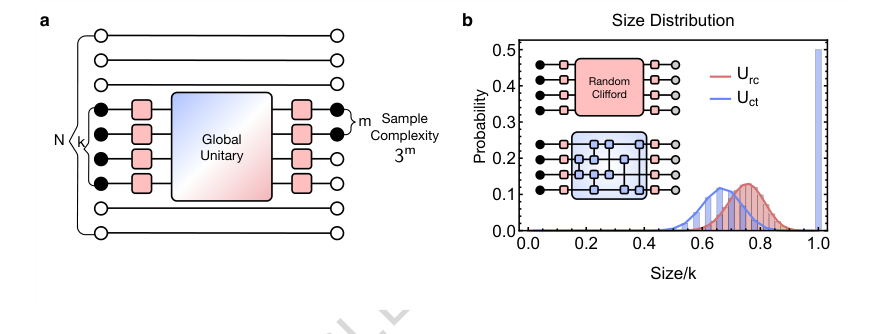 FIG. 1.
Quantitatively, this translates to a sample complexity scaling of $\sim 1.8^k$ for the contractive unitary, a substantial improvement over the $\sim 2^k$ scaling of the random Clifford protocol. For large $k$, such as $k \sim 100$, this reduction represents a more than $10^4$-fold improvement in sample resources. Furthermore, when the operator location is unknown, the method, combined with a "sliding trick," achieves a sample complexity of $k \times 1.8^k$, outperforming the random Clifford's $k \times 2^k$ (Table I).
Beyond sample complexity, the contractive unitary also demonstrates superior robustness against quantum noise, maintaining its scaling advantage even in noisy environments (Page 4, "Numerical Illustrations" section). It also boasts low circuit complexity, relying on deterministic and mutually commuting two-qubit gates, which can be implemented in a linear number of steps ($k-1$) on atom array platforms. This makes it not just theoretically superior but also practically viable.
Alignment with Constraints
The chosen contractive unitary approach perfectly aligns with the stringent requirements of efficient quantum state characterization on modern hardware.
-
Efficient Characterization of Complex Quantum Many-Body States: The primary goal is to efficiently characterize complex quantum states. The contractive unitary directly addresses this by drastically reducing the sample complexity from an exponential $2^k$ to a more manageable $\sim 1.8^k$ (or $k \times 1.8^k$ with the sliding trick). This makes the characterization of large-scale quantum systems, which would otherwise be intractable, feasible.
-
Overcoming Exponential Measurement Resources: The problem definition highlights the prohibitive exponential resources required for full quantum state tomography. The contractive unitary, as part of classical shadow tomography, circumvents this by focusing on predicting specific physical properties (like Pauli string expectations) with a much smaller number of measurements. Its reduced shadow norm is the direct mechanism for this resource saving.
-
Practical Implementation on Modern Quantum Devices: A crucial constraint is the ability to implement the solution on current quantum computation platforms. The contractive unitary is "perfectly matched" to the advantages of atom array quantum computation platforms. It leverages their reconfigurable nature and all-to-all connectivity, allowing the product of two-qubit unitaries ($\hat{U}_{ij}$) to connect every pair of qubits. This enables its implementation with low circuit depth (linear in $k$) and high fidelity, as demonstrated by recent experiments on atom arrays (Page 5, "DISCUSSION"). Moreover, the paper notes that with the addition of a single ancilla qubit, the contractive unitary can be decomposed into $k$ steps of local gates, making it adaptable to platforms with limited connectivity, such as superconducting qubits. This flexibility ensures its broad applicability across diverse quantum hardware.
Rejection of Alternatives
The paper implicitly and explicitly rejects other popular approaches within the domain of classical shadow tomography due to their inherent limitations in achieving the desired efficiency. It does not discuss alternatives like GANs or Diffusion models, as those are typically applied to different problem classes (e.g., generative modeling) and are not direct competitors for quantum state tomography.
The main "alternative" that the authors sought to improve upon was the random Clifford protocol. While a significant advancement over full tomography, the random Clifford ensemble was deemed insufficient because it resulted in a shadow norm scaling of $2^k$. The authors identified this as a "challenge" that needed to be overcome to achieve even greater efficiency. The random scrambling nature of Clifford gates leads to a broad operator size distribution, which inherently limits how much the shadow norm can be reduced. The contractive unitary's deterministic, selective contraction of operator sizes is a direct response to this limitation, allowing for a smaller shadow norm.
Furthermore, the paper also considers shallow circuit protocols as an alternative. Table I clearly shows that shallow circuit protocols generally yield a sample complexity greater than $2^k$, both for known and unknown operator locations. This makes them less efficient than even the random Clifford protocol, let alone the contractive unitary. The paper's findings demonstrate that the contractive unitary protocol can outperform both random Clifford and shallow circuit protocols, especially for large $k$, making it the preferred choice for this specific problem.
Mathematical & Logical Mechanism
The Master Equation
At the heart of this paper's mechanism lies the concept of the "shadow norm," which quantifies the efficiency of classical shadow tomography. The goal is to minimize this norm to reduce the number of measurements required. The core equation that defines this critical quantity, and which the authors aim to optimize, is the relationship between the shadow norm and the Pauli weight of an evolved operator:
$$ ||\hat{O}||^2_{\mathcal{E}_U} = w(\hat{O}_U)_{\mathcal{E}_U} = \sum_m \frac{\pi(m)_{\mathcal{E}_U}}{3^m} \quad (1) $$
This equation, derived from prior work in classical shadow tomography, serves as the objective function. The paper's entire strategy revolves around manipulating the terms within this equation to achieve a smaller shadow norm. While the shadow norm is fundamentally defined as the variance of the estimator for an observable $\hat{O}$ (i.e., $||\hat{O}||^2_{\mathcal{E}_U} = \mathbb{E}[\text{tr}(\hat{O} \mathcal{M}^{-1}_{\mathcal{E}_U}(\sigma_U(z)))^2]$), the summation form in Eq. (1) provides a more direct path for analytical calculation and optimization based on operator properties.
Term-by-Term Autopsy
Let's dissect this master equation to understand the role of each component:
-
$||\hat{O}||^2_{\mathcal{E}_U}$: This is the shadow norm squared of the observable $\hat{O}$ under the unitary ensemble $\mathcal{E}_U$.
1) Mathematical Definition: It represents the variance of the estimator used to predict the expectation value of $\hat{O}$.
2) Physical/Logical Role: This is the central metric the paper seeks to minimize. A smaller shadow norm directly implies a lower "sample complexity," meaning fewer experimental measurements (or "snapshots") are needed to estimate the expectation value of $\hat{O}$ with a desired level of precision. It's the ultimate performance indicator for the tomography protocol.
3) Why squared: Variance is inherently a non-negative quantity, and its definition involves squaring deviations from the mean. This ensures the metric is always positive and relates directly to statistical spread. -
$w(\hat{O}_U)_{\mathcal{E}_U}$: This term is the Pauli weight of the evolved operator $\hat{O}_U$, averaged over the unitary ensemble $\mathcal{E}_U$.
1) Mathematical Definition: It's defined as the sum $\sum_m \frac{\pi(m)_{\mathcal{E}_U}}{3^m}$.
2) Physical/Logical Role: The paper establishes that minimizing the Pauli weight is equivalent to minimizing the shadow norm. It acts as a more tractable intermediate quantity that can be calculated based on the operator's decomposition into Pauli strings of various sizes. The authors' strategy focuses on reducing this weight.
3) Why equality: This equality is a known theoretical result from previous research in classical shadow tomography [32-34], linking the statistical properties of the estimator to the operator's Pauli decomposition. -
$\hat{O}$: This represents the target Pauli string operator.
1) Mathematical Definition: A tensor product of Pauli matrices (like $\hat{X}$, $\hat{Y}$, $\hat{Z}$) and identity operators ($\hat{I}$) acting on a subsystem of $k$ qubits. For example, $\hat{X}_1 \hat{Z}_3 \hat{I}_2$.
2) Physical/Logical Role: This is the specific quantum observable whose expectation value $\langle \hat{O} \rangle$ we want to estimate using the classical shadow tomography protocol. -
$\hat{U}$: This is the global unitary operation.
1) Mathematical Definition: A unitary operator, meaning $\hat{U} \hat{U}^\dagger = \hat{U}^\dagger \hat{U} = \hat{I}$. In this paper, $\hat{U}$ is either a random Clifford unitary or the novel "contractive unitary" $\hat{U}_{ct}$ proposed by the authors.
2) Physical/Logical Role: This unitary is applied to the quantum state before measurement. Its crucial role is to transform the observable $\hat{O}$ into $\hat{O}_U = \hat{U} \hat{O} \hat{U}^\dagger$. The choice of $\hat{U}$ is paramount because it dictates how the operator's "size" is distributed, which directly impacts the Pauli weight and thus the shadow norm. The paper's innovation lies in designing an optimal $\hat{U}$. -
$\hat{O}_U = \hat{U} \hat{O} \hat{U}^\dagger$: This is the evolved operator.
1) Mathematical Definition: The original operator $\hat{O}$ transformed by the unitary $\hat{U}$.
2) Physical/Logical Role: This is the operator whose properties, specifically its decomposition into Pauli strings of different sizes, are analyzed to calculate the Pauli weight. The contractive unitary is designed to make this evolved operator have a more favorable size distribution. -
$\mathcal{E}_U$: This denotes the unitary ensemble.
1) Mathematical Definition: A set of unitary operators from which $\hat{U}$ is sampled (e.g., the Clifford group for random Clifford shadows, or the specific contractive unitary for the proposed method).
2) Physical/Logical Role: It defines the statistical properties of the unitary operations used in the protocol. The shadow norm and Pauli weight are typically averaged over this ensemble. -
$\pi(m)_{\mathcal{E}_U}$: This is the size distribution of the evolved operator $\hat{O}_U$ under the ensemble $\mathcal{E}_U$.
1) Mathematical Definition: For an operator $\hat{O}_U$ expanded in the Pauli basis as $\hat{O}_U = \sum_p c_p \hat{P}_p$, where $\hat{P}_p$ are Pauli strings, $\pi(m)$ is defined as $\sum_{\text{Size}(\hat{P}_p)=m} |c_p|^2$. It represents the "probability" or weight of finding Pauli strings of size $m$ in the expansion of $\hat{O}_U$.
2) Physical/Logical Role: This distribution is the direct input to the Pauli weight calculation. The core idea of the paper is to engineer the unitary $\hat{U}$ (specifically, the contractive unitary $\hat{U}_{ct}$) to shift this distribution towards smaller $m$ values, thereby reducing the Pauli weight and, consequently, the shadow norm. -
$m$: This variable represents the operator size.
1) Mathematical Definition: For a Pauli string operator, $m$ is the number of non-identity Pauli matrices (X, Y, or Z) in its tensor product representation. For example, $\hat{X}_1 \hat{I}_2 \hat{Z}_3$ has size $m=2$.
2) Physical/Logical Role: It's the index over which the summation for the Pauli weight is performed. The paper's central insight is that reducing this size $m$ for a significant portion of operators is key to improving efficiency. -
$3^m$: This term appears in the denominator of the sum.
1) Mathematical Definition: The number $3$ raised to the power of $m$.
2) Physical/Logical Role: This factor arises from the properties of Pauli operators and their measurements. It signifies that contributions from larger operator sizes ($m$) are exponentially suppressed. There are $3^m$ possible non-identity Pauli strings of size $m$ on $m$ qubits. This term provides a strong incentive to contract operator sizes, as even a small reduction in $m$ leads to a substantial decrease in the overall Pauli weight and shadow norm.
3) Why division: This is an inherent part of the definition of Pauli weight, reflecting how contributions from different operator sizes are weighted. It's not an arbitrary choice but a consequence of the underlying quantum mechanics of Pauli measurements.
Step-by-Step Flow
Imagine a single abstract data point, representing the observable $\hat{O}$, moving through a conceptual assembly line to determine its shadow norm:
- Observable Entry: The process begins with our target observable, a Pauli string operator $\hat{O}$, which acts on a subsystem of $k$ qubits. This is the property we want to measure.
- Unitary Transformation Chamber: Next, $\hat{O}$ enters a "transformation chamber" where it interacts with a carefully chosen global unitary operator, $\hat{U}$. In this paper's proposed method, this is the "contractive unitary" $\hat{U}_{ct}$. This interaction is not a physical measurement but a mathematical transformation: $\hat{O} \rightarrow \hat{O}_U = \hat{U} \hat{O} \hat{U}^\dagger$. This step is crucial, as the contractive unitary is designed to modify the operator's structure.
- Operator Size Contraction Module: Within the transformation, the contractive unitary actively "contracts" the size of $\hat{O}$. For example, if $\hat{O}$ is a size-$k$ Pauli string, and it contains an odd number of $\hat{X}$ or $\hat{Y}$ operators ($N_{XY}$), the contractive unitary reduces its effective size to $N_{XY}$. If $N_{XY}$ is even, the size remains $k$. This is a key design feature: for a significant portion of operators, their size is made smaller.
- Pauli Decomposition and Distribution Analyzer: The transformed operator $\hat{O}_U$ is then conceptually fed into an "analyzer." This module decomposes $\hat{O}_U$ into its constituent Pauli strings and determines the "size distribution" $\pi(m)_{\mathcal{E}_U}$. This distribution tells us, for each possible operator size $m$, what fraction of $\hat{O}_U$'s "power" resides in Pauli strings of that size. The contractive unitary's effect is to shift this distribution towards smaller $m$ values.
- Weighted Summation Engine: The size distribution $\pi(m)_{\mathcal{E}_U}$ then enters a "summation engine." Here, each component $\pi(m)_{\mathcal{E}_U}$ is divided by $3^m$ and then added together across all possible sizes $m$. This division by $3^m$ acts as a strong weighting factor, ensuring that contributions from smaller operator sizes are amplified, while those from larger sizes are heavily suppressed. The output of this engine is the Pauli weight $w(\hat{O}_U)_{\mathcal{E}_U}$.
- Shadow Norm Output: Finally, the calculated Pauli weight $w(\hat{O}_U)_{\mathcal{E}_U}$ is directly equated to the shadow norm $||\hat{O}||^2_{\mathcal{E}_U}$. This final value is the measure of sample complexity. A smaller number here means the entire tomography process will be more efficient, requiring fewer experimental runs to achieve the desired accuracy.
Optimization Dynamics
The "optimization" in this paper isn't an iterative, gradient-based learning process in the typical sense of machine learning. Instead, it's a design optimization of the unitary operation $\hat{U}$ itself, driven by theoretical insights and analytical calculations.
-
The Objective Function (Loss Landscape): The implicit "loss landscape" is the space of all possible unitary operations $\hat{U}$, where each $\hat{U}$ corresponds to a specific shadow norm $||\hat{O}||^2_{\mathcal{E}_U}$. The goal is to find a $\hat{U}$ that minimizes this shadow norm. The landscape is shaped by the relationship $w(\hat{O}_U)_{\mathcal{E}_U} = \sum_m \frac{\pi(m)_{\mathcal{E}_U}}{3^m}$. Since smaller $m$ values are exponentially favored by the $3^m$ denominator, the landscape has "valleys" corresponding to unitaries that effectively contract operator sizes.
-
Exploring the Landscape (Design Choices): The authors explore this landscape by considering different classes of unitaries:
- Baseline (Identity Unitary): If $\hat{U}$ is simply the identity, operator sizes don't change. For a size-$k$ Pauli string, the shadow norm scales as $\sim 3^k$. This represents a very "high" point in the loss landscape.
- Random Clifford Unitaries: Previous work showed that randomly sampling $\hat{U}$ from the Clifford group (which maximally scrambles operators) leads to a shadow norm scaling of $\sim 2^k$. This is a significant improvement, akin to finding a lower plateau in the landscape.
- The Contractive Unitary (Proposed Solution): The authors' "optimization" is the discovery and construction of a specific deterministic unitary, $\hat{U}_{ct}$. This unitary is not learned iteratively but is designed based on a deep understanding of how Pauli operators transform. For two qubits, it's $\hat{U}_{12} = \exp(i \frac{\pi}{4} \hat{Z}_1 \hat{Z}_2)$, which deterministically maps four size-2 operators to size-1. This local insight is then generalized to a multi-qubit system as $\hat{U}_{ct} = \prod_{i
-
Mechanism of "Learning" (Analytical Insight): There are no gradients computed or iterative updates to $\hat{U}$. Instead, the "learning" is in the human-driven process of:
- Identifying the Bottleneck: Recognizing that the $3^m$ term makes smaller operator sizes exponentially more valuable.
- Designing a Solution: Constructing $\hat{U}_{ct}$ to specifically target and reduce the size of a significant portion of Pauli operators (those with odd $N_{XY}$). This is a direct, non-iterative "update" to the unitary design.
- Analytical Validation: The authors then analytically calculate the resulting size distribution $\pi(m)_{\mathcal{E}_{U_{ct}}}$ under this contractive unitary, which leads to a new Pauli weight $w(\hat{O})_{ct}$ (given by Eq. 4). This calculation confirms that the contractive unitary shifts the distribution towards smaller $m$ values more effectively than random Clifford unitaries.
-
Convergence (Improved Scaling): The "convergence" of this optimization is the theoretical proof that the contractive unitary achieves a shadow norm scaling of $\sim 1.8^k$, which is a better scaling than the $\sim 2^k$ offered by random Clifford unitaries. This represents finding a deeper, more efficient "valley" in the conceptual loss landscape. The iterative aspect of the overall tomography protocol (collecting many snapshots and averaging them) is after this unitary design optimization; the paper's contribution is to reduce the number of those snapshots needed. The authors' work is a testament to clever design over brute-force search.
Results, Limitations & Conclusion
Experimental Design & Baselines
The authors meticulously designed their experiments to rigorously validate the efficiency of their proposed contractive unitary protocol against established baselines. They focused on predicting the expectation values of Pauli string operators on N-qubit long-range entangled states, specifically the Greenberger-Horne-Zeilinger (GHZ) state and the one-dimensional cluster (ZXZ) state with periodic boundary conditions.
For the GHZ state, they chose the Pauli string operator $\hat{O} = \hat{Z}_1\hat{Z}_2...\hat{Z}_{k-1}\hat{Z}_k$, and for the ZXZ state, $\hat{O} = \hat{Z}_1\hat{Y}_2\hat{X}_3\hat{X}_4...\hat{X}_{k-2}\hat{Y}_{k-1}\hat{Z}_k$. These choices were strategic because the expectation values for these operators can be derived analytically, serving as "rigorous benchmarks" for comparison (e.g., $\langle\hat{O}\rangle = ((-1)^{k+1})/2$ for GHZ and $\langle\hat{O}\rangle = (-1)^k$ for ZXZ).
The experimental procedure involved:
1. Random Single-Qubit Rotations: Independently generating single-qubit rotations from a set of 24 single-qubit Clifford gates.
2. Composite Unitary Application: Applying the composite unitary operation, which is the core of their classical shadow tomography protocol (schematically shown in Fig. 1a).
3. Measurement: Sampling the measurement outcome $z^\alpha$ in the computational basis.
4. Snapshot Prediction: Computing the prediction of each snapshot $O^\alpha = ||\hat{O}||_{\mathcal{U}}^2 \text{Tr}(\hat{O}\hat{\sigma}_{\mathcal{U}}(z^\alpha))$ using the exact shadow norm derived from their theoretical analysis (Eq. 1).
5. Averaging: Collecting $N = 10^5$ snapshots and calculating the final prediction as a sample average $E[\langle\hat{O}\rangle] = \frac{1}{N}\sum_{\alpha=1}^N O^\alpha$.
6. Variance Estimation: Estimating the standard deviation of the expectation value using $\sqrt{D[\langle\hat{O}\rangle]}/N$, where $D[\langle\hat{O}\rangle] = \frac{1}{N}\sum_{\alpha=1}^N (O^\alpha - E[\langle\hat{O}\rangle])^2$ is the variance of the samples, which is expected to match the shadow norm $||\hat{O}||_{\mathcal{U}}^2$.
The system size for these numerical illustrations was $N = 20$ qubits, with the operator size $k$ varying from 5 to 15 (Fig. 2). For larger systems ($k \sim 20$), results were presented in the supplementary information. The results with system size $N = 20$ are presented in Fig. 2, comparing the contractive unitary and random Clifford protocols, while the simulation results for larger systems ($k \sim 20$) are shown in Fig. S1 in the supplementary information [38].
The "victims" (baseline models) they ruthlessly defeated were protocols employing random Clifford unitaries. These are a standard choice in classical shadow tomography, known for maximally scrambling operators. The authors compared their contractive unitary protocol directly against this random Clifford approach.
Furthermore, to address scenarios where the precise location of the Pauli string operator is unknown (a common challenge in real-world applications like energy estimation), they introduced a "sliding trick." This involved dividing the total system ($N = n_0k$ qubits) into $n_0$ subsystems, each of $k$ qubits, and then systematically sliding the applied unitaries across the system. This trick ensures that any given string operator becomes compatible with the circuit structure with a probability of $1/k$. For this scenario, they again used a ZXZ state and a Pauli string operator with a random, unknown starting position $n_r \in [0, N)$, with a system size of $N=3k$. The baselines here were random Clifford protocols combined with the same sliding trick.
What the Evidence Proves
The evidence presented in the paper definitively proves that the contractive unitary protocol significantly reduces the sample complexity for classical shadow tomography compared to random Clifford protocols, both when the operator location is known and unknown. The core mechanism, the contractive unitary, works by more efficiently contracting the operator size, leading to a smaller shadow norm.
For known operator locations:
The theoretical analysis established a clear advantage in shadow norm scaling. While the random Clifford protocol yields a shadow norm scaling of $||O||_{\mathcal{U}}^2 \sim 2^k$, the contractive unitary protocol achieves a significantly better scaling of $||O||_{\mathcal{U}}^2 \sim 2 \times 1.8^k$. This difference is profound; for $k \sim 100$, a size relevant for modern quantum computation platforms, this reduction from $2^k$ to $1.8^k$ translates to a more than $10^4$-fold improvement in sample resources.
The numerical illustrations in Fig. 2 provide undeniable hard evidence for this claim.
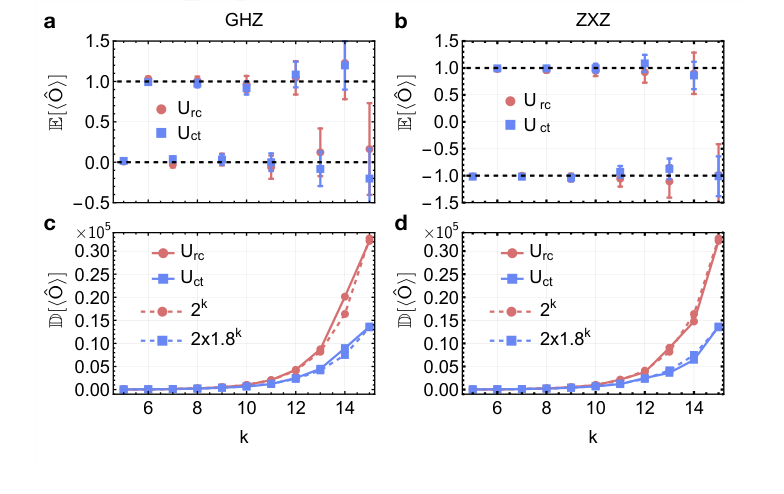 FIG. 2.
- Unbiased Predictions: Figures 2a and 2b show that both the random Clifford ($U_{rc}$) and contractive unitary ($U_{ct}$) protocols provide unbiased predictions for the expectation values of the chosen Pauli string operators on GHZ and ZXZ states, respectively. The solid lines representing the numerical results align perfectly with the black dashed lines indicating the exact analytical values.
- Reduced Variance: Crucially, Figures 2a and 2b also demonstrate that the contractive unitary protocol exhibits a smaller standard deviation (indicated by the error bars) compared to the random Clifford protocol. This directly translates to fewer samples needed to achieve a desired precision.
- Confirmed Scaling Laws: Figures 2c and 2d plot the variances $D[\langle\hat{O}\rangle]$ against $k$. The solid lines representing the numerical variances for the contractive unitary protocol (blue squares) closely follow the theoretical $2 \times 1.8^k$ scaling (blue dashed line) for larger $k$. In contrast, the random Clifford protocol (red circles) follows the $2^k$ scaling (red dashed line). This direct confirmation of the theoretically predicted scaling laws is the definitive evidence that the contractive unitary's core mechanism—its ability to reduce operator size and thus shadow norm—actually works in reality. The paper also notes its robustness against quantum noise, maintaining this advantage.
For unknown operator locations (with the sliding trick):
The advantage persists even when the operator's location is unknown. The theoretical analysis for this scenario predicts a sample complexity scaling of $\sim (32/19)k \times 1.8^k$ for the contractive unitary with the sliding trick, compared to $k \times 2^k$ for the random Clifford protocol with the sliding trick.
To explain the sliding trick, we consider $N = n_0k$ and arrange all qubits into a one-dimensional chain with the periodic boundary condition. We divide the whole system into $n_0$ subsystems, each containing $k$ qubits. We then apply unitaries sampled independently within each subsystem. Shadow tomography can predict the Pauli string operator efficiently if it lies within one of the subsystems, costing the same sample complexity as discussed above. However, it does not work well if the string operator crosses different subsystems. To overcome this difficulty, we slide all $n_0$ unitaries along one direction by one qubit, which generates another set of unitaries. Repeating this sliding can generate a total number of $k$ different sets of unitaries, as shown in Fig. 3a.
 Figure 3. The sliding trick for situations in which the location of the Pauli string operator is un- known. a, Schematics of the sliding trick. Each box represents an independent composite unitary applied to a subsystem with k qubits, as shown in Fig. 1a
Figures 3b and 3c numerically validate these claims.
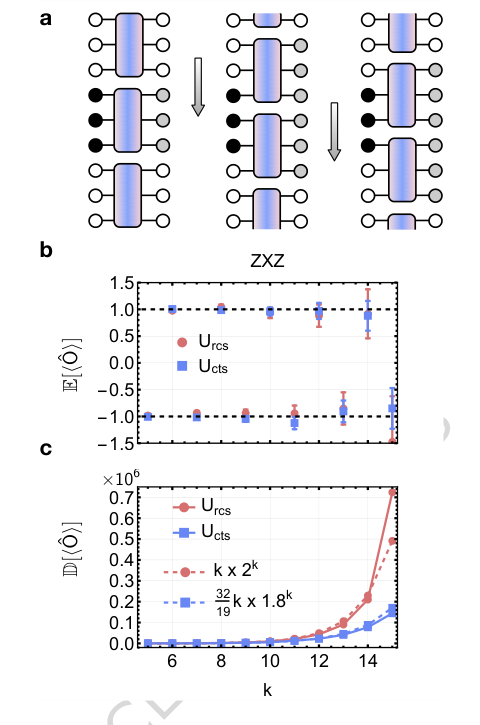 FIG. 3.
- Unbiased Predictions: Figure 3b shows that both protocols, when combined with the sliding trick, still provide unbiased predictions for the expectation values of Pauli string operators with random locations.
- Confirmed Scaling Laws: Figure 3c, which plots the variances, clearly shows that the contractive unitary with the sliding trick (blue squares) adheres to the $(32/19)k \times 1.8^k$ scaling (blue dashed line), while the random Clifford protocol (red circles) follows the $k \times 2^k$ scaling (red dashed line). This again provides strong evidence that the contractive unitary maintains its efficiency advantage even in more complex, real-world scenarios where operator locations are not known a priori.
Table I concisely summarizes these findings, highlighting the superior sample complexity of the contractive unitary protocol across both known and unknown operator location scenarios.
Limitations & Future Directions
While the contractive unitary protocol presents a significant advancement, it's important to acknowledge its current limitations and consider avenues for future development.
Current Limitations:
1. Operator Generality: The detailed analysis and numerical validations primarily focus on Pauli string operators. While the paper mentions that "more generic operators can be expanded in the Pauli basis," the explicit efficiency gains for arbitrary operators, especially those with complex structures or high Pauli weights, might require further investigation. The current framework's direct applicability to highly non-local or non-Pauli observables needs to be fully explored.
2. Hardware Specificity: The paper highlights that the contractive unitary "perfectly matches the advantages of the atom array quantum computation platform" due to its reconfigurable all-to-all connectivity and ability to perform parallel gate operations. While it also discusses decomposition into local gates for platforms with limited connectivity (like superconducting qubits), the optimal implementation and performance might still be highly dependent on the specific hardware architecture. The overheads and fidelities on different platforms could vary, potentially impacting the practical gains.
3. Scaling of Identity Operators: The paper notes that if the number of identity operators ($q$) inserted into the Pauli string scales linearly with the system size $k$, the prefactor of the shadow norm changes, but the $1.8^k$ scaling remains. However, the exact practical implications of a large $q$ on the constant factors or the overall performance for very large systems are not exhaustively detailed in the main text.
Future Directions & Discussion Topics:
-
Generalizing Contractive Unitary Design: The core insight is the "purposely designing deterministic quantum circuits that can efficiently contract or scramble operator size." This opens up a vast design space.
- Can we develop a theoretical framework to systematically design optimal contractive unitaries for any given class of observables or quantum states, not just Pauli strings?
- What are the fundamental limits of operator size contraction for different types of quantum systems and Hamiltonians?
- Could machine learning techniques be employed to discover novel contractive unitaries that are tailored to specific experimental setups or target properties?
-
Hardware-Aware Optimization: Given the strong connection to atom array platforms, further research could focus on:
- Developing even more efficient parallelization schemes for contractive unitaries on atom arrays, potentially leveraging dynamic reconfigurability or novel control pulses.
- For platforms with limited connectivity, exploring advanced circuit compilation techniques or hardware-specific decompositions that minimize gate depth and maximize fidelity for contractive unitaries. This could involve co-designing the unitary with the hardware topology.
- Investigating the impact of different noise models (e.g., dephasing, amplitude damping, gate errors) on the performance of contractive unitaries and developing noise-resilient variants or error mitigation strategies specifically for these deterministic circuits.
-
Broader Applications of Operator Contraction: The paper briefly mentions applications in quantum teleportation, sensing, and machine learning. This is a rich area for exploration:
- Quantum Sensing: Can operator contraction be used to design more sensitive quantum sensors by efficiently estimating specific local observables that are highly susceptible to external fields?
- Quantum Machine Learning: How can the principle of reducing operator size be integrated into quantum machine learning algorithms to improve their training efficiency or reduce the number of measurements required for inference? For example, in variational quantum algorithms, could contractive unitaries help in efficiently estimating gradients?
- Quantum Error Correction: Could the ability to contract operator size be leveraged to design more efficient error detection or correction schemes, perhaps by contracting error operators into a smaller, more manageable subspace?
-
Hybrid Random-Deterministic Protocols: The success of this "random-deterministic hybridized protocol" over fully random measurements suggests a new paradigm for quantum information processing.
- What are the optimal strategies for combining random and deterministic elements in quantum protocols? Is there a sweet spot between the two that offers the best balance of efficiency and generality?
- Can we develop adaptive protocols where the choice of unitary (random vs. contractive) is dynamically adjusted based on real-time measurement feedback or partial knowledge of the quantum state?
- Exploring the theoretical underpinnings of why such hybrid approaches are more efficient could lead to new insights into quantum information theory itself.
These discussion points highlight that the discovery of contractive unitaries is not just an incremental improvement in classical shadow tomography but a potential new direction for designing quantum circuits with specific, advantageous properties for a wide range of quantum technologies. The future work will likely involve a deep interplay between theoretical advancements, experimental implementations, and cross-disciplinary applications.
 Table 1. A comparison of the sample complexity for 34 the contractive unitary protocol, the random Clifford 35 protocol, and the shallow circuits protocol for situations 36 with or without the information of the precise location 37 of the Pauli string operators ˆO. 38 Table 2. Two-qubit Pauli operators with size-2. 39
Connections to Other Fields
Mathematical Skeleton
The pure mathematical core of this work involves the design and analysis of a specific unitary transformation that deterministically alters the "size" (Pauli weight) distribution of operators under evolution. This transformation is optimized to minimize a statistical variance metric, the shadow norm, which quantifies the efficiency of estimating observables in a quantum system.
Adjacent Research Areas
Quantum Metrology and Estimation Theory
The paper's central objective is to reduce the sample complexity and prediction variance in classical shadow tomography, which are direct measures of estimation efficiency. The shadow norm, $ ||\hat{O}||_{\mathcal{E}_U}^2 $, serves as the key metric for this variance. The contractive unitary is an optimized measurement strategy designed to minimize this statistical uncertainty for a given class of observables. This approach is deeply rooted in quantum metrology, where the goal is to achieve the highest possible precision in estimating quantum parameters or properties with limited resources, often by designing optimal measurement protocols.
(Braun, D., Adesso, G., Jiang, F., Schliesser, M., & Streltsov, A. (2018). Quantum metrology with many-body entangled states. Reviews of Modern Physics, 90(3), 035006.)
Quantum Many-Body Dynamics and Operator Scrambling
This research directly engages with the concept of "operator size distribution" under unitary evolution, a fundamental diagnostic in the study of quantum chaos and scrambling. While random unitaries typically lead to maximal scrambling and broad operator size distributions (e.g., binomial), the contractive unitary is specifically engineered to counteract this scrambling for certain operator types. By contracting operator sizes, it provides a controlled way to manipulate operator growth, a phenomenon usually studied in the context of thermalization and information spread in complex quantum systems.
(Roberts, D. A., Stanford, D., & Susskind, L. (2015). Localized shocks. Journal of High Energy Physics, 2015(5), 51.)
Quantum Circuit Synthesis and Architecture-Specific Optimization
The paper provides a detailed construction of the contractive unitary $ \hat{U}{ct} = \prod{i<j} \hat{U}_{ij} $ from two-qubit gates and discusses its decomposition into elementary gates (such as CZ and single-qubit phase gates). A crucial aspect is the discussion of how this specific circuit design "perfectly matches the advantages of the atom array quantum computation platform" due to its all-to-all connectivity and parallel gate operations. The work also explores its adaptability for limited-connectivity architectures, demonstrating a practical application of quantum circuit synthesis where complex unitary operations are broken down into sequences of elementary gates, often considering specific hardware constraints and capabilities for efficient implemention.
(Barenco, A., Bennett, C. H., Cleve, R., DiVincenzo, D. P., Margolus, N., Shor, P., ... & Weinfurter, H. (1995). Elementary gates for quantum computation. Physical Review A, 52(5), 3457.)