
Magnetic excitations of the Kitaev model candidate RuBr3
New study reveals RuBr3's magnetic interactions push it from ideal spin liquid state, offering clues for quantum computing materials.
Background & Academic Lineage
The Origin & Academic Lineage
The problem addressed in this paper originates from the theoretical prediction of the Kitaev model in 2006 by Alexei Kitaev [1]. This model is celebrated for exactly realizing a quantum spin liquid (QSL) ground state, an exotic phase of matter with potential applications in quantum computation. The core of the Kitaev model lies in its unique bond-dependent Ising interactions, which dictate how spins interact based on the specific direction of the chemical bond connecting them on a honeycomb lattice.
Historically, the search for real materials that could host this elusive QSL state began around 2009, following the realization that such bond-dependent interactions could emerge in transition metal compounds with strong spin-orbit coupling, particularly those involving $d^5$ electron configurations like Ir$^{4+}$ and Ru$^{3+}$ ions [8]. Materials like $\alpha$-RuCl$_3$ quickly became a prime candidate and were extensively studied [9-38], showing some signatures consistent with the Kitaev QSL.
However, the fundamental limitation, or "pain point," of previous approaches and candidate materials like $\alpha$-RuCl$_3$ is that they often exhibit competing magnetic orders, such as zigzag antiferromagnetism, at low temperatures [31, 32, 39-43]. These conventional magnetic orders destabilize the fragile QSL state, preventing its full realization and practical utilization. The challenge, therefore, is to understand and control these competing interactions—including Heisenberg and off-diagonal magnetic interactions—to either suppress the unwanted orders or enhance the Kitaev interactions. This paper tackles this problem by investigating RuBr$_3$, a material isostructural to $\alpha$-RuCl$_3$, to explore how ligand substitution (replacing chlorine with bromine) affects the magnetic interactions and spin dynamics, aiming to shed light on how to tune these materials closer to the ideal Kitaev spin liquid state.
Intuitive Domain Terms
- Kitaev Model: Imagine a special kind of magnetic checkerboard where the rules for how two neighboring pieces interact (attract or repel) don't just depend on their own magnetic properties, but also on the specific color of the line connecting them. The Kitaev model is a theoretical blueprint for such a system, designed to create a "spin liquid" where magnets never freeze into a fixed pattern, even at absolute zero temperature.
- Quantum Spin Liquid (QSL): Think of water: even when it's cold, its molecules are constantly moving and interacting, not freezing into a rigid ice crystal. A quantum spin liquid is the magnetic equivalent. Instead of individual electron spins (tiny internal magnets) freezing into an ordered pattern like a typical magnet, they remain fluid and entangled, constantly fluctuating in a highly correlated way, even at the lowest possible temperatures.
- Majorana Fermions: Picture a regular particle, like an electron, as a whole coin. A Majorana fermion is like half a coin—it's a peculiar, fundamental excitation that is its own antiparticle. In quantum spin liquids, these are exotic, emergent "half-particles" that can carry magnetic excitations, behaving like ghostly, fractionalized bits of magnetism moving through the material.
- Bond-Dependent Ising Interactions: Imagine a honeycomb grid where each point has a tiny magnet that can only point up or down. "Bond-dependent" means that the interaction between any two neighboring magnets isn't uniform; it strongly depends on the specific direction of the chemical bond connecting them. For example, magnets connected horizontally might prefer to align parallel, while those connected diagonally might prefer to align anti-parallel. This direction-specific interaction is key to the Kitaev model.
- Zigzag Antiferromagnetic Order: This is a specific type of magnetic arrangement where spins align in a pattern that looks like a zigzag. On a honeycomb lattice, it means that within certain rows, spins alternate (up, down, up, down), but the overall pattern across the material forms distinct, parallel "zigzag" chains where neighboring chains have opposite spin orientations. This is a common, ordered magnetic state that often competes with the more exotic quantum spin liquid state.
Notation Table
| Notation | Description |
|---|---|
Problem Definition & Constraints
Core Problem Formulation & The Dilemma
The fundamental problem this paper addresses lies in understanding the complex interplay of magnetic interactions in Kitaev candidate materials, specifically RuBr$_3$.
The starting point (Input/Current State) is the observation that while materials like $\alpha$-RuCl$_3$ and RuBr$_3$ are considered candidates for hosting the exotic Kitaev spin liquid state, they invariably exhibit conventional magnetic orders, such as zigzag antiferromagnetism, at low temperatures. For RuBr$_3$, this order is observed below 34 K. This indicates that the ideal Kitaev interactions are overshadowed or modified by other magnetic interactions. Previous ab initio calculations for RuBr$_3$ have not fully reconciled with experimental observations regarding the strength and nature of these interactions. Therefore, the current state is a lack of a precise, experimentally validated understanding of the dominant magnetic interactions in RuBr$_3$ and how they compare to related compounds like $\alpha$-RuCl$_3$.
The desired endpoint (Output/Goal State) is to precisely identify and quantify the various magnetic exchange parameters (including Kitaev, Heisenberg, and off-diagonal terms) in RuBr$_3$ that dictate its spin dynamics and lead to its observed zigzag antiferromagnetic ground state. The paper aims to achieve this by analyzing inelastic neutron scattering data and fitting it to theoretical models (linear spin wave theory). The ultimate goal is to clarify how ligand substitution (replacing Cl with Br) influences these magnetic interactions and drives the material away from an ideal Kitaev spin liquid state. The exact missing link or mathematical gap is the absence of a Hamiltonian, specifically the parameters in Equation (2), that accurately reproduces the experimentally observed magnetic excitation spectrum of RuBr$_3$. The authors seek to bridge this by determining the values for $J_1$, $K$, $\Gamma$, $\Gamma'$, $J_2$, $J_3$, and $J_p$ that best fit the experimental data.
The painfull trade-off or dilemma that has historically trapped researchers in this field is that enhancing one desirable magnetic interaction (e.g., the bond-dependent Kitaev interaction) often inadvertently strengthens other, competing interactions (like Heisenberg or off-diagonal terms). These competing interactions then stabilize conventional magnetic orders, preventing the realization of the elusive Kitaev spin liquid. In the case of RuBr$_3$, the dilemma is evident: despite being a Kitaev candidate, the strong zigzag antiferromagnetic order below $T_N$ implies that antiferromagnetic interactions are comparable to or even stronger than ferromagnetic Kitaev interactions. The challenge is to disentangle and quantify these various contributions from experimental data, especially when the signatures of different interactions can be subtle or overlap.
Constraints & Failure Modes
The problem of accurately characterizing magnetic interactions in RuBr$_3$ is made insanely difficult by several harsh, realistic walls:
-
Data-Driven Constraints:
- Powder-Averaged Spectrum: The primary experimental technique used is powder inelastic neutron scattering. This method inherently averages over all possible crystal orientations, leading to a loss of crucial directional information about the magnetic excitations. As the authors note, "The similarity of the spectra simulated from the two different models reflects the difficulty in estimating exchange parameters from the powder-averaged spectrum" (page 9). This makes it extremely challenging to uniquely determine the numerous anisotropic exchange parameters in the Hamiltonian.
- Phonon Contributions: Distinguishing the magnetic signal from phonon (lattice vibration) contributions in the inelastic neutron scattering spectrum is a significant hurdle, particularly at higher temperatures. The authors had to estimate and subtract phonon contributions, acknowledging that "the subtraction is not complete because of the anharmonicity in phonons and the background that has little temperature dependence" (page 7). This incomplete separation introduces uncertainty into the extracted magnetic data.
- Resolution Limits: Neutron scattering experiments have finite energy and wavevector resolutions, which can smear out fine details of the magnetic excitation spectrum, making precise parameter fitting more difficult.
-
Computational & Modeling Constraints:
- Complexity of Hamiltonian and Parameter Space: The Hamiltonian (Equation 2) includes multiple exchange parameters ($J_1$, $K$, $\Gamma$, $\Gamma'$, $J_2$, $J_3$, $J_p$). Simultaneously estimating all these parameters from experimental data is a computationally intensive and often ill-posed problem. The authors explicitly state, "Since it is not possible to estimate several exchange parameters simultaneously, we present two extreme combinations with the dominant $\Gamma$ or J$_3$ term here" (page 8), highlighting the practical limitation in uniquely determining all parameters.
- Linear Spin Wave Theory (LSWT) Limitations: The theoretical framework used, linear spin wave theory, is an approximation. The paper mentions that "linear spin wave approximations would not perfectly apply to the pseudospin-1/2 system" (page 8), meaning it provides only a "rough estimate" of magnetic interactions. This inherent limitation of the model means that even a perfect fit within LSWT might not fully capture the true quantum nature of the system.
-
Physical Constraints:
- Sample Quality and Size: Obtaining a high-quality, sufficiently large polycrystalline sample (9.5 g) of the specific RuBr$_3$ polymorph with a layered honeycomb structure is a non-trivial synthesis challenge. Any impurities or structural defects could significantly affect the observed magnetic properties.
- Temperature Control: The experiments require precise temperature control across a wide range (from 10 K to 300 K) to observe the temperature evolution of magnetic excitations, which adds to experimental complexity.
Why This Approach
The Inevitability of the Choice
The chosen approach, which combines inelastic neutron scattering experiments with linear spin wave calculations based on the Kitaev Hamiltonian, is not merely one viable option but the only appropriate framework for addressing the specific problem presented in this paper. The study aims to elucidate the magnetic excitations and underlying exchange interactions in RuBr$_3$, a candidate material for the Kitaev model. This is a fundamental problem in condensed matter physics, requiring a direct probe of spin dynamics and a theoretical model rooted in quantum mechanics.
The "SOTA" methods mentioned in the prompt, such as standard CNNs, basic Diffusion models, or Transformers, are machine learning paradigms designed for tasks like pattern recognition, data generation, or sequence processing. They are entirely unsuited for the physical characterization and theoretical interpretation of quantum magnetic phenomena. The authors are not attempting to predict a property from a large dataset or generate synthetic spectra; they are seeking to understand the fundamental physical laws governing a material's behavior.
The Kitaev model (introduced on page 4) provides the essential theoretical description for bond-dependent Ising interactions, which are central to understanding quantum spin liquids and the material under investigation. Linear spin wave theory (detailed in "Methods" on page 10 and applied in "Discussion" on page 8) is the established theoretical tool for calculating the dispersion relations of magnetic excitations (magnons) in magnetically ordered systems. These theoretical predictions can then be directly compared with the experimentally obtained inelastic neutron scattering spectra. The "exact moment" of realizing the insufficiency of "traditional" methods (in the context of physics models) is not a sudden discovery but an ongoing refinement process. The complexity of RuBr$_3$'s magnetic behavior, which includes zigzag antiferromagnetic order and various competing interactions, necessitates a comprehensive Hamiltonian (Eq. 2) that goes beyond simpler models to accurately capture the observed spin dynamics.
Comparative Superiority
The application of linear spin wave theory to a detailed Kitaev-Heisenberg-$\Gamma$-$\Gamma'$-$J_2$-$J_3$ Hamiltonian offers qualitative superiority by providing a physically interpretable and mechanistic understanding of the observed magnetic excitations. This approach directly links the experimentally measured inelastic neutron scattering spectra to the fundamental magnetic exchange parameters within the material, a capability that purely data-driven models cannot offer.
The paper explicitly demonstrates the superiority of the $J_1$-$K$-$J_2$-$J_3$ model over the $J_1$-$K$-$\Gamma$-$\Gamma'$ model in reproducing the experimental data. As stated on page 9, "The agreement with the experimental curves is better for the simulated curves from the $J_1$-$K$-$J_2$-$J_3$ model... This is due to the difficulty in yielding strongly dispersive magnetic excitations while retaining the dispersionless excitations in the $J_1$-$K$-$\Gamma$-$\Gamma'$ model." This highlights a significant structural advantage: the $J_1$-$K$-$J_2$-$J_3$ model, by incorporating next-nearest neighbor ($J_2$) and third-nearest neighbor ($J_3$) isotropic magnetic interactions alongside the Kitaev ($K$), Heisenberg ($J_1$), and off-diagonal ($\Gamma, \Gamma'$) terms, provides a more complete and accurate description of the complex spin dynamics in RuBr$_3$. This richer Hamiltonian allows for a more faithful representation of both the strongly dispersive and nearly dispersionless modes observed experimentally, which is crucial for a comprehensive understanding of the material's magnetic ground state and excitations. This superiority is not about computational efficiency or noise reduction in a generic algorithm, but about the model's ability to accurately reflect the underlying physical reality.
Alignment with Constraints
The chosen methodology—inelastic neutron scattering experiments coupled with linear spin wave calculations based on the Kitaev Hamiltonian—demonstrates a perfect alignment with the inherent constraints and requirements of studying magnetic excitations in quantum materials.
- Direct Measurement of Spin Dynamics: Inelastic neutron scattering is the gold standard for directly probing spin excitations (magnons) in magnetic materials, providing crucial information on both energy and momentum transfer. This directly fulfills the primary objective of "investigat[ing] the spin dynamics of RuBr$_3$."
- Microscopic Parameter Extraction: The linear spin wave theory, when applied to the comprehensive Kitaev-Heisenberg Hamiltonian (Eq. 2), is specifically designed to extract and quantify microscopic exchange parameters ($J_1, K, \Gamma, \Gamma', J_2, J_3, J_p$) from the experimental spectra. This allows for a quantitative, physically meaningful interpretation of the observed dynamics, directly addressing the need to understand the underlying magnetic interactions. The paper explicitly seeks "the combination of parameters... that reproduce strongly dispersive excitations" (page 8).
- Consistency with Magnetic Order: The theoretical framework enables the determination of the classical ground state (e.g., the zigzag antiferromagnetic order observed in RuBr$_3$, as illustrated in Fig. 1 and discussed on page 4 and 6) and the canting angle of magnetic moments. The model's capacity to stabilize the experimentally confirmed magnetic order is a critical validation.
- Temperature Dependence: While linear spin wave theory is fundamentally a zero-temperature approximation, the experimental data is meticulously corrected using the temperature-dependent Bose factor $1+n(T)$ to isolate the magnetic contributions (page 5, 7). This allows for a meaningful comparison between the model's predictions and the temperature-evolved experimental observations.
This "marriage" is indispensable because the problem demands a deep, physical understanding of quantum magnetic interactions, not merely a predictive or correlative model. The experimental technique provides the empirical evidence of spin dynamics, and the theoretical model furnishes the essential language and tools to interpret these dynamics in terms of fundamental physical parameters, thereby directly meeting the problem's stringent requirement for mechanistic insight.
Rejection of Alternatives
The paper's "rejection of alternatives" is primarily focused on refining the physics-based theoretical models used to interpret the experimental data, rather than dismissing unrelated machine learning approaches like GANs or Diffusion models, which are not applicable to this domain.
Within the realm of theoretical condensed matter physics, the authors implicitly reject simpler or less comprehensive Hamiltonians that fail to adequately describe the complex magnetic excitations of RuBr$_3$. This is evident in their comparison of two specific linear spin wave models: the $J_1$-$K$-$\Gamma$-$\Gamma'$ model and the $J_1$-$K$-$J_2$-$J_3$ model. The paper concludes that the $J_1$-$K$-$J_2$-$J_3$ model provides a "better" agreement with the experimental curves, explicitly stating that the $J_1$-$K$-$\Gamma$-$\Gamma'$ model had "difficulty in yielding strongly dispersive magnetic excitations while retaining the dispersionless excitations" (page 9). This constitutes a clear rejection of the $J_1$-$K$-$\Gamma$-$\Gamma'$ model as an insufficient description of the material's magnetic properties.
Furthermore, the authors note that "Combinations including antiferromagnetic K were excluded from consideration, as they can be obtained via the self-dual transformation... from those including ferromagnetic K [41]." (page 8). This demonstrates a sophisticated theoretical understanding that allows for the exclusion of certain parameter regimes based on known physical equivalences or inconsistencies with observed properties.
While the paper primarily employs linear spin wave theory, it also acknowledges its limitations, stating that "the linear spin wave approximations would not perfectly apply to the pseudospin-1/2 system" (page 8). This is not a rejection of the method but a candid recognition that for an ideal Kitaev spin liquid, which exhibits fractionalized excitations, a simple magnon picture (the basis of linear spin wave theory) is an approximation. However, for the observed zigzag antiferromagnetic order, magnons remain the most appropriate elementary excitations for a first-order analysis, making linear spin wave theory the most practical and interpretable tool for the current study.
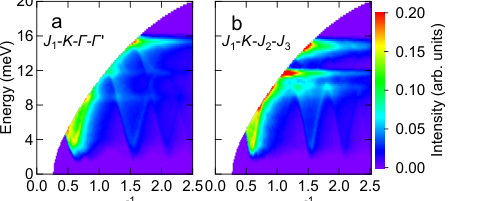 Figure 5. Inelastic neutron scattering spectrum simulated from (a) the J1–K–Γ–Γ′ and (b) the J1– K–J2–J3 models by using linear spin wave theory. The parameters used for the simulations are (a) J1 = −1.8, K = −7.2, Γ = 10.5, Γ′ = −2.5 meV and (b) J1 = 1.5, K = −8.1, J2 = 0.8, J3 = 5.8, and Γ′ = −0.16 meV. Interplane interactions of Jp = 0.15 meV are adopted in both models
Mathematical & Logical Mechanism
The Master Equation
The core of this paper's analysis of magnetic excitations in RuBr$_3$ lies in the Hamiltonian, which describes the total energy of the magnetic system. This Hamiltonian, combined with the specific form of the nearest-neighbor interactions, serves as the mathematical engine for simulating the spin dynamics. The primary Hamiltonian used for linear spin wave calculations is given by:
$$ H = \sum_{NN} S_i J_{ij} S_j + J_2 \sum_{NNN} S_i \cdot S_j + J_3 \sum_{3NN} S_i \cdot S_j + J_p \sum_{interplane} S_i \cdot S_j \quad (2) $$
where $J_{ij}$ represents the nearest-neighbor anisotropic interactions. For a $z$-bond, this interaction matrix is defined as:
$$ J_z = \begin{pmatrix} J_1 & \Gamma & \Gamma' \\ \Gamma & J_1 & \Gamma' \\ \Gamma' & \Gamma' & J_1 + K \end{pmatrix} \quad (3) $$
The matrices for $J_x$ and $J_y$ bonds are constructed by cyclically permuting the diagonal elements and off-diagonal terms in a similar fashion.
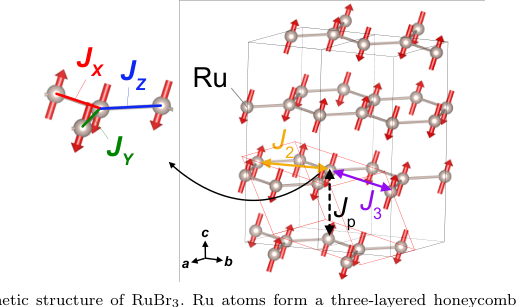 Figure 1. Magnetic structure of RuBr3. Ru atoms form a three-layered honeycomb structure with a crystallographic unit cell indicated by thin black lines. The magnetic moments of the Ru atoms form a zigzag antiferromagnetic structure with the unit cell indicated by thin red lines. JX , JY , and JZ represent bond-dependent anisotropic nearest-neighbour magnetic interactions. J2, J3, and Jp represent the next nearest neighbour, third nearest neighbour magnetic interactions within the honeycomb plane, and interplane magnetic interactions, respectively
Term-by-Term Autopsy
Let's dissect these equations to understand each component's role:
Equation (2): The Total Hamiltonian
-
$H$:
- Mathematical Definition: The Hamiltonian operator of the magnetic system.
- Physical/Logical Role: This operator represents the total energy of the system. Its eigenvalues correspond to the possible energy states, and its eigenvectors describe the corresponding spin configurations. Minimizing this Hamiltonian yields the ground state of the magnetic system.
- Why Summation: The total energy of the system is a sum of all individual interaction energies between pairs of spins. Each summation term groups interactions based on their spatial separation and type.
-
$\sum_{NN}$:
- Mathematical Definition: A summation symbol indicating that the following term is summed over all nearest-neighbor (NN) pairs of spins $(i, j)$ on the honeycomb lattice.
- Physical/Logical Role: This term specifically accounts for the interactions between adjacent Ru atoms, which are the most direct and often strongest magnetic couplings.
- Why Summation: To include every instance of nearest-neighbor interaction across the entire crystal lattice.
-
$S_i$:
- Mathematical Definition: A vector spin operator at site $i$, typically represented by Pauli matrices for a pseudospin-1/2 system.
- Physical/Logical Role: Represents the magnetic moment (spin) of a Ru atom at site $i$. Its orientation and magnitude are fundamental to describing the local magnetic state.
- Why Vector Dot Product (implicitly $S_i^T J_{ij} S_j$): The interaction energy between two spins is a scalar quantity derived from their vector components. The matrix $J_{ij}$ introduces anisotropy, meaning the interaction strength depends not only on the relative orientation of the spins but also on their orientation with respect to the crystallographic axes and the specific bond direction.
-
$J_{ij}$:
- Mathematical Definition: A $3 \times 3$ matrix representing the anisotropic nearest-neighbor exchange interaction between spin $S_i$ and $S_j$. Its specific form (e.g., $J_x, J_y, J_z$) depends on the type of bond connecting sites $i$ and $j$.
- Physical/Logical Role: This matrix is crucial as it encapsulates the various types of nearest-neighbor interactions: the isotropic Heisenberg term ($J_1$), the bond-dependent Kitaev term ($K$), and the symmetric ($\Gamma$) and antisymmetric ($\Gamma'$) off-diagonal exchange terms. It dictates the complex interplay of these interactions.
- Why Matrix: A matrix is necessary to describe anisotropic interactions where the coupling between spin components ($S^x, S^y, S^z$) is not uniform and depends on the bond direction.
-
$J_2 \sum_{NNN} S_i \cdot S_j$:
- Mathematical Definition: A summation over all next-nearest-neighbor (NNN) pairs of spins $(i, j)$, where $J_2$ is an isotropic coupling constant.
- Physical/Logical Role: This term accounts for isotropic Heisenberg interactions between spins that are two steps away on the honeycomb lattice. These longer-range interactions can significantly influence the overall magnetic order and stability.
- Why Summation and Dot Product: The summation ensures all NNN pairs are included. The dot product $S_i \cdot S_j$ signifies an isotropic Heisenberg interaction, meaning the coupling strength is independent of the spin orientation relative to the crystal axes.
-
$J_3 \sum_{3NN} S_i \cdot S_j$:
- Mathematical Definition: A summation over all third-nearest-neighbor (3NN) pairs of spins $(i, j)$, with $J_3$ as an isotropic coupling constant.
- Physical/Logical Role: Represents isotropic Heisenberg interactions between spins that are three steps away. In Kitaev materials, these interactions, particularly $J_3$, are often critical for stabilizing specific magnetic ground states, such as the zigzag antiferromagnetic order observed in RuBr$_3$.
- Why Summation and Dot Product: Similar to the NNN term, this sums isotropic Heisenberg interactions over all 3NN pairs.
-
$J_p \sum_{interplane} S_i \cdot S_j$:
- Mathematical Definition: A summation over all nearest-neighbor pairs of spins $(i, j)$ located in different honeycomb layers, with $J_p$ as an isotropic coupling constant.
- Physical/Logical Role: This term accounts for interplane magnetic interactions, which are essential for describing the full three-dimensional magnetic structure and excitations in layered materials like RuBr$_3$.
- Why Summation and Dot Product: This sums isotropic Heisenberg interactions between spins in adjacent layers.
Equation (3): The Anisotropic Nearest-Neighbor Interaction Matrix ($J_z$)
-
$J_1$:
- Mathematical Definition: The isotropic Heisenberg exchange coupling constant.
- Physical/Logical Role: This is the conventional, direction-independent part of the nearest-neighbor magnetic interaction. It favors parallel (ferromagnetic) or antiparallel (antiferromagnetic) alignment of spins, irrespective of their orientation in space. It forms the diagonal background of the interaction matrix.
- Why on Diagonal: It contributes equally to all diagonal components ($S^x S^x, S^y S^y, S^z S^z$) in an isotropic Heisenberg interaction, which is then modified by other anisotropic terms.
-
$K$:
- Mathematical Definition: The Kitaev exchange coupling constant.
- Physical/Logical Role: This term represents the highly anisotropic, bond-dependent Ising interaction. For a $z$-bond, it specifically couples the $z$-components of the spins ($S^z S^z$). This unique interaction is the defining feature of the Kitaev model, potentially leading to exotic quantum spin liquid states.
- Why Added to $J_1$ on the Diagonal (for $J_z$): For a $z$-bond, the Kitaev interaction specifically acts along the $z$-axis. Therefore, it directly modifies the $S^z S^z$ component of the interaction, appearing as an additive term to $J_1$ in the $J_z$ matrix's $S^z S^z$ position.
-
$\Gamma$:
- Mathematical Definition: The symmetric off-diagonal exchange coupling constant.
- Physical/Logical Role: This term introduces an anisotropic interaction that couples different spin components (e.g., $S^x S^y$ or $S^y S^z$). It arises from spin-orbit coupling and can compete with or enhance Kitaev interactions, often playing a role in stabilizing conventional magnetic orders.
- Why Off-Diagonal: It describes interactions between different spin components (e.g., $S_i^x S_j^y$), hence its placement in the off-diagonal positions of the matrix.
-
$\Gamma'$:
- Mathematical Definition: The antisymmetric off-diagonal exchange coupling constant (sometimes associated with Dzyaloshinskii-Moriya interaction).
- Physical/Logical Role: This is another type of anisotropic interaction that couples different spin components. Its antisymmetric nature can lead to effects like spin canting or spiral magnetic orders, further complicating the magnetic landscape.
- Why Off-Diagonal: Similar to $\Gamma$, it couples different spin components, but its specific arrangement in the matrix reflects its antisymmetric nature.
Step-by-Step Flow
Imagine a single abstract "spin configuration" data point entering a sophisticated computational assembly line to predict its dynamic behavior:
-
Parameter Input & Model Construction: First, a set of specific exchange parameters ($J_1, K, \Gamma, \Gamma', J_2, J_3, J_p$) is fed into the system. These parameters define the magnetic interactions within the RuBr$_3$ crystal, essentially building the blueprint for the Hamiltonian (Equation 2 and 3).
-
Classical Ground State Determination (Luttinger-Tisza Engine): The Hamiltonian is then passed to the "Luttinger-Tisza engine." This engine's job is to find the lowest energy (most stable) classical spin arrangement. It takes the real-space Hamiltonian and transforms it into a momentum-dependent form (Equation 4). This transformed Hamiltonian is then diagonalized. The wavevector that yields the smallest eigenvalue is identified as the propagation vector of the magnetic order (e.g., zigzag antiferromagnetic). The corresponding eigenvector reveals the precise orientation of the magnetic moments in this ground state, including any canting angles. This step establishes the foundational, static magnetic order.
-
Quantum Fluctuation Conversion (Holstein-Primakoff Transformer): Once the classical ground state is fixed, the system moves to the "Holstein-Primakoff Transformer." Here, the classical spin operators ($S_i$) are replaced by bosonic creation and annihilation operators. This approximation allows for the treatment of small quantum fluctuations (spin waves or magnons) around the classical ground state, converting the complex spin problem into a more manageable quantum mechanical problem of quasi-particles.
-
Momentum Space & Quadratic Form (Fourier Processor): The Hamiltonian, now expressed in terms of magnon operators, enters the "Fourier Processor." This unit performs a Fourier transform, moving the problem from real space to momentum space. Crucially, the Hamiltonian is then rewritten in a quadratic form with respect to the magnon operators. This simplification is vital because quadratic Hamiltonians can be exactly diagonalized, revealing the fundamental excitations.
-
Dynamic Matrix Assembly (Bogoliubov-de Gennes Constructor): For the specific zigzag antiferromagnetic structure, which involves four magnetic sublattices, the quadratic Hamiltonian is assembled into an $8 \times 8$ matrix. This matrix is structured in the "Bogoliubov-de Gennes" form for each wavevector. This matrix is the heart of the dynamic calculation, encoding how magnons propagate and interact.
-
Excitation Calculation (Eigenvalue Solver): The $8 \times 8$ Bogoliubov-de Gennes matrix is then fed into an "Eigenvalue Solver." The eigenvalues produced by this solver directly correspond to the magnon excitation energies – the "spin waves" that can propagate through the material. Simultaneously, the eigenvectors are used to calculate the dynamic structure factor, $S(Q, E)$, which is a theoretical prediction of how neutrons will scatter from the material. This is the raw output of the theoretical model.
-
Experimental Matching (Powder Averager & Resolution Convolver): Finally, the raw theoretical spectrum passes through two post-processing units. First, a "Powder Averager" averages the spectrum over all possible solid angles, mimicking the random orientation of crystallites in a powder sample. Second, a "Resolution Convolver" applies the known experimental wavevector and energy resolutions of the neutron scattering instrument. This final step refines the theoretical prediction, making it directly comparable to the actual experimental data observed in the inelastic neutron scattering experiments.
Optimization Dynamics
The "optimization" in this context is not an automated, gradient-based learning process in the typical machine learning sense, but rather a systematic search and refinement of parameters to match experimental observations. The paper describes a process of phenomenological adjustment and comparison.
-
Implicit Objective Function: The underlying "loss landscape" is implicitly defined by the agreement between the simulated inelastic neutron scattering spectrum and the experimentally measured spectrum. The objective is to minimize the "discrepancy" or "error" between the theoretical predictions (magnon energies, dispersion, and intensities) and the experimental data. A perfect match would represent the global minimum in this landscape.
-
Parameter Space Exploration: The authors state they "looked for the combination of parameters ($J_1, K, \Gamma, \Gamma', J_2, J_3$ term in the Hamiltonian (2)) that reproduce strongly dispersive excitations..." This indicates an exploration of the multi-dimensional parameter space. The phrase "phenomenologically adjusted" suggests a guided, perhaps iterative, trial-and-error approach. Researchers would manually or semi-manually tweak the exchange parameters, run the spin wave calculations, and then visually or quantitatively compare the resulting simulated spectrum with the experimental data.
-
Feedback Mechanism (Human-in-the-Loop): The "gradients" in this process are not computed mathematically but are inferred by the human analysts. If a simulated peak is too high or too low, or if its position is off, the analysts adjust the relevant parameters based on their understanding of how each parameter influences the spin dynamics. For instance, if the dispersion is too weak, they might increase $\Gamma$ or $J_3$. This is a feedback loop driven by expert knowledge rather than an algorithmic gradient.
-
Convergence Criteria: "Convergence" is achieved when a set of parameters is found that "reproduce the characteristic features of spin excitations" and "agree better with the experimental curves." The paper notes the "difficulty in estimating exchange parameters from the powder-averaged spectrum," implying that the loss landscape might be relatively flat or have multiple local minima. This degeneracy means several parameter sets could yield similar-looking powder-averaged spectra, making it hard to pinpoint a unique "best" set. The authors present "two extreme combinations" that fit the data well, highlighting this challenge. The final selection of the "more realistic" model is then guided by additional macroscopic properties and magnetic structure information, acting as further constraints on the parameter space.
Results, Limitations & Conclusion
Experimental Design & Baselines
The experimental validation of the magnetic excitations in RuBr$_3$ relied primarily on powder inelastic neutron scattering (INS) experiments. The researchers meticulously architected their approach to ruthlessly prove the nature of magnetic interactions in this Kitaev model candidate. The polycrystalline RuBr$_3$ sample, weighing 9.5 g and shaped into a cylinder, was synthesized using a cubic-anvil high-pressure apparatus, ensuring a consistent material for study.
To capture a comprehensive picture of the spin dynamics, INS measurements were performed using three distinct spectrometers: AMATERAS at J-PARC, PELICAN at ANSTO, and GPTAS at JRR-3. This multi-instrument approach allowed for data collection across a wide range of incident neutron energies ($E_i$), including 20.95, 9.70, 5.57, 3.61 meV, and additionally 42.17, 15.19, 7.75 meV, each with specific energy resolutions. This breadth was crucial for observing both low-energy dispersive modes and higher-energy excitations. Data were collected at various temperatures: 10, 25, 45, 100, and 300 K, spanning the magnetically ordered phase (below $T_N = 34$ K) and extending well into the paramagnetic regime.
A critical aspect of the experimental design was the isolation of magnetic contributions from phononic ones. The data collected at 300 K, where magnetic excitations are expected to be significantly suppressed or broadened, served as a baseline for estimating phonon contributions. These 300 K data were then corrected by the temperature-dependent Bose factor, $1 + n(T) = (1 - e^{-E/(k_B T)})^{-1}$, and subtracted from the lower-temperature spectra. This procedure aimed to definitively reveal the purely magnetic scattering signals.
For theoretical comparison, the researchers employed conventional linear spin wave theory (LSWT), starting from a Hamiltonian that includes various magnetic interactions: nearest-neighbor anisotropic (Kitaev $K$, Heisenberg $J_1$, off-diagonal $\Gamma$, $\Gamma'$), next-nearest-neighbor isotropic ($J_2$), third-nearest-neighbor isotropic ($J_3$), and interplane ($J_p$) interactions. Two specific models, $J_1$-$K$-$\Gamma$-$\Gamma'$ and $J_1$-$K$-$J_2$-$J_3$, were used to simulate the INS spectra. These simulations acted as "victims" or theoretical baselines, against which the experimental data were compared to extract the dominant interaction parameters and understand the underlying magnetic mechanism. The paper also implicitly uses $\alpha$-RuCl$_3$, a well-studied Kitaev candidate, as a comparative baseline to highlight the distinct magnetic properties of RuBr$_3$ due to ligand substitution.
What the Evidence Proves
The inelastic neutron scattering experiments on RuBr$_3$ provided compelling, undeniable evidence that its magnetic ground state is driven by strong antiferromagnetic interactions, stabilizing a zigzag antiferromagnetic order, and moving it away from an ideal ferromagnetic Kitaev spin liquid state.
The most definitive evidence came from the observation of strongly dispersive magnetic excitations below the Néel temperature ($T_N = 34$ K), particularly at 10 K and 25 K (Figures 2a-e). These excitations were centered at the antiferromagnetic zone center, with distinct peaks observed at wavevectors of 0.60 Å$^{-1}$ and 1.55 Å$^{-1}$ (Figure 3a). The presence of such sharp, dispersive modes is a hallmark of magnons in an antiferromagnetically ordered system, directly contradicting the weak wavevector dependence expected for an ideal Kitaev spin liquid. The asymmetric peak shape with a tail at high wavevector further suggested a pseudo two-dimensional nature of these excitations.
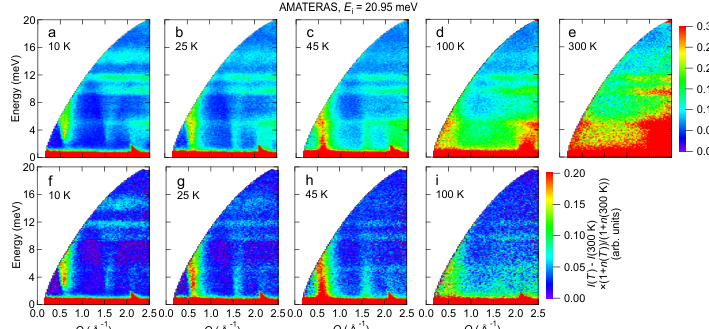 Figure 2. a–e) Inelastic neutron scattering spectrum measured by using AMATERAS with an incident neutron energy of 20.95 meV at a) 10, b) 25, c) 45, d) 100 K and e) 300 K. Dispersive spin excitations were observed at 0.60 and 1.55˚A−1 up to the energy transfer of 15 meV. f–i) Two-dimensional colour maps of the magnetic contributions at f) 10, g) 25, h) 45 and i) 100 K estimated by subtracting the phononic contributions estimated from the 300 K data. Intensities are corrected by the temperature- dependent factor 1 + n(T ) = (1 − e−E/(kBT ))−1, where n(T ) represents a Bose factor
The temperature dependence of these excitations was crucial. While the strong wavevector dependence persisted up to 45 K, it significantly weakened, and the spectral weight shifted to the zero wavevector ($\Gamma$ point) at 100 K ($\sim 3T_N$), eventually disappearing at 300 K. This shift to the $\Gamma$ point indicates the presence of ferromagnetic interactions, while the robustness of magnetic excitations near the Brillouin zone boundary strongly points to the antiferromagnetic interactions that stabilize the zigzag order. The observation of an energy gap of 1.5 meV at 10 K, which then decreased and became almost zero above 25 K (Figure 4b), further characterized the magnetic excitations. Additionally, weakly dispersed excitations were identified at 12 and 15 meV (Figure 3b), interpreted as magnons with a high density of states, possibly related to two-magnon excitations.
The comparison with linear spin wave theory (LSWT) simulations was key to quantifying these interactions. Two models, $J_1$-$K$-$\Gamma$-$\Gamma'$ and $J_1$-$K$-$J_2$-$J_3$, were tested. The $J_1$-$K$-$J_2$-$J_3$ model, which includes a large third-nearest-neighbor isotropic magnetic interaction ($J_3$), showed a better agreement with the experimental curves (Figure 3a, 3b). This strongly suggests that large nearest-neighbor symmetric off-diagonal ($\Gamma$) or third-neighbor isotropic magnetic interactions ($J_3$) are essential for stabilizing the observed zigzag antiferromagnetic order. The paper concludes that the Br substitution enhances these antiferromagnetic interactions, driving RuBr$_3$ deeper into the zigzag antiferromagnetic phase compared to $\alpha$-RuCl$_3$. This enhancement is attributed to stronger d-p hybridization via ligand atoms, leading to increased indirect hopping and a dominant $J_3$ term.
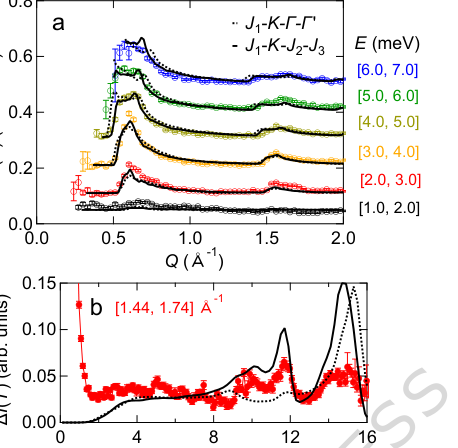 Figure 3. Integrated scattering intensities at 10 K plotted as a function of the wavevector or energy transfer after the subtraction of the phonon contribution estimated from the 300 K data. Dashed and solid curves represent the simulated curves based on the J1–K–Γ-Γ′ and J1–K–J2–J3 models, respectively (see text for details). (a) Wavevector dependence of the intensities with integration ranges of [1.0, 2.0], [2.0, 3.0], [3.0, 4.0], [4.0, 5.0], [5.0, 6.0], and [6.0, 7.0] meV. The intensities are shifted for clarity. (b) Energy transfer dependence of the intensities with an integration range of [1.44, 1.74]˚A−1
Limitations & Future Directions
While this study provides significant insights into the magnetic excitations of RuBr$_3$, it also highlights several inherent limitations and opens up exciting avenues for future research.
One major limitation stems from the use of powder inelastic neutron scattering. As the authors themselves note, estimating exchange parameters precisely from powder-averaged spectra is challenging. The similarity in simulated spectra from different models ($J_1$-$K$-$\Gamma$-$\Gamma'$ and $J_1$-$K$-$J_2$-$J_3$) underscores this difficulty, making it hard to uniquely determine all interaction parameters. This limitation suggests that while the $J_1$-$K$-$J_2$-$J_3$ model provides a better fit, there might be other parameter combinations or models that could also explain the observed powder-averaged data.
Another point of concern is the applicability of linear spin wave theory (LSWT) to a pseudospin-1/2 system. LSWT is a mean-field approximation that might not fully capture the quantum nature and potential fractionalization of excitations in such systems. The discrepancy between experimentally derived Weiss temperatures and those predicted by the models, as well as the differences in canting angles, further indicate the limitations of the classical or semi-classical approximations used. The phonon subtraction procedure, while helpful, was also acknowledged as incomplete due to anharmonicity and background issues, which could subtly affect the interpretation of magnetic signals, especially at higher temperatures.
The paper also notes that the wavevector and energy dependences of the weak excitations (potentially continuous excitations) were not clear from the powder INS spectrum. This ambiguity makes it difficult to definitively conclude whether these weak signals are indeed related to Kitaev interactions or other phenomena.
Looking ahead, these findings present several compelling discussion topics for further development:
-
Single-Crystal Studies: The most immediate and impactful future direction is to perform single-crystal inelastic neutron scattering experiments. This would overcome the limitations of powder averaging, allowing for a much more precise determination of the full dispersion relations and anisotropic exchange parameters. With single-crystal data, it would be possible to definitively distinguish between different Hamiltonian models and potentially resolve the nature of the weak, less-dispersive excitations.
-
Advanced Theoretical Modeling: Moving beyond LSWT, future theoretical work should employ more sophisticated quantum many-body techniques such as exact diagonalization, density matrix renormalization group (DMRG), or quantum Monte Carlo simulations tailored for pseudospin-1/2 systems. These methods could provide a more accurate description of the spin dynamics, especially in the presence of strong quantum fluctuations and potential fractionalized excitations, which are characteristic of Kitaev materials. This would help to reconcile the discrepancies observed in Weiss temperatures and canting angles.
-
Systematic Ligand Substitution and Chemical Tuning: The paper highlights the role of Br substitution in enhancing antiferromagnetic interactions. A systematic study of the entire RuX$_3$ family (X = Cl, Br, I) and even mixed halides (e.g., RuCl$_{3-x}$Br$_x$) could provide a deeper understanding of how d-p hybridization and orbital exchange can be chemically tuned to manipulate the balance between Kitaev and non-Kitaev interactions. This could guide the design of new materials closer to an ideal Kitaev spin liquid state.
-
Influence of External Fields: Investigating the magnetic excitations under external magnetic fields or pressure could offer another powerful knob to tune the magnetic interactions. Magnetic fields can suppress long-range order and potentially stabilize a spin liquid phase, while pressure can alter bond lengths and angles, thereby modifying exchange pathways. Such studies could reveal phase transitions and the emergence of exotic quantum states.
-
Search for Fractionalized Excitations: While the current study emphasizes magnon-like excitations, the ultimate goal in Kitaev materials is to find evidence of Majorana fermions. Future experiments, perhaps with higher resolution or specialized techniques, should focus on identifying the characteristic signatures of these fractionalized excitations, especially at higher temperatures or specific momentum points where they might persist as a continuum. This would require careful disentanglement from magnon and phonon contributions.
-
Refined Phonon Modeling: To improve the accuracy of magnetic signal extraction, developing more advanced methods for phonon subtraction or modeling that account for anharmonicity and temperature-dependent background effects would be beneficial. This is particularly important for studies at elevated temperatures where phonon contributions become significant.
These future directions, pursued with diverse perspectives and rigorous methodologies, will be crucial for a more complete understanding of the complex interplay of interactions in Kitaev materials and for the eventual realization of their potential in quantum technologies. The current work on RuBr$_3$ serves as a vital step, revealing the intricate balance that drives its magnetic ground state.
Connections to Other Fields
Mathematical Skeleton
The pure mathematical core of this work involves the theoretical analysis of spin dynamics in a quantum magnetic system. This is achieved by defining a generalized Kitaev-Heisenberg Hamiltonian on a honeycomb lattice, determining its classical ground state through energy minimization techniques like the Luttinger-Tisza method, and subsequently calculating the magnetic excitation spectrum using linear spin wave theory, which relies on the Holstein-Primakoff transformation and Bogoliubov-de Gennes diagonalization.
Adjacent Research Areas
Quantum Spin Liquids and Kitaev Materials
This research directly contributes to the field of quantum spin liquids, particularly those based on the Kitaev model. The paper investigates a candidate material, RuBr$_3$, whose magnetic interactions are described by a Hamiltonian (Equation 2) that includes bond-dependent Kitaev ($K$), Heisenberg ($J_1$), and off-diagonal ($\Gamma, \Gamma'$) terms. The goal is to understand how these competing interactions drive the system away from an ideal Kitaev spin liquid state, a fundamental problem in this area. The observation of zigzag antiferromagnetic order and its associated magnon excitations provides crucial insights into the parameter space of generalized Kitaev models. For a comprehensive overview of this field, see Winter, S. M. et al. (2017) Journal of Physics: Condensed Matter.
Computational Condensed Matter Physics (Spin Dynamics Simulations)
The methodology employed, specifically the use of linear spin wave theory (LSWT) to simulate inelastic neutron scattering spectra, is a cornerstone of computational condensed matter physics. The paper details the process of rewriting the spin Hamiltonian (Equation 2) in terms of magnon creation and annihilation operators via the Holstein-Primakoff approximation and then diagonalizing the resulting $8 \times 8$ Bogoliubov-de Gennes matrix to obtain excitation energies and dynamic structure factors. This computational framework is widely applicable for predicting and interpreting experimental spectra from various ordered magnetic systems. An example of such computational work in a related context is provided by Chaloupka, J. c. v. & Khaliullin, G. (2015) Physical Review Letters.
Materials Science and Engineering (Design of Quantum Materials)
The study's focus on RuBr$_3$ as a Kitaev model candidate, and its comparison with $\alpha$-RuCl$_3$, highlights a significant connection to materials science and engineering, particularly in the design and tuning of quantum materials. The paper explicitly discusses how ligand ion substitution (e.g., Br for Cl) affects the d-p hybridization and, consequently, the magnetic interactions, leading to different ground states and excitation spectra. This approach of chemical modification to control and optimize magnetic properties is a key strategy in the search for novel quantum states. The work by Kaib, D. A. S. et al. (2022) in npj Quantum Materials explores the electronic and magnetic properties across the RuX$_3$ family, demonstrating the impact of such substitutions. The careful characterization of RuBr$_3$'s magnetic excitations provides valuable feedback for the rational design of new materials with desired quantum magnetic properties, such as those exhibiting Kitaev spin liquid behavior or other exotic states, by understanding the role of chemical composition and structure on the underlying magnetic Hamiltonian. The occurring differences in magnetic properties between RuBr$_3$ and $\alpha$-RuCl$_3$ due to ligand substitution are a prime example of this connection.