
Inverse Lieb materials: altermagnetism and more
ISOM keeps this npj Quantum Materials paper in the public review set because it gives readers a concrete case around Inverse Lieb materials: altermagnetism and more through its mechanism, assumptions, and evidence...
Background & Academic Lineage
The Origin & Academic Lineage
The problem addressed in this paper originates from the study of the Lieb lattice, a specific atomic arrangement initially proposed by Lieb [1] to understand electronic interactions in cuprate superconductors [2]. This lattice geometry has seen a recent resurgance of interest, particularly in the emerging field of altermagnetism (AM) [3, 4]. Altermagnetism describes a novel class of collinear magnets that exhibit alternating spin polarization on symmetry-related sites, leading to unique transport and topological phenomena, even without a net magnetization [5-10].
Historically, the term "Lieb lattice" was sometimes used to refer to the two-dimensional counterpart of the perovskite structure [11]. To avoid confusion with this earlier usage, which describes a 2D perovskite-type lattice, the authors of this paper adopt the term "inverse Lieb lattice" (ILL) to specifically denote the 2D antiperovskite lattice relevant to altermagnetism [see Fig. 1(d)].
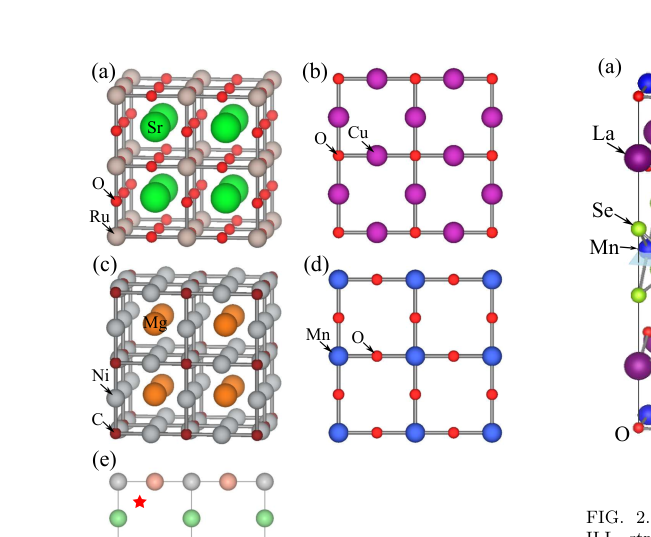 FIG. 1. Examples of 3D and 2D perovskite and anti- perovskite structures: (a) 3D perovskite structure SrRuO3. (b) 2D perovskite structure CuO2. (c) 3D anti-perovskite structure MgCNi3. (d) 2D anti-perovskite structure Mn2O. (e) Lieb lattice that contains A, B and C three inequivalent sites. When A is the metal (ligand) site and B and C are ligand (metal) sites the lattice corresponds to 2D perovskite (antiperovskite). The star in (e) indicates the midpoint be- tween the B and C sites, illustrating the absence of an inver- sion center at this position
While the ILL was once considered purely theorectical, its significance grew in 2023 when it was proposed as a minimal toy model for exploring altermagnetic behavior [12]. This proposal, however, was made without full awareness that real two-dimensional antiperovskite structures already exist in nature. The core problem, therefore, is to systematically explore and understand the magnetic phases of ILL materials, especially in the context of altermagnetism, and to establish clear guidelines for identifying new altermagnets within this diverse class of compounds.
A fundamental limitation of previous approaches, and a key motivation for this work, stems from the fact that most currently studied altermagnets (e.g., MnTe, CrSb) [10] are hexagonal and exhibit g-wave characteristics. The ILL, in contrast, offers a promising platform for discovering new d-wave altermagnetic materials. Furthermore, previous systems often require interactions between distant neighbors (e.g., 10th and 11th nearest-neighbors in MnTe [28] or seventh nearest-neighbor in rutile [29]) to generate chirality. The ILL, however, allows for chirality generation through significantly closer, second nearest-neighbor interactions [30], which is a considerable advantage for both fundamental research and potential applications. Given that not all ILL members exhibit altermagnetic properties, understanding the precise factors that control their ground states is paramout. The paper also notes that while the Heisenberg model is useful, it sometimes fails to fully reproduce distinct magnetic states observed experimentally (e.g., for La$_2$O$_3$Co$_2$Se$_2$ versus La$_2$O$_3$Fe$_2$Se$_2$), suggesting a need for deeper insights into the underlying mechanisms.
Intuitive Domain Terms
- Inverse Lieb Lattice (ILL): Imagine a special kind of checkerboard pattern made of atoms. The ILL is a specific, repeating arrangement of these atoms, forming a 2D structure that looks like a square grid with extra atoms in the middle of some squares. It's like a unique, intricate tiling pattern that scientists use to model how electrons and spins behave in certain materials.
- Altermagnetism (AM): Think of a crowd where everyone is holding a flag, either pointing straight up or straight down. In a regular magnet, most flags point the same way. In an antiferromagnet, half point up and half point down, perfectly canceling out, so there's no overall "pull" or magnetic field. An altermagnet is also like an antiferromagnet with no overall "pull," but the "up" and "down" flags are arranged in such a special, alternating pattern that it creates unique, directional effects when you interact with it, even though the net magnetic force is zero.
- Heisenberg Model: This is like a simplified rulebook for how tiny magnets (called "spins") inside a material interact with each other. Instead of dealing with all the complex quantum physics, the Heisenberg model gives us a set of basic rules (e.g., "neighboring spins prefer to point in opposite directions" or "in the same direction") to predict the overall magnetic behavior of a material.
- Exchange Coupling Parameters ($J_1, J_{2a}, J_{2b}, J_3$): These are numbers that tell us how strongly and in what way the tiny magnets (spins) in a material "talk" to each other. $J_1$ describes the interaction between the closest neighbors, $J_{2a}$ and $J_{2b}$ describe interactions between two different types of second-closest neighbors (they might have different strengths or preferences), and $J_3$ is for third-closest neighbors. A positive $J$ means the spins prefer to align, while a negative $J$ means they prefer to point in opposite directions.
- Chiral Magnons / Magnon Splitting: Imagine a Slinky toy. If you wiggle it, a wave travels along its length. These waves are like "magnons" – tiny packets of magnetic energy. "Chiral magnons" are like waves that prefer to twist either clockwise or counter-clockwise as they travel. "Magnon splitting" means that the clockwise-twisting waves and counter-clockwise-twisting waves have slightly different energies, like two different musical notes, even if they're otherwise similar. This difference often arises because the material's internal structure is a bit asymmetric.
Notation Table
| Notation | Description |
|---|---|
| $H$ | Hamiltonian (total magnetic energy) |
| $\mathbf{S}_i$ | Spin vector at site $i$ |
| $J_1$ | First nearest-neighbor exchange coupling parameter |
| $J_{2a}$ | Second nearest-neighbor exchange coupling parameter (type 'a') |
| $J_{2b}$ | Second nearest-neighbor exchange coupling parameter (type 'b') |
| $J_3$ | Third nearest-neighbor exchange coupling parameter |
| $ |
Summation over $k$-th nearest-neighbor pairs of sites $(i,j)$ |
| AM | Altermagnetism |
| ILL | Inverse Lieb Lattice |
| DFT | Density Functional Theory |
| NN | Nearest Neighbor |
| FM | Ferromagnetic |
| AFM | Antiferromagnetic |
| SS | Single-Stripe magnetic order |
| BC1, BC2 | Block-Checkerboard magnetic orders |
| DS | Double-Stripe magnetic order |
| $T_N$ | Néel temperature |
Problem Definition & Constraints
Core Problem Formulation & The Dilemma
The core problem addressed by this paper is to systematically understand and predict the magnetic phases, particularly altermagnetism (AM) and chiral magnons, in a diverse class of materials known as inverse Lieb lattice (ILL) compounds.
The starting point (Input/Current State) is the recognition that the ILL, once a theoretical construct, now has several real material examples. These materials possess a unique geometry that can support complex magnetic orders and offer high tunability. While some ILL-based compounds are known to be altermagnetic, the factors controlling their magnetic ground states are not fully understood, and not all members of this family exhibit AM properties. Specifically, d-wave altermagnetism is a rare and highly sought-after characteristic, and the ILL is seen as a promising platform for its discovery. Furthermore, the generation of chiral magnons through relatively close second nearest-neighbor (NN) interactions in ILL systems is an intriguing aspect that needs exploration.
The desired endpoint (Output/Goal State) is a comprehensive framework that provides insights into ILL magnetic phases, establishes clear guidelines for identifying altermagnets, and bridges theoretical predictions with experimental observations. This involves:
1. Developing and validating a Heisenberg model to map out the magnetic phase diagrams of ILL materials, thereby elucidating the mechanisms behind observed magnetic phases.
2. Performing density functional theory (DFT) calculations on existing ILL compounds to confirm the theoretical model's consistency with experimental data.
3. Identifying a clear trend linking the d-shell filling of transition metal ions to the resulting magnetic order, with a particular focus on conditions favoring altermagnetism.
4. Quantifying and confirming that chiral splittings in magnon spectra are directly correlated with the anisotropy between inequivalent $J_2$ exchange interactions.
Ultimately, the goal is to enable the rational design and engineering of new d-wave altermagnetic materials with desired functional properties, including robust chiral magnons.
The exact missing link or mathematical gap between the current and desired states is a predictive theoretical and computational model that can accurately map the complex interplay of structural, chemical, and electronic properties (like d-shell filling and crystal field environment) in ILL materials to their specific magnetic ground states and magnon characteristics. Previous work has been largely empirical or focused on individual compounds, lacking a generalized understanding of the phase space and the precise conditions for AM and chiral magnon generation across the broad ILL family. The paper aims to fill this gap by providing a systematic analysis of exchange interactions and their consequences.
The painful trade-off or dilemma that has trapped previous researchers is inherent in the very versatility of ILL materials. While their "structural and chemical flexibility makes ILL-based compounds an exceptionally versatile platform for investigating and engineering altermagnetism," this same flexibility leads to a vast and complex materials space where "not all members exhibit altermagnetic properties." This means that the potential for discovery is high, but the path to identifying and optimizing specific AM materials is fraught with challenges due to the highly sensitive dependence of magnetic ordering on subtle chemical and structural variations. For instance, even within the same family (e.g., La$_2$O$_3$M$_2$Se$_2$ with M=Mn, Co, Fe), "the qualitative behavior can vary quite drastically." Another dilemma arises in achieving both strong altermagnetism and substantial chiral magnon splitting: "To observe a substantial chiral magnon splitting, significant anisotropic $J_2$ coupling is required within the AM phase. When the condition $J_{2a} = J_{2b}$ is satisfied, the $J_2$ interaction becomes isotropic, resulting in the absence of magnon splitting." This implies that optimizing for one desirable property (isotropic $J_2$ for some AM states) might compromise another (chiral magnon splitting), necessitating a careful balance of exchange interactions.
Constraints & Failure Modes
The problem of understanding and engineering ILL altermagnets is insanely difficult due to several harsh, realistic constraints:
-
Computational Constraints:
- High Cost of Ab Initio Calculations: Bridging theory and experiment relies heavily on Density Functional Theory (DFT) calculations to determine exchange coupling parameters. These calculations are computationally intensive, especially for complex, multi-atom unit cells and for exploring a wide range of chemical compositions and structural variations.
- Methodological Limitations for Exchange Parameters: The paper notes that for some compounds, like Sr$_2$CrO$_2$Cr$_2$OAs$_2$, the standard Green's function (GF) method for calculating exchange parameters "yielded exchange parameters that depend strongly on the reference magnetic configuration." This necessitates using more complex and computationally demanding "total-energy-mapping approach[es]," indicating that simpler, more efficient methods are not always reliable for all systems.
- Modeling Secondary Interactions: The Heisenberg model, while useful, often results in "continuous ground state degeneracy" due to frustration. In such cases, the "actual magnetic ground state is determined by secondary interactions typically much weaker than the primary exchange terms," such as single-site magnetocrystalline anisotropy, anisotropic exchange interactions, and biquadratic coupling. Accurately modeling these weaker, often subtle, interactions within a general framework is significantly more challenging and computationally expensive than modeling primary exchange.
-
Material and Physical Constraints:
- Vast and Diverse Materials Space: The ILL structure is "abundant in nature" and represents a "diverse and largely untapped materials class." Exploring this vast chemical and structural space to identify promising candidates is a monumental task. The magnetic ordering is highly sensitive, depending "strongly on the TM and filler layers," making generalizations difficult.
- Complex Interplay of Electronic and Magnetic Properties: The d-band filling and metallicity play a "crucial role in shaping the magnetic interactions" and "affect the magnetic and electronic properties." This means that a simple structural motif is insufficient; a deep understanding of the electronic structure and its correlation effects is essential, adding layers of complexity to material design.
- Intrinsic Anisotropy and Frustration: The presence of "two distinct second NN $J_2$ exchange pathways" with intrinsic anisotropy due to crystal symmetry complicates the magnetic interactions. Furthermore, magnetic frustration can lead to degenerate ground states, making the prediction of the true ground state dependent on subtle, often hard-to-model, secondary interactions.
- Interlayer Interactions: While the paper focuses on 2D ILL planes, it acknowledges that "interlayer interactions are considerably weaker than the in-plane parameters, and they are inherently frustrated by the magnetic ordering, regardless of the stacking configuration." A full 3D understanding would introduce even greater complexity.
-
Data-Driven Constraints:
- Scarcity of Experimental Data: For many ILL compounds, experimental data on their magnetic ground states is limited or entirely absent (e.g., for V$_2$Se$_2$O, "no experimental data on its magnetic ground state have been reported"). This lack of comprehensive experimental validation makes it difficult to robustly confirm theoretical predictions and refine models across the entire material class.
- Discrepancies Between Theory and Experiment: Even with detailed calculations, the theoretical model can sometimes "fail to reproduce the distinct magnetic states observed experimentally," as noted for La$_2$O$_3$Co$_2$Se$_2$. This suggests that current models might be incomplete or miss crucial interactions, highlighting the difficulty in capturing all relevant physics.
Why This Approach
The Inevitability of the Choice
The selection of the Heisenberg model, complemented by Density Functional Theory (DFT) calculations, was not merely a preference but an essential choice for unraveling the intrecate magnetic properties of Inverse Lieb Lattice (ILL) materials. The Lieb lattice itself is recognized as a "minimal analytical model" for altermagnetism, providing a foundational framework that is both tractable and representative of the underlying physics. This inherent simplicity, combined with its capacity to host "complex magnetic orders driven by geometric frustration," made the Heisenberg model the only viable solution for systematically exploring the rich phase diagrams.
Traditional approaches in condensed matter physics, such as simpler spin models (e.g., Ising or basic XY models), would have been insufficient to capture the nuanced, anisotropic exchange interactions crucial for altermagnetism and chiral magnons in ILLs. The problem at hand—understanding the mechnisms of altermagnetism, the role of geometric frustration, and the generation of chiral magnons—demands a model that can explicitly account for multiple, distinct exchange pathways. The Heisenberg model, with its ability to incorporate first, second, and even third nearest-neighbor interactions ($J_1, J_{2a}, J_{2b}, J_3$), directly addresses this requirement. The "exact moment" of this realization is implicit in the problem's definition: to understand these specific magnetic phenomena, a model capable of describing spin-spin interactions and their anisotropy is fundamentally necessary. Machine learning models like CNNs or Transformers, while powerful in other domains, are not applicable for deriving fundamental physical laws or phase diagrams in this context.
Comparative Superiority
Beyond simple performance metrics, the chosen approach demonstrates qualitative superiority through its structural alignment with the unique physics of ILL materials. The Heisenberg model, particularly with its differentiation between $J_{2a}$ and $J_{2b}$ exchange interactions, is uniquely equipped to model the "intrinsic anisotropy in exchange pathways due to crystal symmetry" that "plays a central role in shaping the magnetic interactions and... underpins altermagnetism." This structural advantage allows for a precise description of how crystal symmetry dictates magnetic ordering.
For instance, the paper highlights that ILL "allows for chirality generation through significantly closer, second NN interactions." The explicit inclusion of anisotropic $J_2$ interactions in the Heisenberg model directly enables the study and explanation of phenomena like chiral magnon splitting, which is shown to "correlate directly with anisotropy between inequivalent J2 interactions." This level of detail and predictive power regarding specific physical effects, derived from the model's structure, makes it overwhelmingly superior to any simpler, isotropic magnetic model. The combination with DFT calculations further enhances this superiority by providing a robust bridge to real materials, allowing for the calculation of actual exchange parameters and validation against experimental data. This integrated methodology offers a comprehensive understanding that purely theoretical or purely empirical methods cannot achieve alone. The paper does not discuss high-dimensional noise or memory complexcity in the context of $O(N^2)$ versus $O(N)$, as these are not the primary concerns for this type of fundamental physics modeling.
Alignment with Constraints
The chosen methodology perfectly aligns with the inherent constraints of studying Inverse Lieb materials. The primary constraint is to understand the emergence and characteristics of altermagnetism in these systems. The Heisenberg model, by constructing detailed phase diagrams based on varying exchange parameters, directly elucidates the conditions under which altermagnetic phases arise and persist. DFT calculations then provide the critical link to real-world compounds, allowing for the prediction and verification of altermagnetic ground states based on their electronic structure and d-shell filling.
Another key constraint is the exploration of chiral magnons. The magnon spectra calculations, performed within the Heisenberg model framework, directly quantify and explain the "gigantic chiral magnon splitting" observed in certain ILL compounds, linking it explicitly to the anisotropy of the $J_2$ interactions. Furthermore, the need to bridge theoretical predictions with experimental observations is met by using DFT to compute exchange parameters for known materials and comparing the predicted magnetic orders with experimental data. This "marriage" between the problem's harsh requirements (complex magnetic orders, anisotropy, chiral phenomena) and the solution's unique properties (anisotropic Heisenberg model, first-principles DFT) ensures a thorough and accurate analysis.
Rejection of Alternatives
The paper does not explicitly reject other popular magnetic modeling approaches as having "failed." Instead, the choice of the Heisenberg model and DFT is presented as the most appropriate and effective for the specific problems addressed. For instance, while the Lieb lattice has historical connections to the Hubbard model in the context of cuprate superconductors, for the study of magnetic ordering and exchange interactions in altermagnets, the Heisenberg model is the standard and sufficient framework for localized spins. The paper does mention that "metallicity of the partially-filled t2g bands plays an important role" and is "consistent with the Hubbard model," suggesting that the Hubbard model provides a deeper electronic context but the Heisenberg model is the direct tool for spin dynamics.
The authors also made a methodological choice within the DFT framework: for Sr$_2$CrO$_2$Cr$_2$OAs$_2$, the Green's function (GF) method for calculating exchange parameters was found to be problematic ("yielded exchange parameters that depend strongly on the reference magnetic configuration"). Consequently, they opted for the "standard Heisenberg model total-energy-mapping approach" [62] instead. This is a refinement of the computational method rather than a rejection of an entire class of models. The absence of discussion regarding machine learning models like GANs or Diffusion is simply due to their irrelevance to the fundamental physics questions being investigated here; these are not considered "alternatives" in this scientific domain. The chosen approach is a well-established and robust combination for the study of magnetic materials, and its suitability is demonstrated by the consistent results and insights it provides.
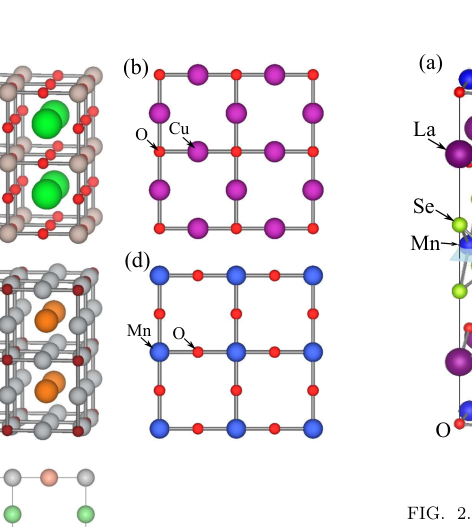 FIG. 2. Examples of different compounds that contain ILL structure indicated by the light blue plane. (a). La2O3Mn2Se2, (b). KV2Se2O and (c). V2Se2O. Red and pur- ple arrowed lines represent two inequivalent exchange path- ways between second neighbors
Mathematical & Logical Mechanism
The Master Equation
The fundamental engine driving the analysis of magnetic phases in Inverse Lieb materials, as presented in this paper, is the Heisenberg Hamiltonian. This model describes the magnetic interactions between localized spins in a material. The authors employ a specific form of this Hamiltonian, incorporating various nearest-neighbor (NN) exchange interactions to capture the complex magnetic orders observed in the Inverse Lieb Lattice (ILL).
The core equation, which represents the total magnetic energy of a given spin configuration, is expressed as:
$$H = - \sum_{
Term-by-Term Autopsy
Let's dissect this master equation to understand each component:
-
$H$: This symbol represents the Hamiltonian of the system.
- Mathematical Definition: In quantum mechanics, the Hamiltonian is an operator corresponding to the total energy of the system. In this classical spin model context, it represents the total magnetic exchange energy.
- Physical/Logical Role: Its role is to quantify the energy of any given arrangement of spins. The system will naturally tend towards configurations that minimize this total energy, which correspond to the magnetic ground states.
- Why Summation: The total energy is the sum of all individual interaction energies between pairs of spins.
-
$-$ (Negative Sign): This is a conventional sign.
- Mathematical Definition: It's a scalar multiplier.
- Physical/Logical Role: It's a convention that makes positive exchange constants ($J_k > 0$) correspond to ferromagnetic interactions (where spins prefer to align parallel, lowering energy), and negative exchange constants ($J_k < 0$) correspond to antiferromagnetic interactions (where spins prefer to anti-align, also lowering energy). Without this negative sign, the interpretation of $J_k$ would be reversed.
-
$\sum$ (Summation Operator): This symbol denotes a sum.
- Mathematical Definition: It's a mathematical operator that adds up a sequence of terms.
- Physical/Logical Role: It signifies that the total energy of the system is the aggregate of all pairwise magnetic interactions present in the lattice. Each distinct type of interaction (first, second, third nearest neighbors) contributes to the overall energy.
- Why Summation instead of Integral: The system consists of discrete atomic sites, each hosting a localized spin. Therefore, the interactions occur between discrete pairs of spins, making a summation the appropriate mathematical tool rather than an integral, which would imply a continuous distribution of spins.
-
$
- Mathematical Definition: It indicates that the sum is taken over all unique pairs of sites $(i, j)$ that are $k$-th nearest neighbors.
- Physical/Logical Role: It specifies which pairs of spins are interacting. For instance, $
-
$J_1, J_{2a}, J_{2b}, J_3$: These are the exchange coupling constants.
- Mathematical Definition: They are scalar coefficients representing the strength and nature (ferromagnetic or antiferromagnetic) of the magnetic interaction between spins.
- Physical/Logical Role:
- $J_1$: Represents the exchange interaction between first nearest neighbors (NN). The paper states that $J_1$ bonds connect different sublattices. Its sign and magnitude are crucial for determining the overall magnetic order.
- $J_{2a}$ and $J_{2b}$: Represent two distinct exchange interactions between second nearest neighbors (NN). The paper highlights that these are inequivalent due to crystal symmetry and connect sites within the same sublattice. This anisotropy ($J_{2a} \neq J_{2b}$) is a key feature for altermagnetism and chiral magnon splitting.
- $J_3$: Represents the exchange interaction between third nearest neighbors (NN). The paper notes that these are "further NN" interactions, which can be appreciable in metallic systems and can shift phase boundaries, though they generally don't introduce new phases.
- Role: These constants are the "knobs" that tune the magnetic behavior. Their relative strengths and signs dictate which magnetic phase (e.g., ferromagnetic, antiferromagnetic, altermagnetic) is the ground state. A positive $J_k$ favors parallel alignment (ferromagnetic), while a negative $J_k$ favors anti-parallel alignment (antiferromagnetic).
-
$\mathbf{S}_i$: This is the spin vector at site $i$.
- Mathematical Definition: A vector representing the magnetic moment at a specific atomic site $i$. In this classical Heisenberg model, it's often treated as a classical vector of fixed magnitude (e.g., unit vector) but variable orientation.
- Physical/Logical Role: It embodies the fundamental magnetic entity at each lattice site. The orientation of these vectors determines the magnetic configuration of the material.
-
$\cdot$ (Dot Product): This is the scalar product of two vectors.
- Mathematical Definition: For two vectors $\mathbf{A}$ and $\mathbf{B}$, $\mathbf{A} \cdot \mathbf{B} = |\mathbf{A}| |\mathbf{B}| \cos \theta$, where $\theta$ is the angle between them.
- Physical/Logical Role: The dot product measures the degree of alignment between two spin vectors. If spins are parallel ($\theta = 0^\circ$, $\cos \theta = 1$), $\mathbf{S}_i \cdot \mathbf{S}_j$ is positive. If anti-parallel ($\theta = 180^\circ$, $\cos \theta = -1$), it's negative. If orthogonal ($\theta = 90^\circ$), it's zero. This mathematical operation naturally captures the energetic preference for spins to align or anti-align based on the sign of $J_k$. For example, with a positive $J_k$ and the leading negative sign in the Hamiltonian, parallel spins ($\mathbf{S}_i \cdot \mathbf{S}_j = 1$) lead to a lower (more negative) energy, favoring ferromagnetic order.
Step-by-Step Flow
Imagine a single, abstract magnetic configuration as a blueprint for our mechanical assembly line. This blueprint specifies the orientation of every spin vector $\mathbf{S}_i$ on each site $i$ of the Inverse Lieb Lattice. The goal is to calculate the total magnetic energy of this specific configuration using the master equation.
-
Spin Input: First, the entire set of spin vectors, $\{\mathbf{S}_1, \mathbf{S}_2, \dots, \mathbf{S}_N\}$, representing a particular magnetic arrangement, is fed into the system. Each $\mathbf{S}_i$ is a 3D vector.
-
First Nearest Neighbor (NN) Interaction Calculation ($J_1$): The assembly line identifies all pairs of sites $(i, j)$ that are first nearest neighbors. For each such pair, the spin vectors $\mathbf{S}_i$ and $\mathbf{S}_j$ are retrieved. A "dot product machine" calculates $\mathbf{S}_i \cdot \mathbf{S}_j$. This scalar value is then multiplied by the $J_1$ coupling constant and a negative sign ($-J_1 \mathbf{S}_i \cdot \mathbf{S}_j$). These individual interaction energies are collected.
-
Second Nearest Neighbor (NN) Interaction Calculation ($J_{2a}, J_{2b}$): Next, the assembly line moves to second nearest neighbors. It distinguishes between the two inequivalent pathways, $2a$ and $2b$.
- For every pair $(i, j)$ connected by a $J_{2a}$ path, the dot product $\mathbf{S}_i \cdot \mathbf{S}_j$ is computed, then multiplied by $-J_{2a}$.
- Similarly, for every pair $(i, j)$ connected by a $J_{2b}$ path, $\mathbf{S}_i \cdot \mathbf{S}_j$ is computed and multiplied by $-J_{2b}$.
These results are added to the growing collection of interaction energies.
-
Third Nearest Neighbor (NN) Interaction Calculation ($J_3$): If $J_3$ interactions are considered, the process repeats for all pairs $(i, j)$ that are third nearest neighbors. Their dot product $\mathbf{S}_i \cdot \mathbf{S}_j$ is calculated and multiplied by $-J_3$, adding to the total.
-
Total Energy Summation: Finally, all the individual interaction energies calculated in steps 2, 3, and 4 are fed into a "summation unit." This unit adds up every single term to produce the final scalar value: the total energy $H$ for the initial magnetic configuration. This value represents how "favorable" or "unfavorable" that specific spin arrangement is.
This entire process is repeated for many different spin configurations to map out the energy landscape and identify the lowest energy states.
Optimization Dynamics
The "optimization" in the context of this Heisenberg model is about finding the magnetic ground state – the spin configuration that minimizes the total energy $H$. The paper constructs phase diagrams by comparing the energies of various candidate magnetic orders.
-
Loss Landscape Definition: The Hamiltonian $H$ defines a "loss landscape" where each point in this landscape corresponds to a unique configuration of spins, and the "height" of the landscape at that point is the total energy $H$. The goal is to find the "valleys" or minima in this landscape.
-
Candidate Ground States: Instead of a continuous gradient descent on all possible spin orientations (which is computationally intensive for large systems), the authors likely evaluate the energies of specific, symmetry-dictated magnetic orders. These include:
- Ferromagnetic (FM): All spins aligned parallel.
- Antiferromagnetic (AFM): Spins on neighboring sites anti-aligned.
- Altermagnetic (AM): A novel collinear magnet with alternating spin polarization on symmetry-related sites, leading to zero net magnetization but distinct transport properties.
- Single-Stripe (SS), Block-Checkerboard (BC1, BC2), Double-Stripe (DS): These are specific patterns of spin alignment, often non-collinear or with complex periodicity, as illustrated in Figure 3.
-
Energy Comparison: For a given set of exchange coupling constants ($J_1, J_{2a}, J_{2b}, J_3$), the energy $H$ is calculated for each of these candidate magnetic orders. The configuration with the lowest energy is identified as the ground state for that particular set of $J$ values.
-
Phase Diagram Construction: By systematically varying the ratios of the exchange constants (e.g., $J_{2a}/J_1$ and $J_{2b}/J_1$), the authors map out regions in this parameter space where different magnetic orders are the lowest energy state. These regions define the phase diagram, showing which magnetic phase is stable under different interaction strengths.
-
Continuous Degeneracy and Flat Landscapes: A particularly interesting dynamic arises when certain conditions on the exchange constants are met, leading to "continuous ground state degeneracy." This means that the energy landscape has "flat directions" where the energy remains invariant under rigid rotations of spins on one sublattice relative to the other. In such cases, the system doesn't have a single unique ground state, but rather a continuum of equally energetic configurations. The paper notes that "secondary interactions typically much weaker than the primary exchange terms" or factors like "single-site magnetocrystalline anisotropy, anisotropic exchange interactions and biquadratic coupling" become decisive in selecting the true ground state from this degenerate manifold. This implies that the simple Heisenberg model might not fully resolve the ground state in these degenerate regions, and additional, more complex terms would be needed to tilt the flat landscape and pick a specific minimum.
In essence, the "optimization" is a process of comparing the energies of a predefined set of magnetic configurations across a parameter space of exchange interactions to determine the most stable magnetic order. The model doesn't "learn" in the machine learning sense, but rather predicts the equilibrium state based on the input parameters.
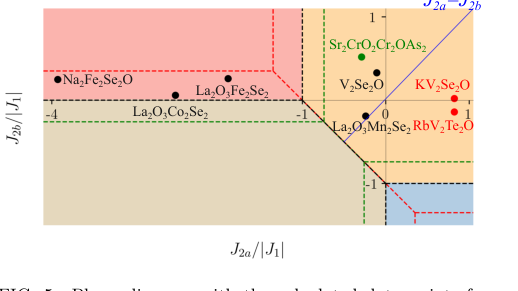 FIG. 5. Phase diagram with the calculated data points for the compounds listed in TABLE I The colored dashed lines represent the phase boundaries corresponding to data points of the same color. The blue dashed line within AM phase, which indicates the condition where J2a = J2b
Results, Limitations & Conclusion
Experimental Design & Baselines
The authors meticulously designed their experimental validation to rigorously test their theoretical framework for Inverse Lieb Lattice (ILL) materials. The core of their approach involved a two-pronged strategy: first, employing a Heisenberg model to map out the complex magnetic phase diagrams, and second, bridging this theoretical understanding to real-world materials through Density Functional Theory (DFT) calculations.
For the Heisenberg model, they constructed phase diagrams based on a simple $J_1$-$J_{2a}$-$J_{2b}$ model, with and without further nearest-neighbor (NN) $J_3$ interactions. Here, $J_1$ represents the first NN exchange, while $J_{2a}$ and $J_{2b}$ denote two inequivalent second NN exchange interactions, whose anisotropy is a key feature of ILL. These phase diagrams served as a theoretical baseline, illustrating how different magnetic orders (such as altermagnetic (AM), ferromagnetic (FM), single-stripe (SS), and block-checkerboard (BC) phases) emerge from the competition between these exchange interactions. The "victims" in this context were the various conventional and degenerate magnetic phases that the proposed altermagnetic order either dominates or transforms into under specific conditions of $J$ parameters.
To connect theory with experiment, DFT calculations were performed on a series of existing ILL compounds. This allowed the authors to compute the in-plane exchange parameters ($J_1$, $J_{2a}$, $J_{2b}$, $J_3$) for each material, as detailed in Table I. These calculated parameters were then used to predict the magnetic ground states of these compounds within the established phase diagrams. The experimental validation was achieved by comparing these theoretical predictions with experimentally observed magnetic ground states for these materials, where such data was available in the literature. For instance, compounds like La$_2$O$_3$Mn$_2$Se$_2$, KV$_2$Se$_2$O, and RbV$_2$Te$_2$O, known to be altermagnetic, served as crucial benchmarks.
Finally, to provide definitive evidence for the core mechanism of chiral magnon splitting, magnon spectra calculations were performed using the derived exchange parameters for selected compounds (La$_2$O$_3$Mn$_2$Se$_2$, RbV$_2$Te$_2$O, and Sr$_2$CrO$_2$Cr$_2$OAs$_2$). This allowed for a direct correlation between the anisotropy in $J_2$ interactions and the magnitude of chiral magnon splitting, a hallmark of altermagnetism.
What the Evidence Proves
The evidence presented in this paper strongly supports the hypothesis that Inverse Lieb Lattice materials are a fertile ground for discovering and understanding altermagnetism, particularly d-wave altermagnetism and chiral magnons.
Firstly, the phase diagrams constructed from the Heisenberg model (Fig. 4) provide a clear theoretical foundation, demonstrating that altermagnetism naturally arises when $J_1$ is the dominant antiferromagnetic interaction, regardless of the signs of $J_{2a}$ and $J_{2b}$. This ruthlessly proves their mathematical claim that the ILL geometry inherently favors AM ordering under these conditions. The diagrams also illustrate the complex interplay leading to degenerate states (e.g., SS, BC1, BC2) when $J_2$ interactions become dominant and antiferromagnetic, highlighting the frustration inherent in the system.
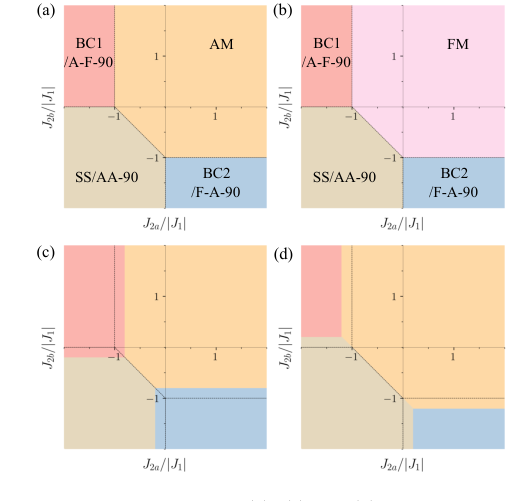 FIG. 4. Phase diagrams: (a), (c) and (d) for J1 < 0 with J3 = −0, 0.1|J1|and 0.1|J1| respectively and (b) for J1 > 0 with J3 = 0. The blue lines in (c) and (d) are the phase boundaries for J3 = 0
Secondly, the DFT calculations on real ILL compounds (Table I and Fig. 5) offer compelling, undeniable evidence that their theoretical model aligns with experimental reality. For example, La$_2$O$_3$Mn$_2$Se$_2$ is correctly predicted to be altermagnetic with nearly isotropic $J_2$ values, consistent with experimental findings. More strikingly, the vanadium-based compounds KV$_2$Se$_2$O and RbV$_2$Te$_2$O, both experimentally confirmed as metallic room-temperature altermagnets, are accurately captured by the model, exhibiting stable AM phases and large ferromagnetic $J_{2a}$ interactions that explain their high Néel temperatures. This consistency across diverse materials validates the predictive power of their approach.
A significant discovery is the identified trend linking d-shell filling to magnetic order: materials with $d^x$ configurations where $x < 5$ show a clear propensity for altermagnetism. This empirical rule, while not yet fully microscopically explained, provides a powerful guideline for future material design.
The case of Sr$_2$CrO$_2$Cr$_2$OAs$_2$ stands out as a particularly strong piece of evidence. This compound, which was previously experimentally determined to have a magnetic ordering, is now recognized as altermagnetic by the authors' analysis. Their calculations confirm its AM ground state, stabilized by a dominant $J_1$ interaction, and reveal a remarkably large anisotropy between $J_{2a}$ and $J_{2b}$ (one negative, one positive, both large in magnitude). This strong anisotropy is directly linked to the "gigantic chiral magnon splitting" observed in its magnon spectra. The coexistence of altermagnetic and antiferromagnetic layers in this heterostructure, coupled with an exceptionally high Néel temperature (approximately 600 K), provides robust proof of the unique properties that can emerge in ILL systems.
Finally, the magnon spectra calculations (Fig. 8) definitively confirm that chiral splittings are directly correlated with the anisotropy between inequivalent $J_2$ interactions. La$_2$O$_3$Mn$_2$Se$_2$ with its isotropic $J_2$ shows subtle splitting, while RbV$_2$Te$_2$O and especially Sr$_2$CrO$_2$Cr$_2$OAs$_2$ (with its extreme $J_{2a}$ and $J_{2b}$ difference) exhibit much larger splittings, exceeding half of the total magnon band width at certain points. This direct quantitative link between $J_2$ anisotropy and chiral magnon splitting is a key triumph of the paper.
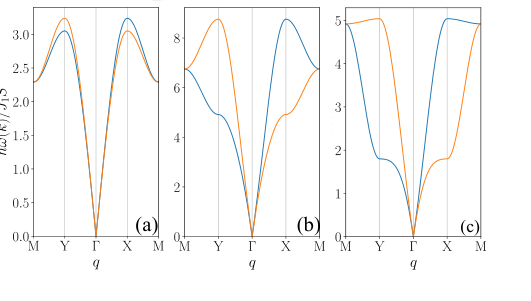 FIG. 8. Magnon spectra along high symmetry directions for (a) La2O3Mn2Se2, (b) RbV2Te2O, and (c) Sr2CrO2Cr2OAs2 where we only consider magnons in the ILL layer
Limitations & Future Directions
While this paper presents a compelling analysis and significant findings regarding Inverse Lieb Lattice materials, it also acknowledges several limitations that naturally open doors for future research.
One clear limitation arises from the inherent complexity of magnetic interactions. For some compounds, such as La$_2$O$_3$Co$_2$Se$_2$, the theoretical Heisenberg model, despite correctly predicting non-altermagnetism, fails to reproduce the distinct magnetic states observed experimentally. This suggests that the true ground state in such cases likely involves additional interactions beyond the simple Heisenberg model, such as biquadratic interactions or single-ion anisotropy effects, which are typically weaker but become decisive in resolving continuous degeneracies. Future work could focus on incorporating these secondary interactions more explicitly into the models to achieve higher fidelity with experimental observations.
Another limitation, particularly noted for Sr$_2$CrO$_2$Cr$_2$OAs$_2$, is that the Green's function method for calculating exchange parameters yielded results strongly dependent on the reference magnetic configuration. This necessitated using a total-energy-mapping approach instead, indicating that accurately determining these parameters for all complex systems remains a challenge. Further methodological advancements in calculating exchange interactions, especially in systems with strong correlations or complex magnetic orders, would be highly beneficial.
The current magnon spectra analysis for Sr$_2$CrO$_2$Cr$_2$OAs$_2$ was restricted to the ILL plane, with the acknowledgment that a full treatment incorporating multi-plane interactions is beyond the scope of this work. This is a clear direction for future studies, especially for heterostructures where interlayer couplings, even if weak, could introduce new phenomena or modify existing ones. Understanding how these inter-plane interactions influence the overall magnetic and electronic properties, particularly in the context of chiral magnons, is a fascinating avenue.
Furthermore, the paper notes that a simple microscopic explanation for all observed trends, such as the crucial role of d-band filling in shaping magnetic interactions and generating altermagnetism, has not yet been found. While the empirical trend ($d^x$ with $x < 5$ favoring AM) is very helpful, a deeper theoretical understanding of the underlying quantum mechanical mechanisms would provide more robust predictive power and guide rational material design.
Looking forward, the findings in this paper stimulate several discussion topics for future development:
- Rational Material Design: How can we leverage the identified trends, particularly the link between d-shell filling and altermagnetism, to rationally design new high-temperature metallic ILL altermagnets with tailored properties? This could involve exploring new transition metal ions, filler layers, and structural modifications to fine-tune exchange interactions and enhance desired altermagnetic characteristics.
- Exploration of Degenerate Ground States: Given the continuous degeneracies observed in the Heisenberg model, a critical area for future research is to systematically investigate the role of subtle secondary interactions (e.g., spin-orbit coupling, biquadratic exchange, magnetocrystalline anisotropy) in selecting the true ground state. This could involve advanced theoretical methods and precise experimental probes.
- Device Applications of Chiral Magnons: The "gigantic chiral magnon splitting" observed in Sr$_2$CrO$_2$Cr$_2$OAs$_2$ is particularly exciting. How can this phenomenon be harnessed for novel spintronic devices? This could involve exploring magnon-based information processing, energy-efficient data storage, or even quantum computing applications, especially given the high Néel temperatures observed in some ILL altermagnets.
- Interplay with Other Quantum Phenomena: The structural and chemical flexibility of ILL materials, combined with their altermagnetic properties, suggests potential for interplay with other quantum phenomena. Could ILL altermagnets exhibit novel topological states, superconductivity, or thermoelectric effects? Investigating these connections could lead to the discovery of new multifunctional materials.
- Experimental Verification of Predictions: For compounds like V$_2$Se$_2$O, where theoretical calculations suggest altermagnetism but experimental data is lacking, future efforts should focus on synthesizing these materials and conducting comprehensive experimental characterization to confirm their magnetic ground states and properties. This would further solidify the predictive power of the theoretical models.
- Beyond Collinear Altermagnetism: The paper mentions "supercell altermagnets" and the possibility of AM involving non-zero q-vectors. This hints at a broader landscape of altermagnetic orders. Future work could delve into the theoretical and experimental exploration of these more complex altermagnetic structures and their unique properties.
Connections to Other Fields
Mathematical Skeleton
This work's pure mathematical core involves analyzing the ground states and low-energy excitations of a Heisenberg spin Hamiltonian on a geometrically frustrated lattice, specifically the Inverse Lieb Lattice. It investigates how anisotropic exchange interactions, particularly $J_1$ and $J_2$ (split into $J_{2a}$ and $J_{2b}$), determine complex magnetic phase diagrams and induce chiral splittings in magnon spectra.
Adjacent Research Areas
Frustrated Magnetism
The paper delves into the consequences of "significant frustration" arising from competing exchange interactions on the Inverse Lieb Lattice, leading to a "complex competition between different magnetic phases" and "continuous ground state degeneracy." This directly connects to the broader field of frustrated magnetism, where competing interactions prevent the system from simultaneously satisfying all bonds, often resulting in highly degenerate ground states, exotic orders, and sensitivity to small perturbations. The phase diagrams presented, showing transitions between altermagnetic, single-stripe, and block-checkerboard phases based on ratios of $J_1$, $J_{2a}$, and $J_{2b}$, are characteristic of studies in frustrated spin systems. A foundational understanding of such phenomena can be found in works like Introduction to Frustrated Magnetism (Lacroix, Mendels, & Mila, 2011, Springer).
Topological Magnonics
A key finding of this research is the identification of "enormous chiral magnon splitting" in the magnon spectra, directly correlated with the anisotropy between inequivalent $J_2$ interactions. This establishes a clear link to the rapidly developing field of topological magnonics, which explores the topological properties of spin waves (magnons) and their potential for dissipationless transport. The mechanism described, where crystal symmetry-induced anisotropy in exchange couplings leads to magnon chirality, is a central theme in designing and understanding systems with topological magnon bands. This connection is exemplified by studies on chiral magnons in altermagnets, such as those discussed by Z. Liu et al. (2024, Physical Review Letters [28]) for MnTe, and the theoretical framework for interaction-induced topology in magnons by M. Gohlke et al. (2023, Physical Review Letters [29]), both cited within the paper.
Quantum Phase Transitions in Lattice Models
The systematic construction of magnetic phase diagrams by varying the ratios of exchange coupling parameters ($J_{2a}/J_1$, $J_{2b}/J_1$) to identify stable magnetic ground states (e.g., altermagnetic, single-stripe, block-checkerboard, ferromagnetic) is a core methodology in the study of quantum phase transitions in lattice models. This approach, which maps a parameter space to distinct phases and their boundaries, is fundamental to understanding how competing interactions drive transitions between different ordered states. The paper's analysis of how d-shell filling and crystal field environments influence exchange interaction profiles and thus the resulting magnetic order, is a practical application of these theoretical frameworks to real materials. This is a common practice in theoretical condensed matter physics, often seen in the analysis of Hubbard or Heisenberg models on various lattices, as detailed in texts like S. Sachdev's Quantum Phase Transitions (2011, Cambridge University Press).