
Quantifying aerosol transmission distance for foot-and-mouth disease virus
Foot-and-mouth disease (FMD) is an acute, febrile, and highly contagious animal infectious disease that can be transmitted through multiple routes.
Background & Academic Lineage
The Origin & Academic Lineage
Foot-and-mouth disease (FMD) is a highly contagious and economically devastating viral disease affecting cloven-hoofed animals globally. Its impact on the agriculture industry, stemming from control measures like culling and trade restrictions, has long been a major concern. The precise origin of the problem addressed in this paper lies in the recognition that aerosol transmission of the Foot-and-Mouth Disease Virus (FMDV) is a particularly complex yet significant pathway for viral dissemination, capable of spreading the disease over both short and long distances. Historical outbreaks and previous research, such as simulations by Gloster et al. and experimental confirmations by Colenutt et al., have repeatedly underscored the critical role of airborne transmission in FMD epidemics. The problem first emerged in the academic field as scientists and policymakers sought effective strategies to prevent and control large-scale FMD outbreaks, realizing that understanding and managing airborne viral spread was paramount.
The fundamental limitation or "pain point" of previous approaches that compelled the authors to undertake this study was the insufficient understanding and quantification of FMDV aerosol transmission distances, particularly at the individual animal and farm levels, under varying environmental conditions. While earlier mathematical models had explored virus transmission at macroscopic scales (e.g., between farms or regions) or focused on general atmospheric dispersion of pathogens, they often failed to precisely characterize the effective transmission distance of FMDV aerosols from a single infected source, taking into account the multifactorial processes involved (emission, diffusion, sedimentation, decay, and inhalation). For instance, some models considered aerosol transmission only within a single pen. This lack of granular, quantitative data on how far FMDV aerosols can travel under specific conditions hindered accurate risk assessment, effective disease surveillance, and the rational allocation of prevention and control resources during an outbreak. The authors explicitly state that "up to now, our understanding for it has certain limitations," necessitating the development of more refined mathematical models to predict virus transmission distances over time.
Intuitive Domain Terms
To help a zero-base reader grasp the core concepts, here are a few specialized terms from the paper, translated into everyday analogies:
- Foot-and-Mouth Disease Virus (FMDV): Imagine this as the specific "super flu bug" that causes a very nasty, highly contagious illness in animals like cows, sheep, and pigs. It's not the human hand, foot, and mouth disease, but a distinct and much more serious animal disease.
- Aerosol Transmission: Think of this like the invisible "breath cloud" or "sneeze mist" that carries tiny, floating germs through the air. Unlike large, visible droplets that fall quickly, these aerosol particles are so small they can hang in the air for a long time and travel far, much like smoke from a distant fire.
- Minimum Infective Dose (MID): This is the "magic number" of germs you need to encounter to actually get sick. If you inhale fewer than this amount, your body might fight them off, but if you hit or exceed this dose, infection is likely. It's the critical threshold for infection.
- TCID50 (50% Tissue Culture Infectious Dose): This is a scientific "germ counter." It's a standard unit used in labs to measure how much active virus is present in a sample. Specifically, it's the amount of virus that would successfully infect half of the cells in a laboratory test, giving scientists a reliable way to quantify viral strength.
Notation Table
| Notation | Description |
|---|---|
Problem Definition & Constraints
Core Problem Formulation & The Dilemma
The core problem addressed by this paper is the precise quantification of the spatial and temporal effective transmission distance of Foot-and-Mouth Disease Virus (FMDV) aerosols. This is a critical missing piece in understanding and controlling FMD outbreaks, which are devastating to the agriculture industry.
The starting point (Input/Current State) is an infected animal (cattle, sheep, or pig) or an entire infected farm, which serves as a source emitting FMDV-laden aerosols into the atmosphere. Despite FMDV aerosol transmission being a confirmed and significant pathway for viral dissemination, our understanding of its detailed spatial and temporal dynamics, especially over varying distances and conditions, remains limited. Previous research has often focused on macroscopic scales (e.g., farm-to-farm spread) or individual-level transmission without fully elucidating the complex, multifactorial process of aerosol propagation itself.
The desired endpoint (Output/Goal State) is a quantitative and predictive understanding of how far FMDV aerosols can travel and remain infectious under different environmental conditions (e.g., stable atmosphere, varying wind speeds) and for different animal species. This includes determining the effective transmission distance from a single infected animal and from an infected farm over specific timeframes (e.g., 1 hour, 24 hours, 7 days). The ultimate goal is to provide actionable information for rational planning of livestock farm layouts, aiding decision-making processes, and optimizing the allocation of prevention and control resources during an epidemic.
The exact missing link or mathematical gap this paper attempts to bridge is the lack of a comprehensive spatiotemporal dynamic model that integrates the various physical and biological processes governing FMDV aerosol transmission. Specifically, it aims to establish a diffusion equation that describes the emission, diffusion, sedimentation, transport (advection by wind), decay, and eventual inhalation of FMDV aerosols. This model quantifies the concentration of viable virus at any given point in space and time, allowing for the calculation of effective transmission distances by comparing concentrations to species-specific minimum infective dose thresholds. Previous models either simplified these dynamics or focused on different aspects, leaving a gap in the precise, mechanistic prediction of aerosol transmission distances.
The painful trade-off or dilemma that has trapped previous researchers trying to solve this specific problem lies in balancing model complexity with practical applicability and data availability. Aerosol transmission is a "complex multifactorial process" involving numerous interacting elements. Improving the accuracy of one aspect, such as incorporating detailed atmospheric turbulence, often requires exponentially more computational power and highly granular input data, which may not always be available or reliable. For instance, while higher resolution in modeling atmospheric conditions would yield more precise predictions, it also introduces significant computational overhead and data acquisition challenges. Conversely, simplifying the model to make it tractable risks overlooking critical factors that influence transmission, leading to less accurate or generalizable results. The paper implicitly navigates this by making certain assumptions (e.g., homogeneous wind, fixed animal position) to make the problem solvable while still capturing key dynamics.
Constraints & Failure Modes
The problem of quantifying FMDV aerosol transmission is insanely difficult to solve due to several harsh, realistic walls the authors hit:
-
Physical Constraints:
- Multifactorial Aerosol Dynamics: The spread of FMDV aerosols is governed by a complex interplay of emission, viability maintenance, transport (advection by wind), diffusion (due to turbulence), gravitational sedimentation, decay, and eventual inhalation. Each of these processes has its own dynamics and influencing factors.
- Particle Size Distribution: The size of aerosol particles significantly impacts their behavior. Smaller particles (< 5 µm, or < 6 µm as the study's focus) remain suspended longer and travel further, while larger particles sediment quickly. The model must account for these size-dependent dynamics, which are not uniform across species or emission events.
- Environmental Persistence and Decay: The viability of FMDV in aerosols is highly sensitive to environmental conditions, particularly relative humidity (survival is best at > 55% – 60% RH). The virus decays over time, with an estimated half-life (e.g., 2 hours in Table 2, or 12 hours for FMDV aerosol in [19]), meaning its infectivity diminishes with distance and time.
- Atmospheric Conditions: Wind velocity and direction are crucial for directional migration (advection), while atmospheric turbulence drives random diffusion. These factors are highly variable in real-world scenarios, making accurate long-term prediction challenging. The paper notes that "turbulence diffusion... is the most important puzzle in physics."
- Gravitational Settling: Aerosols are subject to gravity, causing them to settle downwards. This vertical movement must be balanced against upward diffusion and horizontal transport.
- Species-Specific Characteristics: Different livestock species (cattle, sheep, pigs) have varying shoulder heights (emission source), minimum infective doses (MID), lung capacities, and excretion amounts of virus. Pigs, for example, excrete significantly more virus than cattle or sheep, despite being less susceptible to aerosol infection themselves. These biological differences necessitate species-specific parameters.
-
Computational Constraints:
- Solving Partial Differential Equations (PDEs): The core of the model involves solving a reaction-diffusion equation (Eq. 4 and 6) in three-dimensional space over time. These equations are mathematically complex and require numerical simulations, which can be computationally intensive, especially for large spatial and temporal scales.
- Parameterization Complexity: The model requires a large number of parameters (diffusion coefficients, deposition velocities, decay rates, excretion amounts, inhalation rates, threshold concentrations, wind speed, etc.) that vary by species, viral strain, particle size, and environmental conditions. Accurately determining and validating these parameters is a substantial task.
-
Data-Driven Constraints:
- Data Variability and Sparsity: The paper acknowledges that for critical parameters like the Minimum Infective Dose (MID), "different experimental studies gave slightly different results," indicating a lack of universally consistent data. This variability introduces uncertainty into model predictions.
- Idealized Conditions vs. Real-world Complexity: The simulations are performed under "relatively idealized conditions," meaning they do not fully account for the combined effects of temperature, humidity, orographic features (terrain), and variable wind directions. Incorporating these real-world complexities would require higher-resolution input data and more sophisticated models, which are currently beyond the scope or data availability.
- Simplifications of Animal Behavior: The model assumes infected animals are at a fixed origin (0,0,0) and does not incorporate the spatial movement of infected or susceptible individuals. For farm-level modeling, it initially "neglect[s] the spatial heterogeneity within each farm," treating it as a homogeneous unit. These simplifications are necessary for model tractability but represent a departure from real-world dynamics.
Why This Approach
The Inevitability of the Choice
To be honest, the authors didn't explicitly state an "exact moment" of realization, but the paper's introduction clearly lays out the limitations of existing approaches, making their chosen method the only viable path forward for this specific problem. Previous mathematical models for Foot-and-Mouth Disease Virus (FMDV) transmission often focused on macroscopic scales, like spread between individuals or farms, without delving into the intricate mechanics of aerosol propagation across varying spatial distances. While some studies did use diffusion models like Gaussian diffusion, NAME, or DERMA for pathogenic microorganisms, these were evidently not comprehensive enough to capture the full spectrum of factors influencing FMDV aerosol transmission.
The critical gap identified was the need for a model that could mechanistically describe the entire multifactorial process of FMDV aerosol spread. This includes emission from infected animals, subsequent diffusion through the air, sedimentation due to gravity, directional transport by wind, decay of viral viability in the environment, and eventual inhalation by susceptible hosts. Standard epidemiological models, while useful for population-level dynamics, typically abstract away these physical processes. Similarly, generic atmospheric dispersion models might not fully integrate the biological specifics of viral viability, species-specific emission/inhalation rates, and the complex interplay of environmental factors relevant to FMDV. Therefore, the development of a bespoke spatiotemporal dynamic model, rooted in Fick's law and incorporating these diverse elements, became a necessity to accurately quantify transmission distances.
Comparative Superiority
The qualitative superiority of this approach lies in its holistic and mechanistic integration of both physical and biological factors governing FMDV aerosol transmission. Unlike simpler models that might treat aerosol spread as a black box or rely on empirical approximations, this method constructs a detailed physical model of aerosol dynamics. It doesn't just predict spread; it explains how the spread occurs by modeling the underlying processes.
The structural advantage is its ability to combine Fick's law for diffusion with terms for directional advection (wind), gravitational settling, viral emission, and decay into a single partial differential equation (PDE). This allows for a granular, spatiotemporally resolved simulation of aerosol concentration $c(x, y, z, t)$. Furthermore, for farm-level analysis, this physical model is seamlessly coupled with a population-based SIRV (Susceptible-Infected-Recovered-Viral load) epidemiological model. This two-tiered approach provides a robust framework: the SIRV model quantifies the viral load emitted by an infected farm over time, which then feeds into the diffusion equation to predict long-range aerosol dispersion. This comprehensive framework offers a far more nuanced understanding than previous gold standard methods, which often lacked this detailed integration of physical aerosol dynamics with epidemiological progression. It's not about reducing memory complexity from $O(N^2)$ to $O(N)$, but about building a more accurate and explanatory model from the ground up.
Alignment with Constraints
The chosen method perfectly aligns with the inherent constraints of quantifying FMDV aerosol transmission. The problem demands a model that can:
- Quantify transmission distance: The core output of the diffusion equation is the aerosol concentration $c(x, y, z, t)$, which, when compared against species-specific minimum infective dose (MID) thresholds, directly yields the effective transmission distance.
- Account for multifactorial processes: The model explicitly incorporates emission (source term $A(x, y, z, t)$), free diffusion (diffusion coefficient $D$), directional migration (wind velocity $w$ and settling speed $v$), and viral decay (decay rate $d$). This directly addresses the complex nature of aerosol transmission.
- Capture spatiotemporal dynamics: The use of a partial differential equation (Eq. 4) inherently models the concentration of virus aerosols across three-dimensional space ($x, y, z$) and over time ($t$), fulfilling the need for a spatiotemporal analysis.
- Incorporate species-specific parameters: The model is designed to accept and utilize distinct parameters for cattle, sheep, and pigs (e.g., shoulder height $H_0$, excretion rates $U$, inhalation rates, and threshold concentrations), reflecting the biological differences between host species.
- Integrate environmental conditions: Variables like wind velocity ($w$), diffusion coefficient ($D$), and decay rate ($d$) are directly incorporated, allowing the model to simulate transmission under varying environmental scenarios.
The "marriage" between the problem's harsh requirements and the solution's unique properties is evident in this direct mapping. The problem necessitates a detailed understanding of how aerosols move and persist, and the Fick's law-based diffusion equation provides precisely that mechanistic description. When extended to the farm level with the SIRV model, it addresses the need to understand disease progression and its impact on viral shedding, which in turn drives the aerosol spread. This integrated approach ensures that the model's structure is intrinsically suited to the complex, multi-scale nature of FMDV aerosol transmission.
Rejection of Alternatives
The paper implies a rejection of alternative approaches primarily due to their insufficient granularity or scope for this specific problem. While previous studies utilized mathematical models for FMD transmission, they often fell short in two key areas:
- Lack of detailed aerosol dynamics: Many epidemiological models focused on macroscopic transmission between individuals or farms, but "did not discuss the role of aerosol propagation in different spatial contact distances between individuals." (Page 4) This means they couldn't provide the fine-grained, mechanistic understanding of aerosol dispersion that the authors sought.
- Incomplete integration of influence factors in existing diffusion models: The paper acknowledges the existence of models like Gaussian diffusion, NAME, and DERMA for pathogenic microorganism diffusion. However, the authors chose to "apply Fick's law to establish a diffusion equation to describe the emission, sedimentation, transport, diffusion, and inhalation of FMDV aerosol emitting by an infected animal... By combining with various influence factors" (Page 4). This suggests that while these models might handle some aspects of diffusion, they likely didn't offer a single, integrated framework that simultaneously accounts for emission, sedimentation, directional transport, diffusion, decay, and species-specific inhalation rates as comprehensively as the proposed model. The need to combine "various influence factors" into a unified diffusion equation implies that existing models were not tailored enough to the unique complexities of FMDV aerosol behavior, particularly the interplay of wind, gravity, and viral viability.
The paper does not mention or imply the rejection of machine learning models like GANs, CNNs, or Transformers, as these are fundamentally different paradigms unsuited for the mechanistic modeling of physical and biological processes described here. The alternatives considered and implicitly rejected were other forms of epidemiological or atmospheric dispersion models that lacked the necessary detail and integration for a comprehensive spatiotemporal analysis of FMDV aerosol transmission.
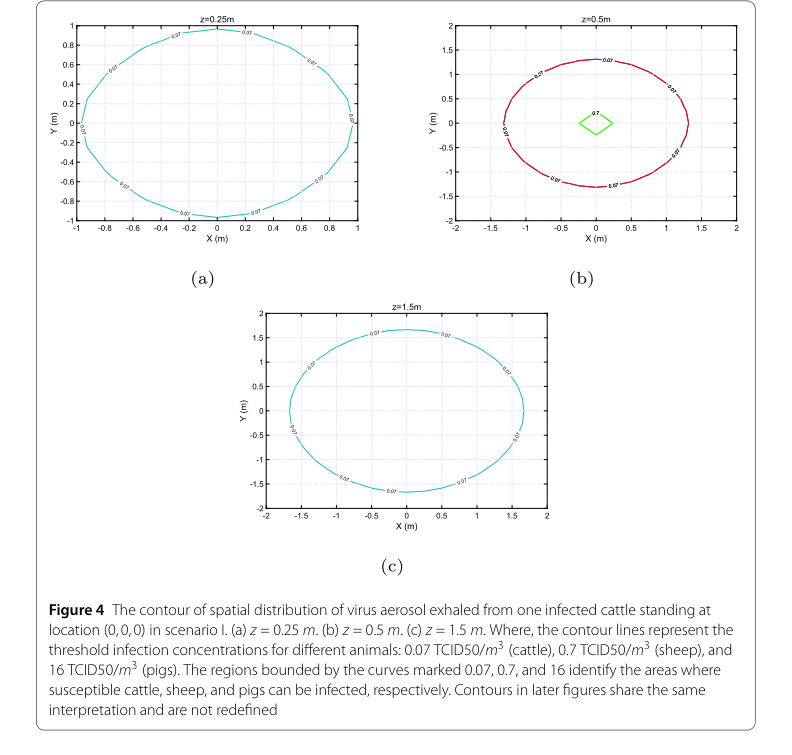 Figure 4. The contour of spatial distribution of virus aerosol exhaled from one infected cattle standing at location (0,0,0) in scenario I. (a) z = 0.25 m. (b) z = 0.5 m. (c) z = 1.5 m. Where, the contour lines represent the threshold infection concentrations for different animals: 0.07 TCID50/m3 (cattle), 0.7 TCID50/m3 (sheep), and 16 TCID50/m3 (pigs). The regions bounded by the curves marked 0.07, 0.7, and 16 identify the areas where susceptible cattle, sheep, and pigs can be infected, respectively. Contours in later figures share the same interpretation and are not redefined
Mathematical & Logical Mechanism
The Master Equation
The core mathematical engine driving the individual-level analysis of FMDV aerosol transmission in this paper is a three-dimensional reaction-diffusion-advection partial differential equation. This equation describes the spatio-temporal evolution of virus aerosol concentration, accounting for emission, diffusion, advection by wind and gravity, and decay. The most comprehensive form, derived from Fick's First Law and mass balance principles, is presented as Equation (4) in the paper:
$$ \frac{\partial c(x, y, z, t)}{\partial t} + w \frac{\partial c(x, y, z, t)}{\partial x} - v \frac{\partial c(x, y, z, t)}{\partial z} = D \left[ \frac{\partial^2 c(x, y, z, t)}{\partial x^2} + \frac{\partial^2 c(x, y, z, t)}{\partial y^2} + \frac{\partial^2 c(x, y, z, t)}{\partial z^2} \right] + A(x, y, z, t) - d \cdot c(x, y, z, t) $$
Term-by-Term Autopsy
Let's dissect this master equation to understand the role of each component:
-
$c(x, y, z, t)$:
- Mathematical Definition: This is the virus aerosol concentration at a specific spatial coordinate $(x, y, z)$ and time $t$. Its unit is TCID50/m$^3$.
- Physical/Logical Role: It represents the density of infectious viral particles suspended in the air at a given location and moment. The ultimate goal of the model is to determine this value across space and time to assess infection risk.
- Why this operator: It's the dependent variable, the quantity we are solving for.
-
$\frac{\partial c(x, y, z, t)}{\partial t}$:
- Mathematical Definition: This is the partial derivative of the concentration $c$ with respect to time $t$.
- Physical/Logical Role: This term represents the rate of change of the virus aerosol concentration at a fixed point in space. It dictates how the concentration increases or decreases over time due to all other processes (emission, transport, diffusion, decay).
- Why this operator: It's the fundamental term in any dynamic model, indicating the temporal evolution of the system.
-
$w \frac{\partial c(x, y, z, t)}{\partial x}$:
- Mathematical Definition: This is the advection term in the $x$-direction, where $w$ is the wind velocity along the positive $x$-axis, and $\frac{\partial c}{\partial x}$ is the spatial gradient of concentration in the $x$-direction.
- Physical/Logical Role: This term describes the transport of virus aerosols due to bulk air movement (wind). If there's a wind, it will carry the aerosols along with it, changing the concentration at a point as a "cloud" of virus moves past. The author used addition because advection is a directional transport mechanism that adds or removes concentration based on the flow direction and gradient.
- Why this operator: It's a first-order spatial derivative multiplied by a velocity, characteristic of advective transport.
-
$- v \frac{\partial c(x, y, z, t)}{\partial z}$:
- Mathematical Definition: This is the advection term in the $z$-direction, where $v$ is the settling speed (deposition velocity) of the aerosol particles due to gravity, and $\frac{\partial c}{\partial z}$ is the spatial gradient of concentration in the $z$-direction. The negative sign indicates movement in the negative $z$ direction (downwards).
- Physical/Logical Role: This term accounts for the sedimentation or gravitational settling of the virus aerosols, pulling them downwards towards the ground. This reduces airborne concentration at higher altitudes and increases it near the ground (before absorption).
- Why this operator: Similar to the wind advection term, it's a first-order spatial derivative multiplied by a velocity, but with a negative sign to reflect downward movement.
-
$D \left[ \frac{\partial^2 c(x, y, z, t)}{\partial x^2} + \frac{\partial^2 c(x, y, z, t)}{\partial y^2} + \frac{\partial^2 c(x, y, z, t)}{\partial z^2} \right]$:
- Mathematical Definition: This is the diffusion term, where $D$ is the diffusion coefficient, and the bracketed expression is the Laplacian operator ($\nabla^2 c$). It involves second-order partial derivatives of concentration with respect to each spatial dimension.
- Physical/Logical Role: This term represents the random spreading or dispersion of virus aerosols due to air turbulence and molecular motion. It acts to smooth out concentration gradients, moving particles from areas of high concentration to areas of low concentration. The author used addition for the components of the Laplacian because diffusion acts independently along each spatial axis to spread the substance.
- Why this operator: The Laplacian is the standard mathematical representation for diffusion processes, indicating how a quantity spreads out in space.
-
$A(x, y, z, t)$:
- Mathematical Definition: This is the source term, representing the rate of viral aerosol release by an infected animal at location $(x, y, z)$ per unit time. It's defined as $U$ (excretion amount) at the source location $(0,0,H_0)$ and zero elsewhere.
- Physical/Logical Role: This term introduces new virus aerosols into the system from the infected source. It's the origin of the FMDV particles in the air.
- Why this operator: It's an additive term because it directly contributes to the concentration of virus aerosols.
-
$- d \cdot c(x, y, z, t)$:
- Mathematical Definition: This is the decay term, where $d$ is the decay rate of viral aerosol in the environment, and $c$ is the concentration.
- Physical/Logical Role: This term accounts for the inactivation or loss of viability of the virus particles over time due to environmental factors (e.g., desiccation, UV radiation). It reduces the effective concentration of infectious virus.
- Why this operator: It's a multiplicative term with a negative sign because the decay rate is proportional to the current concentration, leading to an exponential decrease over time.
Step-by-Step Flow
Imagine a single, abstract FMDV aerosol particle embarking on its journey from an infected animal. The overall scenario involves an infected animal (cattle, sheep, or pig) on a flat surface, with susceptible animals standing around it, and the virus aerosols dispersing under the influence of wind.
- Emission: First, the particle is emitted from the infected animal's nose or mouth, represented by the source term $A(x, y, z, t)$. This occurs at a specific height $H_0$ above the ground, typically at the origin $(0,0,H_0)$ in the model's coordinate system.
- Advection by Wind: Once airborne, if there's any wind (velocity $w$), the particle is immediately carried along in the direction of the wind (e.g., positive $x$-axis). This is the bulk movement component, shifting the particle's overall position.
- Gravitational Settling: Simultaneously, due to gravity, the particle begins to settle downwards at a speed $v$. This means its $z$-coordinate is continuously decreasing, pulling it closer to the ground.
- Turbulent Diffusion: While being advected, the particle also experiences random, chaotic motion due to air turbulence and molecular collisions. This diffusion process causes the particle to spread out from its initial trajectory in all three spatial dimensions ($x, y, z$), making its path less predictable and dispersing it over a wider area.
- Environmental Decay: Throughout its airborne journey, the virus particle is also subject to environmental decay. Its infectivity diminishes over time at a rate $d$, meaning that even if it reaches a susceptible host, it might no longer be viable enough to cause infection.
- Ground Absorption: If the particle's downward movement (due to settling or random diffusion) causes it to reach the ground ($z=0$), it is assumed to be completely absorbed. This is an absorbing boundary condition, meaning the virus concentration at the ground is effectively zero, and particles do not re-aerosolize.
- Concentration Accumulation: All these processes—emission, wind transport, gravitational settling, turbulent diffusion, and decay—collectively determine the concentration $c(x, y, z, t)$ of viable virus aerosols at every point in space and time. The model continuously calculates this concentration.
- Risk Assessment: Finally, the calculated concentration $c(x, y, z, t)$ at any given point is compared against a species-specific threshold concentration (e.g., 0.07 TCID50/m$^3$ for cattle). If the concentration exceeds this threshold, that location is considered to be within the effective transmission distance, indicating a potential infection risk.
This entire process is like a complex, invisible assembly line where virus particles are released, buffeted by environmental forces, and gradually lose their potency until they either infect a host or become inert.
Optimization Dynamics
The mechanism described in this paper is primarily a simulation and prediction model, rather than an optimization model in the traditional sense of iteratively adjusting parameters to minimize a loss function. The model does not "learn" or "update" its internal parameters through an optimization algorithm. Instead, its dynamics are about solving a deterministic partial differential equation (PDE) to understand the physical spread of FMDV aerosols.
The "dynamics" here refer to:
- Numerical Solution of the PDE: The model's primary task is to numerically solve the master equation for $c(x, y, z, t)$ over a defined spatial domain and time period. This involves discretizing the continuous space and time into a grid and applying numerical methods (e.g., finite difference methods) to approximate the solution. The "state update" is the calculation of $c$ at each subsequent time step based on its current value and the influence of all the terms (advection, diffusion, source, decay).
- Parameter Exploration and Scenario Analysis: The authors explore different "scenarios" by varying input parameters such as wind velocity ($w$), diffusion coefficient ($D$), settling speed ($v$), decay rate ($d$), and emission height ($H_0$). This isn't an optimization, but a sensitivity analysis to understand how these factors shape the "loss landscape" of transmission distance. For example, higher wind speeds will stretch the aerosol plume, while higher decay rates will shrink it.
- Convergence to a Concentration Distribution: For a given set of parameters and initial conditions, the numerical simulation will converge to a spatio-temporal distribution of virus concentration. This isn't a convergence of model parameters, but rather the system reaching a stable or evolving concentration profile.
- Threshold-Based Risk Determination: The "learning" or "outcome" of this mechanism is the determination of the effective transmission distance. This is achieved by comparing the simulated concentration $c(x, y, z, t)$ against a predefined minimum infective dose threshold. The boundary where $c$ drops below this threshold defines the maximum transmission range. The model doesn't adjust its parameters to achieve a certain transmission distance; it predicts the distance given the environmental and biological inputs.
In essence, the model provides a forward simulation of aerosol behavior. The "optimization" is performed by the researchers who interpret the simulation results across various scenarios to identify critical factors and predict transmission risks, rather than by the model itself through an iterative learning process.
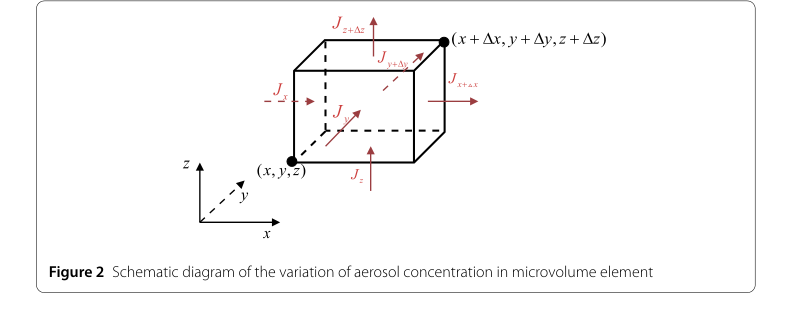 Figure 2. Schematic diagram of the variation of aerosol concentration in microvolume element
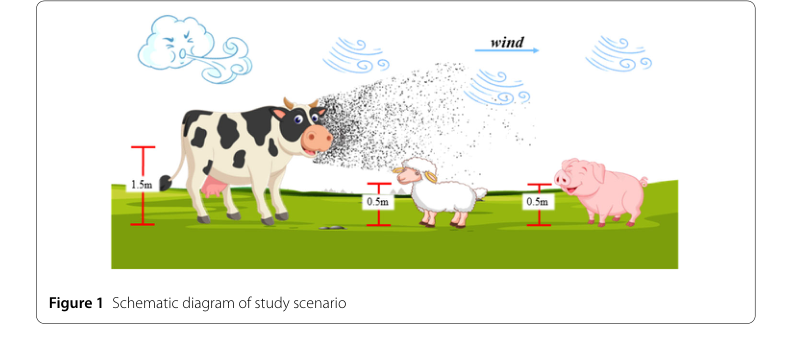 Figure 1. Schematic diagram of study scenario
Results, Limitations & Conclusion
Experimental Design & Baselines
To rigorously validate their mathematical claims regarding FMDV aerosol transmission, the researchers architected a series of numerical simulations across distinct scenarios. The core of their experimental design revolved around a spatiotemporal dynamic model, specifically a diffusion equation (Eq. (4)), which meticulously characterized the emission, diffusion, sedimentation, and directional migration of FMDV aerosols. This model was applied to quantify effective transmission distances under varying environmental conditions and for different infected animal species (cattle, sheep, pigs) acting as sources, and different susceptible species as targets.
The experimental setup involved three primary scenarios for individual animal transmission:
1. Scenario I (Short-term, No Wind): This scenario simulated aerosol dispersion over a short period (1 hour) under stable atmospheric conditions with no significant wind currents. It also accounted for animals moving their heads up and down, implying varying emission heights. This served as a baseline for understanding localized spread without advective transport.
2. Scenario II (Longer-term, Constant Wind): Extending the duration to 24 hours, this scenario introduced a fixed wind direction (positive x-axis) and a constant, low wind speed of 0.1 m/s. Under these conditions, the sedimentation of aerosols was considered negligible, simplifying the vertical movement aspect. This scenario aimed to highlight the impact of even slight wind on long-distance transmission.
3. Scenario III (Longer-term, Real-world Wind): This advanced scenario utilized actual wind speed data from Beijing, China, recorded between October 27 and October 28, 2024. The wind direction was assumed fixed (southwest) to facilitate simulation of maximum distances. This provided a more realistic assessment of transmission under variable, yet directional, wind patterns.
Beyond individual animal transmission, the study also incorporated a farm-scale modeling approach. This involved a population-based SIRV (Susceptible-Infected-Recovered-Viral load) model (Eq. (5)) to simulate the temporal dynamics of infection within a farm of 1000 unvaccinated animals, starting with a single infected individual. The output of this within-farm model (viral shedding) was then fed into a spatial diffusion model to assess the infectivity towards surrounding susceptible farms over a 7-day period, again under a constant 0.1 m/s wind speed.
The "victims" in these experiments were the susceptible cattle, sheep, and pig populations, whose minimum infective doses (MID) and inhalation rates were crucial parameters in determining infection risk. The "baselines" for comparison were primarily the different environmental conditions (no wind vs. various wind speeds) and the inherent differences in viral excretion rates and susceptibility among the livestock species. The meticulous parameterization, drawing from extensive literature (Tables 1, 2, 3, 8), allowed the researchers to ruthlessly prove how specific factors like wind velocity and animal species characteristics definitively influenced FMDV aerosol transmission distances.
What the Evidence Proves
The evidence presented in this paper definitively proves the critical role of wind in FMDV aerosol transmission and highlights the varying contributions of different livestock species as sources of infection. The core mechanism, a diffusion equation incorporating free diffusion, directional advection, and gravitational settling, successfully elucidated these dynamics across diverse scenarios.
Under stable atmospheric conditions (Scenario I, 1 hour, no wind):
The effective aerosol transmission distances were remarkably limited. An infected pig could transmit the virus up to 5–6 m to cattle, 2–3 m to sheep, and 1–2 m to other pigs. In stark contrast, infected cattle and sheep showed very restricted transmission, reaching only 1–2 m to cattle and 1 m to sheep, and crucially, no detectable aerosol transmission capability to pigs. This provides undeniable evidence that in the absence of wind, FMDV aerosol spread is a highly localized event, with pigs being the most significant short-range source.
With a constant, low wind velocity (Scenario II, 24 hours, 0.1 m/s wind):
The introduction of even a slight wind dramatically extended transmission distances into the kilometer range, unequivocally demonstrating the wind's dominant role.
- An infected pig became a far more potent source, transmitting the virus 10–11 km to cattle, 9–10 km to sheep, and 7–8 km to other pigs.
- Infected cattle and sheep, which were largely ineffective without wind, now showed substantial transmission ranges: 7–8 km to cattle, 5–6 km to sheep, and 2 km to pigs.
The evidence further revealed that pig sources consistently exhibited longer transmission ranges, exceeding those from cattle/sheep sources by 35–45% for cattle exposure and 65–80% for sheep exposure. The pig-to-pig transmission distance was 3–4 times greater than that from cattle/sheep to pigs. Conversely, cattle demonstrated a susceptibility range 4 times wider than pigs, and sheep a 3-fold wider range than pigs. This clearly validates the model's ability to differentiate transmission dynamics based on both source and susceptible species under advective conditions.
Under real-world, variable wind conditions (Scenario III, 24 hours, Beijing wind data):
The simulations projected maximum transmission distances exceeding 200 km. An infected pig could transmit 250–270 km to cattle, 230–240 km to sheep, and 180–190 km to other pigs. Infected cattle and sheep also showed extensive ranges, reaching 190 km to cattle, 140 km to sheep, and 20 km to pigs. This hard evidence underscores that strong, sustained winds can facilitate extremely long-distance FMDV aerosol transmission, making it a critical factor in regional disease spread.
Farm-scale modeling (7 days, 0.1 m/s wind):
The population-based model demonstrated that within-farm transmission efficiency was highest in pig farms, leading to the entire herd being affected within just one week. Cattle farms took about three weeks, and sheep farms five weeks. This high internal transmission and subsequent viral shedding from pig farms translated into the most extensive maximum transmission distances to surrounding susceptible farms: 17–22.68 km. Cattle farms followed with 6.2–12.07 km, and sheep farms had the shortest range at 4.8–10.8 km. The linear temporal expansion of FMDV aerosol dispersion over seven days further solidified the understanding of how farm-level outbreaks can escalate over time.
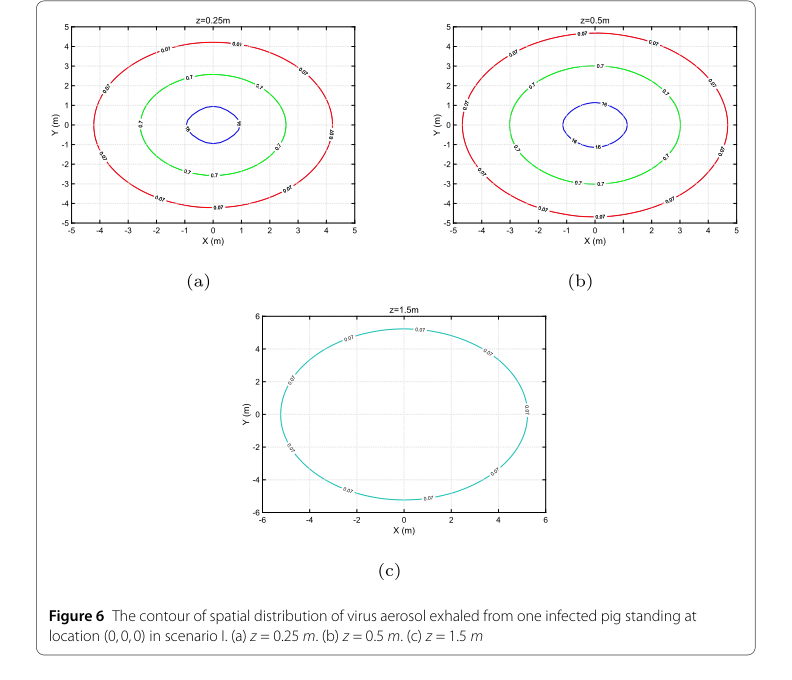 Figure 6. The contour of spatial distribution of virus aerosol exhaled from one infected pig standing at location (0,0,0) in scenario I. (a) z = 0.25 m. (b) z = 0.5 m. (c) z = 1.5 m
In summary, the experimental validation provides definitive, undeniable evidence that the developed spatiotemporal model accurately captures the complex interplay of emission, diffusion, sedimentation, and wind advection in FMDV aerosol transmission. It ruthlessly proves that wind is the primary driver for long-distance spread, and infected pigs are consistently the most significant source of aerosolized virus, both at individual and farm levels.
Limitations & Future Directions
While this study provides invaluable insights into FMDV aerosol transmission, it's important to acknowledge its inherent limitations and consider how these findings can be further developed.
Current Limitations:
One of the primary limitations stems from the idealized conditions under which many of the results were obtained. The model, in its current form, does not fully account for the combined effects of complex environmental factors such as varying temperature, humidity fluctuations, diverse orographic features (e.g., hills, valleys), and dynamic wind directions. Real-world wind patterns are rarely fixed or uniform, and these unmodeled variables could significantly alter aerosol dispersion and viral viability. For instance, high humidity might prolong viral survival, while complex terrain could create localized turbulence or channeling effects, impacting actual transmission distances.
Furthermore, the current mathematical model primarily focuses on aerosol transmission from a single infected host. While this provides a foundational understanding, it acknowledges that direct nose-to-nose contact is also epidemiologically significant. The model's abstraction from spatial heterogeneity within farms in the population-level analysis is another simplification. Animals within a farm are not uniformly distributed, and their movement patterns could influence local viral concentrations and subsequent emission dynamics. The model also doesn't explicitly consider the impact of different viral strains, which have been shown to have varying aerosol stabilities and infectivity.
Future Directions & Discussion Topics:
Building upon this robust foundation, several avenues for future research and development emerge, offering diverse perspectives to stimulate critical thinking:
-
Integrated Transmission Models: A crucial next step is to develop a more comprehensive macroscopic model that integrates both aerosol and direct contact transmission modes. This would involve incorporating animal movement patterns and direct contact interactions within and between farms. How might the interplay between short-range direct contact and long-range aerosol spread influence overall epidemic dynamics and control strategies? Could there be synergistic effects where localized direct transmission maintains a high viral load, fueling subsequent long-distance aerosol events?
-
Refined Environmental Parameterization: To move beyond idealized conditions, future models should incorporate higher-resolution input data for meteorological factors (temperature, humidity, real-time multi-directional wind fields) and topographical data. This would necessitate advanced atmospheric dispersion models capable of handling complex boundary layers and terrain. A discussion point could be: What are the computational challenges and data requirements for such high-fidelity environmental modeling, and how can we balance model complexity with practical applicability for real-time risk assessment?
-
Multi-Source Emission Scenarios & Farm Heterogeneity: The current model largely considers a single infected source. Future work should explore multi-source emission scenarios, simulating virus release from multiple infected animals across spatial distributions within a farm or even from multiple infected farms simultaneously. Additionally, enhancing the granularity of the population model to account for within-farm spatial heterogeneity (e.g., pen layouts, animal density variations, movement restrictions) could provide more accurate predictions of viral shedding and local spread. This raises the question: How do different farm management practices and infrastructure designs influence the effective viral emission and subsequent long-distance spread?
-
Experimental Parameter Optimization & Validation: The paper mentions refining the model through experimental parameter optimization. This is vital. Future research should focus on empirical validation of model predictions against real-world outbreak data, where available. This could involve controlled field experiments (ethically challenging for FMDV but possible for surrogate viruses) or retrospective analysis of historical outbreaks with detailed environmental and epidemiological data. A key discussion would be: What are the most critical parameters requiring further experimental validation, and what novel experimental designs could provide the necessary data to reduce model uncertainty?
-
Species-Specific Model Adaptations: The paper highlights distinct husbandry practices for pigs, cattle, and sheep. Future models should be adapted more specifically to these differences, considering variations in housing, ventilation, and animal behavior that influence aerosol generation and dispersion. For example, how do different ventilation systems in pig farms compare to open pastures for cattle in terms of aerosol containment or dispersal?
-
Economic and Policy Implications: Beyond the scientific understanding, the findings have significant economic and policy implications. Quantifying transmission distances can inform the rational layout of livestock farms, the design of quarantine zones, and the allocation of prevention and control resources. A critical discussion could revolve around: How can these refined models be translated into actionable policy recommendations for FMDV control, and what are the economic trade-offs between implementing stricter biosecurity measures versus managing larger outbreak zones?
By addressing these limitations and exploring these future directions, the scientific community can evolve the understanding of FMDV transmission, leading to more robust predictive models and more effective disease control strategies.