
Negativity percolation in continuous-variable quantum networks
ISOM keeps this npj Quantum Information paper in the public review set because it gives readers a concrete case around Negativity percolation in continuous-variable quantum networks through its mechanism, assumptions,...
Background & Academic Lineage
The Origin & Academic Lineage
The foundational concept of distributing quantum entanglement across vast distances, from microchips to global networks, is central to quantum information technologies. This capability underpins applications like quantum computation and secure quantum communication. The collective behavior of this entanglement distribution in large-scale systems is often modeled as a quantum network (QN). The idea of "entanglement percolation"—a conceptual bridge between entanglement distribution and classical percolation theories—first emerged in 2007, initially linking probabilistic entanglement distribution schemes to classical bond percolation. Subsequent advancements, particularly the development of deterministic entanglement transmission (DET) schemes, led to more sophisticated mappings, such as concurrence percolation theory (ConPT).
However, a significant limitation of these earlier approaches was their exclusive focus on discrete-variable (DV) quantum systems, which typically involve qubits. These models overlooked continuous-variable (CV) quantum systems, an alternative architecture that is particularly prominent in optical settings. CV systems leverage the continuous degrees of freedom of light fields (like amplitude and phase) and naturally generate Gaussian states, offering advantages such as unconditional and consistent entanglement generation, scalability, and chip-integration. The fundamental "pain point" that motivated this paper was the absence of a comprehensive framework to understand how entanglement distributes and "percolates" in these increasingly relevant CV-based QNs. Previous theories were simply not equipped to describe the unique physics of continuous quantum variables, leaving crucial questions about their collective characteristics and potential for long-range entanglement distribution unanswered. This gap meant that the distinct network physics of CV systems remained largely unexplored, hindering the development of robust, scalable CV-based quantum technologies.
Intuitive Domain Terms
- Continuous-Variable (CV) Quantum Networks (QNs): Imagine a quantum internet where instead of sending information using discrete "on/off" signals (like digital bits), we use the continuous properties of light waves, such as their exact brightness or phase. CV QNs are like a quantum internet built with these "analog" light signals, which are naturally generated by optical platforms.
- Entanglement Percolation: Think of it like a chain reaction. If you have a network of individual quantum connections (like links in a chain), entanglement percolation describes how many of these connections need to be strong enough for a large, continuous "super-connection" of entanglement to form across the entire network. It's about how local quantum links can create global quantum connectivity.
- Two-Mode Squeezed Vacuum States (TMSVSs): These are special quantum states of light that act like two perfectly synchronized, quantum "springs." If you measure a property of one spring, you instantly know the corresponding property of the other, no matter how far apart they are. They are a common and powerful way to create entangled links in CV quantum networks, with their "squeezing parameter" indicating the strength of their correlation.
- Ratio Negativity ($x$): If entanglement is the "strength" of a quantum connection, ratio negativity is a specific "strength meter" for it. It gives a value between 0 (no entanglement) and 1 (maximum entanglement). For TMSVSs, it's directly related to how much the quantum "springs" are squeezed, providing a simple, bounded measure of their quantum bond.
- Mixed-Order Phase Transition: Most phase transitions are either smooth (like water gradually warming) or abrupt (like water suddenly boiling). A mixed-order transition is a peculiar blend: it exhibits a sudden, discontinuous jump at a critical point, but also displays long-range correlations, meaning changes at one point can have far-reaching, subtle effects across the entire system. It's a complex, dual-nature shift.
Notation Table
| Notation | Description |
|---|---|
Problem Definition & Constraints
Core Problem Formulation & The Dilemma
The core problem addressed by this paper is the lack of a comprehensive theoretical framework for understanding and distributing entanglement in continuous-variable (CV) quantum networks (QNs). Historically, quantum network research has largely focused on discrete-variable (DV) architectures, where entanglement distribution schemes are well-understood and can be mapped to established classical percolation theories. However, CV systems, particularly those based on optical platforms, offer significant advantages for scalability and chip integration due to their ability to generate Gaussian states and entanglement consistently.
The Input/Current State is a landscape where DV-based QNs have well-defined entanglement distribution protocols and corresponding percolation theories (like concurrence percolation), but CV-based QNs lack such a unified understanding. Crucial questions persist regarding how to effectively distribute entanglement across CV-encoded QNs and whether their continuous nature leads to fundamentally distinct network physics compared to DV systems.
The Output/Goal State is to establish a new theoretical framework, termed "negativity percolation theory (NegPT)," specifically tailored for CV-based QNs. This framework aims to precisely define how entanglement, quantified by a bounded measure called "ratio negativity" ($X_N$), percolates through these networks. The paper seeks to introduce a deterministic entanglement transmission (DET) scheme for CV Gaussian states and analyze its collective behavior using statistical-physics methods, ultimately revealing the unique critical phenomena governing CV-based QNs.
The exact missing link or mathematical gap is the absence of a percolation theory that can accurately describe entanglement distribution in CV systems, bridging the conceptual divide between the well-established DV entanglement percolation theories and the unexplored CV domain. This paper attempts to bridge this gap by introducing a Gaussian-to-Gaussian (G-G) DET scheme and developing NegPT based on the ratio negativity measure, $X_N \in [0,1]$, which simplifies to $x = \tanh r$ for two-mode squeezed vacuum states (TMSVSs).
The painful trade-off or dilemma that has trapped previous researchers, and which this paper uncovers for CV systems, lies in the nature of their phase transition. While CV systems offer promising avenues for scalable quantum technologies, the paper reveals that NegPT exhibits a mixed-order phase transition. This means that, unlike the continuous transitions observed in DV systems (which are relatively stable), CV-based QNs experience an abrupt, discontinuous jump in global entanglement at a critcal threshold ($X_{th}$). This sharp transition introduces a severe practical vulnerability: conventional feedback mechanisms, which are crucial for stabilizing large-scale QNs against environmental degradation, become inherently unstable near this threshold, risking persistent "on/off" oscillations. Thus, the dilemma is between the inherent scalability advantages of CV systems and the significant challenges in maintaining their stability due to their unique and abrupt critical behavior.
Constraints & Failure Modes
The problem of understanding and stabilizing entanglement percolation in CV-based QNs is made insanely difficult by several harsh, realistic constraints:
- Non-Standard Optical Components for Entanglement Concentration: A fundamental physical constraint is that concentrating entanglement from pure Gaussian states, a key component of the G-G DET scheme, cannot be feasibly achieved using standard optical components. The paper explicitly states that this requires "non-standard optical components" and involves "non-Gaussian LOCC" [49]. This implies a significant hurdle for experimental implementation and practical realization.
- Mathematical Complexity of Continuous Variables: Unlike discrete qubits, CV systems deal with continuous degrees of freedom, requiring different mathematical tools and entanglement measures. The introduction of "ratio negativity" and its application within a percolation framework for continuous variables is a non-trivial mathematical challenge, distinct from the simpler discrete probability or concurrence measures used in DV systems.
- Mixed-Order Phase Transition Dynamics: The discovery of a mixed-order phase transition in NegPT is a major theoretical and practical constraint. This type of transition, characterized by both a discontinuous jump in global entanglement and a divergent correlation length, is unprecidented in QNs. It means that the system's behavior changes abruptly, making it difficult to predict and control near the critical point.
- Feedback Control Instability and Real-Time Latency: The most critical practical constraint arises from the mixed-order phase transition: conventional feedback mechanisms, widely used in quantum optical implementations for stabilization, become inherently unstable near the critical threshold ($X_{th}$). As shown in Fig. 4(b), this leads to long-term "on/off" oscillations, making it extremely challenging to maintain robust operation. This highlights a strict real-time latency requirement for control systems, as any delay or standard feedback strategy can lead to system failure or instability. The paper notes that this instability persists across a wide range of feedback settings, demanding "more careful feedback design for CV-based QNs."
- Non-Commutativity of Parallel Rules: For entanglement concentration, the parallel rule is not commutative, meaning the order in which links are concentrated affects the final entanglement. This adds complexity to network design and optimization, as achieving optimal entanglement requires specific ordering (e.g., placing the largest squeezing parameter into $\sinh r_1$).
- Approximation for Non-Series-Parallel Topologies: For complex network topologies that are not strictly series-parallel, the exact transmission rules for NegPT are unknown. The authors must resort to "approximate star-mesh transforms" to calculate the sponge-crossing ratio negativity. This indicates a computational or analytical limitation in precisely modeling entanglement distribution in arbitrary, complex CV QN structures.
- Entanglement Degradation: Realistic quantum states and their entanglement inevitably degrade over time due to environmental influences. The paper assumes an exponential decay of ratio negativity $x(t) \sim \exp(-t/\tau)$, where $\tau$ characterizes noise and decoherence. This inherent physical constraint means that active stabilization is always necessary, and the instability of feedback mechanisms near the critical threshold makes this task particularly difficult for CV systems. The poor efficay of feedback control is a significant failure mode.
Why This Approach
The Inevitability of the Choice
The authors' choice of a Gaussian-to-Gaussian (G-G) Deterministic Entanglement Transmission (DET) scheme, coupled with the novel Negativity Percolation Theory (NegPT), wasn't just a preference; it was a necessity driven by the fundamental nature of continuous-variable (CV) quantum networks. Traditional "state-of-the-art" (SOTA) methods in quantum network analysis, such as those based on standard discrete-variable (DV) entanglement percolation theories (e.g., concurrence percolation), were inherently insufficient.
The exact moment of this realization stems from the recognition that while DV architectures have predominantly driven quantum networks, optical platforms naturally generate Gaussian states, which are the common states of CV systems. This makes CV-based QNs a highly attractive route for scalable, chip-integrated quantum computation and communication. The critical insight was that existing percolation theories were "exclusively confined to discrete-variable (DV) systems (e.g., qubits)" and "overlook an alternative architecture particularly prominent in optical settings: the continuous-variable (CV) system." DV encoding relies on random single-photon sources, leading to unpredictability. In contrast, CV encoding offers "unconditional, consistent generation of entanglement via nonlinear optical interactions," bypassing these hurdles and unlocking significant potential for scalability. Therefore, a new theoretical framework was not merely an improvement but the only viable path to accurately model and understand entanglement distribution in these distinct CV systems.
Comparative Superiority
This method demonstrates qualitative superiority far beyond simple performance metrics by fundamentally redefining the understanding of entanglement percolation in CV systems. Its structural advantage lies in its ability to capture unique physical phenomena that DV-based theories simply cannot.
Firstly, the NegPT introduces a new, bounded entanglement measure called "ratio negativity" ($X_N \in [0,1]$), which simplifies to $x = \tanh r$ for two-mode squeezed vacuum states (TMSVSs). This is qualitatively superior because it is specifically tailored for CV Gaussian states, unlike concurrence, which is used for DV qudit systems. This allows for a direct and appropriate quantification of entanglement in the CV domain.
Secondly, and most profoundly, the NegPT reveals a "mixed-order phase transition," a phenomenon "unprecedented" in quantum networks. This is characterized by both an abrupt, discontinuous change in global entanglement at a critical threshold $X_{th}$ and a divergent correlation length. This stands in "stark contrast with classical or concurrence percolation," which exhibit continuous (second-order) phase transitions. Furthermore, the NegPT exhibits a unique thermal critical exponent $z_v \approx 1/2$ in Bethe lattices, which is distinct from the $z_v \approx 1$ found in classical and concurrence percolation. This difference signifies that CV-based QNs belong to a "new universality class," implying fundamentally different underlying dynamics.
Finally, the NegPT achieves this without requiring additional degrees of freedom, unlike classical interdependent percolation, which needs extra layers (M) to induce mixed-order transitions. This inherent simplicity in modeling complex mixed-order behavior for CV systems represents a significant structural advantage, providing a more parsimonious yet accurate description of their collective behavior.
Alignment with Constraints
The chosen G-G DET scheme and NegPT perfectly align with the inherent constraints of continuous-variable quantum networks, forming a "marriage" between the problem's harsh requirements and the solution's unique properties.
The primary constraint is the focus on continuous-variable (CV) systems and Gaussian states, which are naturally generated by optical platforms. The G-G DET scheme is explicitly designed for these: it takes TMSVSs (a class of entangled CV Gaussian states) as input and produces new TMSVSs as output. The NegPT, in turn, is built upon "ratio negativity," an entanglement measure specifically suited for these CV Gaussian states, unlike measures used for DV systems.
Another crucial requirement is deterministic entanglement distribution via Local Operations and Classical Communication (LOCC). The G-G DET scheme employs deterministic entanglement swapping and concentration operations, adapted for TMSVSs. These operations are described as "series and parallel rules," which are fundamental LOCC protocols. This ensures that the proposed method is physically realizable within the established paradigms of quantum information.
The problem also implicitly demands a framework that can address scalability and collective behavior in large networks. By mapping the G-G DET scheme to a percolation theory, the authors provide a statistical physics framework capable of analyzing large-scale QNs. This allows for the study of critical phenomena and phase transitions, which are essential for understanding and designing robust, scalable quantum networks. The method's ability to uncover a mixed-order phase transition and a new universality class directly addresses the need to understand the unique collective characteristics of CV systems, which was a significant conceptual gap.
Rejection of Alternatives
The paper clearly articulates why other popular approaches, specifically existing discrete-variable (DV) entanglement percolation theories, would have failed to adequately describe continuous-variable (CV) quantum networks. The core reasoning for rejecting these alternatives stems from fundamental differences in the underlying physics and the resulting collective behaviors.
Firstly, existing entanglement percolation theories, such as classical bond percolation and concurrence percolation theory (ConPT), are "exclusively confined to discrete-variable (DV) systems (e.g., qubits)." These theories rely on entanglement measures like probability or concurrence, which are not suitable for characterizing entanglement in CV Gaussian states. The authors explicitly state that their NegPT is "distinct from its DV counterparts" because it uses "ratio negativity" ($X_N$), a measure appropriate for TMSVSs.
Secondly, the dynamics and critical phenomena observed in CV systems are fundamentally different. The paper highlights that NegPT exhibits a "mixed-order phase transition," characterized by a discontinuous jump in global entanglement. This is in "stark contrast with classical or concurrence percolation," where the phase transition is continuous. Furthermore, the critical exponent $z_v \approx 1/2$ for NegPT is distinct from the $z_v \approx 1$ found in DV theories, indicating that CV-based QNs belong to a "new universality class." This means that the physics governing entanglement distribution and connectivity in CV networks is qualitatively different, and DV models simply cannot capture these unique features. Applying DV-based models to CV systems would lead to an inaccurate and incomplete understanding of their behavior, particularly regarding critical vulnerabilities and stabilization challenges near the threshold.
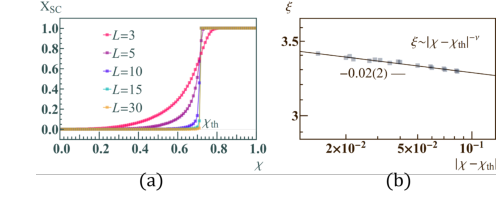 FIG. 3. Entanglement percolation in two-dimensional square lattices. (a) XSC for square lattices with different side length L. (b) Scaling of the correlation length ξ near the critical threshold χth ≈0.715 follows ξ ∼|χ −χth|−ν, with a fitted critical exponent ν = 0.02 ± 0.02
Mathematical & Logical Mechanism
The Master Equation
The core mathematical engine powering the negativity percolation theory (NegPT) in continuous-variable quantum networks is defined by two fundamental rules that govern how entanglement, quantified by ratio negativity $X$, combines in different network topologies: the series rule for entanglement swapping and the parallel rule for entanglement concentration.
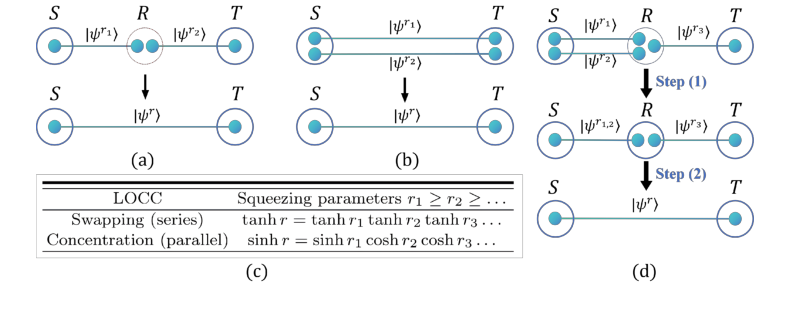 FIG. 1. Gaussian-to-Gaussian deterministic entanglement transmission (G-G DET) scheme. Applicable to Gaussian quantum networks (QN), the scheme consists of two LOCC protocols: (a) Entanglement swapping, facilitated by homodyne detection and displacement [48]; (b) Entanglement concentration, facilitated by non-standard optical components [49]. Both protocols are deterministic, taking two (or more) TMSVS |ψri⟩as input and a new TMSVS |ψr⟩as output. (c) The two LOCC protocols map to series and parallel rules, respectively, to construct G-G DET. (d) Consider a QN example built upon three node. The G-G DET scheme consists of two steps: First, the parallel rule converts the states |ψr1⟩and |ψr2⟩(r1 ≥r2) into |ψr1,2⟩with sinh r1,2 = sinh r1 cosh r2 between S and R; second, the series rule transforms |ψr1,2⟩and |ψr3⟩to the final state |ψr⟩with the ratio negativity XSC = tanh r1,2 tanh r3 between S and T
The series rule, derived from entanglement swapping operations on $N$ Two-Mode Squeezed Vacuum States (TMSVSs) arranged sequentially, is given by:
$$X_{\text{series}} = \prod_{j=1}^{N} X_j$$
The parallel rule, resulting from entanglement concentration operations on $K$ TMSVSs arranged in parallel, is expressed as:
$$X_{\text{parallel}} = \frac{\max_{1 \le k \le K} X_k}{\sqrt{\max_{1 \le k \le K} X_k^2 + \prod_{k=1, k \ne \text{argmax}(X_k)}^K (1-X_k^2)}}$$
Term-by-Term Autopsy
Let's dissect these equations to understand each component's role.
For the Series Rule: $X_{\text{series}} = \prod_{j=1}^{N} X_j$
-
$X_{\text{series}}$:
1) Mathematical Definition: This is the effective ratio negativity of the final entangled state established between two distant nodes (e.g., Source S and Target T) after all $N$ intermediate links in a series chain have undergone entanglement swapping. It is a dimensionless value ranging from 0 to 1.
2) Physical/Logical Role: It quantifies the overall entanglement strength of a composite link formed by sequentially connecting multiple individual entangled links. A higher $X_{\text{series}}$ indicates a stronger effective entanglement.
3) Why multiplication? The underlying physical process of entanglement swapping in series involves a multiplicative combination of the individual squeezing parameters ($\tanh r = \prod \tanh r_j$). Since ratio negativity $X_j$ is defined as $\tanh r_j$, this directly translates to a product. Logically, it reflects that the overall entanglement is limited by the "weakest link" in a multiplicative sense, similar to how probabilities combine for a series of independent events. -
$X_j$:
1) Mathematical Definition: This represents the ratio negativity of the $j$-th individual TMSVS link in the series chain. It's a dimensionless value in $[0,1]$.
2) Physical/Logical Role: It is the fundemental unit of entanglement strength for a single bipartite link in the continuous-variable quantum network. Each $X_j$ characterizes the entanglement of a direct connection between two adjacent nodes.
3) Why $X_j$ (ratio negativity)? The authors chose ratio negativity $X = \tanh r$ as a bounded entanglement measure, simplifying the analysis of entanglement percolation. It provides a normalized, intuitive metric for entanglement strength. -
$\prod_{j=1}^{N}$:
1) Mathematical Definition: The product operator, indicating that all $N$ terms $X_j$ from $j=1$ to $N$ are multiplied together.
2) Physical/Logical Role: This operator mathematically implements the sequential combination of entanglement strengths. It models how entanglement "propagates" through a chain, where each step contributes multiplicatively to the final effective entanglement.
3) Why product instead of summation? This reflects the nature of entanglement swapping. Unlike additive processes, the "strength" of a composite entangled state formed by sequential operations tends to be a product of the individual strengths, indicating a cumulative effect where each step potentially reduces the overall entanglement unless all links are perfect ($X_j=1$).
For the Parallel Rule: $X_{\text{parallel}} = \frac{\max_{1 \le k \le K} X_k}{\sqrt{\max_{1 \le k \le K} X_k^2 + \prod_{k=1, k \ne \text{argmax}(X_k)}^K (1-X_k^2)}}$
-
$X_{\text{parallel}}$:
1) Mathematical Definition: This is the effective ratio negativity of the single, concentrated entangled state formed between two nodes (S and T) by combining $K$ parallel TMSVS links. It is a dimensionless value in $[0,1]$.
2) Physical/Logical Role: It quantifies the enhanced entanglement strength achieved by pooling multiple independent entanglement resources between the same two nodes. Entanglement concentration aims to create a stronger, single entangled link from several weaker ones.
3) Why this complex form? This form arises from the conversion of the squeezing parameter rule for parallel concentration ($\sinh r = \sinh r_1 \prod_{k=2}^{K} \cosh r_k$) into ratio negativity $X = \tanh r = \sinh r / \sqrt{1+\sinh^2 r}$. The structure reflects the optimal strategy of prioritizing the strongest link and how other links contribute to the overall enhancement. -
$X_k$:
1) Mathematical Definition: This represents the ratio negativity of the $k$-th individual TMSVS link in the parallel configuration. It's a dimensionless value in $[0,1]$.
2) Physical/Logical Role: Similar to $X_j$ in the series rule, this is the basic unit of entanglement. In the parallel context, these are distinct, independent channels of entanglement between the same two nodes.
3) Why $X_k$ (ratio negativity)? Consistent with the series rule, $X_k = \tanh r_k$ is used for its properties as a bounded entanglement measure, making it suitable for percolation analysis. -
$\max_{1 \le k \le K} X_k$:
1) Mathematical Definition: The largest value among the $K$ input ratio negativities.
2) Physical/Logical Role: This term signifies the dominant role of the strongest individual parallel link in the entanglement concentration process. The paper notes that optimal concentration is achieved by prioritizing the link with the largest squeezing parameter (and thus largest ratio negativity). This ensures the most efficient use of available entanglement resources.
3) Why maximum? This reflects the strategic choice in the entanglement concentration protocol to maximize the final entanglement. By focusing on the strongest initial link, the protocol leverages its inherent strength as a base for enhancement. -
$\sqrt{\max_{1 \le k \le K} X_k^2 + \prod_{k=1, k \ne \text{argmax}(X_k)}^K (1-X_k^2)}$:
1) Mathematical Definition: The square root of a sum, where the first term is the square of the maximum ratio negativity, and the second term is a product of $(1-X_k^2)$ for all other links.
2) Physical/Logical Role: This entire denominator term is crucial for converting the $\sinh r$ form of the parallel rule into the $\tanh r$ form of ratio negativity, ensuring $X_{\text{parallel}}$ remains bounded between 0 and 1. The product part, $\prod (1-X_k^2)$, originates from the $\cosh r_k$ terms in the squeezing parameter equation, where $\cosh r_k = 1/\sqrt{1-X_k^2}$. These terms represent the collective contribution of the "weaker" parallel links to the overall entanglement capacity.
3) Why square root and product of $(1-X_k^2)$? The square root is a direct consequence of the identity $\tanh r = \sinh r / \sqrt{1+\sinh^2 r}$. The product of $(1-X_k^2)$ terms arises from the multiplicative nature of $\cosh r_k$ in the original squeezing parameter equation for parallel concentration. Each $(1-X_k^2)$ term is effectively $1/\cosh^2 r_k$, so their product reflects the combined influence of the non-maximal links.
Step-by-Step Flow
Let's trace the lifecycle of an abstract data point, which in this context is the ratio negativity $X$ of an entangled link, as it passes through these mathematical operations.
1. Entanglement Swapping (Series Rule):
Imagine we want to establish an entangled connection between a Source (S) and a Target (T) node, but they are separated by $N-1$ intermediate relay nodes, $R_1, R_2, \dots, R_{N-1}$. Each segment $(S-R_1, R_1-R_2, \dots, R_{N-1}-T)$ is an individual quantum link, each characterized by its own ratio negativity $X_j$.
- Initial State: We begin with $N$ distinct ratio negativities, $X_1, X_2, \dots, X_N$, representing the entanglement of each physical link in the chain.
- First Operation: The process starts by performing an entanglement swapping operation at the first relay node, $R_1$. This involves a quantum measurement on the modes at $R_1$ that are entangled with S and $R_2$. This measurement, combined with classical communication, effectively "swaps" the entanglement, creating a new, direct entangled link between S and $R_2$.
- Intermediate Calculation: Mathematically, the ratio negativity of this new link, let's call it $X_{S,R_2}$, is calculated as the product of the original links' negativities: $X_{S,R_2} = X_1 \cdot X_2$. The original links $(S,R_1)$ and $(R_1,R_2)$ are effectively consumed or transformed.
- Iteration: This newly formed link $(S,R_2)$ with its calculated ratio negativity $X_{S,R_2}$ then acts as an input for the next step. An entanglement swapping operation is performed at $R_2$, combining $X_{S,R_2}$ with $X_3$ (the link between $R_2$ and $R_3$). The new effective link $(S,R_3)$ will have ratio negativity $X_{S,R_3} = X_{S,R_2} \cdot X_3 = X_1 \cdot X_2 \cdot X_3$.
- Final Result: This iterative multiplication continues along the chain. After $N-1$ such operations, a single effective entangled link is established directly between S and T. Its ratio negativity, $X_{\text{series}}$, is the product of all individual link negativities: $X_{\text{series}} = X_1 \cdot X_2 \cdot \dots \cdot X_N$. This final value represents the overall entanglement available for communication or computation between S and T through this series path.
2. Entanglement Concentration (Parallel Rule):
Now, consider S and T connected by $K$ independent, parallel quantum links. Each link $k$ has its own ratio negativity $X_k$. The goal is to combine these $K$ resources into a single, stronger entangled state.
- Initial State: We have $K$ distinct ratio negativities, $X_1, X_2, \dots, X_K$, each representing an independent entangled channel between S and T.
- Optimal Selection: The protocol first identifies the link with the highest ratio negativity, $\max_{1 \le k \le K} X_k$. This is a crucial step for optimal concentration.
- First Operation: An entanglement concentration operation is performed, typically involving the strongest link and another chosen parallel link. This operation, using non-standard Local Operations and Classical Communication (LOCC), deterministically converts these two input TMSVSs into a single, more entangled TMSVS and a vacuum state.
- Intermediate Calculation: The ratio negativity of this newly concentrated link is calculated using the parallel rule formula. The $\max X_k$ term is explicitly used, and the other links contribute through their $(1-X_k^2)$ factors in the denominator. This calculation effectively "pools" the entanglement.
- Iteration: This process is repeated. The newly concentrated link (with its updated ratio negativity) is then combined with another remaining parallel link, again prioritizing the strongest available link among the remaining ones for subsequent concentration steps.
- Final Result: After $K-1$ iterative concentration steps, all $K$ parallel links are effectively combined into a single, highly entangled TMSVS between S and T. The final ratio negativity, $X_{\text{parallel}}$, is the result of this complex combination, representing the maximized entanglement achievable from the parallel resources.
Optimization Dynamics
The optimization dynamics in this paper primarily revolve around the system's behavior near a critical threshold and its response to feedback control, rather than a traditional iterative learning algorithm.
-
Loss Landscape and Criticality: The "loss landscape" can be conceptualized as the relationship between the individual link ratio negativity $X$ and the global "sponge-crossing ratio negativity" $X_{SC}$ (which measures the overall connectivity). For NegPT, this landscape is characterized by a "mixed-order phase transition." This means that as the individual link entanglement $X$ increases, $X_{SC}$ remains at zero until it reaches a specific critical threshold, $X_{th}$. At this $X_{th}$, $X_{SC}$ does not increase smoothly but instead exhibits an abrupt, discontinous jump to a positive value $X_{SC}^+$. Beyond this jump, $X_{SC}$ continues to increase with $X$. This sharp discontinuity is a key feature, distinguishing NegPT from continuous phase transitions observed in classical or concurrence percolation.
-
State Updates and Feedback Mechanism: To counteract the natural decay of entanglement in a realistic quantum network, a feedback control mechanism is introduced. The state of the system, represented by the ratio negativity of an individual link $x(t)$ at time $t$, evolves according to the First-Order-Plus-Time-Delay (FOPTD) model:
$$\frac{dx(t)}{dt} = -\tau^{-1}x(t) + u(t - T_0)$$- Decay Term ($-\tau^{-1}x(t)$): The first term describes the natural degradation of entanglement over time, with $\tau$ being the characteristic decay timescale. This is a negative "gradient" that pulls the entanglement value downwards.
- Feedback Term ($u(t - T_0)$): The second term, $u(t - T_0)$, represents the active control applied to boost entanglement. This "update" signal is generated by comparing the observed global entanglement $X_{SC}(t)$ to a desired target $X_{\text{target}}$. If $X_{SC}(t)$ falls below $X_{\text{target}}$, the feedback mechanism increases $u$ (e.g., by increasing pump laser power for squeezing), attempting to push $x(t)$ back up. The term $T_0$ accounts for the inherent time delay in processing and transmitting the feedback signal.
-
Convergence and Instability:
- In systems with continuous phase transitions (like DV-based QNs), feedback control typically leads to stable convergence. The global entanglement $C_{SC}(t)$ (concurrence) recovers smoothly, even with small perturbations, as shown in the paper's simulations. The "gradients" in the landscape are well-behaved, allowing the feedback to gently guide the system towards the target.
- However, the mixed-order phase transition of NegPT introduces a critical vulnerability. The abrupt jump in $X_{SC}$ at $X_{th}$ means that near this threshold, a tiny change in $x(t)$ can cause a large, sudden change in $X_{SC}(t)$. This makes the feedback mechanism inherently unstable. Instead of converging, the system exhibits long-term "on/off" oscillations. The feedback overshoots, causing $X_{SC}$ to jump, then undershoots as it decays, leading to a cycle of instability. This behavior is a direct consequence of the discontinous nature of the phase transition, where the effective "gradient" of the $X_{SC}$ vs. $X$ curve is effectively infinite at the critical point, making stable control extremely challenging. This highlights a significant hurdle for designing robust, feedback-stabilized CV-based QNs.
 Figure 1. Gaussian-to-Gaussian deterministic entan- glement transmission (G-G DET) scheme. Applicable to Gaussian quantum networks (QN), the scheme consists of two LOCC protocols: (a) Entanglement swapping, facil- itated by homodyne detection and displacement; (b) En- tanglement concentration, facilitated by non-standard optical components. Both protocols are deterministic, taking two (or more) TMSVS |ψri⟩as input and a new TMSVS |ψr⟩as output. (c) The two LOCC protocols map to series and parallel rules, respectively, to construct G-G DET. (d) Consider a QN example built upon three node. The G-G DET scheme consists of two steps: First, the parallel rule converts the states |ψr1⟩and |ψr2⟩ (r1 ≥r2) into |ψr1,2⟩with sinh r1,2 = sinh r1 cosh r2 between S and R; second, the series rule transforms |ψr1,2⟩and |ψr3⟩to the final state |ψr⟩with the ratio negativity XSC = tanh r1,2 tanh r3 between S and T. Figure 2: Bethe lattice. (a) A Bethe lattice of degree k (i.e., each node is incident to k links) and network depth l (the path length from the yellow node to the red nodes). (b) The sponge-crossing ratio negativity XSC between S and T for various k (right panel), satisfying the power law XSC −X+ SC ∼|χ−χth|0.47(5) as χ →χ+ th (left panel). The numerical value 0.47 ± 0.05 is derived by a linear least- squares fit to the sixteen data points. (c) When χ → χ− th, XSC exhibits a plateau behavior until the network depth l exceeds the correlation length l∗(defined as the depth l at which XSC = 0.5), after which XSC abruptly drops to zero. (d) Near the critical threshold, we observe l∗∼|χ −χth|−0.508(9), indicating zν ≈1/2. Figure 3: Entanglement percolation in two- dimensional square lattices. (a) XSC for square lattices with different side length L. (b) Scaling of the correlation length ξ near the critical threshold χth ≈0.715 follows ξ ∼|χ −χth|−ν, with a fitted critical exponent ν = 0.02 ± 0.02. Figure 4: Feedback stabilization of QN against entan- glement decay. (a) Under the same feedback control [Eq. (5)], the DV-based QN (k = 3 Bethe lattice) exhibits rapid stabilization; (b) whereas the CV-based QN exhibits long-term “on/off” instability, a direct result of the abrupt drop in Fig. 2(b). Figure 5: Continuous-variable entanglement swapping
Results, Limitations & Conclusion
Experimental Design & Baselines
The authors meticulously designed their experimental validation to rigorously test the proposed Negativity Percolation Theory (NegPT) for continuous-variable (CV) quantum networks (QNs). The core of their approach involved introducing a Gaussian-to-Gaussian (G-G) deterministic entanglement transmission (DET) scheme, which leverages deterministic entanglement swapping and concentration protocols specifically adapted for Two-Mode Squeezed Vacuum States (TMSVSs). This scheme allowed them to map the complex process of entanglement distribution in CV QNs to a percolation-like theory based on a bounded entanglement measure called ratio negativity, $X_N \in [0,1]$.
To ruthlessly prove their mathematical claims, they architected several computational experiments:
-
Bethe Lattice Analysis: They first focused on the Bethe lattice, an infinite tree-like series-parallel network where every node has an identical degree $k > 2$. This theoretical setup allowed them to derive exact self-consistent renormalization group equations, providing a foundational understanding of NegPT's behavior. The "victims" in this context were the established theories of classical bond percolation and concurrence percolation theory (ConPT), both of which predict continuous phase transitions with a thermal critical exponent $z_v \approx 1$. By contrast, NegPT was shown to exhibit a mixed-order transition.
-
Square Lattice Simulations: To demonstrate that their findings were not confined to the idealized Bethe lattice, they extended their investigation to numerical simulations of entanglement percolation on two-dimensional square lattices. This was achieved using the star-mesh transform, a technique for approximating higher-order network rules based on series/parallel rules. This experiment aimed to show the generalizability of the mixed-order transition beyond tree-like structures.
-
Feedback Control Simulations: A crucial practical validation involved simulating the system's dynamics under feedback control. They employed a first-order-plus-time-delay (FOPTD) model to compare how DV-based QNs (governed by ConPT) and CV-based QNs (governed by NegPT) respond to entanglement decay. The baseline for comparison here was the stable behavior of DV-based QNs under standard feedback, which they aimed to contrast with the CV system's response.
What the Evidence Proves
The evidence presented in the paper definitively proves several key aspects of NegPT and its implications for CV-based QNs:
- Mixed-Order Phase Transition: The most striking finding is that NegPT exhibits a mixed-order phase transition. This was evidenced by:
- An abrupt, discontinuous jump in the global entanglement measure, the sponge-crossing ratio negativity ($X_{sc}$), at a critical threshold ($X_{th}$). Figure 2(b) clearly illustrates this discontinuity, where $X_{sc}$ remains zero until $X_{th}$ and then abruptly jumps to a positive value.
- A divergent correlation length $l^* \sim |X - X_{th}|^{-1/2}$ near the critical threshold (Figure 2(d)), indicating long-range correlations, a hallmark of phase transitions.
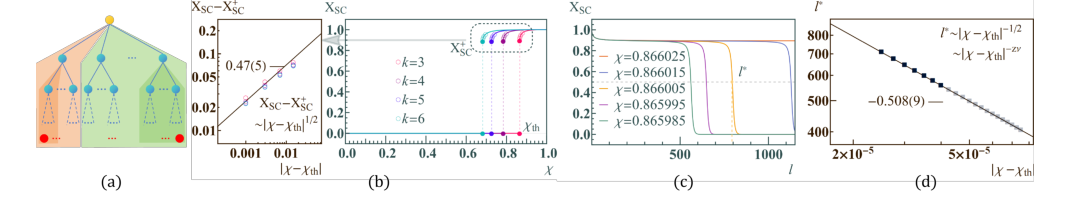 FIG. 2. Bethe lattice. (a) A Bethe lattice of degree k (i.e., each node is incident to k links) and network depth l (the path length from the yellow node to the red nodes). (b) The sponge-crossing ratio negativity XSC between S and T for various k (right panel), satisfying the power law XSC −X+ SC ∼|χ −χth|0.47(5) as χ →χ+ th (left panel). The numerical value 0.47 ± 0.05 is derived by a linear least-squares fit to the sixteen data points. (c) When χ →χ− th, XSC exhibits a plateau behavior until the network depth l exceeds the correlation length l∗(defined as the depth l at which XSC = 0.5), after which XSC abruptly drops to zero. (d) Near the critical threshold, we observe l∗∼|χ −χth|−0.508(9), indicating zν ≈1/2
-
Unqiue Universality Class: The thermal critical exponent $z_v \approx 1/2$ derived for NegPT in Bethe lattices is fundamentally distinct from the $z_v \approx 1$ observed in both classical and concurrence percolation theories. This provides undeniable evidence that CV-based QNs, under NegPT, belong to a new universality class, setting them apart from their DV counterparts. The numerical simulations on square lattices further supported this distinction, yielding a correlation length exponent $\nu \approx 0.02(2)$, which is significantly different from ConPT's $\nu \approx 1.3(3)$.
-
Critical Vulnerability of CV-based QNs: The abruptness of the mixed-order transition introduces a critical vulnerability for large-scale CV-based QNs. Simulations of feedback control (Figure 4) demonstrated that while DV-based QNs (Figure 4a) exhibit rapid and smooth stabilization, CV-based QNs (Figure 4b) suffer from long-term "on/off" instability near the critical threshold. This is a direct consequence of the discontinuous jump in $X_{sc}$ versus $X$, highlighting a significant practial challenge for stabilizing CV systems.
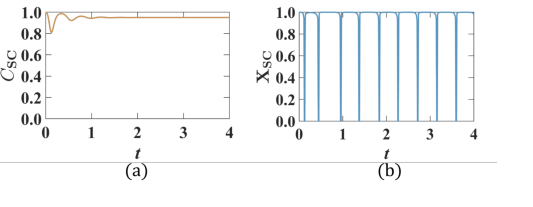 FIG. 4. Feedback stabilization of QN against entanglement decay. (a) Under the same feedback control [Eq. (5)], the DV- based QN (k = 3 Bethe lattice) exhibits rapid stabilization; (b) whereas the CV-based QN exhibits long-term “on/off” instability, a direct result of the abrupt drop in Fig. 2(b)
- Distinct Mechanism for Mixed-Order Transitions: The paper shows that NegPT induces a mixed-order transition without requiring additional degrees of freedom, such as the number of layers M, which is typically needed in classical interdependent percolation. This underscores a fundamental difference in the underlying mechanisms driving these phase transitions.
Limitations & Future Directions
While the findings are profound, the authors also candidly acknowledge several limitations and propose compelling avenues for future research and development:
-
Understanding Mixed-Order Transition Mechanisms: The paper notes that the underlying mechanisms of mixed-order phase transitions, particularly in this context, are not yet fully understood. Traditional theories, like those based on spinodal points, may not directly apply. Future theoretical investigations are needed to explore how the interplay of series and parallel rules specifically induces these mixed-order transitions, potentially unveiling novel phase transition landscapes observable in quantum optical experiments.
-
Optimality of CV Entanglement Concentration: A significant limitation for current CV QN designs is that the CV parallel rule (entanglement concentration) used in the G-G DET scheme is "not optimal" compared to its DV counterparts. This suggests that the current concentration protocols might not achieve the maximum possible entanglement. Future work should focus on understanding the feasibility and implementation limits of entanglement concentration for CV systems to develop more efficient and optimal protocols.
-
Robust Feedback Control Strategies: The discovered instability of CV-based QNs under standard feedback control near the critical threshold is a critical practical concern. This necessitates the development of "more careful feedback strategies" to maintain robust operation. Future research should explore advanced control theory techniques, potentially incorporating predictive models or adaptive control, to stabilize CV systems effectively, especially given the prevalence of quantum feedback control in optical implementations.
-
Generalization to Non-Gaussian States and Operations: The paper hints that the mixed-order phase transition may persist for generalized CV operations and even non-Gaussian states. This opens a broad discussion topic: How do these findings extend beyond the Gaussian regime? Investigating NegPT in more complex, non-Gaussian CV systems could reveal whether this unqiue critical phenomenon is a universal characteristic of CV QNs or specific to Gaussian states. This would involve exploring different physical origins for the generalized series/parallel rules and their impact on the type of phase transition observed.
-
Experimental Validation of Predicted Phenomena: While the paper presents strong theoretical and computational evidence, the ultimate validation lies in experimental realization. Future efforts should focus on designing and executing quantum optical experiments that can implement the G-G DET scheme and observe the predicted mixed-order phase transition and feedback instabilities in real-world CV QNs. This would bridge the gap between theory and practial application, stimulating further advancements in robust, feedback-stabilized QNs.
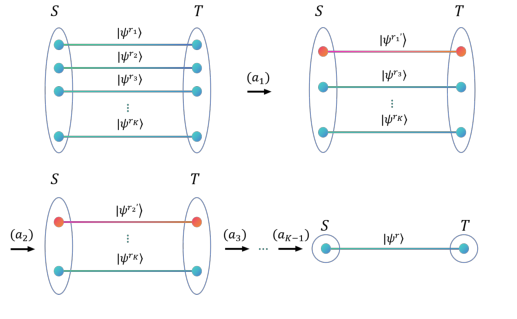 FIG. 6. Continuous-variable entanglement concentration. Consider K parallel TMSVSs written as the tensor product: NK k=1 |ψrk⟩. Step a1: The TMSVS |ψr′ 1⟩is obtained by executing the TMSVS entanglement concentration protocol on |ψr1⟩⊗|ψr2⟩; Step a2: Performing the scheme again on |ψr′ 1⟩⊗|ψr3⟩yields the TMSVS |ψr′ 2⟩; and so on. This even- tually results in a single TMSVS |ψr⟩, where the squeezing parameter r satisfies Eq. (16)