
Collective purification of interacting quantum networks beyond symmetry constraints
Following any quantum information processing protocol, it is essential to reset a mixed state of a many-body interacting spin-network to the computational-zero pure state.
Background & Academic Lineage
The Origin & Academic Lineage
The problem addressed in this paper originates from the fundamental requirements of Quantum Information Processing (QIP), which encompasses fields like quantum computing, quantum simulation, and quantum communication. For any QIP protocol to function effectively and achieve high fidelity, it is essential to reliably reset the quantum system—often a network of interacting qubits (spin-1/2 systems)—to a pure, known initial state, typically the computational zero state (or ferromagnetic ground state), after each operation. This reset is crucial for preparing the system for subsequent tasks and preventing the accumulation of errors. The challenge arises because, after entanglement generation and distribution, the many-body quantum state often becomes partially mixed, and the inherent quantum correlations between constituents persist, making a simple reset difficult.
Previous approaches to this problem faced significant limitations, forming the "pain point" that motivated this research. Passive cooling methods, which involve simply waiting for the network to cool by contact with a cold bath, are fundamentally constrained by the Third Law of Thermodynamics. Such methods produce only a low-temperature thermal distribution of eigenstates rather than exclusively populating the pure ground state. Moreover, passive cooling is impractically slow for many quantum technologies; for instance, achieving an approximate reset in solid-state nuclear spin ensembles can take incredibly long, and in superconducting qubits, it can take milliseconds, orders of magnitude longer than typical gate operations. These slow, stochastic processes drastically limit the throughput, stability, and temporal synchronization of qubits in scalable quantum processors, leading to accumulating initialization errors over repeated runs. Theoretically, prior models often simplified the dynamics of multi-spin systems, focusing on non-interacting ensembles or single qubits, and frequently employed semiclassical or master-equation approaches. These simplifications failed to account for crucial many-body quantum correlations, rendering them ineffective as the system approached zero temperature. Experimentally, cooling interacting multi-spin systems has seen only partial success, often hindered by the inability to directly cool spins decoupled from external baths. Thus, the core limitation was the lack of a rapid, deterministic, and universally applicable strategy to purify interacting quantum networks to a pure state while overcoming persistent quantum correlations and inherent symmetries.
Intuitive Domain Terms
- Quantum Information Processing (QIP): Imagine QIP as a highly advanced, specialized form of computing or communication that uses the peculiar rules of quantum mechanics. Instead of regular "on" or "off" bits, it uses "qubits" that can be "on," "off," or both at the same time, allowing for much more powerful calculations or secure data transfer.
- Purification (or Polarization): Think of this as a "deep clean" for a quantum system. If your room is messy (a mixed quantum state), purification is the process of tidying everything up perfectly, putting every item back in its designated spot (the pure ground state), ready for the next activity. In quantum terms, it means aligning all the quantum "spins" into a specific, desired, and highly ordered configuration.
- Ancilla Qubit: This is like a "helper" or "sponge" qubit. It's a separate, controllable quantum bit that temporarily interacts with the main quantum system to absorb some of its "disorder" or "mess" (entropy). Once it has absorbed the mess, it's quickly "squeezed out" into a cold bath, effectively resetting itself to a clean state, ready to help purify the main system again.
- Symmetry Constraints: Picture a complex knot of ropes. If some parts of the ropes are tied together in very specific, unyielding patterns, these are "symmetry constraints." They prevent you from fully untangling the entire knot because certain sections are rigidly fixed. In quantum systems, these symmetries create "bottlenecks" that prevent the system from reaching a perfectly pure, ordered state, even with cooling efforts.
- Automorphism Orbits (AO): Consider a network of interconnected cities. An "automorphism orbit" is a group of cities that are structurally identical in terms of their connections to the rest of the network. If you were to swap any two cities within the same orbit, the overall map of connections would look exactly the same. In quantum networks, spins within the same AO behave identically, which can lead to collective behaviors that hinder individual purification.
Notation Table
| Notation | Type | Description |
|---|---|---|
Problem Definition & Constraints
Core Problem Formulation & The Dilemma
The core problem addressed by this paper is the efficient and deterministic purification (or cooling) of a many-body interacting quantum spin network.
The Input/Current State is a mixed state of a multi-spin interacting quantum network, often at high temperatures, where interactions and quantum correlations among its constituent spins persist. This mixed state is unsuitable for subsequent quantum information processing (QIP) tasks, which require high fidelity.
The Output/Goal State is the computational-zero pure state, specifically the ferromagnetic ground state (FGS) denoted as $|000\cdots0\rangle$ or $|\downarrow\downarrow\downarrow\cdots\downarrow)$. The objective is to reach this pure state as rapidly and deterministically as possible, with high fidelity, to enable scalable and reliable QIP operations.
The exact missing link or mathematical gap between these states lies in the inability of existing cooling strategies to effectively purify interacting multi-spin systems, particularly in the presence of quantum correlations and symmetries. Previous theoretical approaches, often simplified by semiclassical or master-equation models, fail to accurately track many-body quantum correlations, leading to their breakdown as zero temperature is approached. The fundamental gap is the lack of a universal strategy that can overcome these symmetry-imposed quantum correlations, which prevent the system from equilibrating to a unique pure ground state and thus invalidate the eigenstate thermalization hypothesis (ETH) in this context. Mathematically, this translates to the steady-state purification map $\mathcal{M}$ having a nullity $\mathcal{N}(\mathcal{M}) > 0$, meaning multiple steady states exist, rather than a unique FGS.
The painfull trade-off or dilemma that has trapped previous researchers is the inherent conflict between the necessity of interactions for quantum information processing and the detrimental effect of these same interactions on purification. While interactions are crucial for generating entanglement and performing QIP, they also give rise to persistent quantum correlations and symmetries within the network. These symmetries, whether angular momentum, graph automorphism (AO), or spectral symmetry (SPS), create "bottlenecks" that severely hinder the system's purification. Passive cooling methods are too slow, stochastic, and cannot guarantee a pure ground state due to the Third Law of Thermodynamics. Active cooling strategies, while faster, have historically struggled to break these symmetry-imposed correlations, leading to incomplete purification or computationally intractable dynamics. The dilemma is that the very features enabling complex QIP (interactions, correlations) simultaneously impede the essential task of resetting the system to a pure state.
Constraints & Failure Modes
The problem of purifying interacting quantum networks is made insanely difficult by several harsh, realistic constraints:
-
Physical Constraints:
- Third Law of Thermodynamics: Passive cooling methods are fundamentally limited by the Third Law, which prohibits exclusively populating the ground state. Instead, they lead to a low-temperature thermal distribution of eigenstates, not a pure state. This means passive cooling cannot achieve the desired FGS.
- Symmetry-imposed Quantum Correlations: This is a central physical constraint. Interacting multi-spin systems with spatial or spectral symmetries develop quantum correlations that prevent the system from fully equilibrating to a pure state. These correlations lead to invariant subspaces or "dark states" that cannot be purified by conventional ancilla-based cooling.
- Angular Momentum Conservation: For certain Hamiltonians (e.g., isotropic Heisenberg model), the total angular momentum of the system-ancilla composite is conserved. This conservation law prevents the time-evolution operator from mixing states with different total angular momentum, thereby confining purification within symmetry-protected subspaces and creating "symmetry bottlenecks."
- Spectral Symmetry (SPS): The occurence of zero eigenvalues in the adjacency matrix of the network graph can lead to "dark states" with null support on certain nodes. These states are impervious to purification efforts that do not break this specific symmetry.
- Excitation Preservation: Bilinear ancilla-system couplings that do not preserve the total excitation number (e.g., terms like $\sigma_A^x \sigma_k^x$) are counterproductive for purification, as they do not support a directed population flow towards the target ground state.
-
Computational Constraints:
- Exponential Time Complexity: Diagonalizing the many-body Hamiltonian $\hat{H}_S$ for interacting spin networks, which is necessary to find steady-state solutions, is exponentially time-consuming with respect to the system size $N$. This task is prohibitively large, scaling as $O(4^{3N})$, making it unfeasible for networks with more than a few spins using conventional computers.
- Inaccuracy in Matrix Rank Calculation: Even when resorting to linear map analysis, finding the rank $R(\mathcal{M})$ of the $(4^N - 1)$-dimensional matrix representation of the purification map $\mathcal{M}$ requires iterative convergence to its row-echelon form. This procedure can fail for $N \geq 3$ due to inherent inaccuracy caused by the complex matrix representation of $\mathcal{M}$, further highlighting the computational difficulty.
- Unsolvable Dynamics: The general dynamics of multi-spin networks are often unsolvable, making it challenging to predict or optimize the asymptotic cooling speed.
Why This Approach
The Inevitability of the Choice
The authors faced a fundamental challenge in purifying interacting multi-spin quantum networks: traditional methods were simply inadequate. The primary hurdle was the presence of quantum correlations and symmetries within the many-body system, which severely impede cooling and prevent the system from reaching a pure ground state.
Specifically, passive cooling, while conceptually simple, was deemed impractical due to its extreme slowness. For solid-state nuclear spin ensembles, it "takes incredibly long and is thus not an option" [21], and for superconducting qubits, it would take "several milliseconds [22], orders of magnitude longer than typical gate or measurement times." Moreover, passive relaxation is a stochastic process that "does not guarantee a return to the ground state, resulting instead in residual excitations that accumulate as initialization errors over repeated runs" [23, 24].
On the theoretical front, existing approaches like semiclassical [37] or master-equation [16] methods were found to be insufficient because they "do not keep track of many-body quantum correlations despite their crucial role" and consequently "fail as zero temperature is approached [38]." Furthermore, the computational complexity of diagonalizing the many-body Hamiltonian for interacting spin networks is "exponentially time-consuming as a function of the network size" [46], rendering it "unfeasible with conventional computers" for networks with more than a few spins, with a complexity of $O(4^{3N})$.
The authors realized that the "symmetry-imposed quantum correlations" [43-45] were the exact moment traditional methods failed. Standard quantum information processing protocols, such as those relying on SWAP gates or level-anticrossing schemes for polarization transfer, "respect the symmetries of the problem" [14, 15], thereby hindering complete polarization to the desired $|000\cdots0\rangle_S$ state. This critcal insight necessitated a novel approach that could actively break these symmetries.
Comparative Superiority
The chosen approach, the Alternate Dispersive-Resonant Transfer (ADRT) protocol, offers qualitative superiority over previous methods primarily through its ability to systematically break symmetry constraints and manage computational complexity.
A key structural advantage is its symmetry-breaking mechanism. Unlike traditional methods that preserve system symmetries, ADRT employs "uniquely chosen, alternating, non-commuting system-ancilla interaction Hamiltonians" [Page 3] that "break the combined S + A system symmetries, in order to lift the steady-state degeneracy" [Page 12]. This is crucial because symmetry-imposed correlations prevent full purification. By generating a non-commuting Lie algebra of operators, ADRT "converts correlated steady states into effectively decohered populations, enabling full relaxation to the desired state" [Page 12]. This directly addresses the problem of high-dimensional quantum correlations that plague other methods.
Furthermore, the paper introduces graph theory as a powerful tool to circumvent the prohibitive computational complexity. Instead of attempting the "exponentially difficult solutions of the quantum evolution of arbitrarily interacting spin networks," graph theory "enormously simplifys the calculations" [Page 3], mapping them "onto solutions of much lower polynomial complexity." This reduces the computational burden from an exponential $O(4^{3N})$ to a "quasi-polynomial number of steps $O(N^{p \log N})$ for some polynomial $p$" [64, Page 16], making the analysis of larger networks feasible.
In terms of speed and efficacy, the ADRT protocol is "generally superior... to the algorithmic cooling approach [19, 26, 36] which relies on sequential swaps between adjacent spins" [Page 16]. The paper notes that sequential swaps are slower ($\sim \pi N/K$) compared to the collective swap duration ($\sim \pi/g$) unless $K \geq Ng$, and they can lead to "untractable, non-monotonic entropy distribution" [Page 16]. ADRT's collective coupling of a single ancilla to many system sites is "essential for redistributing entropy among symmetry-related degrees of freedom" [Page 16], a feature not typically found in standard collision models.
Alignment with Constraints
The ADRT protocol is meticulously designed to align with the stringent requirements of purifying interacting quantum networks.
Firstly, the core objective is to reset the system to the computational-zero pure state (FGS). The paper explicitly states that ADRT "leads to complete purification" [Page 3] and "enables full relaxation to the desired state" [Page 12], which is the FGS. This is achieved by actively breaking the symmetries that would otherwise trap the system in mixed states.
Secondly, the problem is defined for interacting many-body quantum systems. The ADRT strategy is specifically developed for "interacting N-spin systems (networks)" [Page 3], acknowledging the complex quantum correlations inherent in such systems. The Hamiltonians used in the protocol, such as the general system Hamiltonian $\hat{H}_S$ (Eq. (2)) with dipole-dipole couplings $J_{ij}$, explicitly account for these interactions.
Thirdly, the most significant constraint identified was the hindrance of purification by symmetry-imposed quantum correlations. The ADRT protocol's central innovation is its ability to "overcome the symmetry bottlenecks" [Page 3] by using alternating, non-commuting interaction Hamiltonians that "break all symmetries of the system" [Page 16]. This "marriage" between the problem's harsh requirement (overcoming symmetry) and the solution's unique property (symmetry breaking) is perfect.
Finally, the approach addresses the computational feasibility constraint. By leveraging graph theory, the authors transform an exponentially complex problem into one of "much lower polynomial complexity" [Page 3], making the theoretical analysis of larger networks tractable. The protocol is also designed for experimental realizability, with discussions of its applicability in diverse platforms like NV centers in diamond, Rydberg atoms, and molecular rulers [Page 15].
Rejection of Alternatives
The paper provides clear reasoning for why several alternative approaches would fail or are suboptimal for the specific problem of collective purification of interacting quantum networks.
Passive Cooling: This was rejected outright due to its inherent slowness and inability to guarantee a pure ground state. It "takes incredibly long and is thus not an option" [21] and "does not guarantee a return to the ground state, resulting instead in residual excitations that accumulate as initialization errors over repeated runs" [23, 24].
Traditional Theoretical Approaches (Semiclassical/Master Equation): These methods were deemed insufficient because they "do not keep track of many-body quantum correlations despite their crucial role" and "fail as zero temperature is approached" [38]. The complex quantum correlations in interacting multi-spin systems are central to the problem, and ignoring them leads to inaccurate predictions.
Standard QIP Protocols (SWAP gates, Level-Anticrossing Schemes): These methods, often used for polarization transfer, were rejected because they "respect the symmetries of the problem" [14, 15]. For complete purification to the FGS, these symmetries must be broken, which these protocols inherently cannot do.
Algorithmic Cooling (Sequential Swaps): While an active cooling method, algorithmic cooling based on sequential swaps was found to be "generally inferior in terms of speed and efficacy" [Page 16] compared to ADRT. The duration of sequential swaps ($\sim \pi N/K$) is typically slower than the collective swap duration ($\sim \pi/g$) unless specific, demanding conditions ($K \geq Ng$) are met. Moreover, sequential swaps can lead to an "untractable, non-monotonic entropy distribution" [Page 16] in closed interacting spin chains, requiring a much longer cooling proces.
Bilinear Couplings that Do Not Preserve Excitation Number: The authors explicitly state that certain bilinear couplings, such as terms proportional to $\sigma_i^+\sigma_j^+$ or $\sigma_i^-\sigma_j^-$, "may destroy the product state $|0\rangle_A|00\cdots0\rangle_S$, such terms cannot support purification" [Page 13]. These operators remove population from already doubly excited states without directing population flow towards the target state, making them "counterproductive for our purification protocols."
Standard Collision Models (CMs): ADRT, while sharing some structural similarities with CMs, fundamentally differs and is superior for this problem. Standard CMs typically involve ancillae interacting locally with a single subsystem [102, 103], whereas ADRT uses a single ancilla collectively coupled to many sites [Page 16]. This collective coupling is vital for redistributing entropy among symmetry-related degrees of freedom. Crucially, standard CMs usually assume fixed interaction Hamiltonians or allow only conditioned changes, failing to exploit "an alternating non-commuting sequence of interactions designed to break the system symmetries," which is the core of ADRT's success [Page 16]. Finally, mapping the dynamics of an interacting qubit network to a standard CM would be "far from trivial," often requiring "many ancillary qubits and collisions with multiple nodes" [Page 16].
The authors' comprehensive analysis of these alternatives underscores the necessity and unique advantages of the ADRT protocol for achieving complete and efficient purification in complex quantum networks.
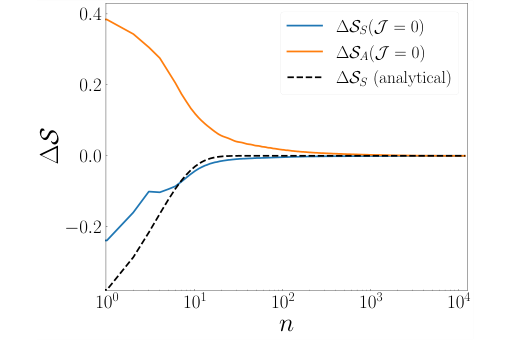 FIG. 6. Purification speed and the third law: Change in purity of S and A states with the number of cycles n for N = 6 isolated spins (J = 0), which is the same as for the isotropic model (∆= 1) chain under ADRT, shows that both purities saturate for n ≳102, cycles, so that the ancilla purity can probe the arrival of the system at the FGS. The dashed black line denotes the estimated analytical curve with a proportionality constant of −0.5, signifying its power-law approach towards the FGS
Mathematical & Logical Mechanism
The Master Equation
The core of this purification protocol lies in its recursive dynamics, which describes how the system's quantum state evolves over successive cycles. The absolute master equation governing this iterative process, mapping the system's state from one cycle to the next, is given by:
$$ \rho_S^{(n+1)} = \text{Tr}_A(\hat{U}(\tau) |0\rangle_{AA} \langle 0| \otimes \rho_S^{(n)}) \hat{U}^\dagger(\tau)) $$
This equation, found as Equation (5) in the paper, encapsulates the entire purification cycle, including the interaction between the system and the ancilla, and the ancilla's subsequent reset. The time-ordered evolution operator $\hat{U}(\tau)$ is itself defined by the total Hamiltonian of the coupled system and ancilla over one cycle:
$$ \hat{U}(\tau) = T_e^{-i \int_0^\tau \hat{H}(t')dt'} $$
where $\hat{H}(t) = \hat{H}_S + \hat{H}_A(t) + \hat{H}_{SA}(t)$ is the total Hamiltonian at time $t$.
Term-by-Term Autopsy
Let's dissect the master equation and its underlying components to understand their individual roles:
-
$\rho_S^{(n+1)}$:
- Mathematical Definition: This is the density matrix of the N-spin system (S) after the $(n+1)$-th purification cycle. It is a positive-semidefinite, Hermitian operator with trace one, representing the quantum state of the system.
- Physical/Logical Role: It represents the updated state of the N-spin network. The entire goal of the protocol is to drive this state towards a pure, fully polarized ground state (the Ferromagnetic Ground State, FGS) over many cycles.
- Why used here: This term is on the left-hand side of an iterative map, indicating how the system's state is transformed from one cycle to the next. The use of a density matrix is essential for describing mixed quantum states, which are typical for thermalized systems.
-
$\text{Tr}_A(...)$:
- Mathematical Definition: This denotes the partial trace operation over the ancilla qubit (A). If $\hat{O}$ is an operator on the combined system-ancilla Hilbert space, $\text{Tr}_A(\hat{O})$ yields an operator on the system's Hilbert space.
- Physical/Logical Role: After the ancilla interacts with the system and potentially absorbs entropy, it is decoupled and reset by coupling to a cold bath. Tracing out the ancilla effectively removes its degrees of freedom from the description of the system's state, reflecting that the ancilla's state is no longer relevant to the system's evolution for the next cycle, having been "discarded" and reset.
- Why used here: This is a standard operation in open quantum systems to obtain the reduced density matrix of a subsystem after it has interacted with another part that is subsequently ignored or reset.
-
$\hat{U}(\tau)$:
- Mathematical Definition: This is the time-ordered unitary evolution operator for the combined system (S) and ancilla (A) over one full cycle of duration $\tau$. The $T_e$ symbol indicates time-ordering, which is crucial when the Hamiltonian $\hat{H}(t')$ is time-dependent.
- Physical/Logical Role: This operator dictates the unitary quantum dynamics of the coupled system and ancilla during the interaction phase of one cycle. It embodies all the interactions, including the system's internal dynamics, the ancilla's internal dynamics, and their mutual coupling.
- Why used here: Unitary evolution describes the coherent, reversible dynamics of an isolated quantum system. The time-ordering is necessary because the interaction Hamiltonians are switched on and off, making the total Hamiltonian time-dependent.
-
$|0\rangle_{AA} \langle 0|$:
- Mathematical Definition: This is the projector onto the ground state $|0\rangle_A$ of the ancilla qubit.
- Physical/Logical Role: This term represents the ancilla being initialized to a pure, ultracold ground state at the beginning of each purification cycle. This pristine state allows the ancilla to act as an effective "cold sink" for the system's entropy.
- Why used here: The ancilla must be reset to a known, pure state to consistently draw entropy from the system. If it were not reset, it would accumulate entropy and lose its cooling capability.
-
$\otimes$:
- Mathematical Definition: The tensor product operator, used to combine the Hilbert spaces of independent quantum systems.
- Physical/Logical Role: It signifies that at the start of each cycle, before the interaction begins, the ancilla (in its ground state) and the system (in its current state $\rho_S^{(n)}$) are initially uncorrelated.
- Why used here: This is the standard mathematical way to represent the joint state of two independent quantum systems.
-
$\rho_S^{(n)}$:
- Mathematical Definition: The density matrix of the N-spin system (S) at the beginning of the $n$-th purification cycle.
- Physical/Logical Role: This is the input state of the N-spin network for the current cycle, which the protocol aims to purify further.
- Why used here: This term represents the state from which the purification process starts in the current iteration, forming the basis for the recursive update.
Underlying Hamiltonians that define $\hat{H}(t)$:
-
$\hat{H}_S = \sum_{i
- Mathematical Definition: The Hamiltonian describing the internal interactions within the N-spin system. It's a general Heisenberg-like model with dipole-dipole couplings $J_{ij}$ between spins $i$ and $j$, and an anisotropy parameter $\Delta$. $\sigma^\alpha$ are Pauli operators.
- Physical/Logical Role: This term captures the inherent, often complex, interacting nature of the quantum network that needs to be purified. It's the "problem" part of the system.
- Why used here: It accurately models the type of multi-spin systems (e.g., spin chains) that are the subject of this purification effort.
-
$\hat{H}_A(t) = h_A(t) \hat{\sigma}_A^z$:
- Mathematical Definition: The Hamiltonian for the ancilla qubit, representing its internal energy splitting. $h_A(t)$ is a time-dependent modulation.
- Physical/Logical Role: This allows for external control over the ancilla's energy levels, which can be tuned to facilitate or inhibit interactions with the system, or to optimize its reset.
- Why used here: The ability to modulate the ancilla's internal state is crucial for implementing the purification protocol effectively.
-
$\hat{H}_{SA}(t)$: This is the system-ancilla interaction Hamiltonian, which takes two alternating forms:
-
Resonant Transfer (RT) form (Eq. 18): $\hat{H}_{SA}^{\text{res}}(t) = \frac{1}{2} \sum_k g_k(t) (\hat{\sigma}_A^+ \hat{\sigma}_k^- + \hat{\sigma}_A^- \hat{\sigma}_k^+)$
- Mathematical Definition: Describes a flip-flop interaction between the ancilla and the $k$-th system spin, mediated by time-dependent couplings $g_k(t)$. $\hat{\sigma}^\pm$ are raising/lowering operators.
- Physical/Logical Role: This term enables resonant excitation exchange (SWAP-like operations) between the ancilla and the system spins. Its primary role is to transfer excitations (and thus entropy) from the system to the ancilla.
- Why used here: This is the direct mechanism for entropy extraction. The addition of terms reflects the coherent superposition of possible flip-flop events.
-
Dispersive Coupling form (Eq. 19): $\hat{H}_{SA}^{\text{disp}}(t) = \hat{\sigma}_A^z \sum_k \tilde{g}_k \hat{\sigma}_k^z$
- Mathematical Definition: Describes an Ising-type interaction where the ancilla's $\hat{\sigma}_A^z$ operator couples to the $\hat{\sigma}_k^z$ operators of the system spins, with time-dependent couplings $\tilde{g}_k(t)$.
- Physical/Logical Role: This interaction is off-resonant and causes dephasing. Its critical role is to break the symmetries of the system that would otherwise prevent full purification. It effectively rotates the joint basis of S and A, mixing previously invariant subspaces.
- Why used here: The authors use this non-commuting interaction to overcome the "symmetry bottlenecks" that hinder complete polarization. The sum indicates a collective interaction with multiple spins.
-
Step-by-Step Flow
Imagine a single abstract data point, representing the quantum state of the N-spin network, undergoing purification. Here's its journey through one cycle of the ADRT protocol:
-
Initial State Setup: The cycle begins with the N-spin system in some mixed state, $\rho_S^{(n)}$, which is the "data point" we want to purify. Simultaneously, a single ancilla qubit (A) is prepared in its pure ground state, $|0\rangle_A$. Conceptually, the combined state is then formed as an uncorrelated tensor product: $|0\rangle_{AA} \langle 0| \otimes \rho_S^{(n)}$.
-
Resonant Interaction Phase (First Half of Cycle): For the initial duration of the cycle (from $n\tau$ to $n\tau + \tau/2$), the system and ancilla are allowed to interact. The specific interaction Hamiltonian, $\hat{H}_{SA}^{\text{res}}(t)$, is switched on. This Hamiltonian facilitates resonant "flip-flop" events, where an excitation can swap between the ancilla and any of the system spins. During this time, the system's internal Hamiltonian $\hat{H}_S$ and the ancilla's internal Hamiltonian $\hat{H}_A(t)$ are also active. The combined system-ancilla state evolves unitarily under the total Hamiltonian $\hat{H}(t) = \hat{H}_S + \hat{H}_A(t) + \hat{H}_{SA}^{\text{res}}(t)$. This phase is designed to transfer entropy from the system to the ancilla.
-
Dispersive Interaction Phase (Second Half of Cycle): Abruptly, at the halfway point ($t = n\tau + \tau/2$), the interaction Hamiltonian is switched to a different, non-commuting form: $\hat{H}_{SA}^{\text{disp}}(t)$. This dispersive coupling is off-resonant and induces dephasing. It acts like a sudden "twist" in the interaction landscape, rotating the joint basis of the system and ancilla. This crucial step mixes states across subspaces that would otherwise remain invariant due to symmetries, effectively breaking those symmetry constraints. The system-ancilla pair continues its unitary evolution under the new total Hamiltonian $\hat{H}(t) = \hat{H}_S + \hat{H}_A(t) + \hat{H}_{SA}^{\text{disp}}(t)$ until the end of the cycle at $(n+1)\tau$.
-
Ancilla Decoupling and Reset: At the end of the cycle, the system-ancilla coupling is switched off. The ancilla, now carrying some of the system's entropy, is momentarily coupled to an ultracold bath (B). This bath acts as an entropy dump, effectively "purifying" the ancilla by resetting it back to its ground state $|0\rangle_A$. This step is not explicitly part of the unitary evolution in the master equation but is an external operation that prepares the ancilla for the next cycle.
-
System State Update for Next Cycle: To find the system's state for the next iteration, $\rho_S^{(n+1)}$, we perform a partial trace over the ancilla's degrees of freedom on the combined system-ancilla state after the unitary evolution of the current cycle. This operation effectively "forgets" the ancilla's state, as it has been reset and is no longer entangled with the system in the context of the system's ongoing purification. The resulting $\rho_S^{(n+1)}$ is then the starting "data point" for the next purification cycle.
This sequence repeats, with the ancilla acting as a continually refreshed entropy sponge, and the alternating interactions ensuring that no symmetry constraints prevent the system from reaching its desired pure state.
Optimization Dynamics
The mechanism learns, updates, and converges by iteratively applying the ADRT protocol to progressively reduce the system's entropy and drive it towards the Ferromagnetic Ground State (FGS). The core of this optimization lies in overcoming symmetry-imposed bottlenecks.
-
Symmetry Bottlenecks and the Loss Landscape:
Initially, the "loss landscape" (or rather, the purity landscape, where higher purity means lower "loss") for the system's state is riddled with plateaus or local minima caused by symmetries. These symmetries (angular momentum, graph automorphism, spectral) lead to "dark subspaces" or invariant blocks in the system's density matrix. If the purification map $\mathcal{M}$ commutes with these symmetry operations, the system gets trapped within these subspaces, preventing full polarization. This means the rank of the map $\mathcal{R}(\mathcal{M})$ is less than the Hilbert-space dimensionality $\mathcal{D}(\mathcal{M})$, leading to multiple steady states, not just the desired FGS. -
Breaking Symmetries with Non-Commuting Hamiltonians:
The ADRT protocol's brilliance lies in its ability to reshape this landscape by actively breaking these symmetries. This is achieved by employing a pair of non-commuting interaction Hamiltonians, $\hat{H}_{SA}^{\text{res}}(t)$ (resonant transfer) and $\hat{H}_{SA}^{\text{disp}}(t)$ (dispersive coupling), in an alternating fashion within each cycle.- The resonant transfer phase is designed to maximize excitation exchange, efficiently moving the system towards the FGS.
- However, the subsequent dispersive coupling phase is the true game-changer. By abruptly switching to an off-resonant interaction, which generly does not commute with the resonant one ($[\hat{H}_{SA}^{\text{res}}, \hat{H}_{SA}^{\text{disp}}] \neq 0$), the protocol dynamically rotates the joint basis of the system and ancilla. This rotation mixes states across the previously invariant symmetry-protected subspaces. The paper explicitly states that the choice of unequal couplings $\tilde{g}_k$ for the dispersive Hamiltonian is what breaks the spin-exchange and angular-momentum symmetries.
-
Gradient Behavior and Convergence:
By breaking these symmetries, the ADRT protocol effectively "smoothes out" the purity landscape, eliminating the trapping local minima and allowing the system to find a path towards the global maximum (the FGS). The non-commuting nature of the Hamiltonians ensures that the map $\mathcal{M}$ no longer commutes with all symmetry operations, thereby lifting the degeneracies and ensuring a unique steady state. The goal is to achieve $\mathcal{R}(\mathcal{M}) = \mathcal{D}(\mathcal{M})$, which guarantees complete purification irrespective of the initial state. -
Iterative State Update:
Each cycle of the master equation $\rho_S^{(n+1)} = \text{Tr}_A(\hat{U}(\tau) |0\rangle_{AA} \langle 0| \otimes \rho_S^{(n)}) \hat{U}^\dagger(\tau))$ represents an iterative update. The ancilla, being reset to a pure state in each cycle, acts as a consistent entropy sink. The alternating interactions ensure that entropy can be extracted from all parts of the system, even those previously protected by symmetry. The system's purity, $\text{Tr}(\rho_S^2)$, increases with each cycle, asymptotically approaching 1 (full polarization). -
Asymptotic Convergence and Third Law:
The paper notes that the rate of entropy change in the system, $\Delta S_S^{(n)}$, decreases as a power-law with the number of cycles $n$. This implies that while the system continuously approaches the FGS, achieving ideal 100% fidelity requires an infinite number of cycles, which is consistent with the third law of thermodynamics. The ADRT dephasing randomizes phases, and with non-uniform couplings, probabilities of states are equalized, except for the FGS, which becomes the dominant state. The modulation of the ancilla Hamiltonian $\hat{H}_A(t)$ can be optimized to maximize the purification speed by operating in the anti-Zeno regime, enhancing the efficasy of entropy transfer.
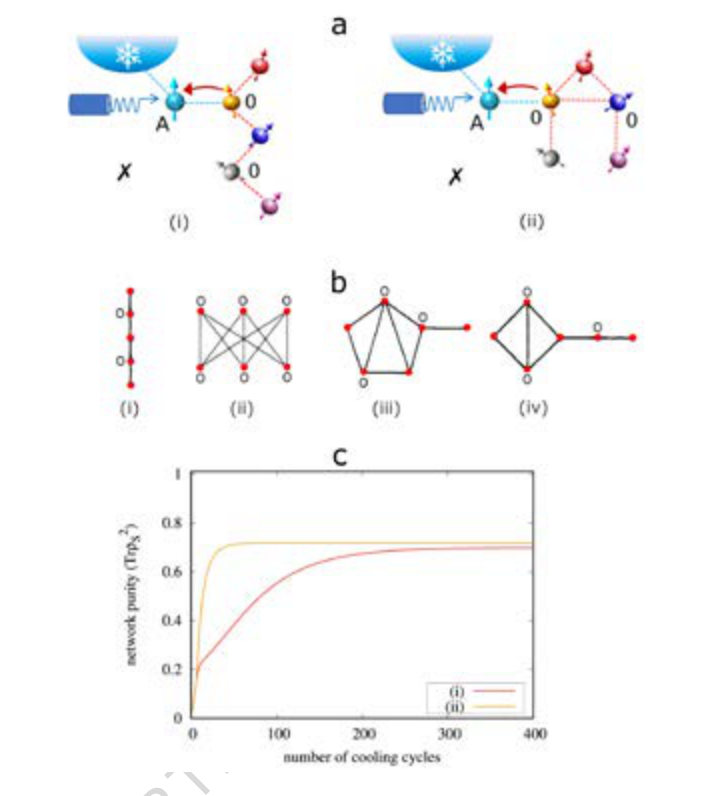 FIG. 4. Spectral symmetry constraints on purification: Networks where spectral symmetry (SPS) hinders full polarization. (a) The nodes where the support of the eigenvector(s) corresponding to the null subspace is zero, are marked with 0. (b) SPS effects in diverse graph classes: (i) Path graph P5 (N = 5), (ii) complete bipartite graph K3,3 (N = 6), (iii) an identity graph (N = 5), (iv) a graph with a non- identity nontrivial AO (mirror symmetry) (N = 6). Nodes marked with ‘O’ denote null support of the kernel. (c) Numerically calculated time dependence of network purity Tr ρ2 S as a function of the number of ancilla-resets for the networks. The calculations confirm that full purification (polarization) is only achievable for spin networks with non-degenerate automorphism orbits (AO) that also lack SPS
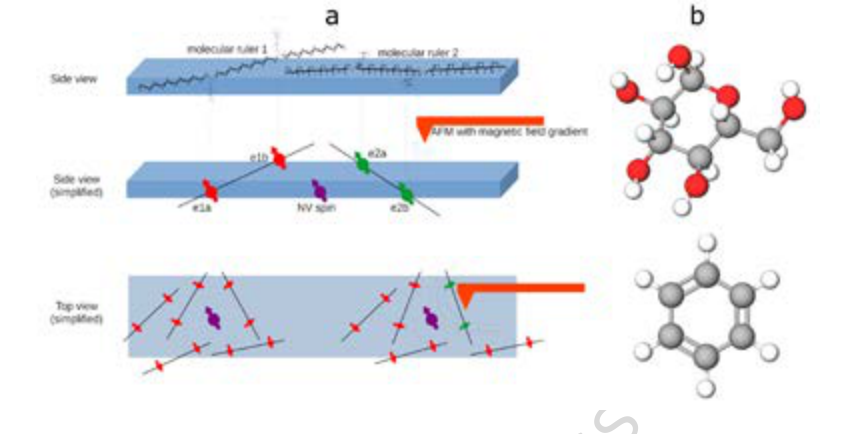 FIG. 7. Experimental demonstrations: (a) A schematic of an envisaged experimental implementation of an addressable spin network using an NV center in diamond coupled to molecular rulers. Top panel: Shows the surface of the diamond with a couple of molecular rulers [87], each with a pair of spin labels (electron spins). Middle panel: Portrays an abstraction of the top panel and introduces a magnetic field gradient from an AFM tip [88], which can be turned on and off with a sub-microsecond speed. The gradient allows for a selective addressing of electron spins from the host of molecular rulers on the surface of the diamond by tuning the Larmor precession frequency of those electrons (here e1a and e1b; e2a and e2b) and bringing them into resonance with the pulse sequence’s resonance condition. Bottom panel: A simplified top-view of the diamond surface, where a proper choice of the AFM’s tip position and current (gradient) enables specific network topologies, e.g., a hexagonal (left) or a pentagonal (right) network. (b) Top— Glucose molecule: an example of a spin network that is fully polarizable, due to lack of symmetry among the spin nodes. Bottom— Benzene molecule: an example of a spin network that is not polarizable due to its symmetry
Results, Limitations & Conclusion
Experimental Design & Baselines
The core of this analysis revolves around a universal cooling strategy for interacting multi-spin networks, aiming to reset them to a computational-zero pure state, specifically the ferromagnetic ground state (FGS) $| \downarrow\downarrow\downarrow\cdots\downarrow \rangle$. The experimental architecture is based on a cyclic purification protocol, schematically depicted in Fig. 1. Each cycle involves a single ancillary qubit (A) that is collectively coupled to the system (S) of $N$ spins. The ancilla is initially prepared in its ground state $|0\rangle_A$. During the first phase of the cycle, the system and ancilla interact via a Hamiltonian $H_{SA}(t)$, while the system's internal Hamiltonian $H_S$ acts constantly. This interaction correlates A and S. Subsequently, $H_{SA}$ is quenched, and the ancilla is coupled to an ultracold bath (B) to dump the entropy it acquired from the system, effectively resetting A back to $|0\rangle_A$. This completes one cycle, which then recommences.
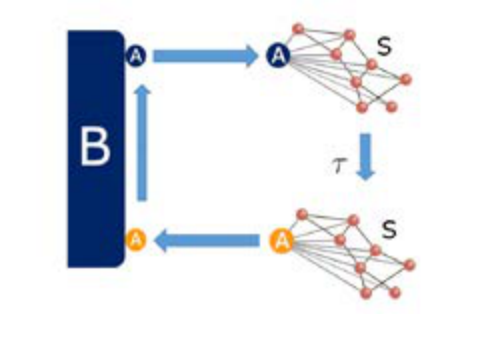 FIG. 1. Purification Protocol: Schematic diagram of the purification protocol: Interacting spin network cooling/purification via collective swapping of the network (S) entropy with an ancilla qubit (A) in recurring cycles. The ancilla is intermittently reset/purified by an ultracold (ideally, zero-temperature) bath (B)
The paper's key innovation, the Alternate Dispersive-Resonant Transfer (ADRT) protocol, is designed to overcome inherent symmetry constraints that impede purification. This protocol employs a pair of non-commuting, consecutive interaction Hamiltonians: a resonant transfer Hamiltonian $H_{SA}^{res}(t)$ and a dispersive coupling Hamiltonian $H_{SA}^{disp}(t)$. The resonant interaction facilitates excitation exchange, guiding the system towards the FGS, while the dispersive interaction, activated halfway through the cycle, abruptly rotates the joint basis of S and A, rendering the exchange off-resonant and crucially breaking system symmetries.
The "victims" or baseline models against which this approach is ruthlessly proven are primarily passive cooling methods, which are shown to be prohibitively slow and unable to reach pure ground states due to the Third Law of Thermodynamics. More directly, the ADRT protocol is contrasted with simpler resonant transfer (RT) protocols that do not actively break symmetries. The paper demonstrates that such symmetry-preserving methods fail to achieve full purification, as they lead to invariant blocks in the system's density matrix, trapping it in mixed states. The experimental validation, therefore, aims to definitively show that the ADRT's symmetry-breaking mechanism is the undeniable evidence of its core functionality.
What the Evidence Proves
The paper provides compelling evidence for both the existence of symmetry-imposed bottlenecks in quantum network purification and the efficacy of the ADRT protocol in overcoming them.
First, the analysis rigorously establishes that various symmetries indeed hinder full polarization:
- Angular Momentum Symmetry: For systems like isotropic Heisenberg chains or isolated spins, the collective ancilla-system coupling, while transferring entropy, confines the dynamics to subspaces where total angular momentum is conserved (Fig. 2b). This prevents the system from fully equilibrating to the pure ground state, as probabilities accumulate at higher $m=j$ blocks, creating a bottleneck. The asymptotic polarization $P$ is shown to scale as $P \approx \sqrt{N} \exp(-N/2)$ for large $N$ (Eq. 10, Fig. 2c), clearly demonstrating the severe limitation.
- Graph Automorphism Symmetry (AO): The paper leverages graph theory to show that the network's polarizability $P$ is fundamentally determined by the number of automorphism orbits (K) in its graph representation. Theorem 2 states that if a graph has fewer than $N$ distinct AOs (i.e., $K < N$), full polarization is not achievable for all initial states. For a maximally mixed initial state, the polarizability is explicitly given by $P \approx 1/2^{N-K}$ (Eq. 13). This means networks with high AO degeneracy (e.g., complete graphs, $P \approx 1/2^{N-2}$) have low polarizability, while those with $N$ distinct AOs (identity graphs, $P=1$) can be fully polarized. Numerical calculations presented in Fig. 3b and 3d for various networks (e.g., open-chain vs. complete graphs) robustly confirm these theoretical predictions, showing that only networks with non-degenerate AOs achieve full purification.
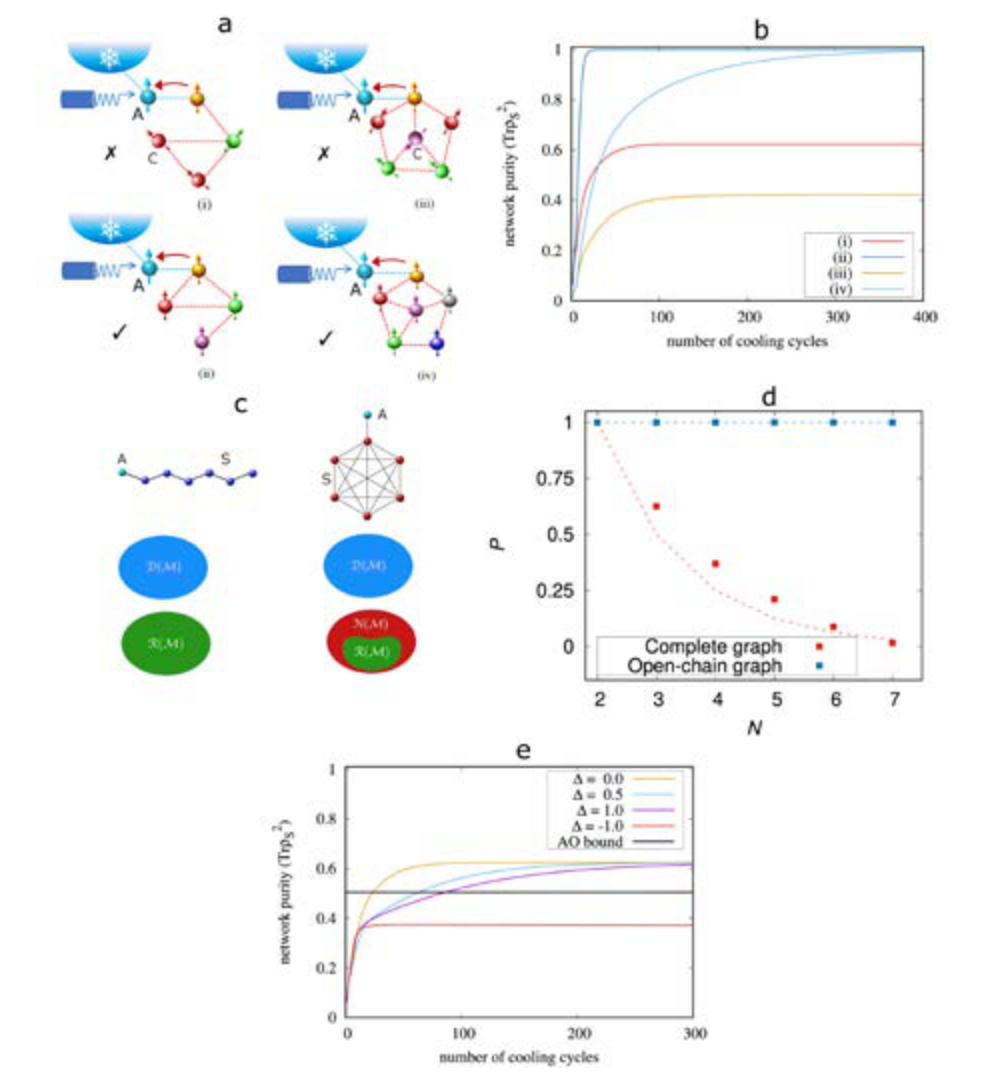 FIG. 3. Automorphism constraints on purification: Polarizable and unpolarizable networks under graph automorphism constraints: (a) Polarizability (✔) or non-polarizability (✗) of some representative networks (i)-(iv) via collective entropy swapping with a probe (ancilla) spin A that is intermittently coupled to a cold bath. Network polarizability is obtained by graph-theoretic considerations regarding their automorphism orbits (AO). Nodes that belong to the same AO, are colored with the same color in the graph, whereas different colors divide the nodes into topologically equivalent sets. Visual inspection of network (i)-(iv) suffices to determine their polarizability bounds. (b) Numerically calculated network purity Tr ρ2 S as a function of the number of ancilla-resets for the networks (i)-(iv) shown in (a). The calculations confirm our prediction that full purification (polarization) is only achievable for networks with non-degenerate automorphism orbits (AO). (c) left- A polarizable network N coupled to an ancilla A represented by an identity (open-chain) graph for which the rank is equal to the dimensionality (R(M) = D(M)), right- an unpolarizable network for which R(M) < D(M). (d) Estimated purity versus spin number N for open-chain graphs and complete graphs. Complete graphs (red dotted line) have maximal N (M) (Eq. (7)) and hence the lowest polarizability. (e) Same as (b) for network (i) with different anisotropy ∆parameters
- Spectral Symmetry (SPS): Beyond AO symmetry, the paper identifies "spectral symmetry" as another constraint. Graphs with zero eigenvalues in their adjacency matrix (singular graphs) can possess "dark states" that have null support on certain nodes (Theorem 4 and 5). These dark states are impervious to purification by the ancilla if the ancilla does not break this symmetry. Fig. 4 illustrates how SPS can hinder polarization even in identity graphs, demonstrating that SPS and AO symmetries are generally unrelated.
Second, the paper provides definitive evidence that the ADRT protocol effectively overcomes these limitations:
- Symmetry Breaking Mechanism: Theorem 6 formally proves that a unique choice of alternating, non-commuting system-ancilla interaction Hamiltonians (resonant with uniform couplings $g_k=g$ and dispersive with unequal $\tilde{g}_k$) exists. This pair satisfies the crucial symmetry-breaking condition (Eq. 16), ensuring that the map $M$ does not commute with any symmetry operations $\Pi_i$ of the system Hamiltonian $H_S$. This mechanism allows the system to approach the desired pure state by mixing previously invariant subspaces.
- Experimental Validation of ADRT: Figures 5b and 5c present numerical results for network purity (Tr($\rho_S^2$)) as a function of cooling cycles for various spin models and graphs. Unlike the simple RT protocol (shown in Fig. 3b), the ADRT protocol consistently drives the network purity towards 1 (full purification) for both isolated spin models and Heisenberg chains, even for graphs previously identified as non-polarizable under RT. This direct comparison provides undeniable evidence that the ADRT's core mechanism—the active breaking of symmetry constraints—works in reality. Furthermore, Fig. 9 explicitly shows that introducing a slight diagonal disorder (transverse-field induced spin-level splitting, $dh$) in a 3-spin closed chain breaks AO symmetry and leads to full purification, directly validating the symmetry-breaking principle.
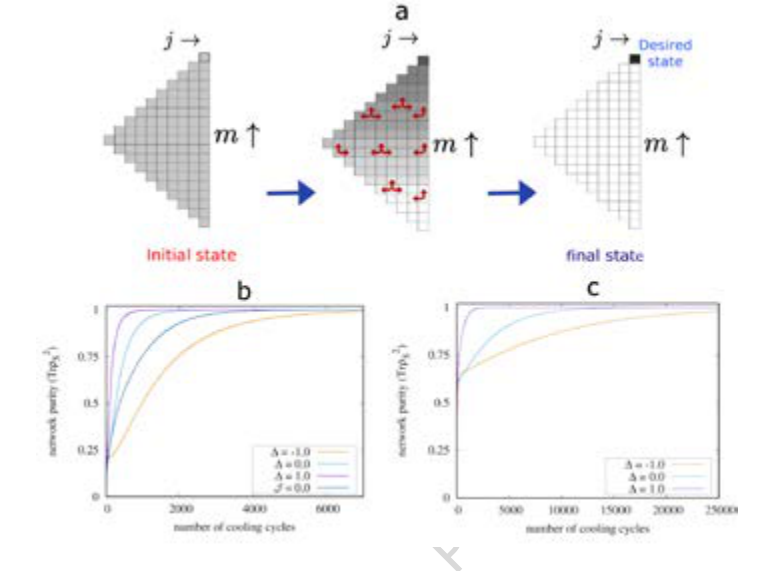 FIG. 5. Purification using ADRT protocol: (a) Schematic representation of the ADRT purification protocol for a star model: a system S of isolated spins via the ancilla spin A, showing its overwhelming ability to overcome symmetry constraints/bottlenecks compared to RT in Fig. 2. In the ADRT protocol, the excitation exchange takes place both horizontally and vertically (i.e., along m and j), thus mixing all j-blocks. This allows us to achieve the desired final state. (b) The variation of the network purity with the number of cycles for the isolated spin model and the Heisenberg chain of 5 spins with different anisotropy parameters ∆. (c) The variation of the network purity with the number of cycles for the non-polarizable graph (i) shown in Fig. 3(a) with different anisotropy parameters ∆. Both plots (b) and (c) show that the desired state is attained using the ADRT protocol, unlike the RT protocol used in Fig. 3(b)
- Purification Speed and Thermodynamic Consistency: The purification speed under ADRT for isolated-spin and isotropic Heisenberg models is shown to saturate for a relatively small number of cycles (e.g., $n \ge 10^2$ for $N=6$ spins, Fig. 6). The rate of entropy change $\Delta S_S$ is found to decrease as a power-law with the number of cycles $n$ (Eq. 31), which is consistent with the Third Law of Thermodynamics. This confirms that while full purification is achievable, reaching ideal 100% fidelity requires an infinite number of cycles, a fundamental thermodynamic constraint.
Limitations & Future Directions
While the paper presents a brilliant and universal strategy for quantum network purification, it also highlights several inherent limitations and opens up rich avenues for future research.
Current Limitations:
One significant limitation lies in the computational complexity for larger systems. Although graph theory simplifies the problem by mapping quantum evolution to lower polynomial complexity, finding the rank of the map $M$ (essential for AO symmetry analysis) can still be challenging and prone to inaccuracy for $N \ge 3$ due to the complex matrix representation. Furthermore, the presence of anisotropy (field-bias, $\Delta \neq 0$) in the system Hamiltonian renders the polarizability intractable, requiring exact diagonalization of the adjacency matrix, which quickly becomes unfeasible. The paper also notes that spectral symmetry (SPS), while a theoretical constraint, is rare for realistic spin-spin interactions in identity graphs with $N \ge 5$, suggesting its practical significance might be marginal. Finally, the Third Law of Thermodynamics imposes a fundamental limit: the power-law decrease in purification speed means that achieving ideal 100% fidelity requires an infinite number of cycles, which is a practical constraint for any finite-time protocol. The general question of the asymptotic cooling speed in multi-spin networks, whose dynamics are often unsolvable, remains an open problem. From an experimental standpoint, realizing the ADRT protocol demands precise and rapid switching between mutually exclusive resonant and dispersive coupling Hamiltonians, requiring sophisticated control over tunable couplings and selective addressing, which can be technically challenging.
Future Directions & Discussion Topics:
-
Generalization and Applicability of ADRT: The paper posits ADRT as a universal strategy. How broadly can this protocol be applied beyond spin-1/2 networks? Could it be adapted for systems with higher-dimensional qudits, different interaction types (e.g., bosonic, fermionic), or even hybrid quantum systems? Exploring its effectiveness in more complex, real-world quantum architectures would be a crucial next step.
-
Optimizing Purification Speed and Efficiency: While the Third Law sets a fundamental limit, can we optimize the ADRT protocol to approach this limit more rapidly in practice? The paper mentions maximizing ancilla cooling speed via the anti-Zeno regime. Future work could delve into advanced optimal control techniques, perhaps leveraging machine learning, to dynamically adjust the Hamiltonians $H_A(t)$ and $H_{SA}(t)$ throughout the cycles, aiming for faster convergence to the FGS while minimizing resource consumption.
-
Deeper Understanding of Symmetry Interplay: The paper acknowledges that the relationship between different symmetries (angular momentum, AO, SPS) when they coexist is an open question. A more comprehensive theoretical framework that unifies these symmetry constraints could lead to more robust and efficient purification protocols. Can we develop a hierarchical understanding of how these symmetries interact and which ones are most dominant in various network topologies?
-
Scalability and Experimental Platform Development: The proposed protocol is experimentally realizable in platforms like NV centers, Rydberg atoms, and molecular rulers. A critical discussion point is how to scale these platforms to larger $N$ while maintaining the necessary control fidelity and coherence times. What are the engineering challenges for implementing the alternating non-commuting Hamiltonians in larger, more complex networks? Research into novel materials or architectures that inherently offer better control over these interactions would be valuable.
-
Integration with Quantum Error Correction (QEC): Active reset protocols are vital for QEC. How can ADRT be seamlessly integrated into existing or future QEC schemes? What are the overheads in terms of time and resources when ADRT is used for rapid initialization in a fault-tolerant quantum computer? Can ADRT itself be made more robust against errors, or can it be combined with QEC techniques to protect the purification process?
-
Graph Theory and AI for Network Design: The paper effectively uses graph theory to characterize polarizability. Can this be extended to a design principle? Could generative AI or advanced graph neural networks be used to design quantum network topologies that are inherently more polarizable or easier to purify, perhaps by minimizing AO degeneracy or avoiding SPS, given specific physical constraints on interactions? This could shift the paradigm from analyzing existing networks to engineering optimal ones.
-
Beyond Bilinear Couplings: The proof for ADRT's efficacy relies on specific bilinear ancilla-system couplings. What if non-bilinear or higher-order interactions are considered? Could they offer new pathways for symmetry breaking or enhanced purification, or would they introduce additional complexities? Exploring the landscape of possible interaction Hamiltonians could uncover novel mechanisms.
-
Alternative Ancilla Strategies: The paper focuses on a single ancilla qubit. Could employing multiple ancillas, or ancillas with different properties (e.g., qudits, or ancillas with tailored internal dynamics), offer advantages in terms of speed, robustness, or the ability to purify highly complex systems? This could lead to a new class of "multi-ancilla" purification protocols.