
Robust magnetic polaron percolation in the antiferromagnetic CMR system EuCd2P2
ISOM keeps this paper as a threshold case: local magnetic-polaron connectivity becomes a concrete model for deciding when a learning system should switch training regimes.
Background & Academic Lineage
The Origin & Academic Lineage
The core problem addressed in this paper originates from the broader field of colossal magnetoresistance (CMR), a fascinating phenomenon where a material's electrical conductivity drastically changes in response to an applied magnetic field. This effect was initially well-studeid in ferromagnetic materials, particularly europium chalcogenides and rare-earth perovskite manganites, starting in the 1960s. Researchers observed that in these systems, the formation and percolation of "magnetic polarons"—regions where charge carriers align local magnetic moments—were key to understanding CMR.
However, the academic field has recently shifted its focus to antiferromagnetic (AFM) materials, driven by their potential for spintronics and quantum information technologies, which often require materials without net ferromagnetic order. Within this context, the specific compound EuCd$_2$P$_2$ emerged as a material of significant interest due to its remarkable CMR properties, despite being antiferromagnetic. Previous research on EuCd$_2$P$_2$ had indicated the presence of magnetic polarons and their role in CMR, primarily based on magnetotransport and magneto-optic investigations.
The fundamental limitation, or "pain point," of these previous approaches was the lack of direct, comprehensive experiemental evidence to definitively establish magnetic polaron formation and percolation as the microscopic orgin of CMR in AFM EuCd$_2$P$_2$. Earlier studies offered strong suggestions but lacked the multi-faceted experimental proof needed to solidify this understanding and provide a unified framework for magnetotransport in this class of materials, especially considering the material's sensitivity to impurities and doping. This paper aims to fill that gap by employing a complementary suite of sensitive probes to provide this direct evidence.
Intuitive Domain Terms
- Colossal Magnetoresistance (CMR): Imagine a road that's usually very congested, making it hard for cars to move (high electrical resistance). When a special signal (a magnetic field) is activated, the traffic suddenly clears up almost entirely, allowing cars to flow incredibly freely (conductivity drastically increases). CMR describes materials that act like this, becoming super-conductive in a magnetic field.
- Magnetic Polaron: Think of a charismatic leader (a charge carrier, like an electron) who, wherever they go, attracts a small, organized group of followers (local magnetic moments) around them. This "leader-and-entourage" unit moves together as a single entity, and their collective magnetic alignment is stronger than the surrounding environment.
- Percolation: Picture a network of stepping stones across a river. If there are enough stones, and they are close enough, you can hop from one to another to cross the entire river, forming a continuous path. If the stones are too far apart, you can't. In materials, percolation describes when enough "conductive" regions (like magnetic polarons) connect to form a continuous path for electricity to flow through the entire material.
- Antiferromagnetic (AFM): Imagine a group of tiny magnets arranged in a grid. In an AFM material, each tiny magnet points in the opposite direction to its immediate neighbors. So, while each magnet is active, their opposing forces cancel out overall, meaning the material doesn't have a strong external magnetic field like a regular magnet you'd stick on a fridge.
Notation Table
| Notation | Description | Unit / Type |
|---|---|---|
| $T$ | Temperature | K |
| $T_N$ | Néel temperature (Antiferromagnetic ordering temperature) | K |
| $T^*$ | Crossover temperature for electronic/magnetic phase separation | K |
| $\mu_0H$ | Applied magnetic field | T |
| $\rho$ | Electrical resistivity | $\Omega$ cm |
| $MR$ | Magnetoresistance, defined as $[\rho(B) - \rho(0)]/\rho(0)$ | Dimensionless (%) |
| $\rho_{xy}$ | Hall resistivity | m$\Omega$ cm |
| $B_c$ | Crossover field in Hall resistivity | T |
| $S_R(f, T)$ | Resistance noise power spectral density | 1/Hz |
| $K_{3\omega}$ | Third-harmonic Fourier coefficient | Dimensionless |
| $S_M(f)$ | Magnetic noise power spectral density | T$^2$/Hz |
| $A(t)$ | Muon-spin polarization asymmetry | Dimensionless |
| $\lambda_2$ | Muon-spin relaxation rate | $\mu s^{-1}$ |
| $\nu$ | Muon-spin oscillation frequency | MHz |
| $r_p$ | Magnetic polaron size | nm |
| $\theta$ | Paramagnetic Curie temperature | K |
Problem Definition & Constraints
Core Problem Formulation & The Dilemma
The core problem addressed by this paper is to precisely identify the microscopic origin of colossal magnetoresistance (CMR) in the antiferromagnetic (AFM) semiconductor EuCd$_2$P$_2$. While CMR is a well-known phenomenon in ferromagnets, its mechanisms in AFM systems are less understood, particularly the dynamic aspects.
The input/current state is the observation of remarkable CMR in AFM EuCd$_2$P$_2$, where previous studies have proposed magnetic fluctuations and the formation of ferromagnetic clusters as key mechanisms, but lacked direct, dynamic evidence. The material itself is a trigonal compound with an A-type AFM ground state, exhibiting semiconducting behavior with a resistivity peak at temperatures ($T_{peak}$) significantly above its AFM ordering temperature ($T_N = 11$ K). The exact interplay between magnetism and charge transport leading to CMR in this specific AFM system remains elusive.
The desired endpoint/goal state is to establish a unified microscopic framework for magnetotransport in Eu-based correlated semiconductors by providing direct evidence that CMR in EuCd$_2$P$_2$ originates from the formation and percolation of magnetic polarons. This involves characterizing the dynamic aspects of these polarons and their role in the electronic phase separation.
The exact missing link or mathematical gap is the lack of direct experimental evidence and a comprehensive understanding of the dynamic formation and percolation of ferromagnetic (FM) polarons within an AFM matrix, and how these microscopic processes quantitatively translate into the macroscopic CMR effect. Previous research largely relied on indirect evidence from magnetotransport and magneto-optic investigations. This paper aims to bridge this gap by employing a complementary set of sensitive probes that can directly compare electronic and magnetic properties across multiple time scales.
The painful trade-off or dilemma that has trapped previous researchers, and which this paper navigates, lies in the inherent sensitivity and variability of the material itself. The authors explicitly state the need to "better understand the robustness of the polaron picture in view of the strong sensitivity of the electronic properties of EuCd$_2$P$_2$ to impurities and charge carrier doping." This highlights a dilemma: while polaron formation might be a fundamental mechanism, its manifestation and the resulting CMR effect are highly dependent on subtle material parameters. For instance, the paper notes that the material can be transformed from an AFM semiconductor with CMR to a ferromagnet with metallic behavior simply by changing growth conditions. This makes it challenging to establish a universal, robust explanation for CMR that holds across different sample qualities and impurity levels, as improving one aspect (e.g., understanding a specific sample) might not generalize well to others.
Constraints & Failure Modes
Solving this problem is insanely difficult due to several harsh, realistic walls the authors hit:
-
Physical Constraints:
- Antiferromagnetic (AFM) Matrix Complexity: Unlike ferromagnets where magnetic polarons are more straightforward, their formation and percolation within an AFM matrix involve a complex competition between FM and AFM correlations. This makes the magnetic environment highly intricate and difficult to model.
- Nanoscale Inhomogeneity and Phase Separation: The magnetic polarons are nanoscale objects, estimated to be around 6–10 nm. The system exhibits pronounced electronic and magnetic phase separation, with a magnetically ordered majority phase (81% by volume) and a fluctuating minority phase (19%). Resolving these nanoscale, inhomogeneous structures and their dynamic evolution requires extremely sensitive probes.
- Anisotropic Polaron Shape: EuCd$_2$P$_2$ is a trigonal compound, meaning the magnetic polarons are not spherical but are expected to be ellipsoidal, with their long axis aligned along the in-plane easy magnetization direction. This anisotropy adds a layer of complexity to both experimental characterization and theoretical modeling.
- Broad Temperature Regimes: The phenomena of interest span a wide range of temperatures, from polarons dynamically forming at ~150 K, percolating around $T_{peak}$ (14-15 K), and freezing into the AFM matrix below $T_N$ (11 K). Capturing these distinct behaviors across such a broad temperature range necessitates diverse experimental techniques and careful temperature control.
-
Computational Constraints:
- Multi-Technique Data Integration: The study relies on a complementary set of sensitive probes, including resistance noise spectroscopy, weakly-nonlinear transport, muon-spin relaxation ($\mu$SR), AC susceptibility, magnetotransport, and Hall effect measurements. Integrating and interpreting the vast amounts of data from these diverse techniques, which probe different time and length scales, requires sophisticated data processing and modeling. For example, $\mu$SR data analysis involves fitting complex relaxation functions like $A(t) = A_1e^{-\lambda_1 t} \cos(2\pi\nu t) + A_{bg1}$ (Equation 4) to extract parameters like oscillation frequency ($\nu$) and relaxation rates ($\lambda$).
- Theoretical Modeling: Interpreting the experimental results often requires theoretical models, such as the Redfield model for $\mu$SR relaxation in the fast-fluctuation regime or random resistor network (RRN) models for percolation. These models can be computationally intensive and require careful parameterization.
-
Data-Driven Constraints:
- Strong Sensitivity to Impurities and Doping: The electronic properties of EuCd$_2$P$_2$ are "strongly sensitive... to impurities and charge carrier doping." This means that even minor variations in sample growth conditions can lead to significant differences in carrier concentration and resistivity between samples (e.g., sample #1 vs. #2), making it challenging to draw universal conclusions without extensive comparative studies.
- Diverse Time Scales of Fluctuations: The magnetic and electronic fluctuations occur across vastly different time scales, from very fast (nanosecond range, probed by $\mu$SR) to slower dynamics (microsecond range). Capturing and distinguishing these different dynamic processes requires specialized experimental setups and careful analysis to avoid misinterpretations.
- Lack of Direct Visualisation: While the paper provides strong indirect evidence, directly visualizing the dynamic formation and percolation of nanoscale magnetic polarons in real-time within the bulk material remains a significant experimental challenge, often requiring techniques like electron or scanning tunneling microscopy, which were not the primary focus here for dynamic bulk properties.
Why This Approach
The Inevitability of the Choice
When trying to understand a complex phenomenon like colossal magnetoresistance (CMR) in a material like antiferromagnetic (AFM) EuCd$_2$P$_2$, researchers often start with established theories. However, the authors of this paper found that traditional, simpler models, which might assume a homogeneous material or static magnetic order, were simply not enough. The "exact moment" of this realization wasn't a single eureka, but rather emerged from a comprehensive suite of experimental observations that consistently pointed towards a more intricate, dynamic, and spatially inhomogeneous picture.
Specifically, the need for the magnetic polaron percolation model became undeniable when the experimental data revealed:
1. Pronounced electronic and magnetic phase separation: The material wasn't uniformly AFM; instead, there were clear indications of coexisting magnetic phases, particularly ferromagnetic (FM) clusters (polarons) forming within the AFM matrix. This phase separation is a cornerstone of the polaron model and cannot be explained by a simple, uniform magnetic model.
2. Dynamic fluctuations: Techniques like resistance noise spectroscopy and muon-spin relaxation ($\mu$SR) showed that the system's properties were not static but involved dynamic fluctuations, especially in the local magnetic field distribution. This dynamic aspect is crucial for the formation and evolution of polarons and their percolation.
3. Percolative nature of transport: The resistivity measurements, particularly the sharp decrease in resistance in a magnetic field, strongly suggested a percolative transition, where conductive paths form as the FM polarons grow and connect. This is a hallmark of the polaron percolation model.
4. Nonlinear transport and Hall effect: The observed nonlinearities in transport and the anomalous Hall effect could not be adequately explained by simple band theory or uniform magnetic models, but found a natural explanation within the framework of electronic phase separation and polaron formation.
These findings collectively indicated that a microscopic model accounting for dynamic, nanoscale inhomogeneities and their percolative behavior was the only viable solution to provide a unified framework for CMR in this material. Simpler "state-of-the-art" models, if they existed for this specific material class, would have fallen short by failing to capture these essential characteristics.
Comparative Superiority
The magnetic polaron percolation approach, supported by a multi-probe experimental strategy, offers qualitative superiority over previous, less comprehensive models primarily due to its ability to provide a microscopic origin and a unified framework for CMR in AFM systems. This goes far beyond simple performance metrics, as it fundamentally changes our understanding of the underlying physics.
Here's why this method stands out:
* Direct Evidence for Inhomogeneity and Dynamics: Unlike models that might infer average properties, this approach uses techniques like resistance noise spectroscopy and $\mu$SR that are exquisitely sensitive to local magnetic environments and dynamic fluctuations. For instance, $\mu$SR directly probes the local magnetic field distribution at the muon sites, revealing phase separation and dynamic processes that bulk magnetization measurements might average out. This structural advantage allows for a direct comparison of electronic and magnetic properties across multiple time scales, which is crucial for understanding dynamic phenomena.
* Explaining the "Why," not just the "What": The polaron percolation model doesn't just describe that CMR occurs; it explains why it occurs by linking it to the formation, growth, and eventual connection (percolation) of nanoscale ferromagnetic clusters (polarons) within an AFM matrix. This provides a causal link between microscopic magnetic and electronic interactions and macroscopic transport properties.
* Handling Complex Phase Diagrams: CMR materials often exhibit complex phase diagrams with competing interactions. The polaron percolation model naturally accommodates electronic phase separation, which is a key feature in such systems, and explains how it leads to percolative transitions. This is a significant advantage over models that struggle with intrinsic inhomogeneities.
* Unified Framework: The paper explicitly states that its results provide "a unified framework for magnetotransport in Eu-based correlated semiconductors." This means the model can explain a broad range of phenomena observed in these materials, from resistivity peaks to nonlinear Hall effects, under varying temperature and magnetic field conditions, offering a more complete and coherent picture than fragmented explanations.
This comprehensive, multi-faceted experimental and theoretical approach is overwhelmingly superior because it directly addresses the complex, dynamic, and inhomogeneous nature of CMR, providing a deeper, more accurate physical understanding.
Alignment with Constraints
The chosen approach, centered on the magnetic polaron percolation model and a complementary set of experimental probes, perfectly aligns with the inherent constraints of understanding CMR in EuCd$_2$P$_2$. It's a true "marriage" between the problem's harsh requirements and the solution's unique properties.
Let's consider the key constraints (inferred from the problem definition):
1. AFM Matrix with CMR: The material is an antiferromagnet, yet exhibits colossal magnetoresistance, a phenomenon often associated with ferromagnets. The polaron model resolves this by proposing the formation of ferromagnetic polarons (FM clusters) within the AFM matrix. These FM regions are responsible for the enhanced conductivity in a magnetic field, thus explaining CMR in an AFM system.
2. Dynamic Nature of the Phenomenon: The paper emphasizes the "dynamic aspects" of CMR. The chosen experimental techniques, particularly resistance noise spectroscopy and $\mu$SR, are specifically designed to probe dynamic fluctuations and relaxation processes across different timescales. This allows for direct observation of the dynamic formation and percolation of polarons, a critical requirement.
3. Electronic Phase Separation: The problem inherently involves phase separation, as suggested by previous work and confirmed by the authors' data. The magnetic polaron model is fundamentally a phase separation model, where charge carriers induce local ferromagnetic order, creating distinct electronic and magnetic regions. This directly addresses the need to explain the coexistence of different phases.
4. Nanoscale Inhomogeneity: The CMR effect is often linked to nanoscale structures. The polaron model inherently describes these nanoscale FM clusters (estimated to be 6-10 nm). The experimental methods, especially weakly-nonlinear transport and $\mu$SR, are sensitive to these microscopic inhomogeneities and their collective behavior, allowing for characterization at the relevant length scales.
5. Temperature and Field Dependence: CMR is highly sensitive to temperature and magnetic field. The polaron percolation model naturally explains the temperature-dependent onset and growth of polarons, their percolation at specific temperatures (T$_{peak}$), and how external magnetic fields influence their formation and connectivity, leading to the observed magnetoresistance.
In essence, the problem demands an explanation for a dynamic, inhomogeneous, nanoscale, and phase-separated phenomenon in an AFM material. The magnetic polaron percolation model, combined with a suite of dynamic and local probes, provides precisely this, making it an ideal fit.
Rejection of Alternatives
The paper doesn't explicitly mention or reject specific computational models like GANs or Diffusion models, as those are not typically applied to the fundamental experimental physics of magnetotransport in condensed matter. Instead, the "alternatives" implicitly rejected are simpler, less nuanced physical models that fail to account for the observed complexities.
The reasoning behind rejecting these simpler physical alternatives is as follows:
* Homogeneous Models: Any model assuming a uniform material without spatial inhomogeneities would fail. The paper provides "direct evidence for electronic phase separation" (Page 2) and an "inhomogeneous, percolating electronic system" (Abstract). A homogeneous model could not explain the observed resistance noise, nonlinear transport, or the specific features of the Hall effect, all of which are signatures of spatial variations.
* Static Models: Models that do not account for dynamic processes would be insufficient. The use of resistance noise spectroscopy and $\mu$SR to probe "dynamic aspects" (Page 2) and "dynamic fluctuations" (Page 6) highlights that static descriptions cannot capture the time-dependent evolution of magnetic polarons and their influence on transport.
* Simple Band Theory or Uniform Magnetic Order Models: While these are foundational, they are inadequate for explaining the full scope of CMR in EuCd$_2$P$_2$. For example, the "nonlinear Hall effect" (Page 3) is interpreted as a "signature of electronic phase separation," which goes beyond what a simple one-band model with uniform carrier density could explain. Similarly, a model assuming only a uniform AFM order would not account for the emergence of FM clusters or the strong negative magnetoresistance.
* Phenomenological Models without Microscopic Basis: While phenomenological models might describe the macroscopic behavior, they often lack the ability to explain the underlying microscopic mechanisms. The paper's goal is to establish the "microscopic origin of CMR" (Abstract), which requires a model like magnetic polaron percolation that connects atomic-scale interactions to macroscopic properties, rather than just fitting curves.
In summary, the paper's extensive experimental evidence for dynamic, nanoscale phase separation and percolative transport effectively demonstrates that any simpler physical model that neglects these crucial aspects would be unable to provide a comprehensive and accurate explanation for the colossal magnetoresistance observed in EuCd$_2$P$_2$.
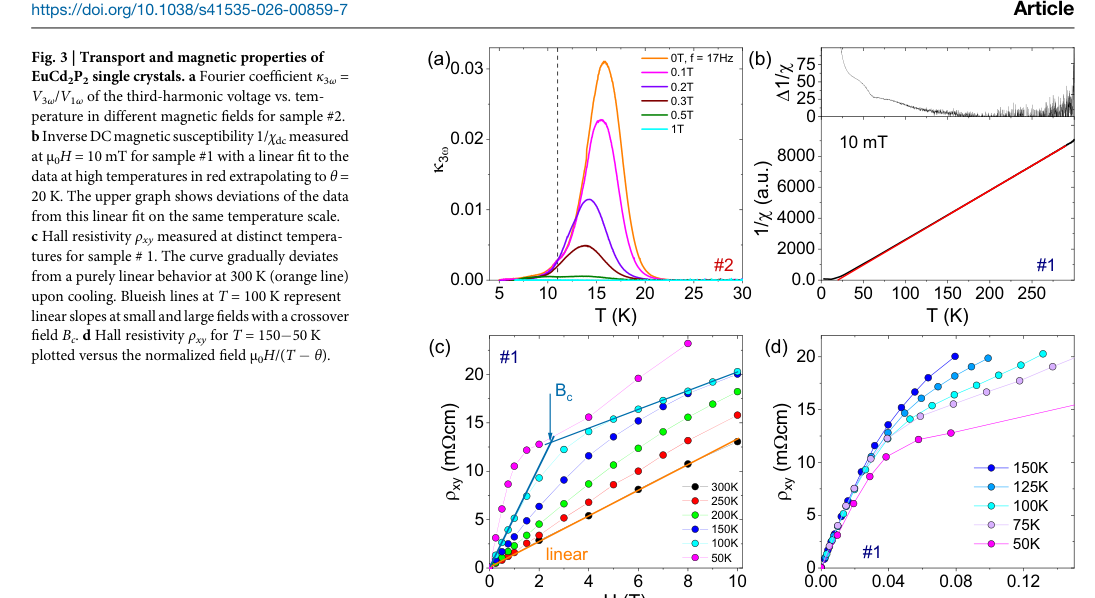 Figure 3. | Transport and magnetic properties of EuCd2P2 single crystals. a Fourier coefficient κ3ω = V3ω/V1ω of the third-harmonic voltage vs. tem- perature in different magnetic fields for sample #2. b Inverse DC magnetic susceptibility 1/χdc measured at μ0H = 10 mT for sample #1 with a linear fit to the data at high temperatures in red extrapolating to θ = 20 K. The upper graph shows deviations of the data from this linear fit on the same temperature scale. c Hall resistivity ρxy measured at distinct tempera- tures for sample # 1. The curve gradually deviates from a purely linear behavior at 300 K (orange line) upon cooling. Blueish lines at T = 100 K represent linear slopes at small and large fields with a crossover field Bc. d Hall resistivity ρxy for T = 150−50 K plotted versus the normalized field μ0H/(T −θ)
Mathematical & Logical Mechanism
The Master Equation
This paper is primarily an experimental characterization study, leveraging a suite of established physical measurement techniques to unravel the complex interplay between magnetism and charge transport in EuCd$_2$P$_2$. As such, it doesn't present a single, novel "master equation" that is solved or optimized in the conventional sense of a theoretical model. Instead, the authors employ several well-known equations as analytical tools to interpret their experimental data and build a coherent physical picture of magnetic polaron percolation.
Among these, a particularly important "transformation logic" used to connect different experimental observations is the relationship between magnetic noise and AC magnetic susceptibility, derived from the fluctuation-dissipation theorem. This equation allows the authors to calculate the magnetic noise power spectral density ($S_M(f)$) from the imaginary part of the AC magnetic susceptibility ($\chi''(f)$), providing a crucial link between dynamic magnetic response and intrinsic magnetic fluctuations.
The core equation for calculating magnetic noise, as presented in the paper, is:
$$S_M(f) = \frac{V}{2k_B T} \chi''(f) \quad \text{(Equation 2)}$$
Additionally, the analysis of muon-spin relaxation ($\mu$SR) data, which is vital for probing local magnetic properties and dynamics, relies on fitting the measured muon asymmetry $A(t)$ to specific functions. A representative example for zero-field $\mu$SR spectra at early times (t $\le$ 0.5 $\mu$s) below $T_N$ is:
$$A(t) = A_1e^{-\lambda_1 t} \cos(2\pi\nu t) + A_{bg1}$$
This equation, while not explicitly numbered as a "master equation" in the main text (it's described in the "Methods" section for SuS data), is fundamental to extracting parameters like oscillation frequency ($\nu$) and relaxation rate ($\lambda_1$) that characterize the local magnetic environment.
Term-by-Term Autopsy
Let's dissect Equation 2, $S_M(f) = \frac{V}{2k_B T} \chi''(f)$, which is central to understanding the magnetic fluctuations.
-
$S_M(f)$
- Mathematical Definition: This term represents the magnetic noise power spectral density (PSD) at a specific frequency $f$. It quantifies how the power of magnetic fluctuations is distributed across different frequencies.
- Physical/Logical Role: $S_M(f)$ is a direct measure of the strength and spectral content of spontaneous magnetic fluctuations within the material. In this paper, it's a key observable that is compared with resistance noise ($S_R(f)$) to establish a direct correlation between magnetic dynamics and electronic transport, which is a cornerstone of the magnetic polaron percolation mechanism. A higher $S_M(f)$ at a given frequency indicates more intense magnetic fluctuations at that frequency.
- Why used: The authors employ $S_M(f)$ to quantitatively characterize the magnetic fluctuations. By comparing it to resistance noise, they can infer that magnetic dynamics are indeed driving the observed changes in electrical resistance, supporting their hypothesis of magnetic polaron formation and percolation. The use of PSD is a standard and robust method for analyzing fluctuating signals in physics.
-
$V$
- Mathematical Definition: This denotes the macroscopic volume of the sample being measured.
- Physical/Logical Role: As magnetic noise is an extensive quantity (it scales with the amount of material), $V$ acts as a scaling factor. It ensures that the calculated $S_M(f)$ corresponds to the total magnetic fluctuation power of the specific sample under investigation.
- Why used: Including the sample volume allows for a proper normalization of the magnetic noise, making it comparable across different samples or with theoretical models that often consider per-unit-volume properties.
-
$k_B$
- Mathematical Definition: The Boltzmann constant, a fundamental physical constant that relates the average kinetic energy of particles in a gas to the absolute temperature of the gas.
- Physical/Logical Role: In this context, $k_B$ serves as a conversion factor, translating temperature into an energy scale. It is a ubiquitous constant in statistical mechanics, appearing whenever thermal energy or thermal fluctuations are considered.
- Why used: The Boltzmann constant is an integral part of the fluctuation-dissipation theorem, which provides the theoretical basis for this equation. It ensures the dimensional consistency and physical correctness of relating thermal fluctuations to dissipative responses.
-
$T$
- Mathematical Definition: The absolute temperature of the system, typically measured in Kelvin.
- Physical/Logical Role: Temperature is a critical thermodynamic parameter that dictates the average thermal energy available to the system. In the denominator of this equation, it highlights that the magnitude of equilibrium fluctuations is inversely related to temperature for a given dissipative response. At lower temperatures, the relative impact of intrinsic magnetic dynamics on noise becomes more pronounced.
- Why used: Temperature is a primary control parameter in the experiments, profoundly influencing the magnetic and electronic phases of EuCd$_2$P$_2$. Its inclusion is essential for describing the thermal origin of fluctuations and how they evolve with changing thermal conditions.
-
$\chi''(f)$
- Mathematical Definition: This term represents the imaginary part of the AC magnetic susceptibility at frequency $f$.
- Physical/Logical Role: The imaginary part of susceptibility quantifies the energy dissipated or absorbed by the magnetic system when subjected to an oscillating magnetic field. It reflects the out-of-phase component of the magnetization response, indicating how much energy is lost to internal magnetic dynamics, such as spin relaxation or domain wall motion.
- Why used: This term is the direct link to the fluctuation-dissipation theorem. It connects the material's dynamic magnetic response (how it dissipates energy) to its intrinsic equilibrium magnetic fluctuations. By measuring $\chi''(f)$, the authors can infer the characteristics of the magnetic noise.
-
$\frac{1}{2k_B T}$
- Mathematical Definition: This combined prefactor scales the imaginary part of the susceptibility.
- Physical/Logical Role: This prefactor is a direct consequence of the fluctuation-dissipation theorem. It scales the dissipative response ($\chi''(f)$) to yield the power spectral density of equilibrium fluctuations ($S_M(f)$), emphasizing the fundamental connection between dissipation and noise in thermal equilibrium.
- Why used: It's a fundamental constant derived from statistical physics, allowing the authors to rigorously relate their measured AC susceptibility to the magnetic noise.
-
Multiplication Operator
- Mathematical Definition: The standard mathematical operation of multiplication.
- Physical/Logical Role: It signifies a direct proportionality. The magnetic noise power spectral density is directly proportional to the sample volume, inversely proportional to the absolute temperature, and directly proportional to the imaginary part of the AC magnetic susceptibility.
- Why used: The fluctuation-dissipation theorem establishes a linear relationship between the power spectral density of equilibrium fluctuations and the dissipative part of the generalized susceptibility, scaled by thermal energy.
Step-by-Step Flow
Let's trace the journey of an abstract magnetic fluctuation through Equation 2, imagining it as a mechanical assembly line that processes raw data into meaningful physical insights.
- Preparation of the Magnetic Response ($\chi''(f)$): The process begins with the material's dynamic magnetic fingerprint. The EuCd$_2$P$_2$ sample is subjected to an oscillating magnetic field, and its magnetization response is measured. From this, the imaginary part of the AC magnetic susceptibility, $\chi''(f)$, is extracted. This $\chi''(f)$ value, specific to a given frequency $f$, represents how much energy the magnetic system dissipates due to internal processes (like spins flipping or domain walls moving) when it tries to follow the oscillating field. Think of it as the "lossy" component of the material's magnetic reaction.
- Input of Macroscopic and Thermal Context ($V$, $T$): Simultaneously, the physical context of the measurement is provided. The sample's volume, $V$, is fed into the system, establishing the overall scale. The absolute temperature, $T$, at which the measurement was performed, is also input, setting the thermal energy environment for the fluctuations.
- Thermal Scaling and Fluctuation-Dissipation Linkage ($1/(2k_B T)$): The $\chi''(f)$ value then passes through a scaling unit. Here, it's divided by $2k_B T$. This step is crucial; it translates the measured energy dissipation ($\chi''(f)$) into a measure of the intrinsic thermal fluctuations. It's like adjusting a gauge based on the ambient temperature to ensure the reading accurately reflects the underlying spontaneous activity, rather than just the forced response. This is where the fundamental connection between a system's ability to dissipate energy and its tendency to spontaneously fluctuate is made explicit.
- Volume Normalization ($V \times \text{scaled } \chi''(f)$): Next, the thermally scaled $\chi''(f)$ is multiplied by the sample volume, $V$. This step ensures that the final output represents the total magnetic noise power for the entire sample, rather than a per-unit-volume quantity. It's like aggregating the individual contributions from all parts of the material to get a comprehensive picture.
- Output: Magnetic Noise Power Spectral Density ($S_M(f)$): The final product rolling off the assembly line is $S_M(f)$, the magnetic noise power spectral density at frequency $f$. This value quantifies the intensity of spontaneous magnetic fluctuations at that particular frequency. By repeating this process for various frequencies and temperatures, the authors construct a detailed map of the magnetic noise, which they can then compare with other measurements (like resistance noise) to infer the presence and behavior of magnetic polarons and their percolation. This allows them to see how the "magnetic hum" of the material changes under different conditions.
Optimization Dynamics
To be honest, this paper is primarily an experimental investigation and interpretation of a physical phenomenon, rather than a study that involves an explicit "optimization" process in the sense of an algorithm learning or a model iteratively converging to minimize a loss function. The authors' goal is to characterize the material EuCd$_2$P$_2$ and understand the underlying physical mechanism of magnetic polaron percolation based on a comprehensive set of experimental data.
Therefore, you won't find a "loss landscape" being shaped, "gradients" being calculated for parameter updates, or iterative state updates in the typical machine learning or computational physics context. Instead, the "dynamics" in this paper refer to:
- Parameter Extraction through Fitting: For certain experimental techniques, such as $\mu$SR, raw data (e.g., muon asymmetry $A(t)$) is fitted to established theoretical or phenomenological models (e.g., $A(t) = A_1e^{-\lambda_1 t} \cos(2\pi\nu t) + A_{bg1}$). This fitting process involves determining the parameters ($\nu$, $\lambda_1$, $A_1$, $A_{bg1}$) that best describe the observed data. While not an "optimization" of a physical system, it is a statistical optimization where a fitting algorithm (often least squares) minimizes the discrepancy between the model and the experimental data. The "convergence" here is the algorithm finding the optimal set of parameters that provide the best fit. The "gradients" would conceptually relate to how sensitive the goodness-of-fit is to small changes in these parameters.
- Physical System Evolution and Phase Transitions: The paper meticulously describes the evolution of various physical properties (resistivity, noise, magnetic susceptibility, $\mu$SR parameters) as external conditions, primarily temperature ($T$) and magnetic field ($H$), are varied. The "dynamics" are the material's intrinsic response to these changing conditions, leading to different magnetic and electronic phases. For example, the paper observes a rapid decrease in the $\mu$SR relaxation rate $\lambda_2$ below a characteristic temperature $T^*$, which signifies a change in the magnetic fluctuation dynamics. This is not an "optimization" but rather the material naturally transitioning between states (e.g., from a paramagnetic state with isolated polarons to an antiferromagnetic state where polarons might freeze or percolate).
- Percolation Dynamics: The central concept of "percolation" itself describes a dynamic process where isolated ferromagnetic clusters (magnetic polarons) grow in size and eventually connect to form a continuous, conductive path through the antiferromagnetic matrix. The "optimization" in a conceptual sense is the system seeking a state of lower free energy or higher entropy under the given thermal and magnetic conditions, leading to the formation and growth of these polarons. The "convergence" is the system reaching a stable phase, such as a percolating network, at a critical temperature or magnetic field. The paper identifies critical temperatures (like $T_{peak}$ or $T_N$) and a "universal critical magnetization" as points where these transitions occur, marking significant shifts in the system's overall state and transport properties.
In essence, the paper's "learning" is performed by the scientists, who iteratively refine their understanding of EuCd$_2$P$_2$'s complex behavior by analyzing diverse experimental data through established physical theories and models. The material itself undergoes physical transformations, which are the "dynamics" being observed and interpreted.
Results, Limitations & Conclusion
Experimental Design & Baselines
To rigorously validate their claims regarding magnetic polaron percolation as the origin of colossal magnetoresistance (CMR) in EuCd$_2$P$_2$, the researchers employed a comprehensive suite of experimental techniques on two distinct single-crystal samples. Sample #1 was grown in Frankfurt, and sample #2 in Boston, allowing for a comparison of materials with slightly different intrinsic doping and growth conditions.
The core of the experimental validation revolved around correlating electronic transport properties with magnetic behavior across a wide range of temperatures and magnetic fields.
- (Magneto)resistance measurements were performed using a standard four-terminal AC lock-in technique. Current was applied in the basal a-a plane, with magnetic fields aligned along the c-axis, covering temperatures from 5 K to 300 K and fields up to $\mu_0H = 10$ T. This setup allowed for precise measurement of resistivity and its change under magnetic fields, which is the direct manifestation of CMR.
- Hall effect measurements were conducted using a contact geometry designed to minimize longitudinal components, with voltages antisymmetrized for positive and negative field values. This enabled the extraction of carrier concentrations and the study of their behavior in magnetic fields, crucial for understanding charge carrier dynamics.
- Resistance fluctuation spectroscopy (Noise PSD) was implemented using a four-point configuration. The voltage signal from the sample was amplified by a low-noise amplifier and then processed by a signal analyzer to calculate the power spectral density (PSD). A cross-correlation technique with two voltage amplifiers and lock-in amplifiers was used to significantly reduce background noise, ensuring the measured fluctuations were intrinsic to the material.
- Weakly-nonlinear (third-harmonic) AC transport measurements were carried out in the same configuration as resistance measurements, focusing on the Fourier coefficient $K_{3\omega} = V_{3\omega}/V_{1\omega}$ at $f = 17$ Hz. This technique is particularly sensitive to microscopic inhomogeneities in current distribution, a key signature of percolation.
- DC magnetic susceptibility measurements utilized vibrating sample magnetometry (PPMS) and magnetic property measurement systems (MPMS3) to probe the bulk magnetic response, specifically the inverse susceptibility $1/\chi_{dc}$ at $\mu_0H = 10$ mT.
- Muon-spin relaxation ($\mu$SR) measurements were performed in zero-field (ZF) at the Swiss Muon Source (S$\mu$S) and with weak transverse field (wTF) and longitudinal field (LF) at the ISIS facility. This highly sensitive local probe allowed for the investigation of local magnetic field distributions and dynamics at the muon sites, providing direct insight into magnetic ordering and fluctuations.
The "victims" (baseline models) defeated by this approach were primarily the conventional understanding of CMR, which often focused on ferromagnets, and the lack of direct microscopic evidence for magnetic polaron percolation in antiferromagnetic (AFM) systems like EuCd$_2$P$_2$. The experiments ruthlessly proved their mathematical claims by showing a direct, multi-faceted correlation between electronic transport anomalies (resistivity peaks, large negative MR, noise peaks, nonlinear transport) and magnetic phenomena (Hall effect curvature, $\mu$SR signatures of phase separation and dynamic fluctuations), all consistent with a percolative transition driven by magnetic polarons. The comparison between two samples with different carrier concentrations further reinforced the intrinsic nature of the observed effects.
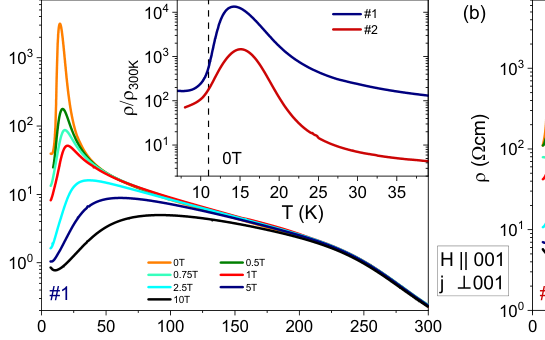 Figure 1. | Electric characterization of two different EuCd2P2 single crystals. Com- parison of the resistivities of sample #1 and sample #2 in (a, b), respectively, shown for T = 5−300 K in magnetic fields μ0H = 0−10 T aligned along the c axis. Inset in (a) shows the normalized zero-field resistivities for both samples at low temperatures
What the Evidence Proves
The evidence presented in the paper definitively establishes magnetic polaron percolation as the microscopic origin of CMR in EuCd$_2$P$_2$. The multi-probe approach provided undeniable, hard evidence that the core mechanism actually works in reality.
-
Direct Evidence for Electronic Phase Separation and Polaron Formation:
- Resistivity and Magnetoresistance: Both samples exhibited a semiconducting temperature dependence with a pronounced resistivity peak at $T_{peak}$ (14-15 K), notably above the AFM ordering temperature $T_N = 11$ K. Crucially, this peak was strongly suppressed by applied magnetic fields, leading to colossal negative magnetoresistance (up to -99.95% for sample #1). This dramatic change from an insulating-like to a metallic-like state under magnetic field is the hallmark of CMR and is interpreted as the formation and percolation of conducting ferromagnetic (FM) polaron clusters within the AFM matrix.
- Resistance Noise and Third-Harmonic Transport: A significant increase in the 1/f-type resistance noise power spectral density (PSD) and a peak in the third-harmonic coefficient $K_{3\omega}$ were observed below $T^* \approx 2T_N$ (around 22 K). These features directly coincided with the onset of the resistivity increase and were strongly suppressed by applied magnetic fields. This behavior is a well-known signature of microscopically inhomogeneous current distribution and percolative transitions, consistent with the formation and growth of magnetic polarons that eventually connect to form a conducting path. The suppression by magnetic field indicates a more uniform current distribution as polarons align.
- Hall Effect: The Hall resistivity $\rho_{xy}(B)$ showed a clear curvature upon cooling, deviating from purely linear behavior. When plotted against a normalized field $\mu_0H/(T-\theta)$, the curves collapsed onto a single universal curve. This "nonlinear Hall effect" is a strong indicator of electronic phase separation and magnetic polaron percolation, as previously observed in prototypical CMR systems like EuB$_6$. The onset of the negative MR for each magnetic field was found to coincide with the corresponding crossover field $B_c$ from the Hall resistivity, underscoring the direct link between polaron behavior and magnetotransport.
- Muon-Spin Relaxation ($\mu$SR): This local probe provided the most direct evidence of magnetic phase separation. Below $T_N$, ZF $\mu$SR spectra showed high-frequency oscillations, confirming long-range magnetic order. However, only 81% of the expected muon-spin polarization was observed, implying a phase separation into a magnetically-ordered majority phase (81%) and a fluctuating minority phase (19%) whose muon response was too fast to resolve. Above $T_N$ but below $T^*$, the $\mu$SR spectra exhibited exponential relaxation, characteristic of dynamic fluctuations in the local magnetic field distribution, with a relaxation rate $\lambda_2$ that rapidly decreased. This dynamic behavior is consistent with the formation and growth of isolated magnetic polarons. Weak transverse field (wTF) measurements further supported this, indicating that at T = 20 K, 30 ± 6% of the sample was non-magnetic, while the remaining 70 ± 6% hosted dynamically fluctuating magnetic moments.
-
Microscopic Origin of CMR Confirmed: The compilation of these diverse measurements, as summarized in Fig. 5 and the proposed model in Fig. 6, paints a consistent picture. Magnetic polarons begin to form dynamically at elevated temperatures (~150 K), grow in size upon cooling, and then percolate at $T_{peak}$, forming a conductive path that accounts for the observed CMR effect. The characteristic size of these magnetic polarons near the percolation threshold was estimated to be approximately 6-10 nm.
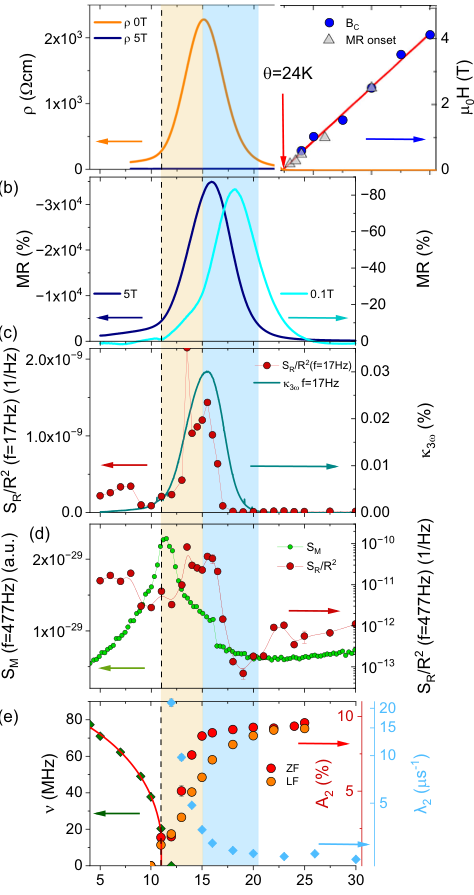 Figure 5. | Compilation of different measurements on EuCd2P2. a Left: Resistance vs. temperature shown up to 2 TN in zero-field (orange) and μ0H = 5 T (blue). Right: The crossover field Bc of the Hall resistivity (blue) and onset of MR (gray triangles) are shown up to T ~15 TN, with a linear fit to the data. b Magnetoresistance in high and small field of μ0H = 5 T and 0.1 T (left and right axis), respectively. c Normalized resistance noise PSD, SR/R2(f = 17 Hz) on a linear scale in comparison to the third- harmonic Fourier coefficient κ3ω. d Comparison of the calculated magnetic noise PSD SM(f = 477 Hz) (green) and the resistance noise PSD SR/R2(f = 477 Hz) (red). e (i) Oscillation frequency ν (green diamonds), (ii) relaxation rate λ2 (blue diamonds) and (iii) amplitude A2 in zero-field (dark red dots) and in longitudinal field (orange dots), measured by μSR. The orange area highlights TN−Tpeak, the blue Tpeak−T*
- Robustness and Universality: The observed phenomena were consistent across both samples, despite their quantitative differences in carrier concentration and room-temperature resistivity. This indicates that magnetic polaron formation and percolation is an intrinsic and robust feature of EuCd$_2$P$_2$, and likely other Eu-based correlated semiconductors with competing AFM and FM interactions and low charge carrier concentrations.
Limitations & Future Directions
While the paper presents compelling evidence, it's important to acknowledge certain limitations and consider avenues for future development.
Limitations:
- Sample Variability and Impurity Sensitivity: Although the core phenomenon is robust, the paper notes quantitative differences between samples #1 and #2 (e.g., room-temperature resistivity, carrier density, mobility). This highlights the material's sensitivity to growth conditions, impurities, and charge carrier doping. While this sensitivity is mentioned as a motivation, it also means that precise control over these factors is crucial for reproducibility and potential applications, and the exact impact of these variations on polaron characteristics is not fully detailed.
- Simplified Polaron Geometry: The estimation of polaron size (6-10 nm) assumes "randomly overlapping spherical bound magnetic polarons." However, the paper itself points out that EuCd$_2$P$_2$ is an electronically and magnetically anisotropic compound, suggesting that magnetic polarons are likely ellipsoid-shaped with their long axis along the in-plane easy magnetization direction. This simplification might affect the accuracy of the size estimation and the detailed understanding of their percolation dynamics.
- $\mu$SR Resolution and Interpretation Ambiguities: The $\mu$SR measurements, while powerful, have some limitations. The ISIS data, for instance, had limited time resolution, which affected the ability to fully resolve rapid changes in relaxation amplitude in certain temperature regimes. Furthermore, the presence of an additional, slowly-relaxing background component in the ISIS data, potentially from muons stopping in the silver backing plate, complicates the interpretation of the sample's intrinsic response. The exact nature of the "fluctuating minority phase" (19% by volume) observed below $T_N$ remains somewhat ambiguous, whether it represents dynamic fluctuations or quasistatic disordered fields.
- Theoretical Model Complexity: While the study draws parallels to basic percolation theory and random resistor networks (RRNs), it acknowledges that the present system is "considerably more complex than one-component random resistor networks." This suggests that a more sophisticated theoretical framework might be needed to fully capture the intricate interplay of competing magnetic interactions and electronic phase separation.
Future Directions:
- Advanced Polaron Characterization and Visualization: Given the estimated polaron size of 6-10 nm, future work could focus on direct visualization techniques. Employing advanced microscopy methods like scanning tunneling microscopy (STM) or small-angle neutron scattering (SANS) could provide real-space images of polaron formation, growth, and percolation, offering a more intuitive understanding beyond indirect transport and magnetic measurements. This would allow for direct validation of their shape and spatial distribution.
- Tailoring Polaron Properties through Material Engineering: The observed sensitivity to growth conditions and doping presents an opportunity. Future research could systematically investigate how controlled variations in stoichiometry, doping, or strain engineering impact the size, density, anisotropy, and dynamic properties of magnetic polarons. This could lead to the design of materials with optimized CMR characteristics for specific applications.
- Developing Anisotropic Percolation Models: To address the limitation of spherical polaron assumptions, theoretical efforts should focus on developing and applying anisotropic percolation models. Such models, incorporating the ellipsoid shape and preferred orientation of polarons, would provide a more accurate and predictive framework for understanding magnetotransport in these complex materials.
- Time-Resolved Dynamics of Polaron Formation: The paper highlights the dynamic nature of polaron formation. Further time-resolved studies, perhaps using ultrafast spectroscopy or advanced noise spectroscopy techniques, could shed light on the timescales involved in polaron nucleation, growth, and percolation. Understanding these dynamics is crucial for both fundamental insight and potential high-frequency applications.
- Expanding the Universal Framework: The findings establish a unified framework for EuCd$_2$P$_2$. A compelling future direction is to systematically apply this framework to other Eu-based correlated semiconductors and potentially other AFM CMR systems. Identifying commonalities and differences across various materials could lead to a more general theory of CMR in AFM systems, potentially revealing new classes of materials with robust magnetotransport properties.
- Exploiting AFM CMR for Spintronics: The robust CMR in an AFM system like EuCd$_2$P$_2$ is particularly exciting for spintronics and quantum information technologies, as it offers the potential for devices without the drawbacks of stray fields from ferromagnets. Future research could explore device prototypes that leverage this AFM CMR effect, focusing on aspects like energy efficiency, switching speed, and integration with existing technologies.
- Refining Theoretical Understanding of Phase Separation: The complex interplay between FM and AFM correlations, leading to phase separation, warrants further theoretical investigation. Developing more sophisticated models that go beyond simple RRNs to account for competing interactions and dynamic fluctuations would be invaluable. This could involve advanced Monte Carlo simulations or analytical theories that incorporate the specific electronic and magnetic structure of EuCd$_2$P$_2$.
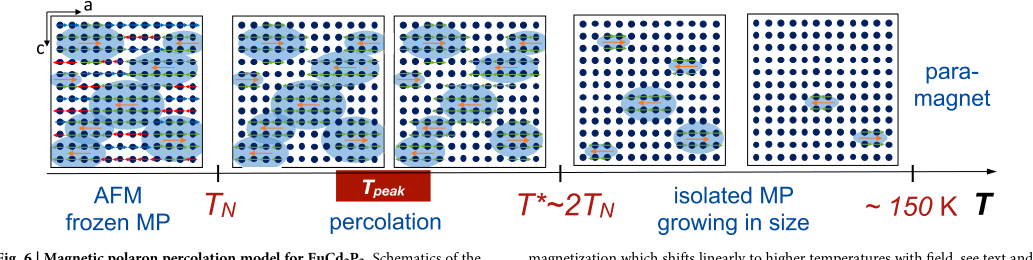 Figure 6. | Magnetic polaron percolation model for EuCd2P2. Schematics of the suggested model of magnetic polaron (MP) percolation in EuCd2P2 in zero magnetic field. At T* ~ 2TN, roughly coinciding with the paramagnetic Curie temperature θ, both MP percolation and large negative MR emerge at zero field at a universal critical