
Magnetic excitations of the Kitaev model candidate RuBr3
New study reveals RuBr3's magnetic interactions push it from ideal spin liquid state, offering clues for quantum computing materials.
Background & Academic Lineage
The Origin & Academic Lineage
The problem addressed in this paper originates from the fascinating field of condensed matter physics, specifically the search for and characterization of quantum spin liquid (QSL) states. This quest began in earnest with the theoretical proposal of the Kitaev model by Alexei Kitaev in 2006 [1]. This model, defined by unique bond-dependent Ising interactions on a honeycomb lattice, is remarkable because it can be exactly solved to reveal a QSL ground state. In this exotic state, spins do not order even at absolute zero temperature; instead, they remain entangled and fluctuate, giving rise to fractionalized excitations known as Majorana fermions [7]. These properties hold immense promise for fault-tolerant quantum computation.
The challenge then became to find real-world materials that could host these elusive Kitaev interactions. The academic field saw a significant breakthrough around 2009 with the realization that strong spin-orbit coupling in certain transition metal compounds, particularly those with $d^5$ electron configurations like Ir$^{4+}$ and Ru$^{3+}$ ions, could effectively induce these bond-dependent interactions through a mechanism involving pseudospin-1/2 states [8]. This led to the emergence of "Kitaev materials" as a new frontier. Among these, $\alpha$-RuCl$_3$ quickly became the most extensively studied candidate [9-38].
However, a fundamental limitation, or "pain point," of previous approaches and studies on $\alpha$-RuCl$_3$ is that while it exhibits some signatures of Kitaev spin liquid behavior at higher temperatures, its ground state below a certain transition temperature ($T_N$) is a conventional zigzag antiferromagnetic order. This indicates the presence of other magnetic interactions (like Heisenberg and off-diagonal terms) that compete with and ultimately destabilize the ideal Kitaev spin liquid state [31, 32, 39-43]. These competing interactions prevent the full realization of the desired QSL properties. The authors of this paper are motivated by the need to understand and control these interactions. One key strategy is to modify the ligand ions surrounding the magnetic atoms, as these ions play a crucial role in mediating the orbital exchange mechanism that gives rise to the bond-dependent interactions. This paper investigates RuBr$_3$ as a new candidate, where substituting bromine for chlorine is expected to alter the balance of these magnetic interactions, potentially pushing the material closer to, or further from, the ideal Kitaev spin liquid state.
Intuitive Domain Terms
- Kitaev Model: Imagine a special kind of magnetic checkerboard where the rules for how two adjacent checkers interact (attract or repel) depend entirely on the direction of the line connecting them. For example, checkers connected horizontally might want to align in the same direction, while those connected diagonally might want to align in opposite directions. The Kitaev model is a theoretical framework that describes such a system, and it's famous because it predicts a "quantum spin liquid" state where the magnets never freeze into a fixed pattern, even at the coldest temperatures.
- Quantum Spin Liquid (QSL): Think of a regular liquid where water molecules are constantly moving and interacting. A quantum spin liquid is similar, but instead of water, it's the tiny internal magnets (spins) of electrons that are in a constant, entangled, "liquid-like" state. Even at absolute zero, they don't settle into a simple, ordered magnetic pattern like a fridge magnet. Instead, their collective behavior is highly complex and quantum mechanical, leading to exotic "half-particles" called Majorana fermions.
- Majorana Fermions: If you think of a regular particle, like an electron, as a whole person, then a Majorana fermion is like "half a person." In the context of quantum spin liquids, the electron's spin can effectively split into two separate, independent parts, each behaving like a Majorana fermion. These "half-particles" are unique because they are their own antiparticles, and their robustness against local disturbances makes them a promising building block for future quantum computers.
- Bond-dependent Ising Interactions: Picture a grid of tiny compass needles, each only allowed to point strictly up or down (like a binary switch). "Bond-dependent" means that whether two adjacent needles prefer to point in the same direction or opposite directions depends entirely on the specific direction of the line connecting them on the grid. For instance, along a "north-south" bond, they might prefer to be parallel, but along an "east-west" bond, they might prefer to be anti-parallel. This directional preference is the core idea behind the Kitaev model.
- Pseudospin-1/2 State: In some complex materials, the electron's actual spin (which is always 1/2) gets tangled up with its orbital motion around the atom. This combination results in an effective magnetic moment that behaves as if it were a simple spin-1/2 particle, but its "up" and "down" directions are dictated by the crystal's structure rather than just a simple magnetic field. It's a clever way to simplify the description of complex electron behavior in these materials.
Notation Table
| Notation | Description |
|---|---|
| $H$ | Total Hamiltonian of the magnetic system |
| $S_i$ | Spin operator at site $i$ |
| $J_{ij}$ | Nearest-neighbor anisotropic interaction matrix |
| $J_1$ | Isotropic Heisenberg exchange coupling constant |
| $K$ | Kitaev interaction term |
| $\Gamma$ | Symmetric off-diagonal exchange term |
| $\Gamma'$ | Antisymmetric off-diagonal exchange term |
| $J_2$ | Coupling constant for next-nearest-neighbor (NNN) isotropic magnetic interactions |
| $J_3$ | Coupling constant for third-nearest-neighbor (3NN) isotropic magnetic interactions |
| $J_p$ | Coupling constant for interplane isotropic magnetic interactions |
| $T_N$ | Néel temperature (magnetic ordering temperature) |
| $E_i$ | Incident neutron energy |
| $S(\mathbf{Q}, E)$ | Dynamic structure factor (measured by inelastic neutron scattering) |
| $\mathbf{Q}$ | Wavevector (momentum transfer) |
| $E$ | Energy transfer |
| $n(T)$ | Bose factor |
| $k_B$ | Boltzmann constant |
| $\theta_{ab}, \theta_c$ | Weiss temperatures (in-plane and out-of-plane) |
Problem Definition & Constraints
Core Problem Formulation & The Dilemma
The core problem addressed by this paper is to precisely characterize the magnetic interactions in RuBr$_3$, a candidate material for the Kitaev quantum spin liquid, and to understand how these interactions drive its ground state away from the ideal Kitaev spin liquid.
The Input/Current State is a material, RuBr$_3$, which is a new polymorph with a layered honeycomb structure, isostructural to the well-studied Kitaev candidate $\alpha$-RuCl$_3$. Both materials exhibit a zigzag antiferromagnetic (AFM) order below their respective Néel temperatures ($T_N$). However, RuBr$_3$ shows distinct magnetic properties compared to $\alpha$-RuCl$_3$, such as suppressed magnetic susceptibility and a different Weiss temperature. Previous ab initio calculations for RuBr$_3$ have suggested magnetic interactions comparable to $\alpha$-RuCl$_3$, which contradicts these experimental observations. The theoretical understanding of the ideal ferromagnetic Kitaev model predicts spin excitations with weak wavevector dependence, but real materials often show more complex behavior due to competing interactions.
The Desired Endpoint (Output/Goal State) is a clarified understanding of the effect of anion substitution (specifically, bromine for chlorine) on the magnetic interactions in Kitaev candidate materials. The paper aims to experimentally investigate the spin dynamics of RuBr$_3$ using inelastic neutron scattering (INS) to identify the specific magnetic interactions ($J_1, K, \Gamma, \Gamma', J_2, J_3, J_p$) that stabilize the observed zigzag AFM order. Ultimately, the goal is to provide a more realistic model for RuBr$_3$ that accurately reproduces its magnetic excitations and macroscopic properties, thereby explaining how its ground state deviates from the ideal ferromagnetic Kitaev spin liquid.
The Missing Link or Mathematical Gap lies in quantitatively determining the precise set of exchange parameters for RuBr$_3$ that can consistently explain both its macroscopic magnetic properties (like Weiss temperature and canting angle) and its microscopic spin dynamics (magnetic excitation spectra). While theoretical models exist (e.g., the J$_1$-K-$\Gamma$-$\Gamma$' and J$_1$-K-J$_2$-J$_3$ models), the paper highlights the difficulty in accurately estimating these parameters from powder-averaged experimental data. There's a clear discrepancy between theoretical predictions from ab initio calculations and the observed experimental magnetic behavior of RuBr$_3$, which this study attempts to bridge through detailed experimental characterization of spin dynamics.
The Painful Trade-off or Dilemma that has trapped previous researchers, and is central to this work, is the inherent competition between the desired Kitaev interactions and other magnetic interactions (Heisenberg, off-diagonal, further-neighbor) in real materials. While the Kitaev model is theoretically appealing for realizing spin liquids, the presence of these additional interactions often leads to conventional magnetic orders, like the zigzag AFM observed in RuBr$_3$. Researchers face the dilemma of how to tune these competing interactions to either suppress the conventional order or enhance the Kitaev physics. Ligand substitution is a strategy, but its exact impact on the delicate balance of interactions is complex and not easily predictable, often leading to unintended consequences or new challenges. The paper explicitly states that "controlling not only the Kitaev interactions but also the Heisenberg and off-diagonal magnetic interactions is essential for the practical utilisation of real materials," underscoring this fundamental trade-off. Furthermore, the difficulty in uniquely determining multiple exchange parameters from powder-averaged experimental data means that improving the experimental accessibility (using powder samples) comes at the cost of precision in parameter extraction, as different parameter sets can yield similar simulated spectra.
Constraints & Failure Modes
The problem of understanding magnetic excitations in RuBr$_3$ is made insanely difficult by several harsh, realistic constraints:
- Physical Constraints:
- Material Complexity: RuBr$_3$ possesses a three-layered honeycomb structure (Fig. 1), which introduces interplane magnetic interactions ($J_p$) in addition to the in-plane interactions. This increases the number of parameters in the Hamiltonian, making the system more complex to model.
- Competing Magnetic Interactions: The material exhibits zigzag antiferromagnetic order, indicating that non-Kitaev interactions (Heisenberg $J_1, J_2, J_3$, and off-diagonal $\Gamma, \Gamma'$) are significant and compete with or even dominate the Kitaev term $K$. This complex interplay makes it challenging to isolate and quantify the individual contributions of each interaction.
- Temperature-Dependent Dynamics: Magnetic excitations in RuBr$_3$ show a complex temperature dependence, including shifts in spectral weight and the closing of an energy gap. Accurately capturing these changes across a wide temperature range is crucial but adds to the experimental and analytical burden.
- Spin-Orbit Coupling: The bond-dependent interactions arise from strong spin-orbit coupling in the Ru$^{3+}$ ions, which necessitates a pseudospin-1/2 description. This quantum mechanical complexity makes classical approximations (like linear spin wave theory) inherently limited.
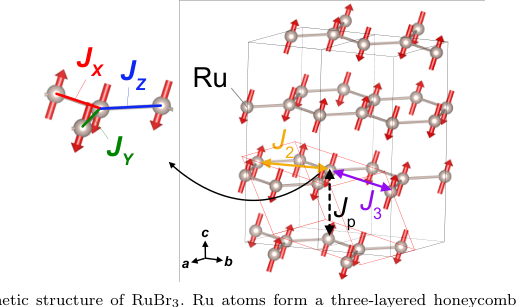 Figure 1. Magnetic structure of RuBr3. Ru atoms form a three-layered honeycomb structure with a crystallographic unit cell indicated by thin black lines. The magnetic moments of the Ru atoms form a zigzag antiferromagnetic structure with the unit cell indicated by thin red lines. JX , JY , and JZ represent bond-dependent anisotropic nearest-neighbour magnetic interactions. J2, J3, and Jp represent the next nearest neighbour, third nearest neighbour magnetic interactions within the honeycomb plane, and interplane magnetic interactions, respectively
-
Computational Constraints:
- Limitations of Linear Spin Wave Theory (LSWT): The paper notes that LSWT, used for simulating spectra, "would not perfectly apply to the pseudospin-1/2 system." This means the theoretical framework itself has inherent limitations in accurately capturing the quantum nature of the magnetic excitations, potentially leading to discrepancies with experimental results.
- High-Dimensional Parameter Space: The Hamiltonian involves numerous exchange parameters ($J_1, K, \Gamma, \Gamma', J_2, J_3, J_p$). The paper explicitly states that "it is not possible to estimate several exchange parameters simultaneously" from the available data. This forces researchers to rely on phenomenological adjustments and present "two extreme combinations" rather than a unique, definitive set of parameters.
- Powder Averaging: The use of powder inelastic neutron scattering data, while experimentally more accessible, inherently averages over all crystallographic orientations. This "difficulty in estimating exchange parameters from the powder-averaged spectrum" means that crucial anisotropic information, which could help distinguish between different models, is lost.
-
Data-Driven Constraints:
- Incomplete Phonon Subtraction: To extract the magnetic signal, phonon contributions are estimated from high-temperature data and subtracted. However, "the subtraction is not complete because of the anharmonicity in phonons and the background that has little temperature dependence." This introduces noise and uncertainty, potentially obscuring subtle magnetic features.
- Sensitivity of Macroscopic Property Estimation: The estimation of the Weiss temperature, a key macroscopic property, is "very sensitive to Van-Vleck paramagnetic-like contributions from spin-orbit coupled excited states." This makes it an unreliable metric for precise parameter determination, further complicating the validation of theoretical models.
- Limited Resolution of Powder INS: Powder INS, by its nature, provides a momentum-averaged view of excitations. The paper mentions that for weak excitations, "wavevector and energy dependences are not clear in the powder inelastic scattering spectrum," making it difficult to resolve fine details of spin dynamics that might be critical for distinguishing between competing theoretical models.
Why This Approach
The Inevitability of the Choice
To be honest, the idea of traditional "SOTA" methods like standard CNNs, basic Diffusion models, or Transformers being considered and then rejected for this specific problem is a bit of a mischaracterization of the scientific domain. This paper operates within condensed matter physics, where the "SOTA" methods for investigating magnetic excitations are established experimental techniques like inelastic neutron scattering and theoretical frameworks such as linear spin wave theory. Machine learning models, while powerful in other fields, are simply not applicable for directly probing the fundamental magnetic interactions and spin dynamics of a material like RuBr3 at this level.
The authors' choice of inelastic neutron scattering combined with linear spin wave theory (LSWT) was not merely a preference but an inevitability given the problem's nature. The core objective is to experimentally observe and theoretically interpret the magnetic excitations in RuBr3, a candidate material for the Kitaev model. Inelastic neutron scattering is the preeminent experimental technique for directly measuring the energy and momentum dependence of spin excitations (magnons or fractionalized excitations) in magnetic materials. It provides a direct window into the dynamic magnetic correlations within the material.
The exact moment the authors realized traditional (in the context of condensed matter physics) "SOTA" methods were insufficient for a simple interpretation likely came from initial characterizations of RuBr3. The paper's abstract and introduction highlight that while the Kitaev model predicts an exact quantum spin liquid ground state, RuBr3 exhibits a "zigzag antiferromagnetic order below $T_N$." This observation immediately signals that the ideal, pure Kitaev model (which would lead to a spin liquid) is insufficient to describe RuBr3. The presence of magnetic order necessitates a theoretical framework capable of describing collective spin excitations (magnons) in an ordered phase, which is precisely what linear spin wave theory provides when applied to an extended Kitaev-Heisenberg Hamiltonian. Therefore, the realization was not about the failure of a computational algorithm, but about the material's physical properties deviating from the simplest theoretical ideal, demanding a more comprehensive experimental and theoretical approach.
Comparative Superiority
The chosen approach, combining inelastic neutron scattering experiments with linear spin wave theory calculations, offers qualitative superiority by providing a direct and physically interpretable link between microscopic magnetic interactions and macroscopic observable spin dynamics.
- Direct Probing of Spin Dynamics: Inelastic neutron scattering is qualitatively superior because it directly measures the dynamic structure factor $S(\mathbf{Q}, E)$, which is proportional to the Fourier transform of the spin-spin correlation function. This means it directly probes how spins fluctuate in both space (momentum $\mathbf{Q}$) and time (energy $E$). Unlike indirect probes, neutron scattering provides a complete picture of the magnetic excitation spectrum, including dispersion relations (how excitation energy changes with momentum) and spectral weights. This directness is unparalleled by other techniques for studying bulk magnetic materials.
- Physical Interpretability through LSWT: Linear spin wave theory, when applied to a carefully constructed Hamiltonian (like the one in Equation 2), allows for the extraction of fundamental exchange parameters ($J_1, K, \Gamma, \Gamma', J_2, J_3, J_p$). This provides a structural advantage: it connects the observed experimental spectra to the underlying microscopic interactions governing the material's magnetism. The paper explicitly demonstrates this by comparing simulated spectra from two different parameter sets (J$_1$-K-$\Gamma$-$\Gamma$' and J$_1$-K-J$_2$-J$_3$ models) against experimental data (Fig. 3). The J$_1$-K-J$_2$-J$_3$ model shows "better" agreement, indicating its superior ability to capture the complex interplay of interactions in RuBr3. This isn't about reducing memory complexity from $O(N^2)$ to $O(N)$ but about providing a robust, physically grounded model that accurately describes the experimental reality. The ability to reproduce "strongly dispersive magnetic excitations" and "dispersionless excitations" observed experimentally is a key qualitative advantage.
Alignment with Constraints
The chosen method perfectly aligns with the implicit constraints of studying a Kitaev model candidate like RuBr3, particularly one that exhibits zigzag antiferromagnetic order.
- Experimental Characterization of Magnetic Excitations: The primary constraint is to experimentally characterize the magnetic excitations. Inelastic neutron scattering is uniquely suited for this, as it directly measures the energy and momentum of spin excitations. The use of powder samples (as opposed to single crystals) is a practical constraint, and the analysis accounts for this by averaging over the whole solid angle during simulations.
- Identification of Underlying Magnetic Interactions: A crucial requirement is to identify and quantify the various magnetic interactions (Kitaev, Heisenberg, off-diagonal) that drive the material's magnetic behavior and potentially stabilize the observed zigzag antiferromagnetic order. Linear spin wave theory, applied to an extended Kitaev-Heisenberg Hamiltonian, is designed precisely for this purpose. It allows the authors to fit experimental data to a theoretical model, thereby extracting the values of these exchange parameters. This "marriage" between experimental observation and theoretical modeling is essential for understanding how ligand substitution affects these interactions, which is a central theme of the paper. The paper's goal to "clarify the effect of anion substitution on magnetic interactions" is directly met by this combined approach.
Rejection of Alternatives
The paper implicitly rejects simpler theoretical models and highlights the limitations of other characterization techniques, rather than explicitly dismissing unrelated "SOTA" machine learning approaches.
- Rejection of the Ideal Kitaev Model: The most significant implicit rejection is that of the ideal ferromagnetic Kitaev model as a complete description for RuBr3. The paper states that "Theoretically, magnetic excitations of the ideal ferromagnetic Kitaev model are characterised by weak wavevector dependence," but their experimental results show "strongly dispersive magnetic modes" and "zigzag antiferromagnetic order." This clear discrepancy means a pure Kitaev model is insufficient. The authors therefore adopt an extended Hamiltonian (Equation 2) that includes additional Heisenberg ($J_1, J_2, J_3$) and off-diagonal ($\Gamma, \Gamma'$) terms, which are necessary to stabilize the observed magnetic order and reproduce the dispersive excitations. This is a refinement of the theoretical model, moving beyond a simplistic view.
- Limitations of Other Characterization Methods: While not a direct rejection, the paper mentions other techniques like Raman scattering, nuclear magnetic resonance, and X-ray scattering experiments in the introduction when discussing previous work on $\alpha$-RuCl$_3$. These methods provide valuable complementary information (e.g., specific phonon modes, local spin environments, electronic structure), but they do not offer the direct, momentum-resolved information about spin excitations that inelastic neutron scattering provides. For example, Raman scattering can detect two-magnon-like excitations, but neutron scattering gives the full dispersion.
- Irrelevance of Machine Learning SOTA: As mentioned earlier, approaches like Generative Adversarial Networks (GANs) or Diffusion models are designed for tasks such as image generation, data synthesis, or complex pattern recognition in large datasets. They are fundamentally ill-suited for the direct experimental measurement of spin dynamics or the derivation of microscopic exchange parameters in quantum materials, which requires specific physical probes and theoretical frameworks. Their application in this context would be a category error, not a failed alternative.
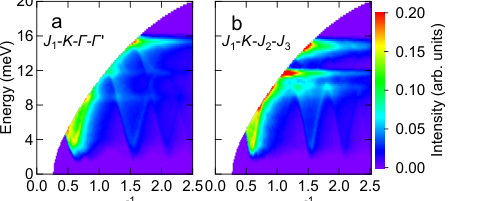 Figure 5. Inelastic neutron scattering spectrum simulated from (a) the J1–K–Γ–Γ′ and (b) the J1– K–J2–J3 models by using linear spin wave theory. The parameters used for the simulations are (a) J1 = −1.8, K = −7.2, Γ = 10.5, Γ′ = −2.5 meV and (b) J1 = 1.5, K = −8.1, J2 = 0.8, J3 = 5.8, and Γ′ = −0.16 meV. Interplane interactions of Jp = 0.15 meV are adopted in both models
Mathematical & Logical Mechanism
The Master Equation
The fundamental mathematical framework underpinning this paper's analysis of magnetic excitations in RuBr$_3$ is the Hamiltonian, which describes the various magnetic interactions within the material. The linear spin wave theory calculations, crucial for interpreting the inelastic neutron scattering data, are built upon this Hamiltonian. The core equation is presented as:
$$ H = \sum_{NN} S_i J_{ij} S_j + J_2 \sum_{NNN} S_i \cdot S_j + J_3 \sum_{3NN} S_i \cdot S_j + J_p \sum_{interplane} S_i \cdot S_j \quad (2) $$
A critical component of this Hamiltonian is the nearest-neighbor anisotropic interaction, $J_{ij}$, which is represented by a matrix. For a $z$-bond, this matrix takes the form:
$$ J_z = \begin{pmatrix} J_1 & \Gamma & \Gamma' \\ \Gamma & J_1 & \Gamma' \\ \Gamma' & \Gamma' & J_1 + K \end{pmatrix} \quad (3) $$
Similar matrices, $J_x$ and $J_y$, are constructed by cyclically permuting the diagonal elements to place the $J_1+K$ term along the $x$ or $y$ direction, respectively, reflecting the bond-dependent nature of the Kitaev interaction.
Term-by-Term Autopsy
Let's break down each element of these equations to understand its role:
From Equation (2) – The Total Hamiltonian:
-
$H$: This symbol represents the total Hamiltonian of the magnetic system.
- Mathematical Definition: It's a quantum mechanical operator that corresponds to the total energy of the system. Its eigenvalues give the possible energy states, and its eigenstates describe the corresponding physical configurations.
- Physical/Logical Role: This is the central equation that governs the magnetic behavior of RuBr$_3$. By solving for its excitations, the authors can predict the material's magnetic spectrum.
- Why addition: The total energy of a system is a sum of all individual interaction energies. Each term in the Hamiltonian represents a distinct type of magnetic coupling, and their combined effect determines the overall magnetic properties.
-
$\sum_{NN}$: This is a summation operator over all nearest-neighbor (NN) pairs of spins.
- Mathematical Definition: It instructs to sum the subsequent term for every pair of spins $S_i, S_j$ that are directly adjacent on the honeycomb lattice.
- Physical/Logical Role: It ensures that the most direct and often strongest magnetic interactions are accounted for across the entire material.
-
$S_i$: This denotes the spin operator at site $i$.
- Mathematical Definition: A vector operator representing the quantum mechanical spin angular momentum of an electron at a specific atomic site (in this case, a pseudospin-1/2 for Ru$^{3+}$). It has components $S_i^x, S_i^y, S_i^z$.
- Physical/Logical Role: These are the fundamental magnetic degrees of freedom. The interactions between these spins are what generate the magnetic excitations observed.
-
$J_{ij}$: This is the nearest-neighbor anisotropic interaction matrix between spins $S_i$ and $S_j$.
- Mathematical Definition: A 3x3 matrix (as shown in Eq. 3) whose elements define the strength and character of the coupling between the $x, y, z$ components of spins $S_i$ and $S_j$.
- Physical/Logical Role: This term is the core of the Kitaev model, capturing the complex, bond-dependent, and anisotropic exchange interactions between adjacent Ru spins. It's crucial for understanding the exotic spin liquid physics. The matrix form is necessary because the interaction is not a simple scalar product but depends on the specific spin components and the bond direction.
-
$S_i \cdot S_j$: This represents the isotropic dot product interaction between spins $S_i$ and $S_j$.
- Mathematical Definition: The scalar product of two spin vectors, $S_i^x S_j^x + S_i^y S_j^y + S_i^z S_j^z$.
- Physical/Logical Role: This describes conventional Heisenberg-type interactions, which are isotropic (direction-independent). It's used for interactions between spins that are further apart, where the bond-dependence is typically less significant.
-
$J_2$: This is the coupling constant for next-nearest-neighbor (NNN) isotropic magnetic interactions.
- Mathematical Definition: A scalar coefficient that scales the strength of the $S_i \cdot S_j$ interaction for NNN pairs.
- Physical/Logical Role: It quantifies the strength of isotropic magnetic coupling between spins separated by two sites. This term plays a role in stabilizing specific magnetic orders, such as the zigzag antiferromagnetic order.
-
$\sum_{NNN}$: This is a summation operator over all next-nearest-neighbor pairs.
- Mathematical Definition: Sums the subsequent term for every pair of spins $S_i, S_j$ that are two sites away.
- Physical/Logical Role: Ensures all NNN isotropic interactions are included in the total energy calculation.
-
$J_3$: This is the coupling constant for third-nearest-neighbor (3NN) isotropic magnetic interactions.
- Mathematical Definition: A scalar coefficient that scales the strength of the $S_i \cdot S_j$ interaction for 3NN pairs.
- Physical/Logical Role: It quantifies the strength of isotropic magnetic coupling between spins separated by three sites. The paper emphasizes its importance in stabilizing the observed zigzag antiferromagnetic order.
-
$\sum_{3NN}$: This is a summation operator over all third-nearest-neighbor pairs.
- Mathematical Definition: Sums the subsequent term for every pair of spins $S_i, S_j$ that are three sites away.
- Physical/Logical Role: Ensures all 3NN isotropic interactions are included.
-
$J_p$: This is the coupling constant for interplane isotropic magnetic interactions.
- Mathematical Definition: A scalar coefficient that scales the strength of the $S_i \cdot S_j$ interaction for spins in different layers.
- Physical/Logical Role: It quantifies the strength of isotropic magnetic coupling between spins located on different honeycomb layers, accounting for the three-dimensional nature of the material.
-
$\sum_{interplane}$: This is a summation operator over all interplane pairs.
- Mathematical Definition: Sums the subsequent term for every pair of spins $S_i, S_j$ that are in different layers.
- Physical/Logical Role: Ensures all interplane isotropic interactions are included.
From Equation (3) – The Nearest-Neighbor Interaction Matrix $J_z$:
-
$J_1$: This is the isotropic Heisenberg exchange coupling constant.
- Mathematical Definition: A scalar coefficient appearing on the diagonal of the $J_{ij}$ matrix, representing the strength of $S_x S_x$, $S_y S_y$, and $S_z S_z$ interactions (excluding the Kitaev term).
- Physical/Logical Role: Represents the conventional, direction-independent part of the nearest-neighbor exchange interaction. It's a fundamental component of magnetic interactions.
-
$K$: This is the Kitaev interaction term.
- Mathematical Definition: A scalar coefficient added to one of the diagonal elements of the $J_{ij}$ matrix, specifically to the $S_z S_z$ component for a $z$-bond.
- Physical/Logical Role: This is the defining feature of the Kitaev model, representing a highly anisotropic, bond-dependent Ising-like interaction. It's responsible for the exotic spin liquid physics. The author uses addition because the Kitaev interaction acts as an additional anisotropic component to the isotropic Heisenberg term along a specific bond direction.
-
$\Gamma$: This is the symmetric off-diagonal exchange term.
- Mathematical Definition: A scalar coefficient appearing in the off-diagonal positions of the $J_{ij}$ matrix (e.g., coupling $S_x S_y$ and $S_y S_x$).
- Physical/Logical Role: Represents an anisotropic exchange interaction that is symmetric under the exchange of spin components. It arises from spin-orbit coupling and can compete with or enhance Kitaev interactions, significantly influencing the magnetic ground state.
-
$\Gamma'$: This is the antisymmetric off-diagonal exchange term.
- Mathematical Definition: A scalar coefficient appearing in other off-diagonal positions of the $J_{ij}$ matrix (e.g., coupling $S_x S_z$ and $S_z S_x$).
- Physical/Logical Role: Represents another type of anisotropic exchange, antisymmetric in nature. Like $\Gamma$, it originates from spin-orbit coupling and plays a role in shaping the magnetic anisotropy and the overall magnetic phase diagram.
Step-by-Step Flow
Imagine a single abstract data point, representing the magnetic state of the RuBr$_3$ material, moving through a series of computational stages:
-
Structural Blueprint Input: First, the physical structure of RuBr$_3$ is fed into the system. This includes the precise arrangement of Ru atoms in a layered honeycomb lattice, defining the nearest-neighbor, next-nearest-neighbor, third-nearest-neighbor, and interplane connections. Each Ru atom is assigned a quantum mechanical pseudospin-$1/2$ operator, $S_i$.
-
Hamiltonian Assembly: Next, the full Hamiltonian (Equation 2) is constructed. For every bond in the lattice, the appropriate interaction terms are selected. For nearest-neighbor bonds, the specific $J_{ij}$ matrix (like $J_z$ in Equation 3, or its $J_x, J_y$ counterparts) is chosen based on the bond direction, incorporating the values of $J_1, K, \Gamma, \Gamma'$. For further-neighbor and interplane bonds, the scalar $J_2, J_3, J_p$ terms are applied. This step builds a comprehensive energy function describing all magnetic interactions.
-
Classical Ground State Determination: Before quantum fluctuations can be studied, the classical ground state—the lowest energy spin configuration—is identified using the Luttinger-Tisza method. The Hamiltonian is treated classically, and the system searches for the spin arrangement that minimizes the total energy (Equation 2) while maintaining a constant spin magnitude for each $S_i$. This yields the equilibrium spin configuration, such as the zigzag antiferromagnetic order, which serves as the reference point for subsequent quantum calculations.
-
Momentum Space Transformation: The real-space Hamiltonian is then transformed into momentum space using a Fourier transform. This converts the site-specific spin operators into momentum-dependent operators, and the interaction terms become momentum-dependent coupling functions (e.g., $J_{AAk}, J_{ABk}$ in Equation 4). This transformation simplifies the problem by exploiting the translational symmetry of the lattice.
-
Holstein-Primakoff Approximation: To describe quantum excitations, the spin operators are approximated using bosonic creation and annihilation operators. This is the Holstein-Primakoff transformation, which linearizes the spin dynamics for small deviations (magnons) from the classical ground state. This effectively converts the complex spin Hamiltonian into a quadratic form in terms of these boson operators.
-
Bogoliubov-de Gennes Matrix Formation: Given the zigzag antiferromagnetic order, the system is effectively described by four magnetic sublattices. The quadratic Hamiltonian, after the previous transformations, is then cast into an 8x8 matrix in the Bogoliubov-de Gennes form for each wavevector $k$. This matrix mathematically describes the coupled dynamics of the bosonic excitations.
-
Eigenvalue Extraction (Excitation Spectrum): This 8x8 Bogoliubov-de Gennes matrix is diagonalized for each wavevector $k$. The resulting eigenvalues directly correspond to the excitation energies (magnon dispersion relations), and the eigenvectors describe the nature of these magnon modes. This step generates the theoretical inelastic neutron scattering spectrum, showing how energy varies with momentum.
-
Dynamic Structure Factor Calculation: From the eigenvalues and eigenvectors, the dynamic structure factor is calculated. This quantity is directly proportional to the intensity measured in inelastic neutron scattering experiments, providing a direct link between theory and experiment.
-
Powder Averaging and Resolution Convolution: Finally, the calculated spectrum is averaged over all possible directions in momentum space (to simulate powder inelastic neutron scattering experiments) and then convoluted with the experimental wavevector and energy resolutions. This produces a theoretical spectrum that can be directly compared with the experimental data shown in the figures.
Optimization Dynamics
The "learning" or "convergence" in this mechanism is primarily a process of parameter fitting and model validation against experimental data, rather than an autonomous iterative optimization algorithm like those found in machine learning. Here's how it unfolds:
-
Initial Parameter Guess: The process begins with an initial set of exchange parameters ($J_1, K, \Gamma, \Gamma', J_2, J_3, J_p$). These values might come from ab initio calculations, previous studies on similar materials, or educated guesses.
-
Classical Ground State Minimization: For each set of parameters, the Luttinger-Tisza method is employed to find the classical ground state. This is an optimization step in itself: the method iteratively searches for the spin configuration that minimizes the total energy (Equation 2) while adhering to the constraint of fixed spin magnitudes. This effectively navigates an energy landscape to find the global minimum.
-
Forward Model Calculation: With the classical ground state established, the linear spin wave theory is applied to deterministically calculate the magnon excitation spectrum and the dynamic structure factor. This is the "forward pass" of the model, generating a theoretical prediction based on the current parameters.
-
Comparison and Discrepancy Evaluation: The calculated theoretical spectrum is then compared against the experimental inelastic neutron scattering data (e.g., the intensity maps in Fig. 2 or integrated intensities in Fig. 3 and 4). The "loss" or "discrepancy" is the difference between the theoretical prediction and the experimental observation. The authors are looking for a qualitative and quantitative match in features like peak positions, dispersion, and overall spectral weight.
-
Phenomenological Parameter Adjustment: The authors then phenomenologically adjust the exchange parameters. This is not a gradient-based optimization in the typical sense, but rather an iterative, human-guided process. They might increase $J_3$ to enhance antiferromagnetic order or adjust $K$ to influence the spin liquid characteristics. For example, they mention trying two "extreme combinations" of parameters (one with dominant $\Gamma$ and another with dominant $J_3$) to reproduce specific features like dispersive and dispersionless excitations.
-
Multi-Constraint Validation: Beyond the inelastic neutron scattering spectrum, the chosen parameters are also validated against other macroscopic properties. For instance, the Weiss temperature (Equation 1) and the magnetic moment canting angle are calculated from the parameters and compared to experimental values. These serve as additional "loss functions" or constraints that the parameters must satisfy, helping to narrow down the viable parameter space. The authors note the sensitivity of Weiss temperature estimation, indicating that this is a delicate part of the fitting.
-
Convergence to a "Best Fit": The process converges when a set of parameters is found that provides the best overall agreement across all available experimental data. This "best fit" represents the authors' interpretation of the underlying magnetic interactions that explain the observed phenomena in RuBr$_3$. The optimization is thus a search for parameters that shape the theoretical magnon dispersion and intensity to match the experimental observations, effectively "learning" the underlying magnetic interactions through iterative comparison and adjustment.
Results, Limitations & Conclusion
Experimental Design & Baselines
To rigorously investigate the magnetic excitations in RuBr3, the researchers employed powder inelastic neutron scattering, a powerful technique for probing spin dynamics. The material under study was a new polymorph of RuBr3, which crystallizes in the R3 space group, forming a three-layered honeycomb structure structurally identical to the low-temperature phase of $\alpha$-RuCl3. The motivation for studying RuBr3 stems from the idea that substituting ligand ions (bromine for chlorine) can experimentally tune the intricate balance between Kitaev, Heisenberg, and off-diagonal magnetic interactions. Previous studies had already indicated that RuBr3 exhibits distinct magnetic properties compared to $\alpha$-RuCl3, such as a smaller band gap, reduced resistance, suppressed magnetic susceptibility, a different Weiss temperature, and a larger magnetic moment tilting angle.
The experiments were conducted using three different neutron spectrometers: AMATERAS at J-PARC, PELICAN at ANSTO, and GPTAS at JRR-3, ensuring a comprehensive view across various energy and momentum ranges. The polycrystalline RuBr3 sample was synthesized using a cubic-anvil high-pressure apparatus. A 9.5 g sample was shaped into a cylinder (15 mm diameter, 15 mm height) and sealed in an aluminum can with helium exchange gas. Inelastic neutron scattering spectra were collected at various temperatures: 10 K, 25 K, 45 K, 100 K, and 300 K. Incident neutron energies ($E_i$) were set to 20.95, 9.70, 5.57, and 3.61 meV, with additional high-energy resolution measurements at 42.17, 15.19, and 7.75 meV.
A crucial step in the data analysis involved isolating the magnetic contributions. This was achieved by estimating and subtracting the phononic contributions, primarily derived from the 300 K data, and correcting the intensities using the temperature-dependent Bose factor, $1 + n(T) = (1 - e^{-E/(k_B T)})^{-1}$. The Utsusemi software suite was used for this analysis.
The "victims" or baseline models in this study were primarily theoretical: linear spin wave theory (LSWT) models, specifically the J1-K-Γ-Γ' and J1-K-J2-J3 models, which represent different combinations of exchange parameters in the Kitaev-Heisenberg Hamiltonian. These models were used to simulate the expected inelastic neutron scattering spectra, allowing for direct comparison with the experimental data. Furthermore, the experimental results for RuBr3 were implicitly and explicitly compared against the known behaviors of other Kitaev candidate materials like $\alpha$-RuCl3 and Na2IrO3, serving as empirical baselines to highlight the unique characteristics of RuBr3.
What the Evidence Proves
The inelastic neutron scattering experiments on RuBr3 provided definitive evidence for the presence of strong antiferromagnetic interactions, manifested as strongly dispersive magnetic excitations centered at the antiferromagnetic zone center. Below the Néel temperature ($T_N = 34$ K, confirmed by neutron diffraction), specifically at 10 K and 25 K, pronounced dispersive excitations were observed. These excitations showed peaks at wavevectors of 0.60 Å$^{-1}$ and 1.55 Å$^{-1}$, which are consistent with magnetic reflections, strongly suggesting their magnetic origin. An energy gap of 1.5 meV was identified at 10 K, which then decreased to nearly zero above 25 K.
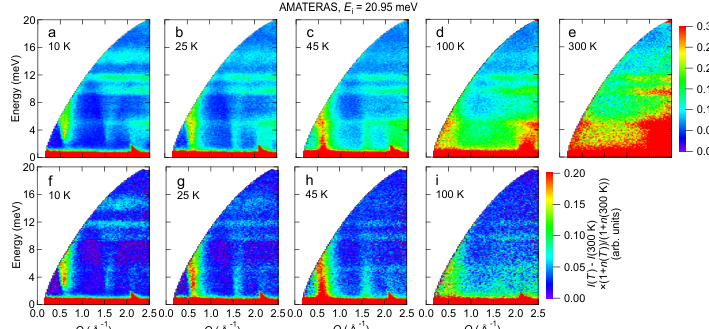 Figure 2. a–e) Inelastic neutron scattering spectrum measured by using AMATERAS with an incident neutron energy of 20.95 meV at a) 10, b) 25, c) 45, d) 100 K and e) 300 K. Dispersive spin excitations were observed at 0.60 and 1.55˚A−1 up to the energy transfer of 15 meV. f–i) Two-dimensional colour maps of the magnetic contributions at f) 10, g) 25, h) 45 and i) 100 K estimated by subtracting the phononic contributions estimated from the 300 K data. Intensities are corrected by the temperature- dependent factor 1 + n(T ) = (1 − e−E/(kBT ))−1, where n(T ) represents a Bose factor
As temperature increased, the strong wavevector dependence of these excitations persisted up to 45 K. However, a significant shift occurred at 100 K (approximately $3T_N$), where the spectral weight shifted to the zero wavevector (the $\Gamma$ point), before disappearing entirely at 300 K. This shift to the $\Gamma$ point is interpreted as clear evidence for the presence of ferromagnetic interactions within the system. Conversely, the robustness of magnetic excitations observed near the Brillouin zone boundary indicates strong antiferromagnetic interactions, which are crucial for stabilizing the observed zigzag antiferromagnetic order.
Comparing RuBr3 to other Kitaev candidates, the temperature robustness of its magnetic excitations was found to be closer to that of Na2IrO3 than $\alpha$-RuCl3. While $\alpha$-RuCl3's excitations shift to the $\Gamma$ point immediately above $T_N$, RuBr3's shift occurs at a higher temperature, around $3T_N$. This suggests a different balance of interactions compared to $\alpha$-RuCl3.
The experimental spectra were then rigorously compared against simulations from two linear spin wave theory models: J1-K-Γ-Γ' and J1-K-J2-J3. Both models could reproduce the characteristic features of the spin excitations, including both dispersive and nearly dispersionless modes. However, the J1-K-J2-J3 model, which incorporates a large third-neighbor isotropic magnetic interaction ($J_3$), showed a better agreement with the experimental wavevector and energy transfer dependencies (as seen in Fig. 3(a) and 3(b)). This strongly suggests that large nearest-neighbor symmetric off-diagonal ($\Gamma$) or third-neighbor isotropic magnetic interactions ($J_3$) are essential for stabilizing the zigzag antiferromagnetic order and explaining the observed strong dispersion.
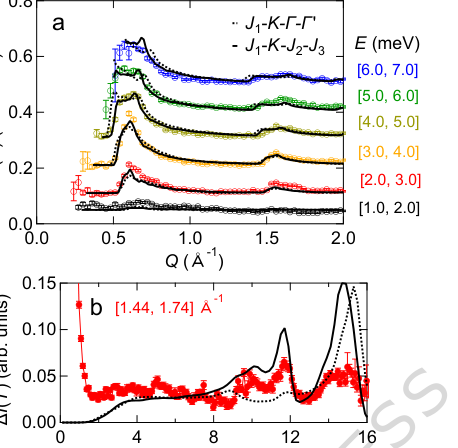 Figure 3. Integrated scattering intensities at 10 K plotted as a function of the wavevector or energy transfer after the subtraction of the phonon contribution estimated from the 300 K data. Dashed and solid curves represent the simulated curves based on the J1–K–Γ-Γ′ and J1–K–J2–J3 models, respectively (see text for details). (a) Wavevector dependence of the intensities with integration ranges of [1.0, 2.0], [2.0, 3.0], [3.0, 4.0], [4.0, 5.0], [5.0, 6.0], and [6.0, 7.0] meV. The intensities are shifted for clarity. (b) Energy transfer dependence of the intensities with an integration range of [1.44, 1.74]˚A−1
While experimental Weiss temperatures and magnetic moment canting angles showed some discrepancies with model predictions, the paper ultimately concludes that the J1-K-J2-J3 model with a large $J_3$ term is more realistic. This conclusion is primarily based on the better fit to the inelastic neutron scattering spectra, despite the challenges in precisely estimating exchange parameters from powder-averaged data and the sensitvity of Weiss temperature calculations to various contributions.
Finally, the study provides hard evidence that bromine substitution significantly impacts the magnetic interactions. The wave analysis suggests that ferromagnetic Kitaev terms persist, but antiferromagnetic interactions (specifically $\Gamma$ or $J_3$) are enhanced. This enhancement drives the ground state of RuBr3 deeper into the zigzag antiferromagnetic phase, moving it away from the ideal ferromagnetic Kitaev spin liquid state. This effect is attributed to stronger d-p hybridization and enhanced indirect hopping via ligand atoms.
Limitations & Future Directions
Despite the compelling evidence presented, the study acknowledges several limitations inherent to the experimental approach and theoretical modeling. A primary limitation stems from the use of powder-averaged inelastic neutron scattering spectra. This averaging makes it inherently difficult to precisely estimate exchange parameters, as evidenced by the similar spectral features reproduced by two distinct theoretical models (J1-K-Γ-Γ' and J1-K-J2-J3). The linear spin wave approximations used for modeling, while useful, may not perfectly apply to pseudospin-1/2 systems, thus providing only a rough estimate of the magnetic interactions. Furthermore, there was a notable discrepancy between the experimentally derived Weiss temperatures and those predicted by the models, which the authors attribute to the sensitivity of the estimation and potential Van-Vleck paramagnetic-like contributions. Similarly, the model-predicted canting angles did not perfectly align with experimental values, although the authors suggest that incorporating further anisotropy in $J_3$ might improve this. Crucially, the paper states that it "could not conclude that the weak excitations are induced from the Kitaev interactions since its wavevector and energy dependences are not clear in the powder inelastic scattering spectrum," indicating a significant gap in definitively identifying the Kitaev contribution. Lastly, the exact origin of the enhanced antiferromagnetic interactions due to Br substitution remains "not clear," requiring further investigation into the underlying electronic mechanisms.
Looking ahead, these findings open up several exciting avenues for future research and development:
-
Single-Crystal Studies for Definitive Evidence: The most immediate and impactful future direction would be to perform inelastic neutron scattering experiments on high-quality single crystals of RuBr3. This would eliminate the ambiguities of powder averaging, allowing for a much more precise determination of exchange parameters and a clearer understanding of the wavevector and energy dependences of all excitations, including the elusive Kitaev contributions. This could provide the definitive, undeniable evidence needed to fully characterize the Kitaev interactions.
-
Advanced Theoretical Modeling: To address the limitations of LSWT, future work should focus on developing and applying more sophisticated theoretical models. Techniques like exact diagonalization, density matrix renormalization group (DMRG), or quantum Monte Carlo simulations, which are better suited for pseudospin-1/2 systems and strongly correlated materials, could provide a more accurate description of the spin dynamics, canting angles, and Weiss temperatures, bridging the gap between theory and experiment.
-
Elucidating Ligand Substitution Mechanisms: The paper highlights the significant impact of Br substitution but notes that the exact mechanism for enhancing antiferromagnetic interactions is unclear. Future studies could combine advanced ab initio calculations with targeted experimental probes (e.g., resonant inelastic X-ray scattering, X-ray absorption spectroscopy) to precisely map how ligand ion changes affect d-p hybridization, orbital exchange pathways, and ultimately, the specific magnetic interactions. This could lead to a predictive framework for designing Kitaev materials with desired properties.
-
Exploring the RuX3 Family and Polymorphs: Given that RuX3 (X = Br, I) forms multiple polymorphs, a systematic investigation of other structural phases of RuBr3 and RuI3 could reveal new magnetic ground states or different balances of Kitaev and other interactions. This comparative approach could identify specific structural motifs or chemical environments that favor the elusive Kitaev spin liquid state.
-
External Perturbations and Phase Tuning: Applying external perturbations such as magnetic fields, pressure, or strain could be a powerful way to tune the balance of competing interactions in RuBr3. Investigating the spin dynamics under these conditions might reveal phase transitions, potentially leading to the stabilization of a spin liquid phase or providing deeper insights into the nature of the competing interactions.
-
Search for Fractionalized Excitations: While the current study emphasizes magnon-like excitations, the presence of weak, broad excitations at higher energies (e.g., 12 and 15 meV) could hint at a continuum of fractionalized excitations, characteristic of a Kitaev spin liquid. Future high-resolution experiments, particularly on single crystals, should specifically look for signatures of Majorana fermions, even if the ground state is ordered.
-
Interplane Coupling and 3D Effects: The Hamiltonian includes interplane interactions ($J_p$), but their role in the observed dynamics is not extensively discussed. Given the three-layered honeycomb structure, a more detailed investigation into the influence of interplane coupling on the magnetic excitations and the overall ground state could be valuable, especially in understanding deviations from purely 2D Kitaev physics.
These diverse perspectives, ranging from experimental refinement to advanced theoretical modeling and materials design, are crucial for fully understanding the complex interplay of interactions in RuBr3 and for advancing the quest for Kitaev spin liquids.