
Finite disorder critical point in ductile-to-brittle transition in amorphous solids with aspherical impurities
Enhancing the mechanical strength and stability of amorphous solids is crucial for material design, with microalloying being a common yet poorly understood method.
Background & Academic Lineage
The Origin & Academic Lineage
The study of mechanical failure in amorphous solids is a field of paramount importance due to its widespread applications in industry and daily life. Historically, while the mechanical behavior of crystalline solids subjected to external deformation is comprehensively elucidated in terms of defects, amorphous solids lack long-range structural order, making their mechanical response difficult to deliniate precisely. This has led to decades of rigorous research without a comprehensive understanding of how amorphous solids yeild.
A key area of investigation is the ductile-to-brittle transistion, where materials shift from deforming gradually (ductile) to failing catastrophically (brittle). Recent studies, particularly under athermal quasistatic straining (AQS) conditions, suggest that this transition is controlled by the inherent disorder strength of the material, with a critical point separating ductile and brittle yielding. However, the existence of such a critical point is contentious in the academic community, with some arguing that yielding is always brittle in the thermodynamic limit for large systems.
The fundamental limitation of previous approaches lies in their inability to conclusively and experimentally accessibly control inherent disorder to study this transition. For instance, methods like thermal annealing, while used in molecular simulations, suffer from finite-size limitations and are not applicable to non-Brownian colloidal systems. Particle pinning, another proposed method, remains challenging to implement in molecular glasses. Furthermore, while microalloying (adding small amounts of impurities) is a common industrial practice to enhance material strength, the microscopic mechanisms behind its effects on the ductile-to-brittle transition have remained elusive. This lack of a robust, experimentally viable, and microscopically understood method to tune disorder and probe this critical transition is the pain point that motivated the authors. They aim to provide a new protocol using aspherical impurities to address these limitations.
Intuitive Domain Terms
- Amorphous Solids: Imagine a pile of randomly dropped LEGO bricks, not neatly stacked into a wall. It's solid, but there's no repeating pattern or organized structure, unlike a perfectly built LEGO house (crystalline solid).
- Ductile-to-Brittle Transition: Think of a piece of soft clay versus a dry cracker. Clay (ductile) can be stretched and molded significantly before it breaks, while a cracker (brittle) snaps suddenly with very little deformation. This transition describes a material becoming more cracker-like and less clay-like in its failure mode.
- Athermal Quasistatic Straining (AQS): Picture slowly pushing a block of Jell-O with an incredibly gentle, steady hand, in a room where temperature changes have no effect. "Athermal" means no heat is involved, and "quasistatic" means the process is so slow that the system is always almost in a balanced state, allowing it to adapt to the deformation.
- Rotational Degrees of Freedom (rDoF): Imagine adding tiny, elongated beads to a bowl of marbles. The marbles can only slide past each other, but the elongated beads can also tumble and spin, giving them extra ways to move and rearrange. These extra "spinning" movements are their rotational degrees of freedom.
- Shear Band: Consider pushing a deck of cards sideways. Instead of all cards sliding smoothly, a few layers might suddenly slip past each other very quickly, creating a localized "fault line" or band where most of the deformation happens, leading to a sudden, catastrophic failure.
Notation Table
| Notation | Description | Type |
|---|---|---|
| $\gamma$ | Shear strain, a measure of deformation. | Variable |
| $\sigma_{xy}$ | Shear stress, the force per unit area acting parallel to the surface. | Variable |
| $\chi_{dis}$ | Disconnected susceptibility, a measure of the fluctuations in stress, indicating brittleness. | Variable |
| $\Theta$ | Structural order parameter, quantifying the local structural order or stability of the amorphous solid. | Variable |
| $S_r$ | Rotational relaxation function, characterizing the degree of rotational mobility of rod impurities. | Variable |
| $D_{min}^2$ | Non-affine displacement, a measure of particle rearrangement not accounted for by macroscopic deformation. | Variable |
| $c_s$ | Number fraction of spherical impurities. | Parameter |
| $c_d$ | Number fraction of dimer impurities. | Parameter |
| $c_r$ | Number fraction of rod impurities. | Parameter |
| $L_r$ | Length of rod impurity. | Parameter |
| $\sigma_{AA}$ | Diameter of parent particle type A. | Parameter |
| $\sigma_{BB}$ | Diameter of parent particle type B. | Parameter |
| $\sigma_s$ | Diameter of spherical impurity. | Parameter |
| $\sigma_b$ | Diameter of beads forming dimer/rod impurities. | Parameter |
| $T$ | Temperature. | Parameter |
| $N$ | Total number of particles in the system (system size). | Parameter |
| $\Delta \sigma_{max}$ | Largest plastic drop, an order parameter for the ductile-to-brittle transition. | Variable |
| $\chi_d$ | Susceptibility of $\Delta \sigma_{max}$ fluctuations, indicating criticality. | Variable |
| $c_r^*$ | Critical rod fraction, the impurity concentration at which the ductile-to-brittle transition occurs. | Parameter |
Problem Definition & Constraints
Core Problem Formulation & The Dilemma
The core problem addressed by this paper revolves around understanding and precisely characterizing the ductile-to-brittle transition in amorphous solids.
Input/Current State: Amorphous solids, which lack long-range structural order, exhibit two distinct failure modes under external deformation: ductile yielding (gradual material flow with continuous stress response) and brittle yielding (catastrophic failure via sudden shear band formation with discontinuous stress drops). It is understood that the nature of this yielding is controlled by the inherent disorder strength of the material, and a transition between ductile and brittle behavior is believed to occur at a finite critical disorder strength. Microalloying, the addition of small amounts of impurities, is a common engineering practice to enhance the mechanical properties of materials, but the microscopic mechanisms governing these improvements in amorphous solids are poorly understood.
Output/Goal State: The paper aims to precisely define and characterize a finite-disorder critical point that marks the boundary between ductile and brittle yielding in amorphous solids. This is achieved by systematically controlling the inherent disorder through the introduction of aspherical impurities with varying rotational degrees of freedom (rDoF). The ultimate goal is to establish a novel, experimentally accessible protocol for tuning the mechanical properties of amorphous solids, particularly soft glasses like colloidal systems, to induce a desired ductile or brittle response.
Missing Link or Mathematical Gap:
1. Contested Critical Point: Despite previous studies suggesting a finite-disorder critical point for the ductile-to-brittle transition, its existence and nature, especially in the thermodynamic limit, remain contested in the literature. Previous methods, such as thermal annealing or elasto-plastic models, have yielded inconclusive results or suffered from finite-size limitations.
2. Microscopic Mechanisms of Microalloying: The precise microscopic mechanisms by which microalloying, particularly with aspherical impurities, influences the yielding transition and mechanical stability of amorphous solids are largely unknown. The role of additional rotational degrees of freedom introduced by aspherical impurities is a key unexplored aspect.
Painful Trade-off or Dilemma:
The central dilemma lies in the intricate relationship between impurity characteristics, rotational freedom, and mechanical response. While adding impurities can generally enhance mechanical strength, achieving a significant shift towards brittleness or ductility is not straightforward. Spherical impurities offer only minimal improvement in yield strain. Aspherical impurities, particularly rod-shaped ones, introduce rotational degrees of freedom that can significantly enhance ductility and load-bearing capacity. However, the paper reveals a counterintuitive trade-off: reducing this rotational freedom (either by increasing the impurity's aspect ratio or artificially freezing its rotation) leads to a more brittle response and ultrastable-like mechanical behavior. Researchers are thus trapped between designing impurities that enhance ductility via rDoF and those that induce brittleness by restricting rDoF, making precise control of the critical transition challenging.
Constraints & Failure Modes
The authors encountered several harsh, realistic walls that make this problem insanely difficult to solve:
- Physical/Structural Constraints:
- Absence of Long-Range Order: Unlike crystalline solids where defects can be precisely delineated, amorphous solids lack long-range structural order, making it inherently difficult to define and track defects, thus complicating the understanding of their mechanical response.
- Inapplicability of Standard Annealing Methods: Traditional methods for tuning disorder, such as thermal annealing or vapor deposition, are not effective or applicable for all systems, particularly non-Brownian colloidal glasses. This limits the experimental accessibility of the ductile-to-brittle transition in these systems.
- Computational Constraints:
- Slow Dynamics of Large Impurities: Systems containing very large spherical impurities or large-diameter dimer impurities exhibit extremely slow dynamics. This makes it computationally challenging to equilibrate such systems within feasible simulation time scales, limiting the range of impurity sizes that can be studied.
- Simulation Limits on Rod Length: There is a practical maximum rod length ($L_r = 2.5\sigma_{AA}$) that can be simulated. This prevents the direct observation of complete rotational arrest for extremely long rods, which would naturally have vanishing rotational diffusivity.
- Difficulty in Annealing Longer Rod Systems: Systems with longer rods are dynamically slower, meaning that standard preparation protocols produce less annealed states. This simulation difficulty can lead to an underestimation of the observed brittleness in such systems.
- Computational Cost of Free Rotational Degrees of Freedom: Simulating systems with very large aspect ratio impurities while allowing their full rotational degrees of freedom is computationally intensive. To circumvent this, the authors resorted to artificially freezing the rDoF to mimic the effect of very long, rotationally immobile rods.
- Data-Driven/Analytical Constraints:
- Elusive Microscopic Mechanisms: Despite experimental evidence that microalloying can improve yield strain, the precise microscopic mechanisms underlying this enhancement remain elusive, requiring detailed computational analysis to uncover them.
- Limited Scope of Parameters: The study focuses primarily on aspect ratio and rotational degrees of freedom. Other crucial parameters, such as particle shape (e.g., elliptical vs. rod-shaped) and the nature of boundary interactions (e.g., degree of overlap of spheres forming rods), are acknowledged but left for future investigation due to the complexity.
- Athermal Quasistatic Assumption: The current analysis is performed under athermal quasistatic straining (AQS) conditions. The authors acknowledge that the results might change with the inclusion of thermal effects and finite strain rates, which are not fully explored in this paper.
Why This Approach
The Inevitability of the Choice
The authors' decision to employ molecular dynamics (MD) simulations with aspherical, rod-shaped impurities, particularly those with frozen rotational degrees of freedom (rDoF), was not merely a preference but a strategic necessity driven by the limitations of existing methods and the specific requirements of the problem. The core challenge was to investigate the ductile-to-brittle transition in amorphous solids and establish the existence of a finite-disorder critical point using a protocol that is both experimentally accessible and offers precise control over inherent disorder.
Traditional "state-of-the-art" (SOTA) methods, such as thermal annealing, proved insufficient for several reasons. While thermal annealing can alter a sample's disorder strength, previous studies [15] provided only "partial support due to the finite size limitations," and conclusions from large-scale elasto-plastic models [22] remained "inconclusive." More critically, thermal annealing is "inapplicable" to non-Brownian colloidal systems, which are a key experimental platform for studying glass transitions. Similarly, while particle pinning [28] offers another route to control disorder and can be achieved in colloidal glass experiments [29], it "remains challenging in molecular glasses." The authors explicitly state that "identifying new protocols to investigate this transition, particularly ones that are experimentally accessible, could have significant implications for the field."
The introduction of aspherical impurities, especially rod-shaped ones, directly addresses this gap. By manipulating their aspect ratio and rotational freedom, the authors found a novel way to tune the inherent disorder strength that is "readily accessible in both molecular and colloidal glass experiments." Furthermore, the computational difficulty of simulating "very long rods that have vanishing rotational diffusivity" due to their slow dynamics necessitated the "manual freezing" of rDoF during stress release. This simulation technique allowed them to mimic the effects of such long rods, which would otherwise be intractable within available simulation time scales, making this specific approach the only viable path to explore the desired regime.
Comparative Superiority
The chosen method of incorporating aspherical impurities, particularly rod-shaped ones with controlled rotational degrees of freedom, demonstrates overwhelming qualitative superiority over previous gold standards, including spherical impurities and thermal annealing.
When comparing spherical impurities to aspherical (dimer) impurities, the paper highlights a "minimal" improvement in mechanical properties with spherical inclusions. For instance, the yield strain ($\gamma_y$) for the 3DKA system increased only from $\gamma_y = 0.09$ for the pure system to $\gamma_y = 0.107$ with spherical impurities at $c_s = 0.1$ (Fig. 2(a,b)). In stark contrast, aspherical dimer impurities at $c_d = 0.1$ led to an "almost 100% improvement" in yield strain, reaching $\gamma_y = 0.127$ (Fig. 3(a,b)). This is a substantial qualitative difference.
The structural advantage lies in the "additional rotational degrees of freedom (rDoF)" introduced by aspherical particles. These rDoF provide "additional local pathways for dissipating internal stresses," enabling the system to "release extra stress, sustain higher loads, and store more stress before a non-local shear banding event causes failure." This mechanism allows the system to withstand significantly larger loads and delays the yielding transition more effectively than spherical impurities, which lack these rotational freedoms.
Furthermore, the ability to freeze these rDoF in simulations, mimicking very long rods, leads to an "ultrastable-like mechanical response" and "extremely brittle" failure (Fig. 5(e,f)). This demonstrates a powerful structural control mechanism: the presence of rDoF enhances ductility, while their restriction or absence promotes brittleness and ultrastability. The structural order parameter $\Theta$ consistently decreases with increasing impurity fraction and rod length (Fig. 2(d), Fig. 4(e)), indicating enhanced structural stability, which is a direct qualitative advantage over less controlled methods. This method offers a precise, tunable control over the material's mechanical response, from ductile to highly brittle, by simply adjusting the impurity's aspect ratio and rotational freedom.
Alignment with Constraints
The chosen method perfectly aligns with the constraints outlined in the problem definition, demonstrating a clear "marriage" between the harsh requirements and the solution's unique properties.
One primary constraint was the need for a protocol to investigate the ductile-to-brittle transition that is "accessible across a broader range of experimental systems, including non-Brownian colloidal systems for which thermal annealing is inapplicable." The use of aspherical impurities, particularly rod-shaped ones, directly addresses this. The authors explicitly state that their approach offers a "novel ductile-to-brittle transition that is readily accessible in both molecular and colloidal glass experiments." This makes it a highly relevant and practical method for experimentalists working with soft glasses, where traditional annealing methods are not feasible.
Another implicit constraint was the need for a method that allows for precise control over the "inherent disorder strength" to probe the critical point. By varying the number fraction and aspect ratio of aspherical impurities, and by controlling their rotational degrees of freedom, the authors gain fine-grained control over the system's structural stability and mechanical response. The structural order parameter $\Theta$ serves as a quantitative measure of this controlled disorder, showing a clear correlation with the observed mechanical behavior.
Finally, the computational constraint of simulating very long rods, which exhibit "very slow dynamics" and "vanishing rotational diffusivity," was overcome by artificially freezing the rDoF during the stress release process. This clever workaround allowed the authors to "mimic the effect of very long rods" and study the resulting ultrastable, brittle behavior, which would otherwise be impossible to achieve within typical simulation time scales. This demonstrates a pragmatic alignment with the need to study realistic physical phenomena despite computational barriers.
Rejection of Alternatives
The paper implicitly and explicitly rejects several alternative approaches based on their limitations for the specific problem at hand: investigating the ductile-to-brittle transition in amorphous solids, especially in an experimentally accessible manner for diverse systems.
-
Thermal Annealing: The authors note that while thermal annealing can vary disorder strength, it provides "partial support due to the finite size limitations" and its conclusions remain "inconclusive" [15, 22]. More importantly, it is "inapplicable" to "non-Brownian colloidal systems," which are a key target for experimental validation. Even for molecular glasses, achieving "realistic systems" through annealing is difficult, as "even the lowest accessible cooling rate results in poorly annealed states." Methods like swap Monte Carlo [34, 35] can produce ultrastable glasses but are "not readily applicable to experiments." This makes thermal annealing an unsuitable universal approach.
-
Particle Pinning: Although particle pinning has been used in recent studies [28] to control disorder in colloidal glass experiments [29], the authors state it "remains challenging in molecular glasses." While a promising technique, it doesn't offer the same broad applicability across different material types as their proposed microalloying strategy.
-
Spherical Impurities: The paper directly compares its aspherical impurity approach with spherical impurities. While spherical impurities do lead to "a higher yield strain and increased brittleness," the authors conclude that the "improvement is minimal" (e.g., $\gamma_y$ increases from $0.09$ to $0.107$ for 3DKA). This is a clear, data-driven rejection of spherical impurities as a sufficiently effective method for robustly controlling the ductile-to-brittle transition. The lack of rotational degrees of freedom in spherical particles limits their ability to dissipate stress and enhance stability compared to aspherical ones.
The paper does not discuss machine learning approaches like GANs or Diffusion models, as its focus is on physical simulations of material properties rather than generative modeling. The rejection of alternatives is rooted in their inability to provide sufficient control, experimental accessibility, or the desired magnitude of mechanical property enhancement for the specific phenomenon under investigation.
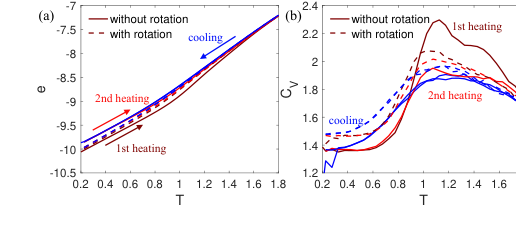 FIG. 6. Ultra-stability with frozen rDoF: Kinetic as- pect. (a) The potential energy per particle e is plotted for a system with 10% dimers subjected to heating-cooling cycles at the rate of dT/dt = 10−4 (same as the rate with which the sample was prepared). The solid lines are for a system with frozen rotational DoFs; the observed hysteresis during the first cycle indicates the ultra-stable character. The sec- ond heating cycle does not show any hysteresis. The dashed lines are for the system evolved with rotational DoFs, and the absence of hysteresis is seen as expected. (b) The specific heat CV = de/dT is calculated from data in (a) by numerical differentiation and conveys the same
Mathematical & Logical Mechanism
The Master Equation
The fundamental interaction governing the behavior of particles in this study, and thus the mechanical properties of the amorphous solids, is described by the Lennard-Jones (L-J) potential. This potential energy function dictates how any two particles in the system interact, forming the bedrock of the molecular dynamics simulations performed. It is the objective function minimized during the system's relaxation to an inherent state.
$$V_{\alpha\beta}(r) = 4\epsilon_{\alpha\beta} \left[ \left(\frac{\sigma_{\alpha\beta}}{r}\right)^{12} - \left(\frac{\sigma_{\alpha\beta}}{r}\right)^6 \right]$$
Term-by-Term Autopsy
Let's dissect this equation to understand the role of each component:
-
$V_{\alpha\beta}(r)$:
1) Mathematical Definition: This term represents the potential energy of interaction between two particles of types $\alpha$ and $\beta$, separated by a distance $r$.
2) Physical/Logical Role: It quantifies the energy stored in the interaction between a pair of particles. This energy determines the forces between them, which in turn dictates their movement, arrangement, and the overall structural and mechanical response of the material.
3) Why Subtraction: The two terms within the square brackets represent distinct physical phenomena: repulsion and attraction. The subtraction signifies that these are opposing forces. The first term (repulsive) pushes particles apart, while the second term (attractive) pulls them together. -
$4\epsilon_{\alpha\beta}$:
1) Mathematical Definition: A scaling factor for the interaction energy, where $\epsilon_{\alpha\beta}$ is the depth of the potential well for the interaction between particle types $\alpha$ and $\beta$.
2) Physical/Logical Role: This coefficient sets the strength or magnitude of the interaction. A larger $\epsilon_{\alpha\beta}$ implies stronger attractive and repulsive forces, leading to a more robust or tightly bound system. It defines the energy scale for the interaction.
3) Why Multiplication: It acts as a global multiplier for the entire potential function, ensuring that the overall strength of both the attractive and repulsive components is scaled proportionally. -
$\sigma_{\alpha\beta}$:
1) Mathematical Definition: The distance at which the potential energy between particles of types $\alpha$ and $\beta$ is zero. It effectively represents the "size" or collision diameter of the particles.
2) Physical/Logical Role: This parameter defines the length scale of the interaction. It determines the effective "hard core" size of the particles, influencing how closely they can pack and the range over which attractive forces are significant. It's crucial for establishing the material's density and local structure.
3) Why Division by $r$: It normalizes the inter-particle distance $r$ by a characteristic particle size $\sigma_{\alpha\beta}$, making the terms inside the brackets dimensionless and allowing the potential to be expressed in terms of relative separation. -
$r$:
1) Mathematical Definition: The instantaneous distance between the centers of two interacting particles.
2) Physical/Logical Role: This is the fundamental spatial variable. The potential energy, and consequently the forces between particles, are directly dependent on this separation.
3) Why Inverse Power Laws ($r^{-12}$ and $r^{-6}$): These inverse power laws are chosen to model the characteristic nature of interatomic and intermolecular forces. The $r^{-12}$ term represents very short-ranged, strong repulsion due to electron cloud overlap, while the $r^{-6}$ term represents longer-ranged, weaker attraction (e.g., van der Waals forces). -
$\left(\frac{\sigma_{\alpha\beta}}{r}\right)^{12}$:
1) Mathematical Definition: The repulsive component of the Lennard-Jones potential, which is proportional to $r^{-12}$.
2) Physical/Logical Role: This term models the strong, short-range repulsion that prevents particles from overlapping or occupying the same physical space. It ensures the "hard core" nature of the particles.
3) Why Exponent 12: This steep power law is an empirical choice that effectively approximates the rapid increase in repulsion as particles get very close, mimicking the Pauli exclusion principle. -
$\left(\frac{\sigma_{\alpha\beta}}{r}\right)^{6}$:
1) Mathematical Definition: The attractive component of the Lennard-Jones potential, which is proportional to $r^{-6}$.
2) Physical/Logical Role: This term models the longer-range attractive forces (e.g., van der Waals forces) that are responsible for holding the material together.
3) Why Exponent 6: This softer power law is characteristic of induced dipole-dipole interactions, which are prevalent in many atomic and molecular systems.
Step-by-Step Flow
The Lennard-Jones potential is the engine driving the molecular dynamics simulations used to explore the ductile-to-brittle transition. Here's how an abstract data point (a particle's position) flows through the simulation:
- System Setup: Imagine a collection of particles, each defined by its type ($\alpha$ or $\beta$) and initial spatial coordinates $(X_i, Y_i, Z_i)$. These types determine the specific $\epsilon_{\alpha\beta}$ and $\sigma_{\alpha\beta}$ parameters for its interactions.
- High-Temperature Equilibration: The system is "heated" to a high temperature. Each particle's position is continuously updated based on the net force acting on it, which is derived from the gradient of the total potential energy (sum of all $V_{\alpha\beta}(r)$ interactions with its neighbors). Particles move vigorously, exploring the energy landscape, until a stable liquid state is achieved.
- Cooling and Quenching: The system is then slowly "cooled" by gradually reducing the particles' kinetic energy. As temperature drops, the attractive forces from $V_{\alpha\beta}(r)$ become more dominant, causing particles to settle into a disordered, amorphous solid state. Finally, the system is "quenched" to an inherent state by minimizing its total potential energy. This means particles are moved to positions where the sum of all $V_{\alpha\beta}(r)$ is at a local minimum, effectively removing all kinetic energy and reaching a mechanically stable configuration.
- Athermal Quasistatic Straining (AQS) Cycle:
- Affine Transformation: A small, incremental shear strain $\delta\gamma$ is applied to the entire system. For a particle at $(X_i, Y_i, Z_i)$, its x-coordinate is affinely transformed to $X_i \leftarrow X_i + \delta\gamma Y_i$. This step distorts the particle's position relative to its neighbors, momentarily pushing the system out of mechanical equilibrium.
- Energy Minimization (Relaxation): After the affine step, the system is no longer at an energy minimum. The particles are then allowed to relax. This involves iteratively adjusting their positions to minimize the total potential energy, using the conjugate gradient method. The forces (gradients of $V_{\alpha\beta}(r)$) guide each particle towards a new local energy minimum. This relaxation process simulates how the material deforms and rearranges under stress.
- Iterative Deformation: Steps 4a and 4b are repeated for many small strain increments. The system's response (e.g., stress) is recorded after each relaxation step. This iterative process allows researchers to trace the material's stress-strain curve and observe plastic events and yielding behavior.
Optimization Dynamics
The "optimization" in this context refers to the process by which the system finds mechanically stable configurations, primarily through energy minimization.
- The Energy Landscape: The total potential energy of the system, $U = \sum_{\text{all pairs } \alpha\beta} V_{\alpha\beta}(r)$, defines a complex, high-dimensional energy landscape. This landscape is characterized by numerous local minima (representing stable configurations or "inherent states") separated by energy barriers (saddle points).
- Gradients as Driving Forces: The "learning" or "updating" mechanism relies on the forces acting on each particle, which are the negative gradients of the total potential energy with respect to their positions ($\mathbf{F}_i = -\nabla_i U$). These forces dictate the direction and magnitude of particle movement during relaxation.
- Conjugate Gradient Method: This iterative algorithm is employed to navigate the energy landscape and find local minima. It operates by:
- Calculating Gradients: At the current particle positions, the forces (gradients) are computed.
- Determining Search Direction: A search direction is chosen that is "conjugate" to previous directions, aiming for efficient descent towards a minimum. This helps avoid zig-zagging and speeds up convergence.
- Line Search: Particles are moved along this chosen direction to find the point of minimum energy in that specific direction.
- Updating Positions: Particle positions are updated, and the process repeats.
- State Updates and Convergence: The system's state (particle positions) is iteratively updated until the net forces on all particles fall below a predefined tolerance. At this point, the system has converged to a local energy minimum, signifying mechanical equilibrium. This iterative process allows the system to "relax" and find a stable configuration after being perturbed by an affine strain.
- Plasticity and Yielding: As strain accumulates, the system eventually reaches a point where the local minimum it occupies becomes unstable. To relax, it must overcome an energy barrier and transition to a new, distinct local minimum. These transitions are "plastic events" and correspond to sudden, irreversible particle rearrangements. The collective behavior of these events shapes the material's yielding response. In ductile yielding, plastic events are numerous and spatially distributed, leading to a gradual stress response. In brittle yielding, plastic events localize into a shear band, leading to a catastrophic, discontinuous stress drop. The shape of the energy landscape, dictated by the L-J potential, governs the barriers and pathways for these rearrangements, thus controlling the material's mechanical behavior. The introduction of impurities, especially aspherical ones, modifies this landscape, altering the ease and nature of these plastic events.
Results, Limitations & Conclusion
Experimental Design & Baselines
The authors meticulously designed their experiments using molecular dynamics simulations of Lennard-Jones (L-J) particles, primarily focusing on the Kob-Andersen (KA) model glass former in both two and three dimensions. The core idea was to introduce various types of impurities into a binary glass matrix and observe their impact on the yielding transition under athermal quasistatic straining (AQS) conditions.
The experimental setup involved preparing quiescent states by equilibrating systems at high temperatures, followed by cooling and quenching to an inherent state. Deformation was then applied incrementally. The "victims" or baseline models against which the proposed mechanisms were tested included:
1. Pure systems: Glassy systems without any impurities ($c_s = 0.00$, $c_d = 0.00$, $c_r = 0.00$). These served as the fundamental reference for ductile behavior.
2. Systems with spherical impurities: A third type of particle with a larger diameter ($\sigma_s = 2.0 \sigma_{AA}$) was added, varying its number fraction ($c_s \in [0, 0.1]$) in a system of $N_T = 100000$ particles.
3. Systems with aspherical dimer impurities: Rod-shaped particles composed of two overlapping spherical beads (diameter $\sigma_b = 2.0 \sigma_{AA}$, aspect ratio $L_d : \sigma_b = 2.3 : 2$) were introduced, with varying number fractions ($c_d$). These were designed to have rotational degrees of freedom (rDoF).
4. Systems with longer rod impurities: More aspherical rods, made of multiple beads (diameter $\sigma_r = \sigma_{AA}$), were added at a fixed fraction ($c_r = 0.1$), with their length ($L_r$) varied to control rotational freedom.
5. Systems with artificially frozen rDoF: To isolate the effect of rotation, rod-shaped impurities were artificially prevented from rotating during the energy minimization steps, while still allowing affine transformation. This was a crucial control experiment.
6. Poorly annealed samples: For the ductile-to-brittle transition study, samples were prepared at a relatively high temperature ($T=0.6$) and cooled rapidly ($T=10^{-1}$) to ensure a poorly annealed, inherently ductile state.
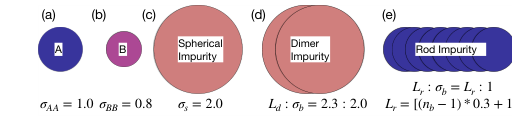 FIG. 1. Components of the system. (a, b) Particle type ‘A’ and ‘B’ of the parent KA system. (c) Spherical impurity with twice the diameter of the particle ‘A’. It has a variable number fraction of cs in the system. (d) Slightly aspherical dimers composed of larger particles with σb = 2.0, added at number fraction cd in the system. (e) Rods with larger aspect ratio, made by attaching A-type particles, studied across dif- ferent aspect ratios at a fixed number fraction of cr = 0.1
The mechanical response was rigorously characterized using several key observables:
* Stress-strain curves ($\sigma_{xy}$ vs. $\gamma$): To directly observe yield strain, shear modulus, and the presence of stress overshoots or discontinuous drops.
* Disconnected susceptibility ($\chi_{dis}(\gamma)$): Defined as $\chi_{dis}(\gamma) = N_T (\langle \sigma_{xy}^2 \rangle - \langle \sigma_{xy} \rangle^2)$, its peak magnitude and sharpness indicate the brittleness of the yielding transition. A larger, narrower peak signifies more brittle failure.
* Structural order parameter ($\Theta$): A local measure (Eq. (4)) to quantify the structural stability and disorder of the quiescent states. Lower $\Theta$ indicates better stability.
* Rotational de-correlation function ($S_r(\gamma)$): To quantify the degree of rotational relaxation of rod impurities under mechanical loading. A faster decay implies better independent mobility.
* Non-affine displacement ($D_{min}^2$): To visualize and quantify the spatial distribution of plastic events and the formation of shear bands.
* Potential energy per particle ($e$) and specific heat ($C_v = de/dT$): Used in heating-cooling cycles to assess the kinetic stability and ultra-stable character of glasses.
Finally, to ruthlessly prove their mathematical claims about a critical point, the authors employed finite-size scaling (FSS) analysis. They varied the total number of particles ($N_T = [25000, 50000, 100000, 200000]$) for systems with rotationally frozen rods, analyzing the scaling of $\chi_{dis}$ peak height, $\langle \Delta \sigma_{max} \rangle$, and its fluctuations ($\chi_d$) with system size. This allowed for extrapolation to the thermodynamic limit ($N \to \infty$) and comparison with the Random Field Ising Model (RFIM) universality class.
What the Evidence Proves
The evidence presented in the paper provides a compelling narrative for the role of aspherical impurities and rotational degrees of freedom in tuning the mechanical properties and the ductile-to-brittle transition in amorphous solids.
-
Spherical Impurities Enhance Brittleness and Stability:
- The stress-strain curves (Fig. 2a, b) clearly show that adding spherical impurities significantly increases the yield strain and shear modulus. For instance, the 3DKA model exhibits a more pronounced stress overshoot.
- The $\chi_{dis}$ plots (Fig. 2c) reveal that with increasing spherical impurity fraction ($c_s$), the peaks shift to higher strains and become notably sharper, which is definitive evidence of a transition towards more brittle-like failure.
- The structural order parameter $\Theta$ (Fig. 2d) decreases with increasing $c_s$, indicating that these impurities lead to enhanced structural stability and order in the glass matrix. This effect is more substantial than that achieved by simply reducing the cooling rate.
-
Aspherical Dimers with rDoF Offer Superior Mechanical Enhancement:
- Introducing slightly aspherical dimer impurities (Fig. 3a, b) leads to an even more significant increase in yield strain and shear modulus compared to spherical impurities. For the 3DKA model, a $c_d = 0.1$ dimer fraction results in a 40% increase in yield strain, almost double the 18% increase seen with spherical impurities.
- Microscopic analysis of stress contributions (Fig. 3d) provides undeniable evidence that rod-sphere interactions continue to sustain stress at higher strains, unlike sphere-sphere interactions which saturate earlier. This suggests that regions containing rods are more structurally stable and can bear higher loads.
- This superior enhancement is directly attributed to the additional rotational degrees of freedom (rDoF) of the aspherical particles. These rDoF provide local pathways for dissipating internal stresses, allowing the system to sustain higher loads and store more stress before catastrophic failure.
-
Restricting rDoF (Longer Rods) Leads to Brittleness:
- As the aspect ratio of rod impurities increases (i.e., longer rods), their rotational freedom is reduced, as evidenced by the faster decay of the rotational de-correlation function $S_r(\gamma)$ (Fig. 4b).
- This reduction in rDoF causes the yield point to shift back to lower values, and the mechanical response becomes increasingly brittle (Fig. 4a).
- The $\chi_{dis}$ peaks (Fig. 4d) become narrower and larger with increasing rod length, confirming the emergence of a brittle phase.
- Crucially, the non-affine displacement maps ($D_{min}^2$) (Fig. 4f, g, h) show a clear transition: shorter rods allow plastic events to be spatially spread out (ductile behavior), while longer rods lead to the formation of a localized, system-spanning shear band (brittle failure). This is hard evidence that the core mechanism (rDoF) directly influences the failure mode.
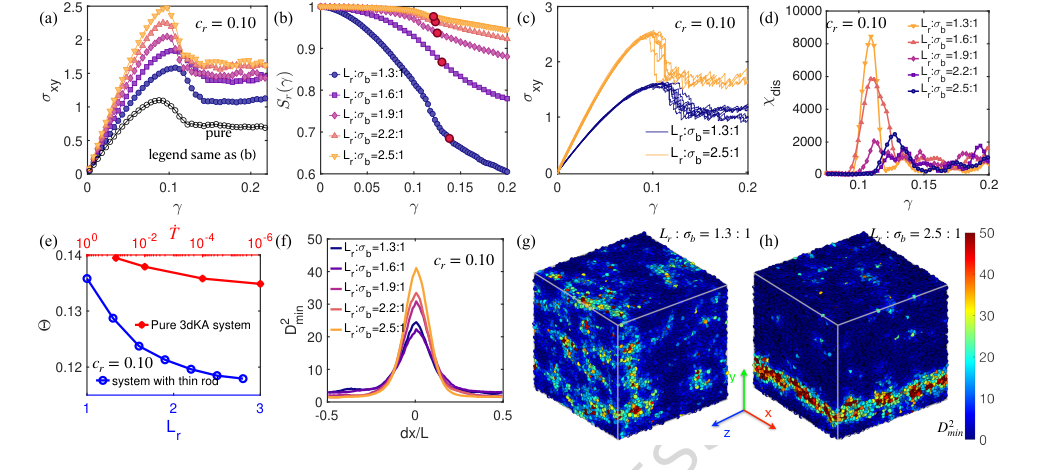 FIG. 4. Mechanical properties with aspherical impurities: Effect of the length of rod impurity. (a) Stress-strain curves for 3dKA systems doped with 10% rods (Fig. 1(e)) of different lengths, Lr. The yield point shifts back as Lr increases, while the response becomes increasingly brittle due to restricted rotations. (b) Rotational de-correlation function for rods of different lengths with mechanical loading; the red points indicate the equal net D2 min . (c) Single ensemble stress-strain plots for systems with Lr = 2.5 (Lr = 1.3) show abrupt-brittle (continuous-ductile) yielding. (d) Corresponding susceptibility plots with increasing magnitude and sharpness indicate the sample’s emerging brittle behavior. (e) The structural order parameter decreases with increasing Lr, indicating greater structural stability. (f) D2 min, averaged in spatial-strips perpendicular to the shear band (at dx = 0) for systems with rods of varying Lr. Strain values are selected to yield a similar area under the curve, ensuring equal plasticity. Larger spread for smaller Lr and large displacement peak for larger Lr advocates the emerging brittle behavior. (g, h) D2 min maps obtained at equal net displacements for Lr = 1.3 and Lr = 2.5, respectively, illustrating the contrast between ductile and brittle responses
-
Artificially Frozen rDoF Induces Ultrastability and Extreme Brittleness:
- The most compelling evidence comes from artificially freezing the rDoF of impurities. This manipulation drastically alters the mechanical response, leading to extremely brittle failure with discontinuous stress drops (Fig. 5a, c, e). The significant yield strain enhancement observed with free rDoF completely disappears, reconfirming the vital role of rotation.
- The $\chi_{dis}$ peaks (Fig. 5b, d, f) become exceptionally sharp and high, indicating a highly brittle response.
- Kinetic stability analysis (Fig. 6a, b) shows clear hysteresis in the potential energy during heating-cooling cycles for systems with frozen rDoF, a hallmark of ultrastable glasses. Systems with free rDoF, in contrast, show no such hysteresis. This proves that freezing rDoF leads to both mechanical and kinetic ultrastability.
-
A Finite Disorder Critical Point Governs the Ductile-to-Brittle Transition:
- By varying the fraction of rotationally frozen rods ($c_r$) in a poorly annealed sample, the authors demonstrate a systematic transition from ductile to brittle yielding (Fig. 7a, b).
- The finite-size scaling analysis provides definitive, undeniable evidence for a finite-disorder critical point in the thermodynamic limit:
- The $\chi_{dis}$ peak amplitude for doped systems grows as a power law $N^{1.1 \pm 0.03}$ with system size, while for pure systems it remains small and non-responsive (Fig. 8b, c).
- The largest plastic drop $\langle \Delta \sigma_{max} \rangle$ vanishes as $N^{-0.4 \pm 0.02}$ for ductile systems ($c_r=0$) but remains finite and grows as $N^{0.2 \pm 0.04}$ for brittle systems ($c_r=0.1$) (Fig. 8d, e).
- The fluctuations of $\langle \Delta \sigma_{max} \rangle$, denoted $\chi_d$, exhibit a non-monotonic peak that sharpens and grows with system size, diverging as $N^{0.36 \pm 0.027}$, while its full width at half maximum (FWHM) vanishes as $N^{-0.46 \pm 0.036}$ (Fig. 8f, g).
- The data collapse (Fig. 8h) using these power laws confirms the critical nature of the transition.
- The scaling relation $\chi_{dis}^{peak} \sim (\chi_{con}^{peak})^2$ (Fig. 9a) strongly suggests that this criticality belongs to the Random Field Ising Model (RFIM) universality class.
- Extrapolating $c_r^*(N)$ to the thermodynamic limit ($N \to \infty$) yields a finite critical rod fraction of $c_r^* \sim 0.045 \pm 0.0003$ (Fig. 9b). This result refutes the notion that a ductile-to-brittle transition does not exist in the thermodynamic limit, providing robust evidence for a genuine disorder-driven critical transition.
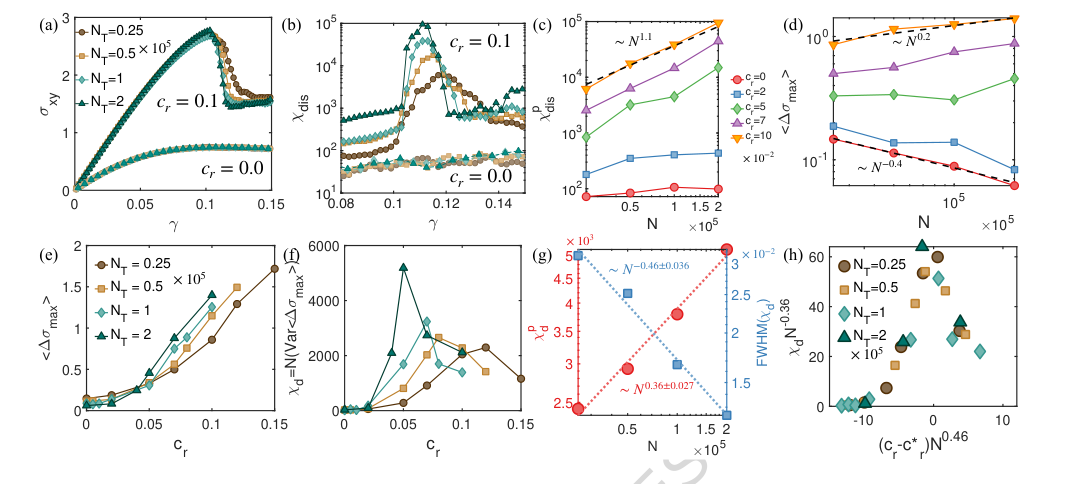 FIG. 8. Impurity driven ductile-to-brittle transition, FSS study. (a) System size dependence of stress-strain curves for the 3dKA system prepared at a high temperature of T = 0.6. The pure system, shown in lighter colors, exhibits a ductile macroscopic response with no system size dependence, while systems with 10% rod impurities (aspect ratio 1.9 : 1) show progressively brittle behavior as system size increases. (b) Susceptibility plots for both the pure and doped systems at various system sizes. (c) System-size dependence of peak height for different impurity concentrations. For cr ≤0.02, the χp dis saturates, while it follows the indicated power law for cr ≥0.05. (d) System size dependence of ⟨σmax⟩with increasing cr. The response shifts from vanishing to not-vanishing in the thermodynamic limit on increasing cr. (e) The increase in ⟨σmax⟩with increasing cr becomes sharper with increasing system size. (f) Ensemble-level fluctuations of ⟨σmax⟩reveal a nonmonotonic peak structure, marking the transition point. As system size increases, the peak narrows, and its height increases, highlighting the critical nature of the transition. (g) The peak height diverges as χp d ∼N 0.36±0.027, while the FWHM vanishes as FWHM ∼N −0.46±0.036. (h) The obtained collapse of data points in panel (f) using the determined power laws
Limitations & Future Directions
While this paper presents a brilliant and thorough analysis, like any scientific endeavor, it operates within certain constraints and opens up numerous avenues for future exploration.
One notable limitation is the incomplete understanding of microscopic mechanisms at higher concentrations of rotationally constrained impurities. The paper acknowledges that the influence of shear-induced nematic ordering on the mechanical response, particularly at higher impurity concentrations, remains unclear. While the authors state that for isotropic initial orientations and systems with low rotational diffusion or frozen rDoF, these effects appear minimal, a deeper dive into this aspect could reveal more nuanced interactions.
Another constraint is the primary focus on athermal quasistatic straining (AQS) conditions. The authors themselves point out that thermal effects and finite strain rates could alter the critical transition from ductile to brittle behavior, especially with rotationally frozen rods. While they expect the microalloyed system to exhibit enhanced mechanical strength even at finite strain rates and temperatures, a comprehensive study incorporating these variables is essential for a complete picture.
Furthermore, the study highlights that particle shape (elliptical versus rod-shaped) and the nature of boundary interactions (e.g., degree of overlap of spheres forming rods) are crucial parameters controlling mechanical response, but these effects were left for future investigations. This suggests a simplification in the current model that could be expanded upon. Computational limitations also prevented the simulation of very long rods with vanishing rotational diffusivity, necessitating the "frozen rDoF" approach as a proxy. While effective, directly simulating such systems could offer additional insights.
Looking ahead, the findings in this paper present exciting discussion topics and research directions:
- Exploring the Full Parameter Space of Impurity Design: Future work could systematically investigate the impact of various impurity shapes (e.g., ellipsoids, branched polymers) and different interaction potentials with the host matrix. This would provide a more comprehensive understanding of how impurity characteristics influence mechanical properties and the ductile-to-brittle transition.
- Integrating Thermal Effects and Strain Rates: Extending the current AQS analysis to finite temperatures and strain rates is crucial. This would allow researchers to map out the phase diagram of ductile-to-brittle transitions under more realistic conditions, potentially revealing new critical points or crossovers. Combining thermal annealing methods (like swap Monte Carlo) with rod-like impurity doping could offer valuable insights into the interplay between inherent disorder, impurity-induced disorder, and dynamic effects.
- Experimental Validation in Colloidal and Molecular Systems: The paper emphasizes the experimental accessibility of this novel ductile-to-brittle transition, particularly in colloidal systems. Future research should focus on direct experimental validation using advanced imaging techniques to observe plastic events, shear band formation, and measure mechanical properties in colloidal glasses doped with aspherical particles. This would bridge the gap between simulation and real-world materials. For soft glasses, where traditional annealing is difficult, this microalloying strategy could be a game-changer.
- Microscopic Mechanisms of Ultrastability and Shear Banding: A deeper investigation into the microscopic mechanisms driving the transition at higher concentrations of rotationally constrained impurities is warranted. This includes understanding how shear-induced nematic ordering influences the mechanical response and how the imposed static correlation length from long rods compares to the point-to-set (PTS) correlation lengths of ultrastable glasses in the supercooled regime. This could involve advanced theoretical modeling and high-resolution simulations.
- Applications in Material Design: The findings offer a simple, controlled microalloying strategy for tuning the mechanical properties of amorphous solids. Future work could explore how these principles can be applied to design new materials with tailored ductility or brittleness for specific industrial applications, from robust composites to self-healing materials. The ability to induce ultrastability and brittle failure via frozen rDoF could be particularly relevant for applications requiring high mechanical stability.
- Universality Class Exploration: Further detailed finite-size scaling analysis, potentially with more system sizes and different aspect ratios, could solidify the connection to the RFIM universality class and explore if other universality classes emerge under different conditions. This would deepen our fundamental understanding of non-equilibrium phase transitions in disordered systems.