
Emergence of low-energy spin waves in superconducting electron-doped cuprates
In order to fully utilize the technological potential of unconventional superconductors, an enhanced understanding of the superconducting mechanism is necessary.
Background & Academic Lineage
The Origin & Academic Lineage
The problem addressed in this paper stems from the long-standing quest to understand high-temperature superconductivity, particularly in a class of materials known as cuprates. Decades of condensed matter research have established a crucial link between superconductivity and magnetism in these materials. A key puzzle emerged from the observation of a significant asymmetry in the phase diagrams of electron-doped (n-type) and hole-doped (p-type) cuprates. While both types can become superconducting, n-type cuprates, such as Nd$_{1.85}$Ce$_{0.15}$CuO$_{4-\delta}$ (NCCO), exhibit a peculiar requirement: they must undergo a reductive annealing process after synthesis to become superconducting. As-grown n-type cuprates remain antiferromagnetic and non-superconducting.
The precise effect of this reductive annealing on the material's structure and its subsequent impact on magnetic and superconducting properties has been a subject of considerable debte without a clear consensus. Previous studies on annealed, superconducting NCCO had identified a "spin pseudogap" in its magnetic fluctuation spectrum. However, a significant gap in understanding remained because the low-energy spin dynamics in as-grown, non-superconducting NCCO had not been dedicatedly investigated. This lack of direct comparison left an open question regarding how reductive annealing specifically influences these low-energy spin dynamics and, by extension, the emergence of superconductivity. This paper aims to fill that viod by directly comparing the magnetic excitations in NCCO before and after the annealing process.
Intuitive Domain Terms
To help a zero-base reader grasp the core concepts, here are some specialized terms from the paper, translated into everyday analogies:
- Cuprates: Imagine these as a special family of ceramic materials, like advanced pottery, that are famous for their ability to conduct electricity perfectly without any resistance (superconductivity) when cooled to certain temperatures. They're particularly interesting because they achieve this at relatively "high" (though still very cold) temperatures compared to other known superconductors.
- Antiferromagnetic Mott Insulators: Think of a tiny checkerboard where each square holds a miniature magnet (an electron's spin). In an antiferromagnetic material, these magnets are perfectly aligned in an alternating pattern—north-south, north-south—so their overall magnetic effect cancels out. A "Mott insulator" means that despite having these magnetic properties, the electrons are stuck in place and cannot move freely to conduct electricity, making the material an insulator.
- Spin Pseudogap: Picture a concert hall where musicians (magnetic excitations) usually play a full range of notes, from very low to very high frequencies. A "spin pseudogap" is like a temporary "quiet zone" for the lowest notes. It's not a complete silence, but there's a noticeable suppression or absence of these low-frequency sounds, creating a "gap" in the available musical range.
- Reductive Annealing: Imagine you've baked a cake (synthesized a material), but it's not quite right. "Reductive annealing" is like putting the cake back in a special oven with a controlled atmosphere (perhaps with less oxygen) to subtly chage its internal structure and properties, making it perfect. For these materials, it's a crucial "re-baking" step to remove some oxygen atoms and unlock their superconducting abilities.
- Spin Waves: Envision a stadium full of people doing "the wave." Instead of people standing and sitting, imagine the tiny magnets (spins) of electrons in a material collectively tilting and propagating through the structure. These "spin waves" are how magnetic energy travels through the material, and studying them helps us understand its magnetic behavior.
Notation Table
| Notation | Description | Type |
|---|---|---|
| $T_c$ | Critical temperature for superconductivity | Parameter |
| $\hbar\omega$ | Energy transfer (often related to the energy of excitations, like spin waves, being measured) | Variable |
| $\chi''(\omega)$ | Dynamic susceptibility (a measure of how easily a material's magnetization can be changed by an oscillating magnetic field) | Variable |
| $Q$ | Antiferromagnetic ordering wave vector (describes the spatial periodicity and direction of magnetic order) | Parameter |
| $E_{gap}$ | Spin pseudogap onset energy (the energy at which the spin pseudogap, or suppression of low-energy magnetic excitations, begins) | Parameter |
Problem Definition & Constraints
Core Problem Formulation & The Dilemma
The central problem this paper addresses is to precisely define the role of reductive annealing in the emergence of superconductivity in electron-doped cuprates, specifically Nd$_{1.85}$Ce$_{0.15}$CuO$_{4-\delta}$.
The Input/Current State is an as-grown crystal of Nd$_{1.85}$Ce$_{0.15}$CuO$_{4-\delta}$. In this state, the material is a non-superconducting antiferromagnetic Mott insulator, exhibiting a large spin pseudogap in its magnetic fluctuation spectrum. Previous research had not thoroughly investigated the low-energy spin dynamics of these as-grown samples.
The Output/Goal State is to achieve a comprehensive understanding of how the magnetic excitation spectrum, particularly the spin pseudogap, evolves when the material transitions from its as-grown, non-superconducting state to a superconducting state induced by reductive annealing. The ultimate goal is to establish a direct, mechanistic connection between material defects, magnetism, and the onset of high-temperature superconductivity.
The exact missing link or mathematical gap this paper attempts to bridge lies in the detailed characterization of the low-energy spin dynamics in as-grown, non-superconducting electron-doped cuprates and a direct comparison with their reductively annealed, superconducting counterparts. While the presence of a spin pseudogap in annealed, superconducting NCCO was known, the behavior of spin fluctuations in the as-grown state, and how annealing precisely alters them to enable superconductivity, remained an open question. The paper aims to quantify the change in the spin pseudogap and relate it to the "healing" of defects and the development of longer-wavelength spin waves.
The painful trade-off or dilemma that has trapped previous researchers stems from the complex interplay between superconductivity and magnetism in cuprates, particularly the role of the spin pseudogap. The common understanding was that superconductivity opens a spin pseudogap. However, this study reveals a significant dilemma: the as-grown, non-superconducting sample already exhibits a pronounced and even larger spin pseudogap (onset at 10 $\pm$ 0.5 meV at 2 K) compared to the annealed, superconducting sample (onset at 2 $\pm$ 0.6 meV at 2 K). This observation directly challenges the prevailing notion that superconductivity is solely responsible for opening the pseudogap. Instead, it suggests that reductive annealing, which induces superconductivity, actually reduces the spin pseudogap. This creates a paradox where the "improvement" (superconductivity) is associated with a smaller pseudogap, rather than its emergence.
Constraints & Failure Modes
The problem of understanding the emergence of low-energy spin waves and superconductivity in electron-doped cuprates is made insanely difficult by several harsh, realistic constraints:
-
Physical & Material Constraints:
- Chemical Complexity of n-type Cuprates: Electron-doped cuprates like NCCO are chemically more complex than p-type counterparts because they require a reductive annealing process to become superconducting after synthesis. This necessity immediately breaks the electron-hole symmetry often considered in cuprate physics.
- Defect-Ridden As-Grown State: As-grown NCCO crystals are inherently imperfect, containing various defects (e.g., interstitial apical oxygen atoms, oxygen vacancies in CuO$_2$ planes, or Cu vacancies) that strongly perturb the local ionic potential and act as scattering centers. These defects are believed to counteract superconductivity. The exact nature and location of these defects, and how annealing affects them, has been a longstanding debate without consensus.
- Antiferromagnetic Ground State: The as-grown material starts in an antiferromagnetic ground state, and superconductivity emerges only after annealing, implying a delicate balance and competition between magnetic order and superconductivity.
- Crystal Electric Field Interference: Inelastic neutron scattering measurements are severely limited by strong interference from the crystal electric field levels of Nd, particularly around 15 meV. This makes it impossible to reliably measure inelastic signals at energies beyond approximately 14 meV, restricting the observable energy range for spin dynamics.
- Sample Variability: Ensuring sample consistency for a direct comparison between as-grown and annealed states is crucial. The authors addressed this by splitting a single, optimally doped crystal into two parts, one for annealing and one left as-grown. This minimizes uncertainties associated with sample variability, which is a common challenge in materials science.
- Twin Domains: The reductively annealed, superconducting sample exhibited an additional twin domain rotated by 45°, effectively reducing the sample mass available for certain measurements. This complicates data analysis and can impact signal quality.
-
Computational & Data-Driven Constraints:
- Weak Magnetic Signals: The magnetic moments of Cu$^{2+}$ (S = 1/2) are small, leading to weak magnetic signals that are difficult to detect. This necessitates the use of thermal triple-axis spectrometers with larger resolution volumes to integrate these weak signals.
- Normalization Challenges: To ensure comparability between different samples and measurements, intensities must be carefully normalized, often requiring additional measurements of acoustic phonons, which adds complexity to the experimental procedure.
- Statistical Rigor for Signal Detection: Determining the presence or absence of a magnetic signal (e.g., a Gaussian peak in q-scans) requires robust statistical methods, such as Wilks' theorem with a specified confidence interval (p = 0.05), to avoid unsupported claims or misinterpretations.
- Limited Absolute Unit Conversion: The large crystals required for neutron scattering experiments are often too big for standard SQUID magnetometers to convert magnetization into absolute units, leading to measurements reported as magnetization per gram, which can hinder direct quantitative comparison with some theoretical models.
Why This Approach
The Inevitability of the Choice
The core of this research is to unravel the intricate dance between magnetism and superconductivity in electron-doped cuprates, specifically focusing on the dynamic behavior of magnetic excitations, known as spin waves, and the mysterious spin pseudogap. To truly understand these phenomena, we need a tool that can directly "see" these tiny magnetic fluctuations, not just their bulk effects. This is where inelastic neutron spectroscopy, particularly using a thermal neutron triple-axis spectrometer, becomes not just an excellent choice, but arguably the only viable experimental approach.
Traditional methods, if we consider them in the context of condensed matter physics, like standard magnetometry (e.g., SQUID measurements shown in Figure 1), can tell us if a material is superconducting or antiferromagnetic. However, they are blind to the energy and momentum of the magnetic excitations themselves. They give us a macroscopic picture, but not the microscopic dynamics. The authors needed to probe how spin waves emerge, how their energy spectrum changes with annealing, and how defects influence them. This requires a technique that can resolve energy transfers (the "$\hbar\omega$" axis in Figures 3-6) and momentum transfers (the "$q$" scans in Figure 2) simultaneously. Neutron scattering excels at this because neutrons interact directly with the magnetic moments of the atoms, allowing us to map out the spin excitation spectrum. Without this direct probe, the subtle changes in the spin pseudogap and the underlying spin dynamics, which are central to the paper's findings, would remain entirely hidden.
Comparative Superiority
Beyond simply being able to measure spin dynamics, inelastic neutron spectroscopy offers qualitative advantages that make it overwhelmingly superior for this specific problem. The paper highlights several structural benefits:
First, it directly measures the density of states of the spin waves (as explained on page 7 and illustrated in Figure 7). This means it doesn't just detect a magnetic signal, but provides a detailed energy landscape of where these spin excitations can exist. This is crucial for understanding the spin pseudogap, which is essentially a depletion of these low-energy spin states.
Second, the technique allows for precise momentum-resolved measurements (q-scans, Figure 2). Spin waves are collective excitations that propagate through the material, and their behavior depends on their wavelength (or momentum). Being able to map this "dispersion" is fundamental to characterizing them. Other techniques might infer some aspects, but neutron scattering provides a direct, unambiguous picture.
Third, the authors specifically chose thermal neutron triple-axis spectrometers over cold-neutron ones (page 9). This was a deliberate decision based on the nature of the signal. Thermal neutrons, with their "larger resolution volumes," are better suited to "integrate weak signals stemming from small magnetic moments of Cu$^{2+}$ (S = 1/2)." This means they can effectively capture the faint magnetic whispers from the copper ions, which are the key players in cuprate superconductivity, even when those signals are difficult to detect. This choice directly addresses the experimental challenge of working with materials where the magnetic moments are small and the signals can be weak.
Alignment with Constraints
The chosen method of inelastic neutron spectroscopy perfectly aligns with the inherent constraints and requirements of the problem, creating a true "marriage" between the scientific question and the experimental tool.
- Understanding the "Emergence" and "Evolution" of Spin Waves: The paper's goal is to observe how low-energy spin waves emerge and how the spin pseudogap evolves with reductive annealing. Neutron scattering directly provides the energy and momentum spectra of these spin waves, allowing for a direct comparison between the as-grown (non-superconducting) and annealed (superconducting) states (Figures 3, 4, 5). This direct comparison, using samples from the same crystal, minimizes sample variability, a critical constraint for reliable results.
- Focus on Low-Energy Dynamics: The problem specifically targets "low-energy spin waves." The neutron spectrometers were tuned to measure energy transfers in the range of 2 meV to 13 meV (page 9), precisely capturing the relevant low-energy regime where the spin pseudogap manifests.
- Probing Defects and Their Impact: The central hypothesis revolves around how defects, removed by annealing, affect magnetism and superconductivity. By measuring the spin dynamics before and after annealing, the method directly reveals the impact of these defects on the spin wave spectrum and the pseudogap (Figure 7 illustrates this beautifully).
- Weak Magnetic Signals: Cuprates involve relatively small magnetic moments from Cu$^{2+}$ ions. The selection of thermal neutron spectrometers with their larger resolution volumes was a direct response to the constraint of needing to detect these "weak signals" (page 9), ensuring that even subtle magnetic fluctuations could be reliably measured.
Rejection of Alternatives
While the paper doesn't explicitly frame its discussion as a "rejection" of other popular machine learning approaches (as it's a fundamental physics experiment), it implicitly demonstrates why other experimental techniques would be insufficient for its primary goal.
- SQUID Magnetometry: As seen in Figure 1, SQUID measurements are used to confirm the bulk magnetic state (antiferromagnetic vs. superconducting Meissner effect). However, they cannot provide information about the dynamic spin excitation spectrum or the energy and momentum of spin waves. For the detailed understanding of the spin pseudogap, SQUID data is a necessary characterization, but not the main investigative tool.
- Angle-Resolved Photoemission Spectroscopy (ARPES): The paper mentions ARPES as providing "additional perspective on the momentum dependence of the pairing interaction inferred from our neutron measurements" (page 8). ARPES probes the electronic excitation spectrum. While crucial for understanding the electronic structure and pairing, it does not directly measure the magnetic spin waves and their dynamics, which is the focus of this study. It's a complementary technique, not a substitute.
- Resonant Inelastic X-ray Scattering (RIXS): A previous RIXS study is cited (Ref 54) as supporting the authors' model, but with a key distinction. That RIXS study focused on "high-energy magnetic excitation spectra... in the energy range from approximately 100 meV to 1 eV." The authors of this paper, however, are specifically interested in "low-energy (i.e. long wavelength) spin waves" (page 8). While RIXS can probe magnetic excitations, its application in the cited work was at a different energy scale than the low-energy phenomena central to this paper.
- Cold-Neutron Triple-Axis Spectrometers: This is perhaps the most direct "rejection" of an alternative variant of the chosen method. The authors explicitly state that thermal neutron triple-axis spectrometers were preferred "over cold-neutron triple axis spectrometers due to larger resolution volumes, which enable us to integrate weak signals stemming from small magnetic moments of Cu$^{2+}$ (S = 1/2), to better verify the existence or absence of magnetic fluctuations" (page 9). This is a clear technical justification for selecting the most appropriate neutron energy range for the specific, weak magnetic signals they were trying to detect.
The choice of inelastic neutron spectroscopy, and specifically the thermal variant, was thus a carefully considered one, dictated by the need for direct, high-resolution probes of low-energy spin dynamics in these complex materials.
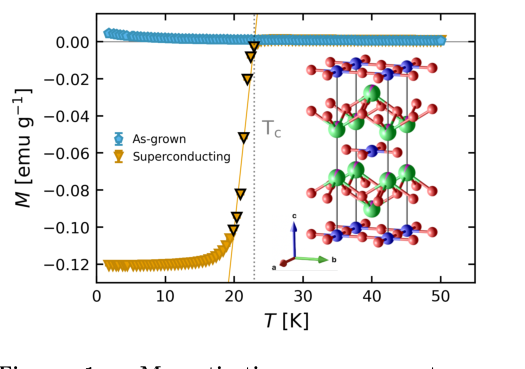 Figure 1. shows the magnetization measurements of the two crystal pieces from the same growth, of which one has been reductively annealed. Note that here the mag- netization is simply given as magnetization per gram of crystal, as the large crystals needed for our neutron scat- tering experiments are generally too large for the SQUID magnetometer to convert into absolute units. The an- nealed sample displays a clear negative magnetization at low temperatures, indicative of the Meissner effect, with an onset temperature of the superconducting transition at Tc = 23 K. In contrast, the as-grown sample shows a flat magnetization curve, with only a slight increase at low temperatures. This is typical of an antiferromag- netic response and clearly differs from the sharp super- conducting transition. The insert shows the tetragonal crystal structure, I4/mmm for both annealed and as- grown, optimally doped NCCO with lattice parameters a = b = 3.957 ˚A and c = 12.075 ˚A.25
Mathematical & Logical Mechanism
The Master Equation
To be honest, the paper, being primarily an experimental study in condensed matter physics using neutron spectroscopy, does not present a single "master equation" in the sense of an objective function, an ordinary/stochastic differential equation, or a complex transformation logic that powers the underlying physical phenomenon or a computational model. Instead, the core mathematical observable that the authors meticulously measure and analyze is the dynamic magnetic susceptibility, $\chi''(\omega)$. This quantity is central to understanding the magnetic excitations and the spin pseudogap.
The paper states that "The integrated intensities are converted into dynamic susceptibility $\chi''(\omega)$" (page 4) and that this quantity is then used to determine the spin pseudogap onset by fitting it with an error function (page 4, referring to Supplementary Note 4). While the full theoretical definition of $\chi''(\omega)$ or the precise form of the error function used for fitting are not explicitly laid out in the main text, $\chi''(\omega)$ is the fundamental quantity whose behavior is investigated.
In the context of inelastic neutron scattering, the dynamic susceptibility $\chi''(\mathbf{Q}, \omega)$ is related to the dynamic structure factor $S(\mathbf{Q}, \omega)$, which is directly proportional to the measured neutron scattering cross-section. The authors integrate over momentum transfer $\mathbf{Q}$ to obtain $\chi''(\omega)$. A general form for the imaginary part of the dynamic susceptibility, as a response function, can be thought of as:
$$ \chi''(\omega) = \int d\mathbf{Q} \, \chi''(\mathbf{Q}, \omega) $$
where $\chi''(\mathbf{Q}, \omega)$ is the momentum- and energy-resolved dynamic susceptibility. This integral represents the total magnetic dissipative response at a given energy $\omega$, summed over all relevant momentum transfers $\mathbf{Q}$.
Term-by-Term Autopsy
Let's dissect the central observable, $\chi''(\omega)$, and the concepts surrounding its measurement and interpretation.
-
$\chi''$ (Dynamic Magnetic Susceptibility, Imaginary Part):
- Mathematical Definition: $\chi''$ is the imaginary component of the complex dynamic magnetic susceptibility $\chi(\mathbf{Q}, \omega) = \chi'(\mathbf{Q}, \omega) + i\chi''(\mathbf{Q}, \omega)$. It describes the dissipative part of the material's magnetic response to an oscillating magnetic field. In the context of neutron scattering, it is directly proportional to the dynamic structure factor $S(\mathbf{Q}, \omega)$ via the fluctuation-dissipation theorem, especially at low temperatures and energies. The paper integrates this over momentum $\mathbf{Q}$ to obtain $\chi''(\omega)$.
- Physical/Logical Role: This term is the direct probe of magnetic excitations, specifically spin waves, in the material. A non-zero $\chi''(\omega)$ indicates that the material can absorb energy from the incident neutrons by exciting spin waves. Its magnitude reflects the density and strength of these excitations. A suppression of $\chi''(\omega)$ at low energies signifies a "spin pseudogap," meaning there are no (or very few) low-energy magnetic excitations available.
- Why Integration (Implicit): The authors integrate the momentum-resolved susceptibility $\chi''(\mathbf{Q}, \omega)$ over $\mathbf{Q}$ to obtain $\chi''(\omega)$. This integration is used because the spin pseudogap is a phenomenon observed across a range of momentum transfers around the antiferromagnetic ordering wave vector. Integrating over $\mathbf{Q}$ provides a momentum-averaged picture of the magnetic response at a given energy, effectively giving a density of states for the spin excitations, which is crucial for characterizing the pseudogap. The choice of integration over summation reflects the continuous nature of momentum space in a bulk material.
-
$\omega$ (Energy Transfer):
- Mathematical Definition: $\omega$ represents the angular frequency of the excitation, related to the energy transfer $\Delta E$ by $\Delta E = \hbar\omega$, where $\hbar$ is the reduced Planck constant.
- Physical/Logical Role: This variable dictates the energy scale of the magnetic excitations being probed. By varying $\omega$ (or $\hbar\omega$), the experimenters can map out the energy spectrum of the spin waves. The presence or absence of a signal at certain $\omega$ values directly reveals the energy landscape of magnetic fluctuations, allowing for the identification of gaps or peaks.
- Why it's a Continuous Variable: Energy transfer in inelastic scattering is a continuous variable, reflecting the continuous spectrum of possible excitations in a solid. Therefore, $\chi''$ is naturally expressed as a function of $\omega$, allowing for a detailed spectral analysis rather than discrete points.
Step-by-Step Flow
Imagine a single, abstract neutron, representing the flow of data through this experimental and analytical pipeline:
- Initial State: Our abstract neutron, carrying a specific initial energy ($E_i$) and momentum ($\mathbf{k}_i$), approaches the Nd$_{1.85}$Ce$_{0.15}$CuO$_{4-\delta}$ sample.
- Interaction and Scattering: The neutron interacts with the magnetic moments within the sample. If a magnetic excitation (like a spin wave) exists at an energy $\hbar\omega$ and momentum $\mathbf{Q}$, the neutron can either create or annihilate this excitation. Our neutron then scatters off, emerging with a new final energy ($E_f$) and momentum ($\mathbf{k}_f$).
- Energy and Momentum Transfer Calculation: Detectors measure $E_f$ and $\mathbf{k}_f$. From these, the energy transfer $\hbar\omega = E_i - E_f$ and momentum transfer $\mathbf{Q} = \mathbf{k}_i - \mathbf{k}_f$ are precisely determined for this single scattering event.
- Raw Data Accumulation: This process is repeated millions of times. The number of scattered neutrons (counts) for specific ranges of $\mathbf{Q}$ and $\omega$ are accumulated, forming a raw intensity map, such as the q-scans shown in Figure 2. This map shows where magnetic excitations are present in momentum-energy space.
- Normalization: Before meaningful comparison, these raw counts are normalized. This involves dividing by factors that account for instrumental efficiency, sample volume, and other experimental conditions, often by comparing to a known standard like an acoustic phonon signal (page 9). This ensures that the measured intensity truly reflects the intrinsic magnetic properties of the sample, not experimental artifacts.
- Momentum Integration: The normalized intensities, which are proportional to $\chi''(\mathbf{Q}, \omega)$, are then integrated over a relevant range of momentum transfers $\mathbf{Q}$ (e.g., around the antiferromagnetic ordering vector). This integration collapses the multi-dimensional data into a one-dimensional spectrum of dynamic susceptibility $\chi''(\omega)$, representing the total magnetic response at each energy $\omega$. This is the data shown in Figures 3 and 5.
- Spin Pseudogap Determination: Finally, the $\chi''(\omega)$ spectrum is analyzed. The authors fit this curve with an error function. The parameters of this fit, particularly the onset energy ($E_{gap}$), are extracted. If $\chi''(\omega)$ is significantly suppressed at low energies, a spin pseudogap is identified, and its energy scale ($E_{gap}$) is quantified. This entire process is repeated for both as-grown and annealed samples at different temperatures, allowing for a direct comparison of their magnetic excitation spectra.
Optimization Dynamics
The "optimization dynamics" in this paper can be understood in two complementary ways: the physical transformation of the material and the analytical process of data fitting.
-
Physical System's "Update" (Reductive Annealing):
The primary "update" mechanism in this study is the reductive annealing process applied to the Nd$_{1.85}$Ce$_{0.15}$CuO$_{4-\delta}$ samples. This is not an algorithmic learning process but a physical transformation that alters the material's state.- Initial State (As-grown): The as-grown sample is characterized by a high concentration of defects (e.g., interstitial oxygen atoms or Cu vacancies) which act as scattering centers for spin waves. This leads to fragmented antiferromagnetic patches and a large spin pseudogap, suppressing low-energy spin fluctuations.
- "Learning" / "Update" Mechanism: Reductive annealing involves heating the sample in a reducing atmosphere. This process "heals" the defects by removing excess oxygen atoms or allowing Cu atoms to migrate and fill vacancies. This is akin to the system "learning" to become more ordered and less resistive.
- "Loss Landscape" (Metaphorical): One could metaphorically view the material's energy landscape. The as-grown state, with its defects, might represent a higher-energy, less stable configuration. Annealing drives the system towards a lower-energy, more ordered, and superconducting state. The "gradient" here is the thermodynamic driving force towards equilibrium.
- Converged State (Annealed/Superconducting): The annealed sample exhibits fewer defects, allowing for larger antiferromagnetic patches and longer-wavelength spin waves. This results in a significantly reduced spin pseudogap and the emergence of superconductivity. The material has "converged" to a more optimal physical state for superconductivity.
-
Data Analysis "Convergence" (Curve Fitting):
Within the data analysis, standard curve fitting techniques are employed to extract quantitative information from the measured $\chi''(\omega)$ spectra.- Objective: The goal is to find the best-fit parameters (e.g., $E_{gap}$, peak amplitude, width for Gaussian or error functions) that describe the experimental data.
- Loss Function: A common loss function for such fitting is the sum of squared residuals (SSR) between the experimental data points and the chosen fitting model (e.g., Gaussian for peaks, error function for pseudogap onset). The aim is to minimize this loss.
- Gradient Behavior: Optimization algorithms (e.g., Levenberg-Marquardt, gradient descent) iteratively adjust the fitting parameters. The "gradients" of the loss function with respect to each parameter guide these adjustments, indicating the direction of steepest descent towards a minimum.
- Loss Landscape: The parameter space forms a "loss landscape" where the value of the loss function varies. The algorithm navigates this landscape, seeking the global minimum, which corresponds to the optimal set of fitting parameters.
- Convergence: The fitting process "converges" when the changes in the parameters and the loss function fall below a predefined tolerance, indicating that a local (and ideally global) minimum has been found. This provides a quantitative measure of the spin pseudogap ($E_{gap}$) and other spectral features, allowing for precise comparison between different samples and conditions. The authors use statistical tests, like Wilks' theorem, to assess the significance of their fits and ensure robust conclusions.
Results, Limitations & Conclusion
Experimental Design & Baselines
To rigorously investigate the effect of reductive annealing on the magnetic excitations and superconductivity in electron-doped cuprates, the authors employed a meticulous experimental design centered on direct comparison. The core of their approach was to use a single, optimally doped Nd$_{1.85}$Ce$_{0.15}$CuO$_{4-\delta}$ crystal, which was then split into two parts. One half was subjected to a reductive annealing process, known to induce superconductivity, while the other half was left in its as-grown, non-superconducting state. This strategy was crucial for minimizing sample-to-sample variability, ensuring that any observed differences could be directly attributed to the annealing process.
The "victims" (baseline models) in this study were essentially the as-grown, non-superconducting state of the material itself. The first definitive evidence of the annealing's effect came from magnetization measurements. Using a Quantum Design MPMS-XL SQUID magnetometer, zero-field cooled (ZFC) measurements were performed at an applied field of 10 Oe across a temperature range of 1.8 K to 50 K. The annealed sample clearly displayed a negative magnetization at low temperatures, a hallmark of the Meissner effect, with a superconducting transition onset at $T_c = 23$ K (Figure 1).
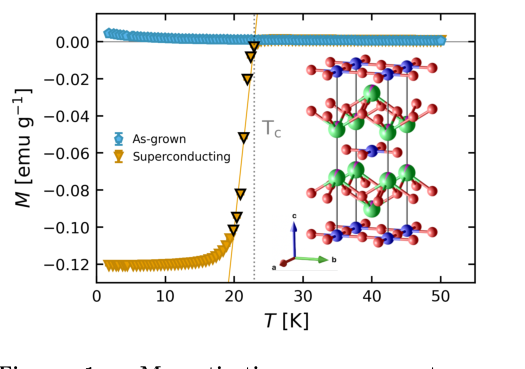 Figure 1. Magnetization measurements as a function of temperature. Zero-field cooled (ZFC) measurement at 10 Oe applied field, for the as-grown and reductively annealed, superconducting Nd1.85Ce0.15CuO4–δsingle crystals, depicted in blue pen- tagons and orange triangles, respectively. The criti- cal temperature Tc is defined as the onset tempera- ture of superconductivity. Insert: crystal structure of Nd1.85Ce0.15CuO4–δ,24,25 with Cu, O and Nd depicted in blue, red and green, respectively. The 15% Ce doping on the Nd site is denoted as a pink slice on the green Nd atoms
In stark contrast, the as-grown sample exhibited a flat magnetization curve with only a slight increase at low temperatures, characteristic of an antiferromagnetic response and confirming its non-superconducting nature. This established the fundamental difference between the two samples.
The primary experimental technique for probing magnetic excitations was inelastic neutron spectroscopy, conducted at the ANSTO TAIPAN instrument and the ILL IN20 instrument. These thermal triple-axis spectrometers were chosen for their larger resolution volumes, which are advantageous for detecting weak signals from the small magnetic moments of Cu$^{2+}$ ($S = 1/2$). Both crystal samples were carefully aligned in the (h, k, 0)-plane using a combination of X-ray and neutron Laue diffraction. The experiments involved performing diagonal q-scans around the magnetic Bragg point (h, 1-h, 0) for $h = 0.5$, with energy transfers ($\hbar\omega$) ranging from 2 meV to 13 meV. Measurements were taken at two key temperatures: 1.9 K (the base temperature, well below $T_c$ for the annealed sample) and 27 K (above $T_c$ for the annealed sample). To track the temperature dependence of the spin pseudogap, the magnetic signal was also measured at fixed energy transfers of $\hbar\omega = 2$ meV and $\hbar\omega = 8$ meV from 2 K up to 55 K.
A critical aspect of the experimental design was the normalization of neutron scattering intensities. To ensure direct comparability between the as-grown and annealed samples, the intensities were normalized to an acoustic phonon scan (e.g., at (2,0,0)). The spin pseudogap onset energy ($E_{gap}$) was determined by fitting the dynamic susceptibility $\chi''(\omega)$ with an error function. For the as-grown sample at 2 K, where no clear saturation was observed, $E_{gap}$ was estimated as the first data point where the error bars between 2 K and 27 K data overlapped. This rigorous approach allowed for a direct, quantitative comparison of the magnetic excitation spectra under different conditions.
What the Evidence Proves
The evidence presented in this paper provides a compelling narrative about the interplay between defects, magnetism, and superconductivity in electron-doped cuprates, directly challenging some conventional understandings. The initial magnetization measurements (Figure 1) unequivocally demonstrated that reductive annealing successfully transformed the as-grown, antiferromagnetic Nd$_{1.85}$Ce$_{0.15}$CuO$_{4-\delta}$ crystal into a superconductor with a $T_c$ of 23 K, as evidenced by the Meissner effect. This established the two distinct states of the material for subsequent magnetic investigations.
The core mechanism at play was ruthlessly proven through the direct comparison of the spin excitation spectra of the same crystal before and after annealing. For the as-grown, non-superconducting sample, neutron scattering data revealed a clear magnetic response peak at $\hbar\omega = 6$ meV at 27 K (Figure 2). However, at 2 K, this signal significantly vanished, indicating a strong suppression of low-energy magnetic excitations. More strikingly, the dynamic susceptibility $\chi''(\omega)$ for the as-grown sample at 2 K showed a pronounced spin pseudogap, gradually emerging from approximately 10 meV to 4 meV, with a well-defined onset at 10 $\pm$ 0.5 meV (Figure 3a).
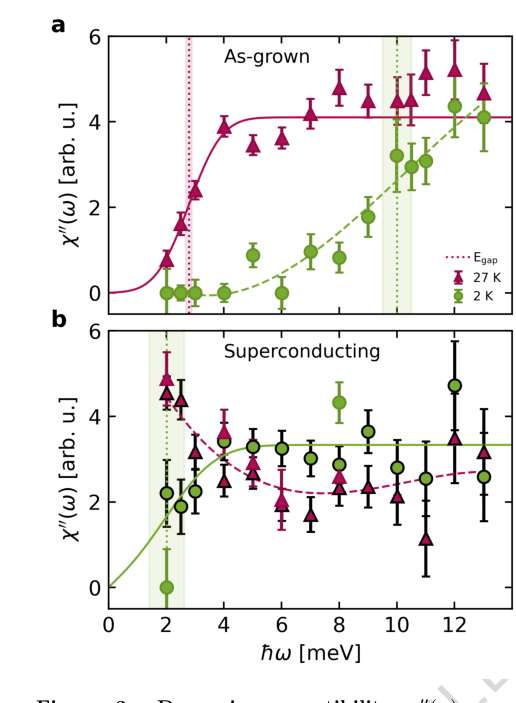 Figure 3. Dynamic susceptibility χ′′(ω), as a function of energy transfer. a) as-grown sample. b) annealed, superconducting sample. The black out- lined points indicate 3-point scans, while colored out- lined points indicate q-scans. Error bars represent the fitting error of the area under the Gaussian signal. For the 3-point scans, error bars are determined as outlined in Supplementary Note 2. The solid lines are fits to the response following Supplementary Note 4. The dashed lines are drawn as guide to the eye, while the colored ver- tical dotted lines are the estimate of the spin pseudogap onset with the faded area representing the uncertainty
The temperature dependence further highlighted this, showing stronger energy fluctuations at 8 meV than at 2 meV for all temperatures below ~40 K (Figure 5a, Figure 6), confirming the suppression of low-energy fluctuations in the as-grown state.
In stark contrast, the annealed, superconducting sample exhibited a dramatically different behavior. At 2 K (in its superconducting state), it displayed only a small spin pseudogap of 2 $\pm$ 0.6 meV (Figure 3b). Above $T_c$, no spin pseudogap was observed. The analysis of the shift in dynamic susceptibility ($\Delta\chi''$) between 2 K and 27 K (Figure 4) further underscored this difference: the annealed sample showed a steep closing of the spin pseudogap with an onset at 3.0 $\pm$ 0.1 meV. The 2 meV fluctuations dominated until they were gapped out below ~5 K (Figure 5b, Figure 6), a clear departure from the as-grown sample's behavior.
This is the definitive, undeniable evidence: reductive annealing, which induces superconductivity, simultaneously reduces the spin pseudogap from a large ~10 meV in the as-grown state to a smaller ~3 meV in the superconducting state. This directly challenges the common notion that superconductivity opens a spin pseudogap. Instead, the authors propose that the large pseudogap in the as-grown sample arises from defects fragmenting the CuO$_2$ planes, thereby suppressing long-wavelength spin waves. Annealing "heals" these defects, allowing longer-wavelength spin waves to form and occupy lower energy states, which in turn reduces the spin pseudogap (Figure 7).
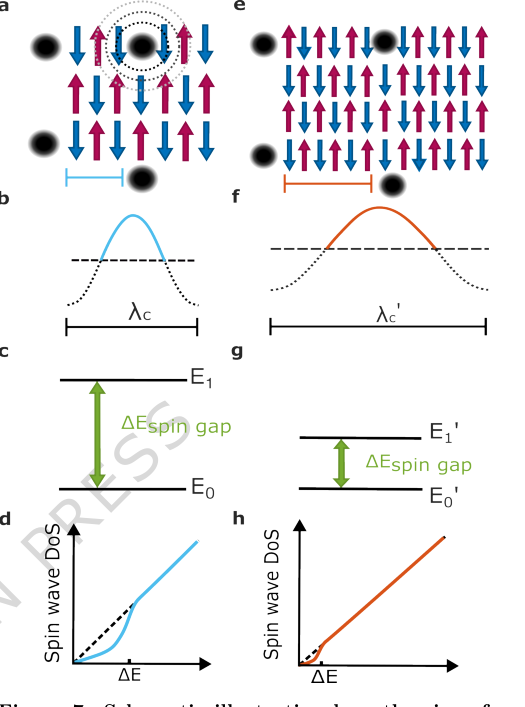 Figure 7. Schematic illustrating how the size of the antiferromagnetic patches influences the spin waves allowed in the system. Left column (a-d) rep- resents the as-grown sample, the right column (e-h) rep- resents the annealed, superconducting sample. a) and e) show the antiferromagnetic structure in each case, with the structure composed of smaller patches created by defects (black circles), that are still weakly antiferro- magnetically interacting. In the annealed sample, the undisturbed patches are larger. b) and f) show how the patches restrict the spin waves above a certain wave- length. By having larger patches, more low-energy states are occupied, minimizing the energy spin pseudogap, as illustrated in c) and g). This is more quantitatively ex- pressed as a (partial) suppression of the spin wave density of states (DoS) at low energies, seen in d) and h)
This provides a direct, hard-won link between material defects, magnetic correlations, and the emergence of superconductivity. Furthermore, elastic scattering measurements confirmed that the superconducting sample exhibited suppressed antiferromagnetic order compared to its as-grown counterpart, consistent with the broader understanding of competing orders.
Limitations & Future Directions
While this study provides compelling evidence for the role of defects and reductive annealing in shaping the spin pseudogap and enabling superconductivity in electron-doped cuprates, it also highlights several limitations and opens up rich avenues for future research.
One significant limitation was the inability to measure inelastic signals beyond 14 meV due to interference from Nd crystal electric field levels around 15 meV. This restricts a full understanding of the magnetic excitation spectrum at higher energies, which could potentially hold further clues about the pairing mechanism or other magnetic phenomena.
Perhaps the most critical limitation acknowledged by the authors themselves is the "longstanding debate" and lack of consensus regarding the exact chemical consequences of reductive annealing on the material's structure. While the paper proposes a model of defect healing, it notes conflicting hypotheses in the literature concerning whether annealing primarily reduces apical oxygen defects, creates in-plane oxygen vacancies, or "repairs" Cu sites. Without a definitive understanding of the precise atomic-level changes, the direct link between "defect healing" and the observed spin dynamics, while strongly suggested, remains somewhat conceptual.
Another point for discussion is the absence of a clear resonance peak in the superconducting sample, unlike what has been observed in some p-type cuprates and even related n-type cuprates like PLCCO. This raises questions about the universality of the resonance peak as a signature of superconductivity and suggests that the magnetic excitation spectrum in Nd$_{1.85}$Ce$_{0.15}$CuO$_{4-\delta}$ might have unique characteristics.
Furthermore, the paper notes that previous studies on magnetic correlation length ($\xi$) in annealed NCCO found it to be smaller than in as-grown NCCO, which seems to contradict the "lattice healing" model implying larger, less fragmented patches. While the authors attribute this discrepancy to differences in scattering methods and integrated energy ranges, this highlights the complexity of comparing results across different experimental techniques and the need for a more unified theoretical framework.
Looking ahead, several discussion topics emerge that could further develop and evolve these findings:
-
Elucidating the Atomic-Scale Mechanism of Annealing: Future research should focus on definitively resolving the chemical and structural changes induced by reductive annealing. Advanced experimental techniques such as atomic-resolution scanning transmission electron microscopy (STEM), X-ray absorption spectroscopy (XAS), or nuclear magnetic resonance (NMR) could provide direct evidence of oxygen vacancy creation, apical oxygen removal, or Cu site reconstruction. This would provide a solid foundation for the "defect healing" model.
-
Engineering Defect Landscapes: If defects indeed fragment spin chains and suppress low-energy spin waves, can we intentionally engineer specific defect types and densities to tune the magnetic properties and potentially enhance superconductivity? This could involve controlled doping strategies or post-synthesis treatments beyond simple annealing.
-
Revisiting Spin-Fluctuation-Mediated Pairing: The findings support a spin-fluctuation-mediated pairing mechanism, with the reduction of the spin pseudogap upon annealing correlating with superconductivity. This challenges the idea that a larger spin pseudogap is always beneficial. Further theoretical modeling, perhaps incorporating the specific defect structures and their impact on spin wave dispersion, is needed to fully understand how these modified spin fluctuations contribute to pairing. A deeper comparison with Angle-Resolved Photoemission Spectroscopy (ARPES) data, as suggested by the authors, could also provide crucial insights into the momentum dependence of the pairing interaction.
-
Universality of Magnetic Signatures: The absence of a clear resonance peak in this NCCO sample warrants further investigation. Is this a material-specific characteristic, or does it depend on doping, measurement conditions, or the precise nature of the spin fluctuations? Comparative studies across a wider range of electron-doped and hole-doped cuprates, using consistent methodologies, could help establish which magnetic features are truly universal to high-T$_c$ superconductivity.
-
Bridging Discrepancies in Correlation Length: A dedicated study that directly compares magnetic correlation lengths using both energy-integrating and inelastic neutron scattering methods on the same samples (as-grown vs. annealed) could help reconcile the apparent contradictions in the literature. This would clarify how defects influence both static magnetic order and dynamic spin fluctuations.
By addressing these points, we can gain a more comprehensive and nuanced understanding of the intricate relationship between structural imperfections, magnetic excitations, and the emergence of high-temperature superconductivity, ultimately guiding the design of improved superconducting materials.