
Surpassing kilometer-scale terahertz wireless communication beyond 300 GHz enabled by hybrid photonic–electronic synergy
Terahertz (THz) bands are critical for next-generation wireless fronthaul/backhaul applications.
Background & Academic Lineage
The Origin & Academic Lineage
The precise origin of the problem addressed in this paper stems from the escalating global demand for high-speed data traffic in wireless communications. This surge has driven the exploration of unoccupied high-frequency terahertz (THz) bands, specifically those above 300 GHz, due to their immense bandwidth potential, capable of supporting data rates of tens to hundreds of gigabits per second. Historically, these THz wireless links emerged as a critical solution for next-generation wireless fronthaul/backhaul networks and emergency communications, particularly in scenarios where deploying traditional optical fiber infrastructure is either impractical or prohibitively expensive, such as across challenging terrains like mountains and rivers. In the last decade, photonics-assisted THz communication, which leverages light-based technologies, has gained prominence as a promising approach for generating high-frequency, high-speed, and real-time THz signals, and for seamlessly integrating THz wireless links into existing optical fiber networks.
However, previous approaches faced fundamental limitations that compelled the authors to develop this novel solution. The primary "pain point" was the severely restricted wireless transmission distance of high-frequency THz communications, especially those enabled by photonics. This limitation was primarily due to two factors:
1. Intrinsic Propagation Loss: High-frequency THz waves, particularly above 300 GHz, suffer from significant propagation losses, including free space path loss and atmospheric absorption. For instance, a 300 GHz THz wave experiences over 150 dB of total loss after just 1 km of atmospheric transmission under standard conditions.
2. Low Optical-to-THz (O/T) Conversion Efficiency: The conversion of optical signals to THz signals, typically using photodiodes, exhibits a power conversion efficiency of less than 2% in the 300 GHz band and above. This inefficiency severely limits the output power of generated THz signals to the microwatt level.
While state-of-the-art solid-state THz amplifiers (SSPAs) could offer some power increase, they were inherently limited to less than 50 mW output power and under 30 dB gain. Even advanced Traveling Wave Tube Amplifiers (TWTAs) above 300 GHz, though capable of 1 W output power with 18 dB gain, fell short of the multiwatt continuous-wave power and over 30 dB gain required for practical kilometer-level coverage. Photonics-assisted schemes, while offering high data rates, were typically confined to wireless transmission distances within several hundred meters. These limitations collectively highlighted the urgent need for a breakthrough in THz power amplification and reception sensitivity to enable long-range, high-capacity THz wireless communication.
Intuitive Domain Terms
- Terahertz (THz) Bands: Imagine the entire radio spectrum as a vast highway system. Your current Wi-Fi and mobile data use specific, often congested, lanes. THz bands are like a brand-new, super-wide, and mostly empty "expressway" far above the existing ones. This expressway is designed for incredibly fast data traffic, allowing for massive amounts of information to be sent at once, much faster than what's possible on today's crowded digital roads.
- Photonic-Electronic Synergy: Think of this as a highly specialized relay team for sending messages. "Photonics" (using light, like fiber optics) is excellent at creating the initial, super-fast message signal, but it's very faint. "Electronics" (using traditional radio waves) then takes this faint signal, amplifies it into a powerful broadcast, and also has sensitive ears to hear even the weakest return messages. This "synergy" is the smart combination of light and electronics, each doing what it does best, to achieve long-distance, high-speed communication that neither could do alone.
- Traveling Wave Tube Amplifier (TWTA): Picture a tiny, weak whisper that needs to be heard across a vast concert hall. A TWTA is like a sophisticated, high-power megaphone. It takes that faint THz signal, guides it through a special tube, and uses a focused stream of electrons to "push" and amplify the signal's energy, making it incredibly loud and strong so it can travel a great distance and be clearly heard. It's a key component for boosting weak signals into powerful beams.
- Spatial Diversity Reception: If you're trying to catch a ball in a very windy and unpredictable field, using just one hand might lead to many misses. Spatial diversity reception is like using two hands, or even two separate nets placed slightly apart, to catch the same ball. Even if the wind makes the ball swerve and one net misses, the other might catch it, or you can combine the information from both to get a much clearer and more reliable catch. This makes the signal reception much more robust against fading or interference.
Notation Table
| Notation | Description | Unit |
|---|---|---|
| $G$ | Gain parameter for Traveling Wave Tube Amplifiers (TWTAs) | Dimensionless |
| $K$ | Interaction impedance | $\Omega$ |
| $I_o$ | DC beam current | A |
| $V_o$ | DC beam voltage | V |
| $SNR_C$ | Signal-to-Noise Ratio after combining (diversity reception) | dB |
| $\Delta SNR_{C,max}$ | Maximum achievable SNR gain from diversity reception | dB |
Problem Definition & Constraints
Core Problem Formulation & The Dilemma
The central problem addressed by this paper is the significant limitation in transmission range and data rate for photonics-assisted terahertz (THz) wireless communication systems operating beyond 300 GHz.
Input/Current State:
Existing photonics-assisted THz systems, particularly those operating above 300 GHz, are characterized by:
- Low THz emission power: The optical-to-THz (O/T) conversion process, typically using photodiodes, exhibits a power conversion efficency of less than 2% in the 300 GHz band and above. This limits the output power of the generated THz signal to microwatt levels.
- Severe signal degradation: High-frequency THz waves suffer from substantial intrinsic propagation loss, including free space path loss and atmospheric absorption. For instance, a 300 GHz THz wave experiences over 150 dB of total loss after just 1 km of atmospheric transmission under standard conditions (Fig. 1b).
- Poor recieveing sensitivity: The weak received THz signals, combined with system noise, result in low signal-to-noise ratios (SNRs), further restricting the achievable transmission distance and data rates.
- Limited amplifier performance: State-of-the-art solid-state THz amplifiers above 300 GHz offer low amplification gains and low saturation output power, while even advanced Traveling Wave Tube Amplifier (TWTA) prototypes typically provide only around 1 W output power with 18 dB gain. These metrics are insufficient for kilometer-level coverage, which demands multiwatt continuous-wave power and gains exceeding 30 dB.
- Restricted wireless distance: Consequently, previous photonics-assisted THz communication schemes have been limited to maximum wireless distances within 850 m (Table 2).
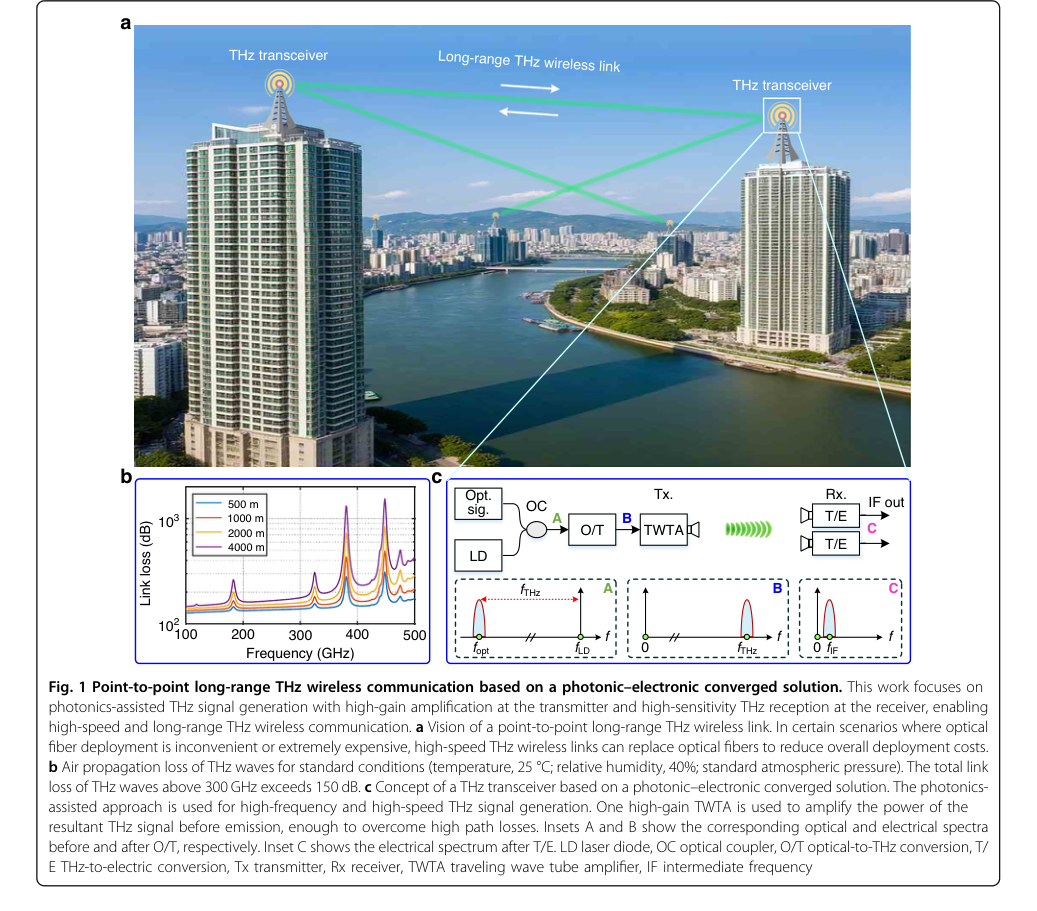 Figure 1. Point-to-point long-range THz wireless communication based on a photonic–electronic converged solution. This work focuses on photonics-assisted THz signal generation with high-gain amplification at the transmitter and high-sensitivity THz reception at the receiver, enabling high-speed and long-range THz wireless communication. a Vision of a point-to-point long-range THz wireless link. In certain scenarios where optical fiber deployment is inconvenient or extremely expensive, high-speed THz wireless links can replace optical fibers to reduce overall deployment costs. b Air propagation loss of THz waves for standard conditions (temperature, 25 °C; relative humidity, 40%; standard atmospheric pressure). The total link loss of THz waves above 300 GHz exceeds 150 dB. c Concept of a THz transceiver based on a photonic–electronic converged solution. The photonics- assisted approach is used for high-frequency and high-speed THz signal generation. One high-gain TWTA is used to amplify the power of the resultant THz signal before emission, enough to overcome high path losses. Insets A and B show the corresponding optical and electrical spectra before and after O/T, respectively. Inset C shows the electrical spectrum after T/E. LD laser diode, OC optical coupler, O/T optical-to-THz conversion, T/ E THz-to-electric conversion, Tx transmitter, Rx receiver, TWTA traveling wave tube amplifier, IF intermediate frequency
Desired Endpoint/Goal State:
The paper aims to achieve kilometer-scale, high-capacity THz wireless communication beyond 300 GHz. Specifically, the goal is to demonstrate:
- A record-breaking net data rate of 27.84 Gbit s$^{-1}$ over a 2.2 km wireless link at 335 GHz.
- An unprecedented rate-distance product of 61,248 Gbit s$^{-1} \cdot$ m beyond 300 GHz.
- High-power THz transmitters capable of watt-level emission and high-gain amplification (e.g., >50 dB).
- High-sensitivity THz receivers, potentially enhanced by diversity reception.
Missing Link/Mathematical Gap:
The exact missing link is the ability to maintain a sufficiently high signal-to-noise ratio (SNR) over kilometer-scale distances at THz frequencies, given the inherent power limitations and propagation losses. This requires a synergistic approach to:
1. Boost THz emission power: Overcome the microwatt-level output from O/T conversion to watt-level transmission.
2. Achieve high amplification gain: Compensate for the severe path loss.
3. Enhance receiving sensitivity: Improve the detection of weak signals at the receiver.
The paper mathematically bridges this gap by developing components and techniques that collectively increase the overall link budget, enabling a higher SNR at the receiver for a given distance. For instance, the theoretical SNR gain for a single-emission and double-reception diversity scheme is up to 3 dB, as shown by:
$$ \text{ASNR}_{\text{max}} = \lim_{\text{SNR}_0 \to \infty} \frac{\text{SNR}}{\text{mean}(\text{SNR}_1, \text{SNR}_2)} = 2 \frac{\text{SNR}_1 + \text{SNR}_2}{(\text{SNR}_1 + \text{SNR}_2)/2} = 2 $$
This indicates a doubling of the effective signal power or a 3 dB gain in SNR under ideal conditions, which is crucial for extending range.
The Dilemma:
Previous researchers have been trapped by a painful trade-off between achieving high data rates (requiring high frequencies and bandwidth) and extending transmission distance (requiring high power and low loss). Specifically:
- High-frequency THz vs. propagation loss: While THz bands above 300 GHz offer vast bandwidths for high data rates, they are inherently susceptible to extreme free-space path loss and atmospheric absorption, severely limiting transmission range. Improving data rate by increasing frequency directly exacerbates the range problem.
- Photonics-assisted generation vs. output power: Photonics-assisted THz generation is excellent for high-frequency and wideband signal generation, but its low O/T conversion efficiency means the generated THz power is typically in the microwatt range. This low power cannot overcome the high propagation losses for long-distance links, creating a fundamental conflict between the benefits of photonics and the need for practical range.
- TWTA performance vs. physical scaling limits: Scaling TWTAs to THz frequencies to achieve the necessary multiwatt power and high gain introduces severe challenges. Improving gain and output power often comes at the cost of stability, continuous-wave operation, and bandwidth due to fundamental physical limitations like attenuation loss in the slow-wave structure and miniaturization constraints.
Constraints & Failure Modes
The problem is insanely difficult to solve due to several harsh, realistic constraints:
Physical Constraints:
- Extreme Propagation Loss: As mentioned, THz waves above 300 GHz experience immense atmospheric absorption and free-space path loss, exceeding 150 dB per kilometer. This necessitates extremely high emission power and sensitive receivers.
- Low Optical-to-THz (O/T) Conversion Efficiency: The fundamental limitation of current O/T conversion technologies (e.g., using UTC-PDs) means less than 2% of optical power is converted to THz power, resulting in microwatt-level THz signals at the source.
- Traveling Wave Tube Amplifier (TWTA) Scaling Challenges:
- Severe Attenuation Loss in Slow-Wave Structures (SWS): At THz frequencies, the SWS, a core component of TWTAs, suffers from significant attenuation loss, directly degrading energy transfer efficency between the electron beam and electromagnetic waves, thereby limiting gain and output power.
- Miniaturization and Misalignment: As TWTA components shrink to micrometer scales, even minor misalignments in the electron beam trajectory drastically reduce transmission efficiency and destabilize beam-wave interaction.
- Thermal Loading: Beam scattering in microscale structures leads to excessive thermal loading, which hinders continuous-wave operation—a critical requirement for THz communications.
- Surface Roughness: Fabrication processes introduce surface roughness in the SWS, which elongates the high-frequency current path and increases conductor losses, especially when the root-mean-square roughness exceeds the skin depth $\delta = \sqrt{2/(\omega\mu\sigma)}$.
- Limited TWTA Bandwidth and Gain Flatness: The operational bandwidth of TWTAs can be restricted, and the gain may vary significantly across the operational bandwidth, which limits the achievable transmission rate and consistency.
Computational Constraints:
- Complex Digital Signal Processing (DSP): To achieve high data rates and improve receiving sensitivity (e.g., through Maximum Ratio Combining, MRC), sophisticated DSP algorithms are required, including down-conversion, resampling, synchronization, matched filtering, carrier phase estimation, and advanced equalizers like LSTM-ANN. These processes demand significant computational power and introduce latency.
- Real-time Latency Requirements: For practical applications like 5G new radio and high-definition video transmission, the entire communication chain, including DSP, must operate with strict real-time latency, which is challenging given the complexity of the required processing.
Data-Driven Constraints:
- Statistical Independence for Diversity: The effectiveness of diversity reception schemes relies on the assumption that impairments (e.g., atmospheric turbulence, multipath effects, partial misalignment) are statistically independent across different recieveing paths. If these impairments are highly correlated, the benefits of diversity are diminished.
- Data for Machine Learning Equalizers: Data-driven equalizers like LSTM-ANN require substantial and diverse training data to learn and adapt to channel impairments effectively. The quality and quantity of this data directly impact the equalizer's performance.
The combination of these physical, computational, and data-driven constraints makes achieving kilometer-scale, high-capacity THz wireless communication a formidable engineering and scientific challenge, requiring innovative solutions across multiple disciplines.
Why This Approach
The Inevitability of the Choice
The authors' decision to pursue a hybrid photonic-electronic synergy, specifically incorporating a high-power continuous-wave Traveling Wave Tube Amplifier (TWTA) and a diversity reception scheme, was not arbitrary but a direct response to fundamental limitations of existing technologies for kilometer-scale terahertz (THz) communication beyond 300 GHz.
The critical juncture where traditional methods proved insufficient became clear when considering the severe challenges of high-frequency THz transmission. Firstly, intrinsic propagation loss, including free space path loss and atmospheric absorption, is exceptionally high at frequencies above 300 GHz, often exceeding 150 dB over just 1 km (Fig. 1b). This necessitates extremely high emission power to maintain a viable signal over long distances. Secondly, photonics-assisted THz generation, while excellent for high-frequency and large-bandwidth signals, typically relies on optical-to-THz (O/T) conversion using photodiodes, which have a power conversion efficiency of less than 2% in this band. This limits the output power to microwatt levels.
The authors explicitly state that "the expansion of THz wireless transmission distance has to rely on key amplifcation components." However, state-of-the-art solid-state THz amplifiers (SSPAs) above 300 GHz, while capable of some power increase, are fundamentally limited by "low amplification gains and low saturation output power." As shown in Table 1, SSPAs typically deliver less than 50 mW of output power and less than 30 dB of gain, which is orders of magnitude below what is required to overcome the massive link losses for kilometer-scale links. This realization made vacuum-electronics-based TWTAs, known for their "high power capacity, high signal gain, and high reliability," the only viable path for achieving the necessary watt-level continuous-wave output power and high gain.
Comparative Superiority
The chosen approach demonstrates qualitative superiority over previous gold standards through several structural and operational advantages, extending beyond mere performance metrics.
For amplification, the vacuum-electronics-based TWTA, particularly the novel design featuring a modified circular bend (MCB) folded waveguide (FWG) slow-wave structure (SWS), offers overwhelming advantages over solid-state power amplifiers (SSPAs). TWTAs inherently possess "high power capacity, high signal gain, and high reliability" (Page 3). Critically, they can achieve watt-level output power, "significantly outperforming solid-state power amplifiers (SSPAs) by over an order of magnitude at comparable frequencies" (Page 3). The structural innovation of the MCB FWG SWS, which introduces geometric loading to enlarge the waveguide's bend curvature, substantially enhances the axial electric field in the interaction region. This directly improves beam-wave coupling dynamics, leading to a sixfold leap in coupling impedance from 0.28 Ω (for previous SDV designs) to 1.7 Ω at 335 GHz (Fig. 2d). This enhanced coupling impedance is a fundamental structural advantage, as the gain parameter $G$ in TWTAs is directly proportional to the interaction impedance $K$, as given by:
$$G = \left(\frac{K I_0}{4 V_0}\right)^{1/3}$$
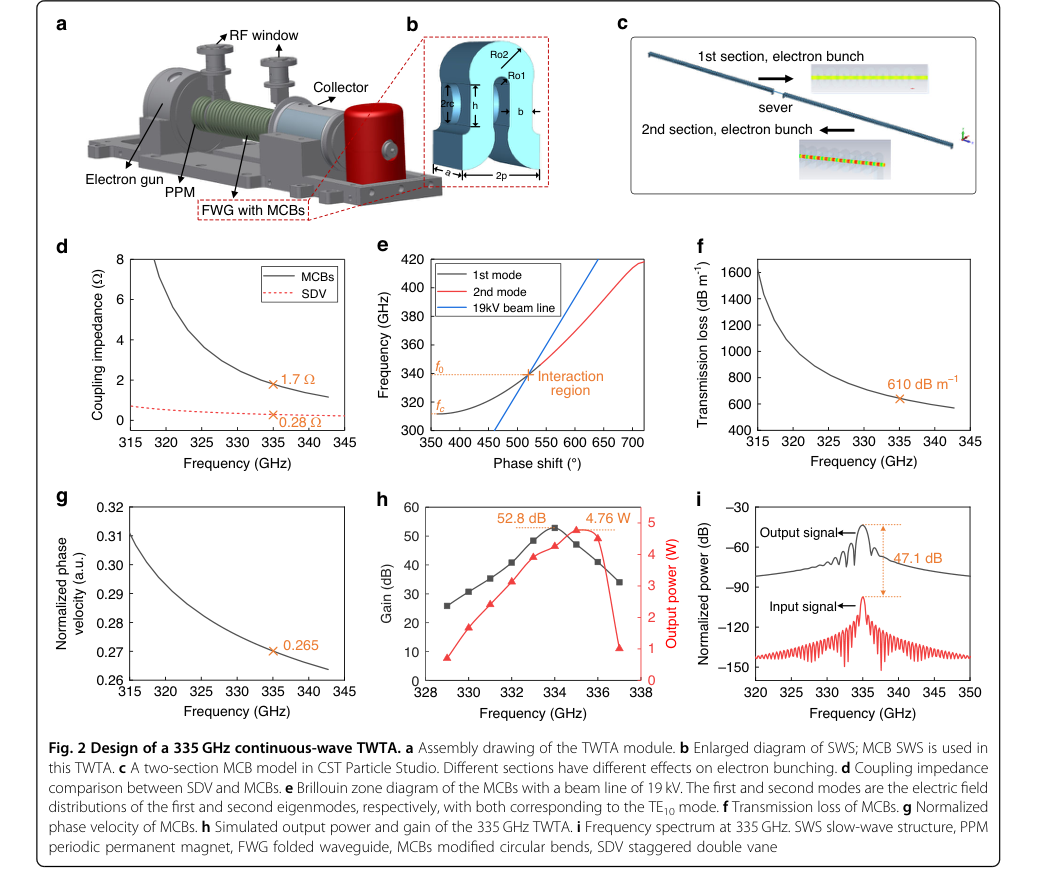 Figure 2. Design of a 335 GHz continuous-wave TWTA. a Assembly drawing of the TWTA module. b Enlarged diagram of SWS; MCB SWS is used in this TWTA. c A two-section MCB model in CST Particle Studio. Different sections have different effects on electron bunching. d Coupling impedance comparison between SDV and MCBs. e Brillouin zone diagram of the MCBs with a beam line of 19 kV. The first and second modes are the electric field distributions of the first and second eigenmodes, respectively, with both corresponding to the TE10 mode. f Transmission loss of MCBs. g Normalized phase velocity of MCBs. h Simulated output power and gain of the 335 GHz TWTA. i Frequency spectrum at 335 GHz. SWS slow-wave structure, PPM periodic permanent magnet, FWG folded waveguide, MCBs modified circular bends, SDV staggered double vane
This structural improvement enables the TWTA to achieve a continuous output power up to 3.82 W and a signal gain of over 50 dB, far exceeding the capabilities of SSPAs and even previous TWTA designs.
For reception, the diversity reception scheme with LSTM-ANN-based Maximum Ratio Combining (MRC) offers superior robustness and sensitivity compared to traditional single-input single-output (SISO) links. This method qualitatively handles high-dimensional noise and channel impairments much better. In a SISO link, issues like atmospheric turbulence, multipath effects, and partial misalignment are critical and can lead to deep fading. In contrast, the diversity reception scheme leverages two independent receiving paths. Since impairments are statistically independent for different paths, "the probability of both paths simultaneously undergoing deep fading is significantly lower than that of a SISO link" (Page 9). Furthermore, the LSTM-ANN combiner acts as an intelligent equalization strategy, autonomously optimizing weighting coefficients for the two input paths, thereby significantly improving overall transmission performance and achieving a substantial SNR gain of up to 2.9 dB (Fig. 5e). This structural advantage provides a more stable and reliable link in dynamic outdoor environemnts.
Alignment with Constraints
The chosen hybrid photonic-electronic approach, with its high-power TWTA and diversity reception, perfectly aligns with the stringent constraints of achieving kilometer-scale, high-speed THz wireless communication beyond 300 GHz. This "marriage" between the problem's harsh requirements and the solution's unique properties is evident in several key aspects.
The primary constraint is overcoming the severe path loss and atmospheric absorption at frequencies above 300 GHz, which can easily exceed 150 dB/km. The high-power continuous-wave TWTA directly addresses this by providing an unprecedented output power of 3.82 W and a gain of 52 dB (Table 1). This watt-level emission power is essential to counteract the massive link losses over a 2.2 km distance. The TWTA's continuous-wave operation mode is also a fundamental requirement for practical THz communications, ensuring sustained high-power transmission.
Another critical constraint is the low output power from photonics-assisted THz generation (microwatt level due to <2% O/T conversion efficiency). The TWTA acts as the crucial amplification stage, boosting this weak signal to watt levels before emission, making long-range transmission feasible.
For high-speed data rates, the system leverages photonics-assisted THz generation for its inherent large bandwidth capabilities. The diversity reception scheme, coupled with LSTM-ANN-based MRC processing, further enhances this. It enables the system to meet the 25% SD-FEC BER threshold at a higher baud rate (8.7 GBaud compared to 5.5 GBaud for a single receiver), thereby increasing the transmission rate to 34.8 Gbit s$^{-1}$. This directly supports the demand for tens or even hundreds of gigabits per second.
Finally, the system's robustness against challenging outdoor environments (e.g., urban rivers, Fig. 4c) is met by the diversity reception scheme. By combining signals from two spatially separated receivers, the system mitigates the effects of atmospheric turbulence, multipath fading, and partial misalignment, which are common in real-world deployments. This ensures a more stable and reliable link, even under varying environmental conditions. The intelligent equalization provided by the LSTM-ANN combiner further refines this robustness.
Rejection of Alternatives
The paper provides clear reasoning for rejecting alternative approaches, highlighting their inherent limitations for the specific problem of long-range, high-speed THz communication beyond 300 GHz.
Solid-State Power Amplifiers (SSPAs) were explicitly considered and dismissed as insufficient for the required power levels. While SSPAs exist for THz frequencies, the authors note that "long-range THz wireless transmission toward the kilometer level for photonics-assisted THz communications still faces great challenges, limited by low amplification gains and low saturation output power" (Page 2). Table 1 quantitatively supports this rejection, showing that state-of-the-art SSPAs in the 280-328 GHz range typically offer maximum powers below 50 mW and gains below 30 dB. In stark contrast, the proposed TWTA achieves 3.82 W and 52 dB gain, outperforming SSPAs by "over an order of magnitude" in output power. This vast difference in power and gain capacity makes SSPAs unviable for kilometer-scale links where hundreds of decibels of loss must be overcome.
Purely electronics-based THz generation schemes were also deemed inadequate for the paper's specific goals, particularly concerning high data rates and operating frequencies. While electronics-based schemes can achieve relatively high output power and longer wireless distances at 300 GHz, they suffer from a fundamental "electronic bottleneck [that] inherently limits the transmission rate and operting THz carrier frequency" (Page 11). The paper points out issues such as "limited modulation rate due to electronic bottleneck constraints, the aggravated multiplicative noise and conversion loss from multi-stage frequency multiplier chains, and increased integration difficulties" (Page 11). In contrast, photonics-assisted schemes, which form the generation part of this hybrid approach, are superior in enabling "high-frequency, large-bandwidth, and ultra-high-speed wireless transmission" (Page 10). Therefore, a purely electronic approach would fail to meet the high-capacity demands of next-generation wireless communication.
Finally, traditional single-input single-output (SISO) wireless links were rejected for their lack of robustness in challenging environments. The paper highlights that "issues such as atmospheric turbulence, multipath effects, and partial misalignment are critical for a traditional single-input single-output (SISO) link" (Page 9). The proposed diversity reception scheme, by utilizing two independent receiving paths and intelligent MRC processing, directly addresses these vulnerabilities. The probability of both paths simultaneously experiencing deep fading is significantly lower than that of a SISO link, making the diversity approach inherently more robust and reliable for outdoor, long-range THz communication.
Mathematical & Logical Mechanism
The Master Equation
The core mathematical engine powering the diversity reception scheme, which is a critical component of this paper's long-range THz communication system, is encapsulated in the following two equations. These equations describe how signals from multiple receiving channels are combined to enhance the overall signal quality.
The first equation defines the combined Signal-to-Noise Ratio ($\text{SNR}_{\text{C}}$) after Maximum Ratio Combining (MRC) processing:
$$ \text{SNR}_{\text{C}} = \frac{\text{SNR}_0(\text{SNR}_1 + \text{SNR}_2) - 2\text{SNR}_0\text{SNR}_1\text{SNR}_2}{\text{SNR}_0 - \text{SNR}_1\text{SNR}_2} \quad (2) $$
The second equation quantifies the maximum achievable SNR gain ($\text{ASNR}_{\text{C,max}}$) under ideal conditions:
$$ \text{ASNR}_{\text{C,max}} = \lim_{\text{SNR}_0 \to \infty} \frac{\text{SNR}_{\text{C}}}{\text{mean}(\text{SNR}_1, \text{SNR}_2)} = \frac{\text{SNR}_1 + \text{SNR}_2}{(\text{SNR}_1 + \text{SNR}_2)/2} = 2 \quad (3) $$
Term-by-Term Autopsy
Let's dissect each component of these equations to understand its role in the overall mathematical and logical mechanism.
-
$\text{SNR}_{\text{C}}$ (Combined Signal-to-Noise Ratio)
- Mathematical Definition: This is the Signal-to-Noise Ratio of the merged signal, calculated after applying the optimal weighting and combining strategy from the two diversity reception channels.
- Physical/Logical Role: $\text{SNR}_{\text{C}}$ represents the ultimate signal quality achieved by the system's diversity reception. A higher value here means a clearer signal, which directly translates to a lower Bit Error Rate (BER) and enables higher data rates and longer transmission distances. It's the key metric for the effectiveness of the diversity scheme.
- Why this structure: The specific algebraic structure of this equation, with its combination of additions, subtractions, and multiplications, is the result of substituting the optimal weight coefficient $w$ (derived from maximizing the SNR of the combined signal) into the general SNR expression for two weighted and combined signals, followed by algebraic simplification. The paper refers to a detailed derivation in Supplementary Information S3, which I don't have access to, but the form itself is characteristic of Maximum Ratio Combining (MRC) where individual channel SNRs are combined to yield an enhanced overall SNR.
-
$\text{SNR}_0$ (Initial Signal-to-Noise Ratio)
- Mathematical Definition: The Signal-to-Noise Ratio of the received signal immediately after passing through the PTFE THz lens, but before the introduction of additive white Gaussian noise (AWGN) from the individual electronic receiving channels.
- Physical/Logical Role: This term represents the baseline signal quality of the incoming THz wave from the wireless link, prior to the noise contributions from the receiver electronics. In scenarios with significant propagation loss, the paper notes that $\text{SNR}_0$ is typically much higher than the SNRs of the individual channels ($\text{SNR}_1, \text{SNR}_2$), implying that receiver noise is the dominant factor limiting performance.
- Why this operator: It acts as a foundational input parameter to the MRC calculation, representing the signal quality at a specific point in the reception chain. Its presence in both the numerator and denominator reflects its influence on the overall signal and noise components before channel-specific noise is added.
-
$\text{SNR}_1$ (Channel 1 Signal-to-Noise Ratio)
- Mathematical Definition: The Signal-to-Noise Ratio of the signal received through the first independent receiving channel, including its specific additive white Gaussian noise.
- Physical/Logical Role: This term quantifies the signal quality of the first path in the diversity reception setup. In a diversity scheme, having multiple paths with statistically independent noise and fading characteristics is crucial for improving overall system reliability and sensitivity.
- Why this operator: It's a component SNR, combined additively with $\text{SNR}_2$ in the numerator to reflect the combined signal power contribution, and multiplicatively in the denominator to account for the interaction of noise components in the MRC process.
-
$\text{SNR}_2$ (Channel 2 Signal-to-Noise Ratio)
- Mathematical Definition: The Signal-to-Noise Ratio of the signal received through the second independent receiving channel, including its specific additive white Gaussian noise.
- Physical/Logical Role: Symmetrical to $\text{SNR}_1$, this term quantifies the signal quality of the second independent receiving path. The diversity scheme leverages the statistical independence of noise and fading across these two channels to achieve a more robust signal.
- Why this operator: Its role is symmetrical to $\text{SNR}_1$, contributing to the combined signal and noise interactions in the MRC formula.
-
$\text{ASNR}_{\text{C,max}}$ (Maximum Achievable SNR Gain)
- Mathematical Definition: The theoretical upper bound on the SNR gain of the combined signal, relative to the mean of the individual channel SNRs, under the ideal condition where the initial signal-to-noise ratio ($\text{SNR}_0$) approaches infinity.
- Physical/Logical Role: This term provides a theoretical benchmark for the performance improvement offered by the diversity reception scheme. A value of 2 (or 3 dB) indicates that, ideally, MRC can double the signal-to-noise ratio compared to simply averaging the individual channel SNRs, which is a substantial enhancement for weak signals.
- Why this operator: The limit operation ($\lim_{\text{SNR}_0 \to \infty}$) is used to analyze the system's asymptotic behavior under ideal conditions (i.e., when the initial signal is so strong that receiver noise is the only significant impairment). The ratio form defines "gain," and the division by the mean of $\text{SNR}_1$ and $\text{SNR}_2$ normalizes the gain against the average performance of a single receiver.
-
Mathematical Operators (e.g., addition $+$, subtraction $-$, multiplication $\times$, division $/$, limit $\lim$)
- Mathematical Definition: These are standard arithmetic operations and the concept of a mathematical limit, fundamental to quantitative analysis.
- Physical/Logical Role:
- Addition ($+$): Represents the coherent combination of signal powers or the accumulation of noise powers from different sources or channels. In MRC, signals are added constructively.
- Subtraction ($-$): Used to isolate specific components or represent differences, often arising from algebraic manipulation during the derivation of optimal weighting factors or simplified SNR expressions.
- Multiplication ($\times$): Reflects scaling, weighting, or the interaction between different SNR terms, particularly in the denominator where noise interactions are modeled.
- Division ($/$): Defines ratios, most notably the SNR itself (signal power divided by noise power), and the gain (output SNR divided by input SNR).
- Limit ($\lim$): Employed to analyze the asymptotic behavior of the system under specific ideal conditions (e.g., very high initial SNR), allowing for the derivation of theoretical maximums.
- Why these operators: These operators are chosen because they accurately model the physical processes of signal combination, noise accumulation, and the fundamental definition of signal-to-noise ratio and gain in communication theory. The specific arrangement is a result of the Maximum Ratio Combining (MRC) theory, which aims to maximize the output SNR by weighting each received signal according to its instantaneous SNR.
Step-by-Step Flow
Let's trace the journey of an abstract data point through this photonic-electronic converged system, focusing on the reception and processing aspect. Imagine our data point as a tiny, invisible packet of information.
- Optical Signal Origin: Our data point starts its life encoded onto optical signals generated by two tunable laser diodes. These optical signals are then modulated and combined.
- THz Conversion: The combined optical signal enters a Uni-Traveling Carrier Photodiode (UTC-PD), which acts like a tiny factory, converting the optical energy into a weak Terahertz (THz) electrical signal. Our data point is now riding a THz wave.
- THz Amplification: This weak THz signal, still carrying our data point, is then fed into a powerful Continuous-Wave Traveling Wave Tube Amplifier (TWTA). This amplifier is like a supercharger, boosting the signal's power significantly (e.g., to several watts) to prepare it for a long journey.
- Wireless Transmission: The now-amplified THz signal is launched into the air via an antenna. Our data point travels across 2.2 km, facing challenges like atmospheric absorption and potential fading. It arrives at the receiving end significantly weaker and corrupted by noise.
- Diversity Reception: At the receiver, a special PTFE lens focuses the incoming THz wave. Crucially, this focused wave is directed onto two separate THz receivers, spaced just 5 cm apart. Our single data point, now faint and noisy, is captured by both Receiver 1 (Rx1) and Receiver 2 (Rx2) simultaneously. Because they are slightly separated, the noise and fading effects on each received signal might be different, offering two distinct "views" of our data point.
- THz-to-Electric Conversion & Digitization: Each receiver (Rx1 and Rx2) independently converts its received THz signal into an Intermediate Frequency (IF) electrical signal. At this stage, each path has its own Signal-to-Noise Ratio ($\text{SNR}_1$ and $\text{SNR}_2$), reflecting the quality of the signal after its wireless journey and the noise added by the individual receiver electronics. The $\text{SNR}_0$ term represents the signal quality before this individual receiver noise is added. These analog IF signals are then digitized.
- Digital Signal Processing (DSP) - Pre-processing: The two digitized IF signals (from CH1 and CH2) enter the DSP module. Here, they undergo initial processing: down-conversion to baseband, resampling, frame synchronization, clock recovery, matched filtering, and carrier phase estimation. This ensures that the two versions of our data point are perfectly aligned in time and frequency.
- LSTM-ANN-based MRC Processing: This is the heart of the logical mechanisim. The two pre-processed signals are fed into a Long Short-Term Memory-Artificial Neural Network (LSTM-ANN) equalizer, which performs Maximum Ratio Combining (MRC). The LSTM-ANN dynamically calculates an "optimal weight coefficient" ($w$) for each of the two signals. This weighting is intelligent: it gives more emphasis (a higher weight) to the signal path that currently has better quality (higher SNR) and less emphasis to the noisier path.
- Signal Combination: The two weighted signals are then coherently combined. This isn't a simple average; it's a sophisticated sum designed to maximize the output SNR. The $\text{SNR}_{\text{C}}$ equation (2) mathematically describes the resulting, enhanced signal quality after this intelligent combination.
- Output: The combined, higher-SNR signal, representing our recovered data point, is then passed for further processing, such as Bit Error Rate (BER) calculation. The $\text{ASNR}_{\text{C,max}}$ equation (3) tells us that, ideally, this MRC process can double the SNR, making the faint data point much clearer and enabling robust long-range communication. This entire process acts like a sophisticated assembly line, where the data point is transformed, amplified, transmitted, and then intelligently reconstructed from multiple noisy observations to achieve maximum clarity.
Optimization Dynamics
The optimization dynamics in this system primarily revolve around maximizing the Signal-to-Noise Ratio (SNR) at the receiver through the Maximum Ratio Combining (MRC) process, which is adaptively managed by an LSTM-ANN equalizer.
- The Optimization Objective: The fundamental goal is to maximize the combined SNR, $\text{SNR}_{\text{C}}$, as defined by equation (2). This is an "SNR optimization problem" where the system seeks to find the ideal way to combine the two received signals to achieve the best possible signal quality. Conceptually, this defines a "loss landscape" where lower "loss" corresponds to higher $\text{SNR}_{\text{C}}$.
- Optimal Weighting: The theoretical foundation of MRC dictates that to maximize the output SNR, each received signal should be weighted proportionally to its signal amplitude and inversely proportionally to its noise power. The paper provides the analytical solution for the optimal weight coefficient $w$:
$$ w = \frac{\text{E}[n_1^2]}{\text{E}[n_2^2]} = \frac{\text{SNR}_1^{-1} - \text{SNR}_0^{-1}}{\text{SNR}_2^{-1} - \text{SNR}_0^{-1}} $$
This equation shows that the weight applied to channel 2's signal relative to channel 1's signal is determined by the inverse of their respective noise powers (or their SNRs relative to $\text{SNR}_0$). If channel 2 is less noisy (higher $\text{SNR}_2$), it will receive a proportionally higher weight, contributing more to the final combined signal. - Learning and Adaptation via LSTM-ANN: While the optimal $w$ can be derived analytically for static conditions, real-world wireless channels are dynamic. This is where the "LSTM-ANN-based MRC processing" equalizer comes into play, introducing a learning and adaptive element.
- Data-Driven Adaptation: The LSTM-ANN equalizer employs a "data-driven approach" to achieve symbol recovery. Instead of relying solely on a fixed calculation of $w$, the neural network learns the optimal equalization and combining parameters directly from the incoming data streams. This allows it to adapt to changing channel conditions, such as atmospheric turbulence, multipath effects, and partial misalignments, which can cause the individual channel SNRs ($\text{SNR}_1, \text{SNR}_2$) to fluctuate over time.
- Iterative State Updates: The LSTM-ANN, being a type of recurrent neural network, processes data sequentially, maintaining an internal "memory" of past observations. During operation, it continuously updates its internal state and parameters (weights and biases) based on the incoming signals. This iterative update process is typically driven by minimizing a performance metric, such as the Bit Error Rate (BER) of the recovered symbols or maximizing the output SNR. Although the specific gradient-based optimization algorithm (e.g., backpropagation through time) is not detailed in the paper, it's the underlying mechanism for how neural networks learn.
- Dynamic Loss Landscape: The wireless channel's characteristics (fading, noise) constantly reshape the "loss landscape" for optimal signal recovery. The LSTM-ANN's ability to learn from data and its "time memory" allow it to dynamically navigate this changing landscape, continuously adjusting its effective weighting and equalization to maintain peak performance. The "performance-driven weighting of the two input paths" by the LSTM-ANN combiner ensures that the system autonomously optimizes its coefficients, leading to a significant improvement in overall transmission performance and robustness, even in challenging outdoor enviroments. This adaptive learning is key to the system's ability to converge to an optimal state over time, despite varying channel conditions.
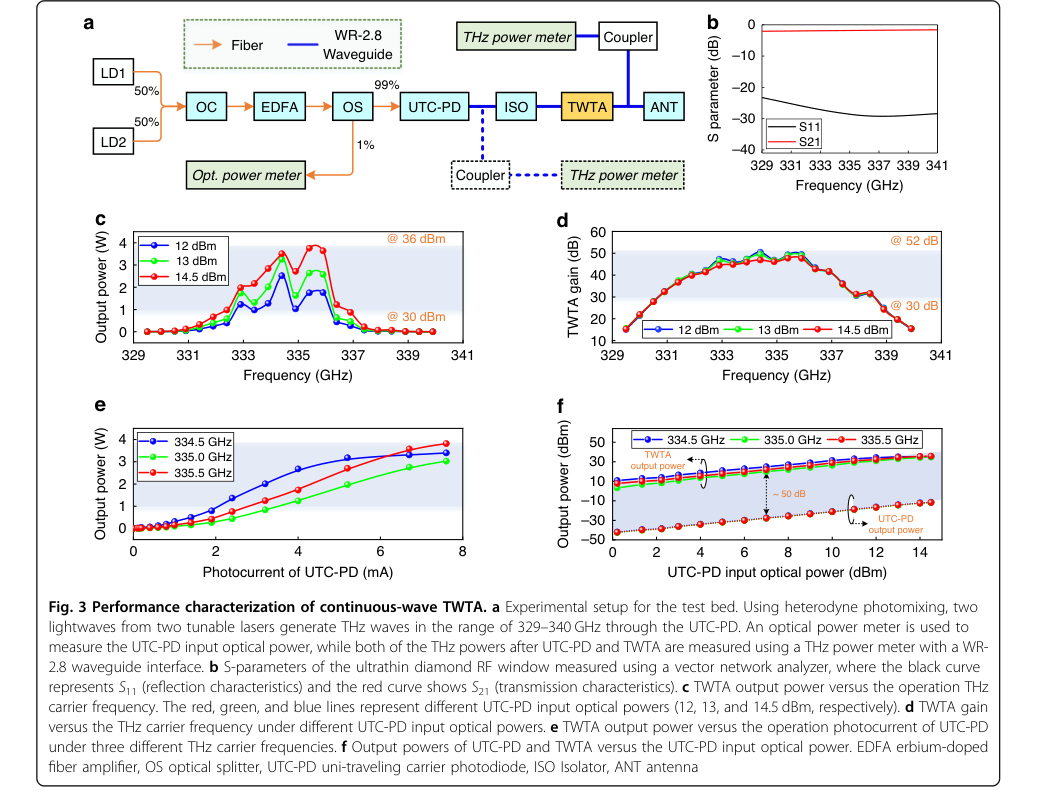 Figure 3. Performance characterization of continuous-wave TWTA. a Experimental setup for the test bed. Using heterodyne photomixing, two lightwaves from two tunable lasers generate THz waves in the range of 329–340 GHz through the UTC-PD. An optical power meter is used to measure the UTC-PD input optical power, while both of the THz powers after UTC-PD and TWTA are measured using a THz power meter with a WR- 2.8 waveguide interface. b S-parameters of the ultrathin diamond RF window measured using a vector network analyzer, where the black curve represents S11 (reflection characteristics) and the red curve shows S21 (transmission characteristics). c TWTA output power versus the operation THz carrier frequency. The red, green, and blue lines represent different UTC-PD input optical powers (12, 13, and 14.5 dBm, respectively). d TWTA gain versus the THz carrier frequency under different UTC-PD input optical powers. e TWTA output power versus the operation photocurrent of UTC-PD under three different THz carrier frequencies. f Output powers of UTC-PD and TWTA versus the UTC-PD input optical power. EDFA erbium-doped fiber amplifier, OS optical splitter, UTC-PD uni-traveling carrier photodiode, ISO Isolator, ANT antenna
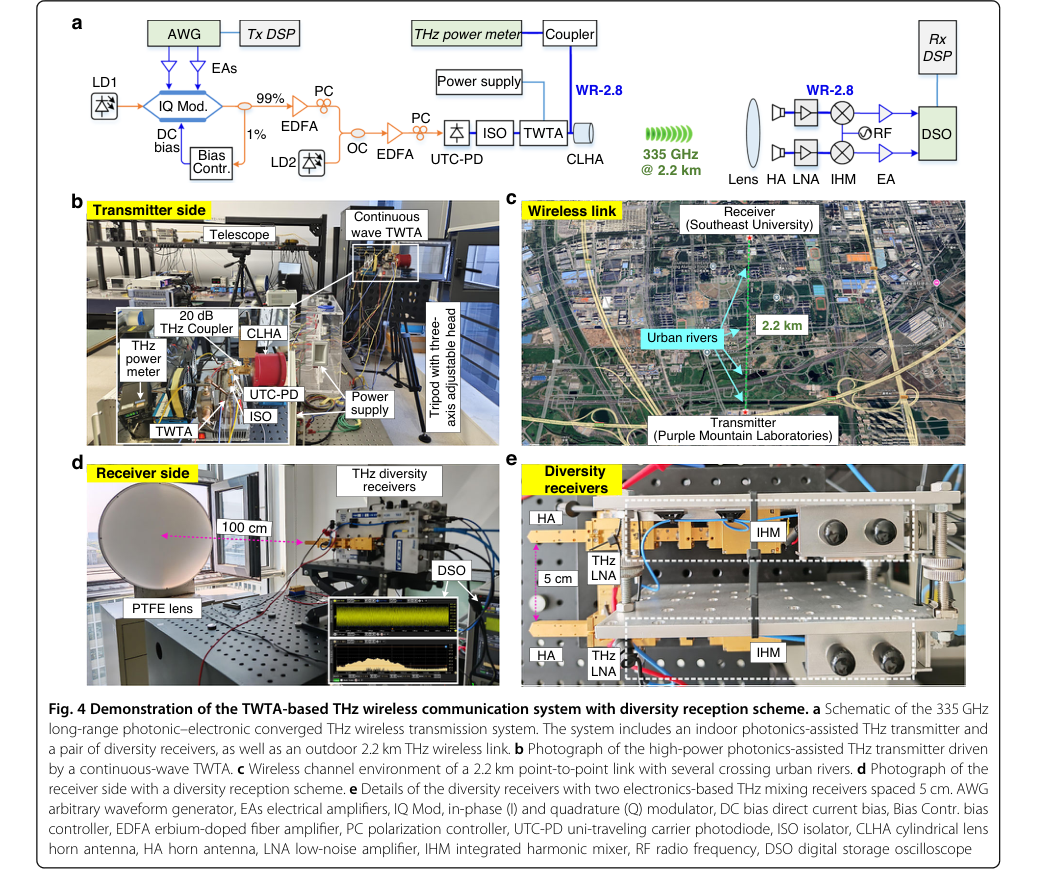 Figure 4. Demonstration of the TWTA-based THz wireless communication system with diversity reception scheme. a Schematic of the 335 GHz long-range photonic–electronic converged THz wireless transmission system. The system includes an indoor photonics-assisted THz transmitter and a pair of diversity receivers, as well as an outdoor 2.2 km THz wireless link. b Photograph of the high-power photonics-assisted THz transmitter driven by a continuous-wave TWTA. c Wireless channel environment of a 2.2 km point-to-point link with several crossing urban rivers. d Photograph of the receiver side with a diversity reception scheme. e Details of the diversity receivers with two electronics-based THz mixing receivers spaced 5 cm. AWG arbitrary waveform generator, EAs electrical amplifiers, IQ Mod, in-phase (I) and quadrature (Q) modulator, DC bias direct current bias, Bias Contr. bias controller, EDFA erbium-doped fiber amplifier, PC polarization controller, UTC-PD uni-traveling carrier photodiode, ISO isolator, CLHA cylindrical lens horn antenna, HA horn antenna, LNA low-noise amplifier, IHM integrated harmonic mixer, RF radio frequency, DSO digital storage oscilloscope
Results, Limitations & Conclusion
Experimental Design & Baselines
The authors meticulously designed their experiments to rigorously validate the performance of their hybrid photonic-electronic THz communication system. The core of their experimental setup, as depicted in Fig. 4a, involved an indoor photonics-assisted THz transmitter, a pair of electronics-based THz diversity receivers, and a challenging outdoor 2.2 km THz wireless link. This link was established between Purple Mountain Laboratories (Tx) and Southeast University (Rx) in Nanjing, China, notably traversing four urban rivers (Fig. 4c), which introduces significant environmental complexities.
At the transmitter side (Fig. 4b), the system employed electro-optic modulation to encode data onto optical carriers generated by two tunable laser diodes (LD1, LD2). This modulated optical signal was then converted to a 335 GHz THz wave using a uni-traveling carrier photodiode (UTC-PD). The crucial innovation here was the amplification of this weak THz signal by a self-developed continuous-wave traveling wave tube amplifier (TWTA), boosting its power from microwatt to watt levels. The amplified THz signal was then radiated into the air via an integrated cylindrical lens horn antenna (CLHA). Precise beam alignment over the 2.2 km link was achieved using tripods with three-axis adjustable heads and a telescope, ensuring the signal reached the distant receiver.
The receiving end (Fig. 4d) was equally sophisticated. A large circular polytetrafluoroethylene (PTFE) THz lens was used to maximize the collection of the attenuated THz power. To enhance receiving sensitivity, a pair of electronics-based THz mixing receivers were deployed, spaced 5 cm apart (Fig. 4e). Each receiver comprised a horn antenna (HA), a THz low-noise amplifier (LNA), and an integrated harmonic mixer (IHM), all driven by a common RF source. The downconverted intermediate frequency (IF) signals (at a 5 GHz carrier frequency) from both receivers were captured by a real-time digital storage oscilloscope (DSO) for subsequent offline digital signal processing (DSP).
The DSP flow for signal recovery, particularly for the diversity reception, is detailed in Fig. 5a. After initial down-conversion, resampling, synchronization, matched filtering, and carrier phase estimation, the two complex-valued symbol sequences from Rx1 and Rx2 were fed into a long-short-term memory-artificial neural network (LSTM-ANN) equalizer. This data-driven approach performed Maximum Ratio Combining (MRC) to optimally merge the signals, followed by bit error rate (BER) calculation.
To definitively prove the efficacy of their TWTA, the authors benchmarked its performance against state-of-the-art solid-state THz amplifiers (SSPAs) and previous TWTA prototypes, as summarized in Table 1. For the wireless link, the "victims" were single-receiver configurations ("Only Rx1" and "Only Rx2"), which served as baselines to highlight the undeniable advantages of their proposed diversity reception scheme ("Rx1 + Rx2 scheme"). Furthermore, the overall system performance was compared against other long-range THz wireless communication systems, both electronic-based and photonics-assisted, from existing literature (Table 2).
What the Evidence Proves
The evidence presented in this paper unequivocally demonstrates significant advancements in long-range THz wireless communication, primarily driven by the novel TWTA and the diversity reception scheme.
First, the self-designed continuous-wave TWTA proved to be a game-changer. Simulations (Fig. 2h) predicted an output power over 2 W and a gain of 52.8 dB at 334 GHz. Experimental characterization (Fig. 3c, 3e) confirmed these claims, showing a maximum output power reaching 3.82 W at 335.5 GHz with a photocurrent of 7.6 mA. The TWTA also exhibited a peak gain of approximately 52 dB at 334.5 GHz (Fig. 3d) and maintained over 30 dB gain across an 8 GHz bandwidth (330.5 to 338.5 GHz). This performance is a substantial leap, as highlighted in Table 1, where previous SSPAs typically delivered less than 50 mW and under 30 dB gain, and even prior TWTAs struggled to exceed 1.6 W output power or 18 dB gain at comparable frequencies. The authors' innovative modified circular bend (MCB) folded waveguide (FWG) slow-wave structure (SWS) was the definitive mechanism behind this, achieving a coupling impedance of 1.7 $\Omega$ at 335 GHz, a sixfold improvement over the 0.28 $\Omega$ of their original staggered double vane (SDV) design (Fig. 2d). This enhanced interaction impedance directly translated to the observed high gain and output power. The frequency spectrum (Fig. 2i) also showed good signal purity with a gain of 47.1 dB.
Second, the diversity reception scheme, coupled with LSTM-ANN-based MRC processing, dramatically improved receiver sensitivity and overall link performance. As shown in Fig. 5b, a single receiver (Rx1 or Rx2) failed to meet the 25% SD-FEC BER threshold (4.2 $\times$ 10$^{-2}$) when the baud rate exceeded 5.5 GBaud. In stark contrast, the proposed Rx1 + Rx2 diversity scheme successfully pushed the baud rate to 8.7 GBaud, resulting in a 58% improvement in transmission rate, from 22 Gbit s$^{-1}$ to 34.8 Gbit s$^{-1}$. This improvement is directly attributable to the diversity gain. The constellation diagrams in Fig. 5c visually illustrate this, showing clearer and more focused clusters for the diversity scheme compared to single receivers. Quantitatively, the average SNR of recovered symbols improved from 12.95 dB (single Rx) to 15.5 dB (diversity Rx), yielding a 2.55 dB gain (Fig. 5e), which is remarkably close to the theoretical 3 dB gain for such a scheme. Furthermore, Fig. 5d demonstrates that the diversity reception scheme significantly reduced the required UTC-PD input optical power to meet the BER threshold and lowered the best BER from 7.71 $\times$ 10$^{-2}$ to 3.38 $\times$ 10$^{-2}$.
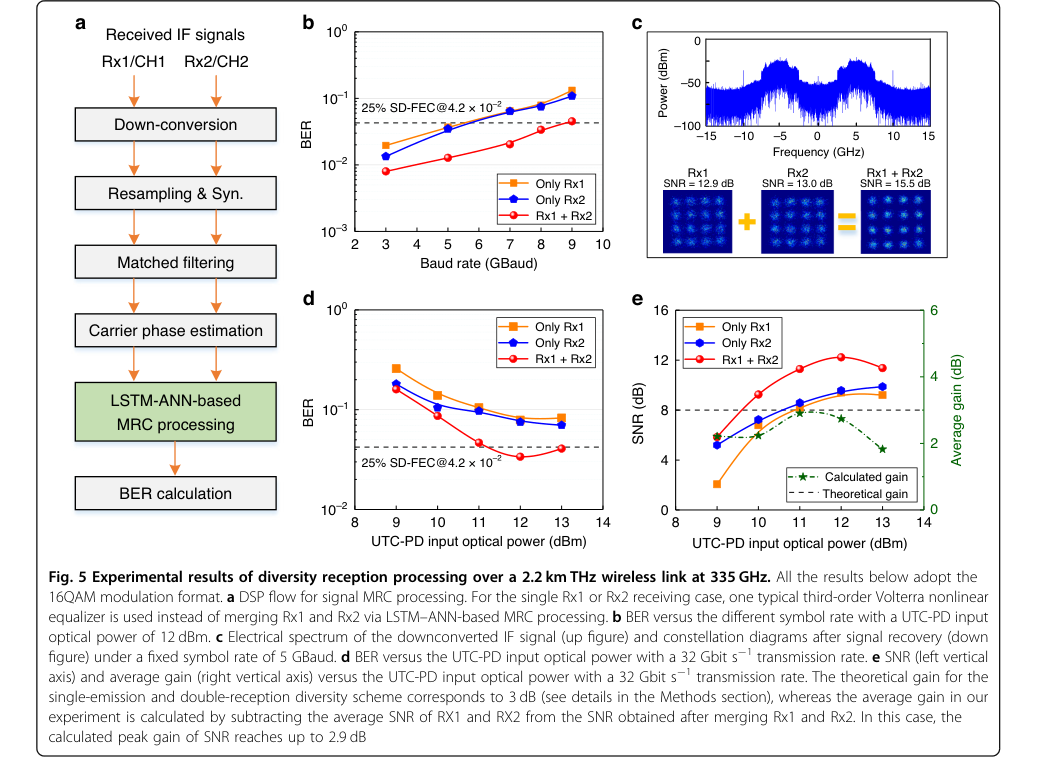 Figure 5. Experimental results of diversity reception processing over a 2.2 km THz wireless link at 335 GHz. All the results below adopt the 16QAM modulation format. a DSP flow for signal MRC processing. For the single Rx1 or Rx2 receiving case, one typical third-order Volterra nonlinear equalizer is used instead of merging Rx1 and Rx2 via LSTM–ANN-based MRC processing. b BER versus the different symbol rate with a UTC-PD input optical power of 12 dBm. c Electrical spectrum of the downconverted IF signal (up figure) and constellation diagrams after signal recovery (down figure) under a fixed symbol rate of 5 GBaud. d BER versus the UTC-PD input optical power with a 32 Gbit s−1 transmission rate. e SNR (left vertical axis) and average gain (right vertical axis) versus the UTC-PD input optical power with a 32 Gbit s−1 transmission rate. The theoretical gain for the single-emission and double-reception diversity scheme corresponds to 3 dB (see details in the Methods section), whereas the average gain in our experiment is calculated by subtracting the average SNR of RX1 and RX2 from the SNR obtained after merging Rx1 and Rx2. In this case, the calculated peak gain of SNR reaches up to 2.9 dB
Collectively, these innovations enabled an unprecedented long-range THz wireless link. The system achieved a net data rate of 27.84 Gbit s$^{-1}$ over a 2.2 km wireless link at 335 GHz. This translates to a record-breaking rate-distance product of 61,248 Gbit s$^{-1}\cdot$m beyond 300 GHz, as highlighted in Table 2. This product significantly surpasses previous photonics-assisted schemes, which were limited to distances within 850 m and lower rate-distance products, and also outperforms electronic-based schemes in this frequency band. The real-time transmission of 5G new radio and high-definition video over the 2.2 km link, as mentioned in the supplementary information, further underscores the system's robustness in a real-world environment.
Limitations & Future Directions
While this paper presents a truly groundbreaking achievement in kilometer-scale THz wireless communication, it also candidly acknowledges several limitations that pave the way for future research and development.
One primary limitation stems from the continuous-wave TWTA itself: its limited operating bandwidth and uneven gain across that bandwidth. These factors currently restrict the maximum achievable transmission rate in long-range THz links. Although the TWTA achieves record-breaking power and gain, maintaining consistent performance over a wider frequency range is a persistent technical challenge. Additionally, while only a slight power saturation was observed in the TWTA at higher UTC-PD input optical powers (Fig. 3f), it suggests that the conversion efficiency of the UTC-PD could be further improved to fully leverage the TWTA's potential output power.
Looking ahead, several promising avenues for further development and evolution emerge:
-
TWTA Performance Enhancement:
- Bandwidth and Gain Flatness: Future work should prioritize optimizing the TWTA's design to achieve a flatter gain profile and wider operational bandwidth. This could involve exploring novel slow-wave structures, advanced electron beam shaping techniques, or multi-stage amplification architectures that compensate for frequency-dependent losses. The goal is to enable transmission rates exceeding 100 Gbit s$^{-1}$ or more, as the authors suggest.
- Power Efficiency: Improving the overall power efficiency of the TWTA beyond the current 3% is crucial for practical, energy-efficient deployments. Research into more sophisticated depressed collectors for energy recovery, or alternative electron beam generation and interaction mechanisms, could yield significant gains.
- Miniaturization and Integration: While the current TWTA is powerful, its size and complexity could be reduced through advanced manufacturing techniques and tighter integration with photonic components. This would facilitate more compact and deployable THz transceivers.
-
Advanced Diversity and MIMO Systems:
- Sophisticated DSP Algorithms: The LSTM-ANN-based MRC is effective, but exploring more advanced machine learning or artificial intelligence algorithms for equalization and combining could further enhance performance, especially in dynamic and complex atmospheric channels. These algorithms could adaptively mitigate impairments like atmospheric turbulence, multipath fading, and partial misalignment more effectively.
- Full MIMO Implementation: Expanding from a two-receiver diversity scheme to a full Multiple-Input Multiple-Output (MIMO) system with multiple transmit and receive antennas could unlock even higher data rates and greater link robustness, particularly in scenarios requiring spatial multiplexing or advanced beamforming.
-
System Robustness and Adaptability:
- Dynamic Channel Adaptation: Developing systems that can dynamically adjust modulation formats, coding schemes, and power levels based on real-time channel conditions (e.g., varying humidity, rain, fog) would significantly improve reliability and availability in diverse environments. This would require robust sensing and feedback mechanisms.
- Interference Management: As THz communication systems become more prevalent, addressing potential interference from other THz sources or co-existing wireless systems will be critical. Research into advanced interference cancellation and spectrum sharing techniques will be necessary.
-
Exploration of Other THz Windows:
- While 335 GHz is a challenging atmospheric window, investigating the application of this hybrid photonic-electronic synergy to other THz frequency bands (e.g., 140 GHz, 220 GHz, or even higher frequencies like 400-500 GHz) could open up new opportunities. Each window presents a unique trade-off between path loss and available bandwidth, and tailoring the technology to specific windows could optimize performance for different applications.
-
Cost and Commercialization:
- For widespread adoption, the cost-effectiveness of manufacturing these high-performance THz components needs to be addressed. Research into scalable, low-cost fabrication methods and assembly processes will be vital for commercial viability.
This work represents a significant stride towards practical, kilometer-scale THz communication. The proposed discussion topics highlight that while the fundamental challenges of THz propagation and power generation are being overcome, the journey towards ubiquitous, high-capacity THz networks is an ongoing, exciting endeavor requiring continued innovation across multiple scientific and engineering disciplines.
Connections to Other Fields
Mathematical Skeleton
The pure mathematical core of this work involves the analysis of electron beam-wave interactions within periodic structures for high-frequency signal amplification and the optimal combination of multiple noisy signals to maximize the signal-to-noise ratio in a diversity reception system.
Adjacent Research Areas
Accelerator Physics and Free-Electron Lasers
The principles of electron beam interaction with guided electromagnetic waves in periodic slow-wave structures, which are central to the Traveling Wave Tube Amplifier (TWTA) design, are fundementally similar to those explored in accelerator physics and free-electron lasers (FELs). The gain parameter formula $G = (\frac{K I_0}{4V_0})^{1/3}$ directly quantifies the efficiency of energy transfer between the electron beam and the electromagnetic wave. This same underlying physics of resonant interaction between charged particle beams and electromagnetic fields in periodic or quasi-periodic structures is crucial for particle acceleration in linear accelerators and for coherent radiation generation in FELs, where the goal is either to impart energy to the beam or extract energy as light, with similar energy exchange processes occuring.
Wireless Communications (Diversity Combining)
The diversity reception scheme employed in this paper directly applies the well-established technique of Maximum Ratio Combining (MRC) from wireless communications. The mathematical framework for combining signals from two reciever branches to enhance the signal-to-noise ratio (SNR), as expressed by equation (2) for $\text{SNR}_C$ and its theoretical gain limit in equation (3), is a canonical method for mitigating fading and improving link quality in multi-path environments. This technique is widely adopted in modern wireless standards to improve the robustness and capacity of communication links. (Lo, 1999, IEEE Trans. Commun.).
Deep Learning for Signal Processing
The integration of an LSTM-ANN-based equalizer for signal recovery in the diversity reception processing highlights a strong connection to the field of deep learning applied to signal processing. This data-driven approach leverages the capabilities of Long Short-Term Memory (LSTM) networks and Artificial Neural Networks (ANNs) to adaptively learn and compensate for complex channel impairments and nonlinear distortions. Such neural network architectures are increasingly used for advanced equalization, interference cancellation, and channel estimation tasks in high-speed communication systems, where traditional model-based methods may struggle with the complexity of real-world channels. (Liu et al., 2023, Optics Express).