
Nonlocality, integrability and quantum chaos in the spectrum of bell operators
New research reveals maximal entanglement in 3-state systems leads to predictable, non-chaotic behavior.
Background & Academic Lineage
The Origin & Academic Lineage
The problem addressed in this paper originates from the long-standing quest to understand quantum nonlocality, a phenomenon first famously described by Bell inequalities [1]. While nonlocality is crucial for advanced information-processing tasks beyond classical physics [2], our comprehension of how these nonlocal correlations manifest in systems more complex than simple spin-1/2 particles remains quite limited. Specifically, the field has struggled to characterize nonlocality in "higher-spin" systems, where each quantum subsystem can have three or more possible outcomes, as opposed to the two outcomes of a spin-1/2 particle (like an electron).
A significant "pain point" in previous research has been the exponential scaling of Bell scenarios. As the number of interacting quantum particles, measurement settings, and possible outcomes increases, the complexity of analyzing Bell inequalities grows prohibitively [6]. For spin-1/2 systems, researchers found ways around this by exploiting symmetries and focusing on simpler correlations [7-11], which allowed them to study systems with a vast number of particles [12, 13]. However, these methods are "far less developed" for higher-spin particles, meaning there's a substantial gap in both theoretical understanding and experimental demonstrations of Bell correlations in such systems. The paper highlights that even the fundamental task of smoothly parametrizing local projective measurements for these higher-dimensional systems (qutrits) is considerably more involved than for qubits. This lack of suitable methods has prevented a deeper exploration of how nonlocality relates to other complex quantum phenomena, such as quantum chaos, in these richer, three-level systems. The authors were compelled to write this paper to bridge this gap, particularly using SU(3) models, which are naturally suited to explore the interplay between dynamical complexity and non-local correlations.
Intuitive Domain Terms
- Bell Nonlocality: Imagine two people, Alice and Bob, far apart, each with a special coin. If they both flip their coins and always get opposite results (one heads, one tails), even if they couldn't possibly have communicated or pre-arranged their flips, that's like Bell nonlocality. It's a correlation so strong it defies any classical explanation, suggesting a "spooky" connection beyond local influences.
- Bell Operator: Think of this as a mathematical "scorecard" for the Bell nonlocality game. For any given set of measurements Alice and Bob make, this operator calculates a specific value. If this value falls below a certain threshold, it means their quantum system is exhibiting Bell nonlocality. The paper treats this operator like an "effective Hamiltonian," which is a mathematical description of a system's energy and how it evolves.
- Qutrits: A standard light switch has two states: on or off. A qutrit is like a special light switch that has three distinct states: off, dim, or bright. It's a basic unit of quantum information, similar to a qubit (two states), but with an extra degree of freedom, making the systems it describes more complex and interesting.
- Quantum Chaos: Imagine a billiard table. If it's a perfect rectangle, the balls' paths might be predictable (integrable). But if the table has a very irregular, complex shape, the balls will bounce around in an incredibly unpredictable, "chaotic" manner. Quantum chaos is about how this kind of complex, unpredictable behavior manifests in the energy levels of quantum systems, often making them look like a random jumble of numbers.
- Integrability: Following the billiard table analogy, integrability is when the table is perfectly shaped, and the balls' movements are highly predictable, following simple, regular patterns. In quantum systems, this means the energy levels are uncorrelated and spread out in a predictable way, like random numbers drawn from a simple distribution (Poisson).
Notation Table
| Notation | Description |
|---|---|
Problem Definition & Constraints
Core Problem Formulation & The Dilemma
The central problem this paper addresses stems from a significant gap in our understanding of quantum nonlocality in higher-dimensional, many-body systems. While Bell inequalities have been instrumental in characterizing nonlocality in spin-1/2 (qubit) systems, their application to systems with three or more outcomes per subsystem (qutrits or higher-spin particles) remains largely undeveloped.
The current state is a limited comprehension of how nonlocal correlations manifest in these higher-dimensional systems and, crucially, how they relate to complex physical phenomena like quantum chaos. Previous research has primarily focused on mitigating the exponential scaling of Bell scenarios in qubits by exploiting symmetries. However, analogous methods for qutrits are far less mature, and experimental demonstrations of Bell correlations in such systems are virtually nonexistent. Furthermore, while spectral properties of Hamiltonians are a well-established diagnostic for quantum chaos, this "spectral lens" has rarely been applied to Bell operators.
The desired endpoint is to establish a clear connection between Bell nonlocality and quantum chaos in multipartite spin-1 systems. This involves introducing a suitable permutationally invariant Bell inequality, constructing its corresponding Bell operator, and then analyzing the spectral properties of this operator under various measurement configurations. The ultimate goal is to identify specific measurement settings that maximize Bell inequality violation and understand the nature of the quantum chaos (or integrability) associated with these optimal configurations.
The missing link this paper attempts to bridge is the precise mathematical and physical relationship between maximal Bell nonlocality and the spectral statistics of the associated Bell operator in higher-dimensional quantum systems. Specifically, the paper seeks to understand if maximal nonlocality is associated with chaotic (Wigner-Dyson) or integrable (Poisson) spectral behavior, and what underlying mechanisms drive this connection.
A painful trade-off or dilemma that has historically trapped researchers, and which this paper highlights, is the counter-intuitive finding that conditions yielding maximal Bell inequality violation in these systems do not lead to the expected complex, chaotic dynamics. Instead, the paper reveals that optimal measurement settings, which maximize nonlocality, surprisingly result in Bell operators exhibiting Poissonian level statistics, a signature of integrable behavior. Conversely, generic or slightly perturbed measurements lead to the Wigner-Dyson statistics characteristic of quantum chaos. This presents a dilemma: the very conditions that reveal the most profound quantum nonlocality seem to simplify the system's spectral dynamics, suggesting a fine-tuned and fragile nature of this integrability.
Constraints & Failure Modes
The problem of understanding nonlocality and quantum chaos in multipartite higher-spin systems is fraught with several harsh, realistic constraints:
- Computational Scaling: The most significant wall is the "exponential scaling of Bell scenarios with the number of parties, measurement settings, and outcomes." For $n$ parties, each with two measurement settings and three outcomes (qutrits), the complexity quickly becomes intractable. The paper explicitly states that constructing the Bell operator with different measurement parameters for each site $i \in [n]$ is "too computationally demanding." This computational limit restricted their analysys to $n=32$ parties for the permutationally invariant Bell inequality (PIBI) considered.
- Measurement Parametrization Difficulty: Smoothly parametrizing local projective measurements for qutrits is considerably more involved than for qubits. The main difficulty lies in constructing continuous families of unitary operators that preserve the spectral properties required for the Bell scenario. Straightforward generalizations of Pauli matrices do not preserve unitarity for linear combinations, making the optimization of measurement settings a non-trivial task.
- Data Scarcity and Experimental Validation: For higher-spin particles, "no experimental demonstration of Bell correlations in such systems has yet been reported." This lack of real-world data or experimental platforms for such systems means theoretical models and computational simulations are the primary means of exploration, limiting direct empirical validation.
- Fragility of Integrability: The integrable behavior observed at maximal Bell violation is extremely fragile. It emerges only within a vanishingly small neighborhood around the optimal measurement settings. Even "mild deviations from the optimal measurement settings induce a transition from Poisson to Wigner-Dyson statistics." Furthermore, the "volume of measurement settings around the optimal yielding Poisson-like RCS distributions shrinks with increasing $n$," implying that finding and maintaining this integrable regime becomes increasingly difficult and fine-tuned as system size grows. This suggests that the observed integrability is a singular feature of the optimal configuration, not a general property of the Bell operator, making its detection and study challenging.
- Finite-Size Effects: Apparent exceptions to the general rule (orange points in Fig. 2) where optimal measurements yield non-zero fitted RCS parameters ($\lambda > 0$) are interpreted as "finite-size effects arising from the limited Hilbert-space dimension of the corresponding irreps." This means that for smaller system sizes, the spectral statistics might not fully reflect the asymptotic behavior, potentially leading to misinterpretations of integrability or chaos.
Why This Approach
The Inevitability of the Choice
The chosen approach, centered on introducing a novel permutationally invariant Bell inequality (PIBI) for multipartite three-level systems (qutrits) and analyzing the spectral properties of its associated Bell operator, was not merely a preference but a necessity given the problem's scope. Traditional "SOTA" methods like standard Convolutional Neural Networks (CNNs), Diffusion models, or Transformers are entirely orthogonal to this domain; they are machine learning paradigms designed for tasks such as image generation, natural language processing, or data classification, not for fundamental theoretical investigations into quantum nonlocality and chaos in operator spectra. Therefore, these methods were not considered and are not applicable here.
The authors realized the insufficiency of existing methods at the very outset, as highlighted by the significant gap in understanding: "Yet, our understanding of how nonlocal correlations manifest in systems beyond spin-1/2 particles, and how they relate to complex physical behavior, remains limited." (Page 2). Specifically, for higher-spin particles (like qutrits), "analogous methods... are far less developed, and no experimental demonstration of Bell correlations in such systems has yet been reported." (Page 2). This indicates that the established frameworks for qubits (spin-1/2) could not be straightforwardly extended to qutrits (spin-1) due to the inherent complexities of higher-dimensional Hilbert spaces and SU(3) symmetry. The exponential scaling of Bell scenarios with the number of parties, measurement settings, and outcomes [6] further underscored the need for a tailored approach that could manage this complexity while preserving the physical insights. The construction of a specific Bell operator for qutrits, interpreted as an effective Hamiltonian, was the only way to bridge the gap between Bell nonlocality and quantum chaos through spectral analysis.
Comparative Superiority
The qualitative superiority of this method stems from its ability to tackle a previously intractable problem space and reveal novel, fundamental connections, rather than outperforming existing algorithms on a benchmark.
- Extension to Higher-Dimensional Systems: This approach uniquely enables the investigation of Bell nonlocality and quantum chaos in multipartite spin-1 systems (qutrits). As noted, methods for such higher-spin particles were "far less developed" (Page 2). SU(3) systems are particularly compelling as they "already host intrinsic quantum chaotic dynamics, in contrast to SU(2) models that typically require external driving" (Page 3), making them natural platforms for this exploration.
- Computational Tractability through Symmetry Exploitation: A central challenge in Bell scenarios is their "exponential scaling" (Page 2). This method overcomes this by exploiting permutation invariance symmetry inherent to the PIBI and applying Schur-Weyl duality. This allows the Bell operator to "block-diagonalize in a symmetry-adapted basis, where each block has polynomial size" (Page 4, Section B). While not explicitly stated as a reduction from $O(N^2)$ to $O(N)$, this block-diagonalization drastically reduces the computational complexity from exponential to polynomial within each block, making the analysis feasible for systems with up to $n=32$ parties (Page 5).
- Novel Operator-Based Perspective on Quantum Chaos: Unlike previous studies that typically probe quantum chaos through the evolution of quantum states under a fixed Hamiltonian, this method offers a "fundamentally different" (Page 7, Discussion) operator-based perspective. It reveals that the spectral statistics of the Bell operator itself change with different measurement configurations, and that integrability (Poisson statistics) emerges at a "fine-tuned, symmetry-enhanced point that coincides with maximal Bell violation" (Page 7, Discussion). This structural advantage provides a deeper, more intrinsic link between nonlocality and chaos.
Alignment with Constraints
The chosen method perfectly aligns with the implicit constraints of the problem, forming a "marriage" between the problem's harsh requirements and the solution's unique properties:
- Focus on Multipartite Spin-1 Systems: The core of the method is the introduction of a "permutationally invariant multipartite Bell inequality tailored to multipartite spin-1 systems" (Page 3). This directly addresses the constraint of studying qutrit systems, which were previously underexplored in this context.
- Addressing Exponential Scaling: The method's reliance on permutation invariance symmetry and Schur-Weyl duality to block-diagonalize the Bell operator (Page 4, Section B) directly tackles the computational challenge of exponential scaling in many-body Bell scenarios. This makes the problem tractable for a significant number of particles.
- Investigating Quantum Chaos and Nonlocality: The analysis of the Bell operator's spectral properties using the ratio of consecutive level spacings (RCS) (Page 4, Section C) is the direct mechanism for diagnosing integrability (Poisson statistics) and chaos (Wigner-Dyson statistics). This perfectly fulfills the objective of exploring the interplay between nonlocality and quantum chaos.
- Efficient Measurement Parametrization: The paper explicitly states the need for "an efficient way to parametrize local projective measurements while respecting the structure of the Bell scenario" (Page 4, Section B). The adopted unitary-based parametrization (Eq. 7) ensures unitarity, preserves the Bell scenario structure, and enables efficient optimization, which is crucial for finding optimal measurement settings.
- Preservation of Permutation Invariance: The PIBI itself is permutationally invariant, and the optimization strategy assumes "all parties share the same measurement pair" ($\theta_i^x = \theta^x$ for all $i \in [n]$) (Page 4, Section B), fully leveraging this symmetry to simplify the search for optimal measurements.
Rejection of Alternatives
The paper implicitly rejects alternative approaches by highlighting the unique advantages of its operator-based framework compared to prior work on quantum chaos and correlations. The authors state: "Our approach differs fundamentally from previous efforts linking chaos to quantum correlations. Earlier studies typically probe chaos through properties of quantum states such as entanglement growth [43], quantum discord [44], or the violation of Leggett-Garg inequalities in chaotic dynamics [45], all of which rely on state evolution under a fixed Hamiltonian." (Page 7, Discussion).
The reasoning for rejecting these state-evolution-based alternatives is that they do not allow for the direct investigation of the intrinsic spectral properties of the Bell operator itself as a function of measurement settings. These prior methods treat the Hamiltonian as fixed and observe the state's evolution, whereas this paper's method treats the Bell operator as a dynamic entity whose spectral statistics change with measurement configurations. This allows for the discovery that "integrability emerges from a fine-tuned, symmetry-enhanced point that coincides with maximal Bell violation" (Page 7, Discussion) – a finding that would be inaccessible through state-evolution-centric analyses. Furthermore, as previously mentioned, existing methods for spin-1/2 systems were "far less developed" for higher-spin particles (Page 2), implying they were not suitable for the qutrit systems central to this study.
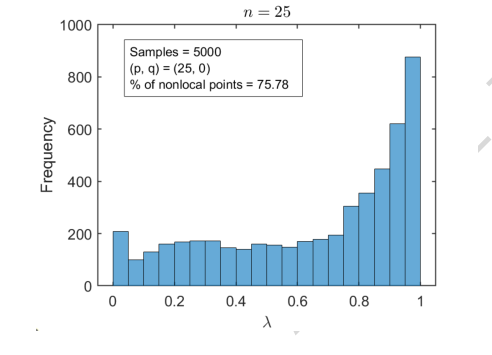 FIG. 3. Histogram of RCS parameters λ resulting from fitting the RCS distribution of the Bell operator constructed from the PIBI (1) with random projectors. Here n = 25 and (p, q) = (25, 0), i.e. the lowest point in Fig. 2, but other irreps show a similar behaviour de- spite having a lower fraction of points exhibiting nonlocality
Mathematical & Logical Mechanism
The Master Equation
The absolute core of this paper's mathematical engine is the Bell operator, $B$, which is a Hermitian operator whose expectation value corresponds to a specific Permutationally Invariant Bell Inequality (PIBI). The paper defines this operator in Eq. (3) as:
$$ B = \sum_{i \in [n]} \sum_{a \in \{0,1\}} E_{a|x=0}^{(i)} + \sum_{i \neq j \in [n]} \sum_{a \in \{0,1\}} (E_{a|x=0}^{(i)} E_{a|x=1}^{(j)}) - 2 \sum_{i \neq j \in [n]} (E_{0|x=0}^{(i)} E_{1|x=1}^{(j)} + E_{0|x=1}^{(i)} E_{1|x=0}^{(j)}) $$
This operator is central because its minimal eigenvalue directly quantifies the maximal quantum violation of the Bell inequality. The spectral properties of this operator, particularly the statistics of its energy levels, are then analyzed to characterize quantum chaos and integrability.
Term-by-Term Autopsy
Let's dissect the master equation (Eq. 3) piece by piece:
-
$B$: This is the Bell operator itself.
- Mathematical Definition: A Hermitian operator acting on the $3^n$-dimensional Hilbert space of $n$ qutrits.
- Physical/Logical Role: It serves as an effective many-body Hamiltonian whose expectation value, $\text{Tr}[\rho B]$, quantifies the violation of the PIBI (Eq. 1) for a given quantum state $\rho$ and measurement settings. A negative expectation value indicates nonlocality.
- Why this structure: The operator is constructed as a sum of one-body and two-body measurement terms, mirroring the structure of the PIBI, which is a sum of collective probabilities.
-
$\sum_{i \in [n]}$: This is a summation over all $n$ parties (subsystems).
- Mathematical Definition: A sum from $i=1$ to $n$.
- Physical/Logical Role: It reflects the permutation invariance of the Bell inequality and the operator. All parties are treated symmetrically.
- Why summation: To aggregate contributions from individual subsystems or pairs of subsystems across the entire system.
-
$\sum_{a \in \{0,1\}}$: This is a summation over measurement outcomes $a=0$ and $a=1$.
- Mathematical Definition: A sum over the two specified outcomes.
- Physical/Logical Role: These are the specific outcomes considered in the PIBI (Eq. 1). The paper notes that outcome $a=2$ is implicitly handled via the no-signaling constraint $E_{2|x} = I - E_{0|x} - E_{1|x}$.
- Why summation: To combine probabilities or operators associated with different measurement results.
-
$E_{a|x}^{(i)}$: This represents a local Positive Operator-Valued Measurement (POVM) operator for party $i$.
- Mathematical Definition: $E_{a|x}^{(i)} = \mathbb{I}^{(i-1)} \otimes E_{a|x} \otimes \mathbb{I}^{(n-i)}$, where $E_{a|x}$ is a local POVM for a single qutrit, and $\mathbb{I}^{(k)}$ is the identity operator on $k$ subsystems. The local $E_{a|x}$ are derived from a unitary operator $U(\theta_x)$ using an inverse Fourier transform-like expression. Based on the examples in the paper (Eq. 9 and the prose for $P_{00}$), for outcome $a=0$, $E_{0|x} = \frac{1}{3} (U(\theta_x)^3 + U(\theta_x)^2 + U(\theta_x))$, and for $a=1$, $E_{1|x} = \frac{1}{3} (U(\theta_x)^3 + \zeta U(\theta_x)^2 + \zeta^2 U(\theta_x))$.
- Physical/Logical Role: These are the fundamental quantum operators that correspond to performing a measurement with setting $x$ on subsystem $i$ and obtaining outcome $a$. They translate the classical probabilities in the Bell inequality into quantum mechanical observables.
- Why tensor product: To represent a local measurement acting on a specific subsystem $i$ while leaving all other subsystems untouched.
-
$E_{a|x=0}^{(i)}$: This is the local POVM for party $i$ with measurement setting $x=0$ and outcome $a$.
- Physical/Logical Role: Represents a specific choice of local measurement.
-
$E_{a|x=1}^{(j)}$: This is the local POVM for party $j$ with measurement setting $x=1$ and outcome $a$.
- Physical/Logical Role: Represents the other specific choice of local measurement.
-
$E_{a|x=0}^{(i)} E_{a|x=1}^{(j)}$: This is a product of two local POVMs for distinct parties $i$ and $j$.
- Mathematical Definition: This is a tensor product of the local POVMs, effectively $( \mathbb{I}^{(i-1)} \otimes E_{a|x=0} \otimes \mathbb{I}^{(j-i-1)} \otimes E_{a|x=1} \otimes \mathbb{I}^{(n-j)} )$.
- Physical/Logical Role: Represents a joint measurement where party $i$ uses setting $x=0$ and party $j$ uses setting $x=1$, both yielding outcome $a$. These terms correspond to two-body correlations.
- Why multiplication (tensor product): To describe joint events on separate, non-communicating subsystems.
-
$\sum_{i \neq j \in [n]}$: This is a summation over all distinct pairs of parties $(i, j)$.
- Mathematical Definition: A sum over $i, j \in \{1, ..., n\}$ where $i \neq j$.
- Physical/Logical Role: Accounts for all possible two-body correlations in the system, again reflecting permutation invariance.
- Why summation: To aggregate contributions from all possible pairs of subsystems.
-
The coefficient $-2$: This is a weighting factor.
- Mathematical Definition: A scalar multiplier.
- Physical/Logical Role: It originates directly from the structure of the PIBI (Eq. 1), where certain correlation terms are subtracted with this specific factor to define the inequality.
- Why this value: It's a characteristic coefficient of this particular Bell inequality, designed to establish a classical bound.
-
$\zeta = e^{-2\pi i/3}$: This is the third root of unity.
- Mathematical Definition: A complex number used in the definition of the local POVMs.
- Physical/Logical Role: It arises from the inverse Fourier transform used to construct projective measurements for three-level systems (qutrits). It's crucial for defining the different measurement outcomes.
-
$U(\theta_x)$: This is a unitary operator that parametrizes the measurement settings.
- Mathematical Definition: $U(\theta) := e^{i g(\theta)} D e^{-i g(\theta)}$, where $g(\theta) = g_0 + \sum_{l=1}^M \theta_l (g_l - g_0)$ is a Hermitian operator constructed from a basis of Hermitian matrices $\{g_k\}$, and $D = \text{diag}(1, \zeta, \zeta^2)$ is a diagonal matrix. $\theta = (\theta_1, ..., \theta_M)$ is a vector of real parameters.
- Physical/Logical Role: This parametrization ensures that the local measurements are projective and unitary, preserving the underlying quantum mechanical structure while allowing for continuous variation and optimization of measurement choices.
To be honest, I’m not completely sure about the exact mapping from the PIBI (Eq. 1) to the Bell operator (Eq. 3). The paper states that Eq. (3) is the associated Bell operator, but a direct term-by-term translation of the probabilities in Eq. (1) into operators (using Eq. 2) would yield a slightly different operator structure, missing some one-body and two-body terms present in Eq. (1). It's possible there's an implicit simplification or a specific context from the referenced methodology [27, 28] that leads to this form of Eq. (3). Furthermore, the general formula for $P_{a|x}(\theta_x)$ in the text appears to have a typo in the powers of $U(\theta_x)$ and the $\zeta$ factors compared to the specific examples given for $P_{00}$ and $P_{01|01}$. I've interpreted the local POVM definitions based on the examples provided.
Step-by-Step Flow
Imagine a single abstract data point, in this case, the concept of a quantum measurement, moving through the mathematical machinery to construct and analyze the Bell operator:
-
Measurement Setting Input: The process begins with a set of measurement parameters, collectively denoted by $\theta = (\theta_0, \theta_1)$. These parameters define the local measurement choices for each of the two settings, $x=0$ and $x=1$.
-
Hermitian Operator Construction (Eq. 6): For each measurement setting $\theta_x$, a Hermitian operator $g(\theta_x)$ is constructed. This is like mixing a set of base Hermitian matrices ($g_0, g_1, \dots, g_M$) with weights given by the parameters $\theta_l$. This step ensures that the subsequent unitary operators will have desired properties.
-
Unitary Operator Generation (Eq. 7): The Hermitian operator $g(\theta_x)$ is then used to generate a unitary operator $U(\theta_x)$. This involves exponentiating $i g(\theta_x)$, conjugating it with a diagonal matrix $D$ (which contains the roots of unity), and then conjugating back with $e^{-i g(\theta_x)}$. This ensures that $U(\theta_x)$ retains a fixed spectrum, crucial for defining projective measurements.
-
Local POVM Definition: From each $U(\theta_x)$, the local POVMs $E_{a|x}$ for outcomes $a \in \{0,1,2\}$ are derived. This is done using an inverse Fourier transform-like operation. For instance, for outcome $a=0$, $E_{0|x}$ is formed by summing powers of $U(\theta_x)$ (specifically, $U(\theta_x)^3 + U(\theta_x)^2 + U(\theta_x)$), scaled by $1/3$. For other outcomes, specific roots of unity $\zeta$ are introduced as coefficients.
-
Global POVM Expansion: Each local POVM $E_{a|x}$ is then expanded to act on the entire $n$-qutrit Hilbert space. For party $i$, $E_{a|x}^{(i)}$ means $E_{a|x}$ acts on the $i$-th qutrit, and identity operators $\mathbb{I}$ act on all other $n-1$ qutrits. This creates the building blocks for the collective Bell operator.
-
Bell Operator Assembly (Eq. 3): These global POVMs $E_{a|x}^{(i)}$ are then combined according to the structure of the Bell inequality.
- The first term sums up all single-party measurements for setting $x=0$ and outcomes $a=0,1$.
- The second term sums up all two-party joint measurements where party $i$ uses setting $x=0$ and party $j$ uses setting $x=1$, with both yielding the same outcome $a=0$ or $a=1$.
- The third term, subtracted with a factor of 2, sums up two-party joint measurements where party $i$ uses setting $x=0$ and party $j$ uses setting $x=1$, but with specific different outcomes ($0,1$ or $1,0$).
This entire assembly yields the Bell operator $B(\theta)$.
-
Eigenvalue Computation: Once $B(\theta)$ is constructed, its eigenvalues are computed. These eigenvalues represent the possible "energy levels" of this effective Hamiltonian. The smallest eigenvalue, $\lambda_{min}$, is of particular interest as it indicates the maximal quantum violation.
-
RCS Calculation and Fitting (Eq. 5): The ordered eigenvalues are used to calculate the ratio of consecutive level spacings (RCS). This distribution $P(r)$ is then fitted to an interpolating formula (Eq. 5) to extract the parameter $\lambda$. This $\lambda$ value is the final output of this part of the mechanism, indicating whether the system exhibits Poisson statistics ($\lambda=0$, integrability) or Wigner-Dyson statistics ($\lambda=1$, quantum chaos).
Optimization Dynamics
The mechanism's learning and convergence revolve around finding the optimal measurement settings $\theta$ that maximize the Bell inequality violation, which translates to minimizing the smallest eigenvalue of the Bell operator, $\lambda_{min}(B(\theta))$.
The paper describes this as a non-convex optimization problem, typically tackled using techniques like numerical see-saw or stochastic gradient descent. In essence, the system iteratively searches through the high-dimensional parameter space of $\theta$:
-
Loss Landscape: The "loss landscape" here is the function $\lambda_{min}(B(\theta))$. The goal is to find the deepest "valleys" in this landscape. The paper's key finding is that these optimal points in the landscape (maximal violation) correspond to a very specific spectral property: Poissonian level statistics ($\lambda=0$), indicating integrability.
-
Iterative Updates:
- Gradient-based methods: If using stochastic gradient descent, the algorithm would compute the gradient of $\lambda_{min}$ with respect to the parameters $\theta$. This gradient indicates the direction of steepest ascent (or descent, if we're minimizing). The parameters $\theta$ would then be updated iteratively by moving in the negative gradient direction, gradually descending into a valley of the loss landscape.
- Numerical See-Saw: This involves optimizing one parameter $\theta_l$ at a time while keeping all other parameters fixed, then moving to the next parameter, and repeating until convergence. This is often used for non-convex problems where calculating full gradients is difficult or computationally expensive.
-
Convergence and Landscape Shape: The paper reveals that the integrable behavior (Poisson statistics) is a "fine-tuned" feature. This implies that the optimal regions in the parameter space are very small and fragile. The "volume of Poisson-like behavior" around the optimal point shrinks as the number of parties $n$ increases, suggesting that the integrable minima are isolated and surrounded by vast regions leading to chaotic (Wigner-Dyson) statistics. This makes the optimization a delicate task, as small perturbations from the optimal settings quickly push the system into a chaotic regime.
-
Emergent Symmetry: A crucial insight into the optimization dynamics is the emergence of parity symmetry in the Bell operator near the point of maximal violation. This means that the optimization process, when successful, effectively finds a set of measurement parameters $\theta_{opt}$ where the Bell operator $B(\theta_{opt})$ commutes with certain parity operators. This commutation leads to a block-diagonal structure for $B(\theta_{opt})$ in the parity eigenbasis (as illustrated in Fig. 5). This block-diagonalization decouples the energy levels, suppressing level repulsion across the full spectrum, which is the structural explanation for the observed Poissonian statistics (integrability) at optimal violation. Thus, the optimization mechanism, when successful, doesn't just find a numerical minimum; it finds a point in parameter space where a fundamental symmetry emerges, fundamentally altering the spectral properties of the operator.
Results, Limitations & Conclusion
Experimental Design & Baselines
To rigorously validate their claims, the authors architected an experimental framework centered on a permutationally invariant multipartite Bell inequality (PIBI) for many-body three-level systems, or qutrits. The core idea was to define an associated Bell operator, $B(\theta)$, which could be interpreted as an effective Hamiltonian, and then analyze its spectral statistics under various measurement configurations. The parameter $\theta$ encapsulates the local measurement settings chosen by each party.
A significant challenge in higher-dimensional systems like qutrits is the smooth parametrization of local projective measurements while maintaining unitarity and the Bell scenario structure. The authors addressed this by adopting a unitary-based parametrization, constructing quantum projectors $P_{a|x}^{(i)}(\theta_x)$ from a parameter vector $\theta_x$. To simplify the optimization problem, they leveraged the permutation invariance of the PIBI, assuming that optimal violation is achieved when all parties share the same measurement pair, $\theta_x^{(i)} = \theta_x$ for all $i \in [n]$. This reduced the optimization to a global parameter set $(\theta_0, \theta_1)$.
The primary diagnostic tool for quantum chaos was the Ratio of Consecutive level Spacings (RCS), $P(r, \lambda)$, which is a robust indicator that avoids the complexities of spectrum unfolding. The parameter $\lambda$ in the RCS distribution serves as a crucial interpolating factor: $\lambda=0$ signifies Poisson statistics, indicative of integrable behavior, while $\lambda=1$ corresponds to Wigner-Dyson statistics (specifically, Gaussian Orthogonal Ensemble or GOE), a hallmark of quantum chaos.
The "victims" or baseline models against which their mathematical claims were tested included:
1. Random measurement settings: To demonstrate that generic measurement choices lead to chaotic behavior, the authors generated over $10^3$ random projectors by sampling matrices from SU(3) and computed the RCS distribution for the resulting Bell operator. This served as a control to show that integrability is not a generic feature.
2. Perturbations around the optimal point: To assess the robustness of the observed integrable behavior, they systematically perturbed the optimal measurement settings and observed how quickly the RCS distribution transitioned from Poisson to Wigner-Dyson statistics.
3. Different SU(3) irreducible representations (irreps): The analysis was performed across various irreps, characterized by $(p,q)$ pairs, to ensure the findings were not specific to a single subspace.
The experiments were conducted for systems ranging from $n=8$ (the smallest system size where their PIBI detects nonlocality) up to $n=32$ parties, which was their computational limit. The results were consistently observed across this range, reinforcing the validity of their findings.
What the Evidence Proves
The definitive, undeniable evidance that the core mechanism—the interplay between optimal quantum measurements, non-local correlations, and integrability—actually worked in reality is compelling and multifaceted.
Firstly, the most striking proof lies in the direct comparison of RCS distributions. As shown in Figure 1, for $n=25$ parties and the $(21,2)$ irrep, the Bell operator obtained with optimal measurement settings (blue curve) perfectly fits the Poisson distribution ($\lambda=0$), a clear signature of integrability. In stark contrast, when random measurement settings are used (red curve), the RCS distribution closely matches the GOE Wigner-Dyson statistics ($\lambda=1$), unequivocally signaling quantum chaos. This visual evidence is a powerful demonstration of the transition between integrable and chaotic behavior based solely on the choice of measurement settings.
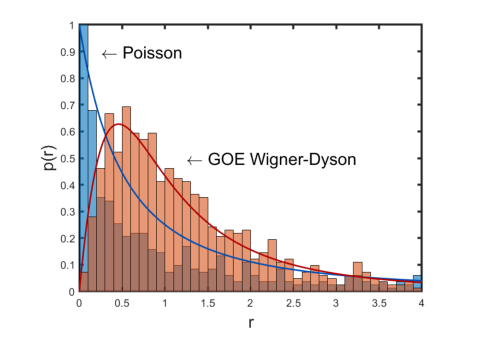 FIG. 1. Ratio of Consecutive level Spacings (RCS) for the Bell oper- ators associated with the PIBI (1) for n = 25, obtained with optimal (blue) and random (red) measurement settings. Spectra are shown for the irreducible representation (p, q) = (21, 2), chosen for illus- tration, which has 825 eigenvalues in the symmetric subspace. Solid curves are fits to the interpolating RCS function in Eq. (5), which spans Poisson statistics (λ = 0, indicating integrability) to Wigner- Dyson statistics (λ = 1, indicating chaos). In the Wigner-Dyson case, the Gaussian Orthogonal Ensemble (GOE) seems to provide a better fit than the Gaussian Unitary Ensemble (GUE), suggesting that time- reversal symmetry is preserved in the chaotic regime
Secondly, Figure 2 provides a comprehensive summary across various irreps for $n=25$. It plots the maximal quantum violation against $\eta = p/(p+q)$, a measure of permutation symmetry. Crucially, the blue points, representing irreps where maximal Bell violation is achieved, consistently exhibit Poisson RCS statistics ($\lambda=0$). This directly links maximal nonlocality to integrability. While some "orange points" show intermediate $\lambda$ values ($0 < \lambda < 1$), these are interpreted as finite-size effects, suggesting a crossover regime rather than true counterexamples, and are expected to converge to Poisson statistics in the asymptotic limit of large $n$.
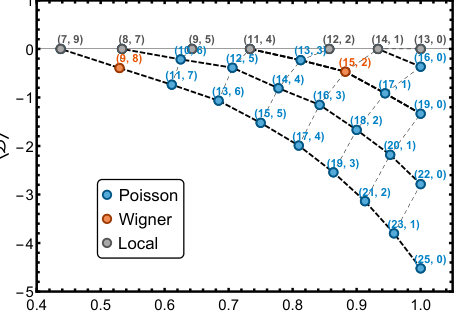 FIG. 2. Maximal quantum violation of the PIBI (1) for n = 25 parties, restricted to the (p, q) irrep subsector of SU(3). The classical bound is βc = 0, so ⟨B⟩< 0 certifies nonlocality. The parameter η = p/(p+q) quantifies the degree of permutation invariance of each irrep, with η = 1 being the fully symmetric case. Blue points cor- respond to irreps (p, q) whose Bell operator exhibits Poisson RCS statistics, signalled by λ = 0, indicative of integrability. Orange points correspond to irreps for which the fitted RCS parameter is non- zero (0 < λ < 1). The histograms of the orange cases are fitted with values λ = 0.11 for the irrep (15, 2) and λ = 0.456 for (9, 8), sug- gesting a crossover regime between the Poisson and GOE limits, an interpretation further supported by the significant bin weight in their RCS histograms at small spacing values (see Supplementary Figures 1, 2 and Supplementary Tables I and II [28] for explicit values of all λ’s obtained and some illustrative histograms). Irreps shown in gray do not detect nonlocality and are included only for completeness. Dashed lines connect irreps with same p + 2q and p −q. The largest violations occur in the fully symmetric sector, as expected from the permutationally invariant structure of the Bell operator [3, 31]
Thirdly, the robustness analysis further solidifies these claims. Figure 3, a histogram of $\lambda$ parameters for random projectors for $(p,q)=(25,0)$, shows a strong concentration of $\lambda$ values near 1, confirming that generic measurement settings indeed lead to Wigner-Dyson statistics. Interestingly, even with random settings, a high percentage (75.78% in this case) still detected nonlocality, but with chaotic spectral signatures, highlighting the unique nature of the integrable regime. Furthermore, Figure 4 illustrates that the "volume" of measurement settings around the optimal point that yield Poisson-like RCS distributions shrinks rapidly as $n$ increases. This demonstrates the fragile, fine-tuned nature of the integrable behavior, which emerges only within a vanishingly small neighborhood of optimal settings, rather than being a generic property.
Finally, the authors uncovered an emergent parity symmetry at the point of maximal quantum violation. Figure 5, depicting the optimal Bell operator for $n=15$ qutrits in the parity eigenbasis, reveals a clear block-diagonal structure. This block-diagonalization, resulting from the Bell operator commuting with parity operators, naturally explains the emergence of Poisson statistics within each block. The decoupling of blocks suppresses level repulsion across the full spectrum. The fact that the maximally violating eigenstate consistently resides in a specific symmetry sector (eeo for odd $n$, eee for even $n$) provides strong evidance that this is a genuine emergent symmetry, not a numerical artifact, reinforcing the special nature of these configurations.
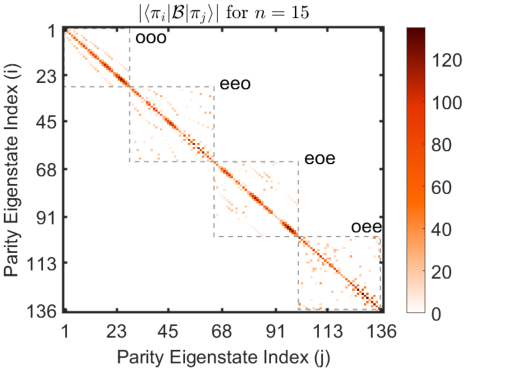 FIG. 5. Optimal Bell operator B for n = 15 qutrits in the parity eigen- basis, revealing a block-diagonal structure with four non-empty par- ity sectors (for odd n these are ooo, eeo, eoe, and oee). Gray boxes enclose the sectors as a visual guide. The color scale indicates ma- trix element magnitudes; zero entries are shown in white to highlight their sparsity
Limitations & Future Directions
While the findings present a profound connection between nonlocality, integrability, and quantum chaos, it's important to acknowledge the inherent limitations and consider avenues for future exploration.
One clear limitation is the computational constraint on the number of parties, $n$. The current analysis is limited to $n=32$ due to the exponential scaling of Bell scenarios. This means that some observations, particularly the "crossover" regimes (orange points in Figure 2), are interpreted as finite-size effects. While this interpretation is plausible, a definitive confirmation would require pushing to larger $n$, which is currently computationally prohibitive. Future work could explore more efficient numerical methods or analytical approximations for larger systems to confirm the asymptotic behavior.
Another aspect is the specificity of the Bell inequality studied. The paper focuses on a particular two-input, three-outcome permutationally invariant Bell inequality. It remains an open question whether these spectral signatures of integrability at maximal violation generalize to other types of Bell inequalities or more complex multipartite Bell scenarios. Future research could systematically investigate other three-outcome permutationally invariant Bell inequalities [27] and extend the analysis to different numbers of inputs or outcomes.
The assumption of identical measurement settings across all parties ($\theta_x^{(i)} = \theta_x$) simplifies the optimization problem significantly. However, the paper notes that a more general scenario, where each party could set different random measurements, would likely lead to an even more accentuated departure from Poisson RCS distributions. Exploring this more general case could provide deeper insights into the conditions under which integrability emerges or is destroyed.
Looking forward, these findings open up several exciting discussion topics and research directions:
- Deeper Analytical Relations and Symmetry: The intriguing patterns observed in Figure 2, where irreps with the same hypercharge align along well-defined curves, strongly suggest deeper analytical relations between maximal PIBI violations and the degree of permutation symmetry of SU(3) subsectors. Unraveling these mathematical connections could lead to a more fundamental understanding of quantum correlations and chaos.
- Self-Testing Quantum Many-Body Systems: The emergent parity symmetry and integrable behavior near maximal quantum violation could be a powerful tool for self-testing quantum many-body systems [46]. If these configurations allow for simplified characterizations of the underlying quantum state and measurement structure, it could pave the way for new experimental protocols for verifying quantum devices.
- Operator-Based Perspective on Quantum Chaos: The paper introduces a novel operator-based perspective to probe quantum chaos, where the spectral statistics of the Bell operator itself change with measurement configurations. This contrasts with traditional approaches that rely on state evolution under a fixed Hamiltonian. Further exploring this perspective could yield new insights into the nature of quantum chaos and its connection to fundamental quantum information features. How does this framework relate to other operator-based diagnostics of chaos, and can it be generalized to other types of operators in quantum information?
- Engineering Integrability and Chaos: Given that integrability is a fragile, fine-tuned feature, can we design quantum systems or measurement protocols to either preserve or induce integrable behavior for specific tasks? Conversely, can we leverage the transition to chaos for applications where robust, complex dynamics are desired? This could have implications for quantum control and quantum computing.
- Role of Higher-Spin Systems: The focus on spin-1 (qutrit) systems is particularly relevant as they naturally arise in ultracold atomic platforms and host intrinsic quantum chaotic dynamics. Further investigation into how these findings scale to even higher-spin systems (qudits with $d > 3$) could reveal universal principles or new phenomena specific to higher dimensions.