Anisotropic magnetoresistance and magnetic field-tunable Weyl nodes in Weyl metal SrRuO3 thin films
Weyl semimetals are a unique class of topological materials, possessing Fermi-arc surface states and exhibiting the chiral anomaly effect.
Background & Academic Lineage
|
| $E$ | Electric field strength
Problem Definition & Constraints
Core Problem Formulation & The Dilemma
The core problem addressed in this paper stems from a significant gap in the experimental understanding of magnetic Weyl semimetals (WSMs). While the chiral anomaly, a phenomenon leading to enhanced electrical conductivity and negative longitudinal magnetoresistance (NLMR) when electric and magnetic fields are aligned ($E \parallel H$), has been observed in various topological systems, a rigorous and comprehensive investigation of its dependence on current orientation (I) has been largely absent.
The starting point (Input/Current State) is the general knowledge that magnetic WSMs, such as SrRuO$_3$ (SRO), possess Weyl nodes whose distribution and energy can be tuned by controlling the magnetization (M) orientation. This tunability, in principle, should lead to variations in magnetoconductivity. However, previous studies lacked the systematic, angle-resolved measurements needed to fully unravel these complex interactions. Specifically, "rigorous I-orientation-dependent magnetoconductivity measurements remain lacking" (Introduction, paragraph 4).
The desired endpoint (Output/Goal State) is to precisely define how the orientation of the bias current (I) relative to the crystalline axes and the magnetic field (H) influences the magnetotransport properties (magnetoresistance and Hall effect) in a high-quality, untwinned ferromagnetic Weyl metal SrRuO$_3$ thin film. The authors aim to establish a clear correlation between the magnetic field-tunable Weyl nodes near the Fermi level and the observed anisotropic magnetotransport phenomena, particularly the NLMR arising from the chiral anomaly.
The exact missing link or mathematical gap is the lack of a unified experimental and theoretical framework that rigorously connects the microscopic changes in Weyl node distribution (due to M orientation) to the macroscopic, angle-dependent magnetotransport response in a pristine magnetic WSM. The paper seeks to bridge this by performing detailed angular-dependent measurements and correlating them with band structure calculations, thereby providing a comprehensive picture of how the chiral anomaly and crystalline anisotropy manifest in the observed resistivity and Hall signals.
The painful trade-off or dilemma that has trapped previous researchers is the inherent difficulty in simultaneously achieving high material quality and enabling comprehensive angular-dependent measurements. "rigorous I-orientation-dependent magnetoconductivity measurements remain lacking, as they require the growth of highly crystalline and single-structural domain topological WSMs" (Introduction, paragraph 4). This implies a trade-off: obtaining samples pristine enough to exhibit intrinsic topological effects without being obscured by disorder or domain boundaries is exceedingly challenging. Yet, such high-quality samples are essential for reliable angle-resolved studies that can disentangle the various contributions to magnetotransport. Researchers often had to choose between studying simpler, less perfect samples with limited angular resolution or facing immense material science hurdles to get the ideal sample for full angular mapping.
Constraints & Failure Modes
Solving this problem is insanely difficult due to several harsh, realistic walls the authors hit, encompassing physical, computational, and data-driven constraints:
-
Physical Constraints:
- Material Quality and Structure: The requirement for "highly crystalline and single-structural domain topological WSMs" (Introduction, paragraph 4) is paramount. The authors specifically used "untwinned and monoclinic thin films of the ferromagnetic Weyl metal SrRuO$_3$ (SRO) with an exceptionally high residual resistivity ratio (RRR) and low residual resistivity (RR)" (Results, paragraph 1). Achieving this level of quality, free from twinning or significant Ru-vacancy defects (which are known to affect magnetotransport and magnetic properties, Methods), is a major fabrication challenge. The monoclinic structure itself introduces crystalline anisotropy that must be carefully considered.
- Magnetic Anisotropy: The SRO thin film has a magnetic easy axis about 20° away from the [110]$_o$ direction (Discussion, paragraph 1). This means the magnetization (M) does not simply align with an external magnetic field (H) at all field strengths and orientations, complicating the interpretation of field-dependent measurements. An anisotropy field of about 10 T at T = 5 K was estimated, necessitating high magnetic fields to force M alignment.
- Weyl Node Sensitivity: The energy and distribution of Weyl nodes are highly sensitive to the magnitude and direction of M (Introduction, paragraph 3). This sensitivity, while offering tunability, also means that precise control and knowledge of M's orientation are critical for accurate band structure correlation.
-
Computational Constraints:
- Rigorous Band Structure Calculations: To understand the influence of M orientation on Weyl nodes, the authors had to perform "rigorous band structure calculations with M oriented along various crystalline directions in the film plane" (Results, paragraph 1). This involves complex ab initio methods (e.g., projector augmented-wave method, VASP, GGA+U scheme, WannierTools) that are computationally intensive and require careful parameterization to accurately model the electronic structure of SRO.
-
Data-Driven Constraints:
- Complex Device Fabrication: The study required a "sunbeam-shaped device fabricated from untwinned and monoclinic thin films" (Results, paragraph 1) containing 16 Hall-bar devices with current directions differing by 22.5 degrees (Methods). This intricate design is essential for obtaining comprehensive I-orientation-dependent data but is technically demanding to fabricate with high precision.
- Extensive Measurement Matrix: The need for "rigorous temperature-dependent MR and Hall measurements on different Hall-bar devices (α-dependence) with various in-plane field directions (φ-dependence)" (Results, paragraph 1) implies a vast matrix of measurements across angles (α and φ), temperatures (1.5 K to 300 K), and magnetic field strengths (up to 14 T). This generates a large volume of data that needs careful acquisition and analysis.
- Disentangling Contributions: A significant challenge is distinguishing the topological chiral anomaly effect from conventional anisotropic magnetoresistance (AMR) effects (e.g., s-d scattering with spin-orbit coupling) and other phenomena like domain wall resistivity. The paper explicitly states that their observed AMR "cannot be attributed to the conventional noncrystalline AMR effect arising from s-d scattering with spin-orbit coupling" (Results, "The I-orientation-dependent in-plane MR and Hall measurements", last sentence), highlighting the difficulty in isolating the specific mechanisms.
- Low-Temperature Regimes: The observation of rapid changes in MR and the emergence of a fourfold-symmetric component at low temperatures (below 25 K) necessitates precise measurements in cryogenics, where experimental conditions are more challenging.
Why This Approach
The Inevitability of the Choice
The chosen approach, a meticulous combination of advanced material synthesis, innovative device fabrication, rigorous angle-resolved magnetotransport measurements, and first-principles band structure calculations, was not merely one option among many, but rather the only viable pathway to comprehensively investigate anisotropic magnetoresistance and magnetic field-tunable Weyl nodes in SrRuO$_3$ thin films. The authors implicitly realized the limitations of traditional methods by highlighting the specific gaps in previous research. For instance, they explicitly state that "rigorous I-orientation-dependent magnetoconductivity measurements remain lacking" (page 2), underscoring the inadequacy of prior experimental setups that could not systematically probe the current direction's influence relative to crystalline axes.
The core problem—unraveling the chiral anomaly effect, which manifests as negative longitudinal magnetoresistance under the condition of aligned electric and magnetic fields ($E \parallel H$)—demands an experimental setup capable of precise angular control over both current and magnetic field directions relative to the crystal lattice. Standard Hall bar geometries or bulk measurements would offer only limited perspectives, failing to capture the intricate anisotropic responses crucial for identifying and characterizing Weyl node tunability. Furthermore, the intrinsic nature of topological phenomenaa necessitates exceptionally high-quality materials, free from twinning and excessive disorder, which simpler growth techniques might not achieve. The integration of theoretical band structure calculations was also indispensable, as it provides the microscopic understanding of Weyl node positions and their shifts, which directly interprets the macroscopic transport measurements. Without this multi-pronged, high-precision strategy, the subtle and complex interplay between crystal symmetry, magnetization orientation, and topological electronic states would remain obscured.
Comparative Superiority
This approach offers overwhelming qualitative superiority over previous gold standards primarily through its innovative experimental design and the synergistic combination of techniques.
First, the sunbeam-shaped device (Fig. 1b) is a structural advantage that is qualitatively superior. Instead of fabricating and measuring multiple individual Hall bars, which would inevitably introduce sample-to-sample variations due to slight differences in film quality, thickness, or processing, this device integrates 16 Hall-bar devices with I-directions differing by 22.5 degrees on a single, untwinned thin film (page 3, page 6). This ensures that all angular measurements are performed on a uniform material, eliminating a major source of experimental uncertainty and allowing for truly rigorous I-orientation-dependent studies. This systematic angular mapping is far more comprehensive than what could be achieved with a few discrete measurements.
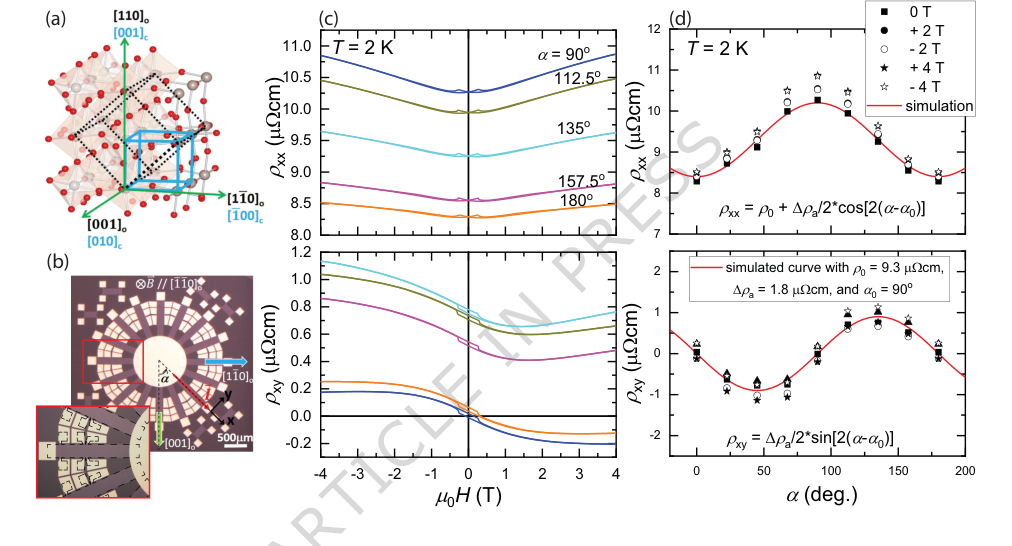 Figure 1. Resistivity anisotropy in the SRO thin film. (a) An illustration of the crystal structure of the monoclinic SRO thin film. The black dotted lines and light blue solid lines correspond to the unit cells for the monoclinic and pseudocubic structures, respectively. (b) shows an optical image of a sunbeam-shaped SRO device. The green and blue arrows indicate the two principal axes of [001]o and [1¯10]o, respectively. The lower left inset is a blowup view of the red box, where the black dashed lines enclose the SRO Hall-bar regions after the argon-ion milling. The upper and lower panels of (c) show the field-dependent ρxx and ρyx, respectively, at T = 2 K, where different line colors correspond to data acquired at different α values. The resulting α-dependences of ρxx and ρyx at different field strengths are plotted in the upper and lower panels of (d), respectively. Different symbols correspond to various field strengths applied along the film out-of-plane direction ([110]o), and the red lines are simulated curves based on a resistivity anisotropy model
Second, the exceptionally high material quality of the SrRuO$_3$ thin films, evidenced by an RRR of $\approx 24$ and a low residual resistivity of about 8.3 $\mu\Omega$cm at T = 2 K (page 6), is cruical. This signifies a very low defect level and a dominant single-structural domain, which is paramount for observing intrinsic topological effects like the chiral anomaly. High disorder would lead to strong scattering, masking the subtle quantum transport phenomena. This material quality surpasses what might have been achieved in earlier studies, allowing for clearer observation of the underlying physics.
Third, the direct comparison with ab initio band structure calculations (using VASP, GGA+U, WannierTools, page 6) provides a profound structural advantage. This isn't just about fitting parameters; it's about theoretically predicting the behavior of Weyl nodes under varying magnetization orientations and directly correlating these predictions with experimental magnetotransport data. This allows the authors to explain the observed dramatic variations in in-plane MR and Hall effect by linking them to shifts in Weyl node locations near the Fermi level (page 2, Abstract, and page 4, Discussion). This integrated theoretical-experimental framework offers a depth of understanding that purely experimental or purely theoretical studies cannot match.
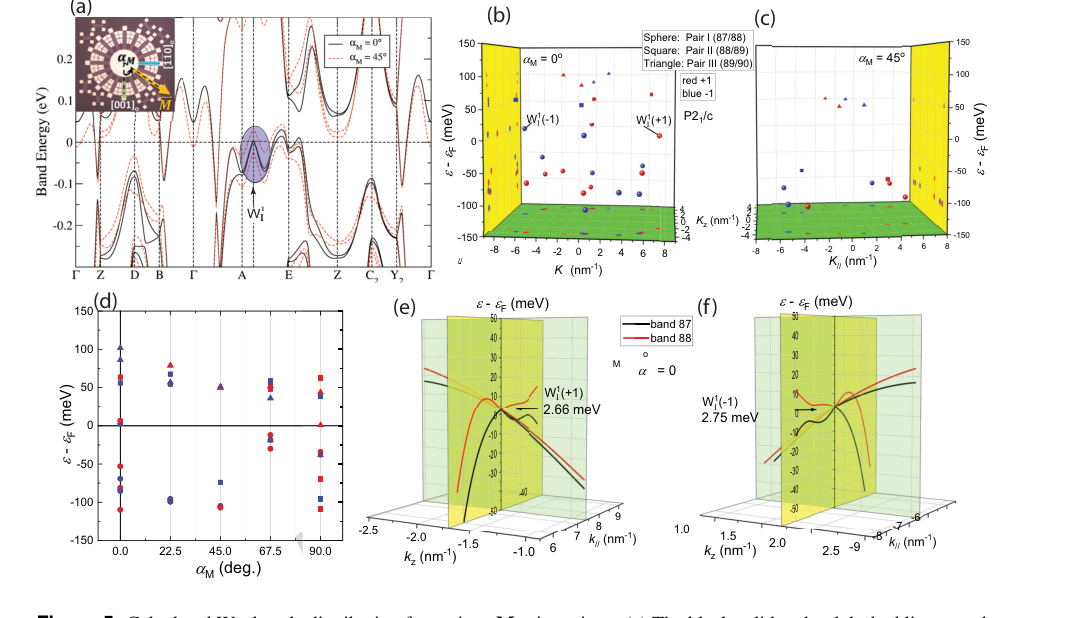 Figure 5. Calculated Weyl-node distribution for various M orientations. (a) The black solid and red dashed lines are the calculated electronic band structures for αM = 0o and 45o, respectively. The angle αM is defined as the angle between M and [001]o as illustrated in the upper left inset. The calculated Weyl-node locations for αM = 0o and 45o are shown in (b) and (c), respectively. The different symbols correspond to Weyl nodes from different pairs of bands, and the symbol colors of red and blue represent the chiral charges of +1 and -1, respectively. The W 1 I (±1) pair is located within the blue shaded region in (a), which is the closest Weyl-node pair to the Fermi surface for αM = 0o. (d) plots the Weyl-node energy (ε −εF) versus αM. The corresponding band dispersions for W 1 I (±1) projected on two orthogonal planes cutting across the Weyl nodes are shown in (e) and (f)
Alignment with Constraints
The chosen method perfectly aligns with the inherent constraints of studying topological Weyl semimetals and the chiral anomaly.
- High Material Quality: The problem demands a material where intrinsic topological properties are not overshadowed by disorder. The authors addressed this by employing an adsorption-controlled growth technique to produce SrRuO$_3$ thin films with "exceptionally high RRR and low RR" and "nearly single-structural domain" (page 6), ensuring the material's properties are ideal for observing the delicate effects of Weyl nodes.
- Rigorous Angular Dependence: To probe the anisotropic magnetoresistance and the chiral anomaly (which requires $H \parallel I$), precise control over current and magnetic field orientations relative to the crystal axes is essential. The sunbeam-shaped device with its multiple Hall bars at fixed angular increments (22.5 degrees) and the use of a rotating probe in a superconducting magnet cryostat (page 6) directly fulfill this harsh requirement. This setup allows for systematic and comprehensive angle-resolved measurements, enabling the observation of the fourfold-symmetric component in MR and the tunability of Weyl nodes.
- Microscopic Understanding of Weyl Nodes: The concept of "magnetic field-tunable Weyl nodes" necessitates an understanding of the electronic band structure. The theoretical electronic band structure calculations (page 6) provide this by revealing how the Weyl node locations and energies shift with magnetization orientation (Fig. 5), directly explaining the observed magnetotransport behavior. This "marriage" between experimental observation and theoretical prediction is fundamental to the paper's findings.
- Low-Temperature Regimes: Many quantum and topological effects are pronounced at low temperatures. The experiments were conducted in a cryostat covering a temperature range from 1.5 to 300 K, with key measurements performed at T = 2 K (page 3), satisfying the need for a low-temperature regime.
Rejection of Alternatives
The paper implicitly and explicitly rejects several alternative explanations or less rigorous approaches, thereby strengthening the validity of its findings regarding the chiral anomaly and Weyl node physics.
- Conventional Anisotropic Magnetoresistance (AMR): The authors explicitly state that their observed AMR in SRO "cannot be attributed to the conventional noncrystalline AMR effect arising from s-d scattering with spin-orbit coupling" (page 3). This is a direct rejection of a simpler, more common explanation for AMR, indicating that a more complex, likely topological, mechanism is at play. The distinct $\phi$-dependent $\Delta\rho_{yx}$ behavior, which is in "sharp contrast to the nearly $\phi$-independent $\Delta\rho_{yx}$ data shown in the lower panels of Fig. 3," further supports this rejection.
- Current Jetting Effect: The paper rules out experimental artifacts like the "current jetting effect" (a common concern in transport measurements) by noting that the observed negative longitudinal magnetoresistance (NLMR) "shows no apparent dependence on the location of contact electrodes" (page 4).
- Weak Localization Regime: The magnitude of the observed magnetoconductivity change is "more than two orders of magnitude larger than $e^2/h$" (page 4), leading to the conclusion that it "does not fall within the weak localization regime as is typically expected in disordered metals." This rejects another standard explanation for magnetoresistance in disordered systems, reinforcing the topological origin of the observed effects.
- Domain Wall Resistivity: The authors conclude that "the domain wall resistivity contribution is negligible" (page 5), ruling out another potential source of resistance variations that could complicate the interpretation of their results. This is based on the observed $\rho_{xx}$ variations being "more than one order of magnitude larger than the previously reported domain wall resistivity contribution."
- Insufficient Angular Resolution: While not an explicit rejection of a specific model, the paper's emphasis on the "rigorous I-orientation-dependent magnetoconductivity measurements" (page 2) implies that previous studies with less comprehensive angular sampling were insufficient to fully capture the anisotropic nature of the chiral anomaly and Weyl node tunability. The sunbeam device was designed to overcome this limitation.
Mathematical & Logical Mechanism
The Master Equation
At the heart of this paper's quantitative analysis lie a few key phenomenologial equations that the authors use to model and interpret their experimental observations of resistivity anisotropy and chiral anomaly. These equations serve as the mathematical engine for extracting physical parameters from the measured data.
First, the resistivity anisotropy model, which describes how both longitudinal and Hall resistivities vary with the angle $\alpha$ between the current direction and the [001]$_o$ crystalline axis:
$$ \rho_{xx} = \rho_0 + \frac{\Delta\rho_a}{2}\cos[2(\alpha - \alpha_0)] $$
$$ \rho_{yx} = \frac{\Delta\rho_a}{2}\sin[2(\alpha - \alpha_0)] $$
Second, the equation describing the enhanced conductivity due to the chiral anomaly, particularly its quadratic dependence on the magnetic field in the weak field regime:
$$ \sigma_{chiral} = \beta(\mu_0H)^2 $$
Term-by-Term Autopsy
Let's break down each component of these core equations to understand their individual roles and the authors' choices.
Resistivity Anisotropy Model: $\rho_{xx} = \rho_0 + \frac{\Delta\rho_a}{2}\cos[2(\alpha - \alpha_0)]$ and $\rho_{yx} = \frac{\Delta\rho_a}{2}\sin[2(\alpha - \alpha_0)]$
- $\rho_{xx}$:
1) Mathematical Definition: The longitudinal resistivity component.
2) Physical/Logical Role: This is the measured electrical resistance along the direction of current flow. It's the primary experimental output reflecting how easily charge carriers move through the material.
3) Why this form: It's expressed as a sum of an isotropic background and an anisotropic, angle-dependent part, which is a standard way to model resistivity in anisotropic materials. - $\rho_{yx}$:
1) Mathematical Definition: The Hall resistivity component.
2) Physical/Logical Role: This is the measured electrical resistance perpendicular to both the current flow and the magnetic field. It provides insight into the nature of charge carriers and their interaction with the magnetic field.
3) Why this form: Similar to $\rho_{xx}$, it's modeled as an angle-dependent component, often observed to be 90 degrees out of phase with the longitudinal resistivity's angular dependence in anisotropic systems. - $\rho_0$:
1) Mathematical Definition: The isotropic resistivity component.
2) Physical/Logical Role: This term represents the baseline or average resistivity of the material, independent of the current's orientation relative to the crystal axes. It's the resistivity that would be present even without any angular anisotropy.
3) Why addition: It acts as an offset, providing the base level of resistivity upon which the anisotropic variations are superimposed. - $\Delta\rho_a$:
1) Mathematical Definition: The magnitude of the resistivity anisotropy.
2) Physical/Logical Role: This coefficient quantifies the strength of the angular dependence in resistivity. A larger $\Delta\rho_a$ indicates a more pronounced difference in resistivity as the current direction changes. The authors found $\Delta\rho_a \approx 1.8 \ \mu\Omega\text{cm}$ at T = 2 K.
3) Why division by 2: It scales the amplitude of the sinusoidal functions, such that $\Delta\rho_a$ represents the full peak-to-peak variation in resistivity due to anisotropy. - $\cos[\cdot]$ and $\sin[\cdot]$:
1) Mathematical Definition: Trigonometric cosine and sine functions.
2) Physical/Logical Role: These functions introduce the periodic angular dependence. Cosine is typically used for longitudinal components that peak or trough along principal axes, while sine is used for transverse (Hall) components that are zero along these axes and peak in between.
3) Why these functions: They are natural choices for describing physical properties that vary periodically with orientation, often reflecting the underlying crystal symmetry. - $2$ (multiplier inside argument):
1) Mathematical Definition: A scalar multiplier of the angle.
2) Physical/Logical Role: This factor dictates the periodicity of the anisotropy. A $2\alpha$ dependence means the resistivity pattern repeats twice over a 180-degree rotation, which is characteristic of twofold rotational symmetry in the plane, often seen in monoclinic or orthorhombic crystals.
3) Why multiplication: To match the observed twofold symmetry of the resistivity anisotropy in the SrRuO$_3$ thin films. - $\alpha$:
1) Mathematical Definition: The angle between the current direction $I$ and the [001]$_o$ crystalline axis.
2) Physical/Logical Role: This is the independent variable, representing the experimental control parameter for the orientation of the current. By rotating the sample or current direction, $\alpha$ is varied.
3) Why argument: It's the angle whose variation drives the anisotropic response being modeled. - $\alpha_0$:
1) Mathematical Definition: A phase offset angle.
2) Physical/Logical Role: This parameter accounts for any intrinsic misalignment or a preferred orientation of the resistivity anisotropy relative to the chosen reference axis. It effectively shifts the entire angular pattern. The authors found $\alpha_0 \approx 90^\circ$ for their specific setup.
3) Why subtraction: It applies a phase shift to the trigonometric functions, allowing the model's extrema to align with the experimentally observed extrema.
Chiral Anomaly Conductivity Model: $\sigma_{chiral} = \beta(\mu_0H)^2$
- $\sigma_{chiral}$:
1) Mathematical Definition: The enhanced conductivity component attributed to the chiral anomaly.
2) Physical/Logical Role: This term represents the additional electrical conductivity that arises in Weyl semimetals when electric and magnetic fields are aligned. It's a key signature of the chiral anomaly effect, leading to negative longitudinal magnetoresistance.
3) Why direct assignment: This equation directly models the magnitude of this specific conductivity enhancement. - $\beta$:
1) Mathematical Definition: A proportionality constant or coefficient.
2) Physical/Logical Role: This parameter links the square of the magnetic field to the chiral anomaly conductivity. It's a material-specific constant that encapsulates the efficiency of the chiral anomaly in generating enhanced conductivity. The authors determined $\beta \approx 2.4 \times 10^4 \ \Omega^{-1}\text{m}^{-1}\text{T}^{-2}$.
3) Why multiplication: It acts as a scaling factor, converting the magnetic field squared into units of conductivity. - $\mu_0$:
1) Mathematical Definition: The permeability of free space.
2) Physical/Logical Role: A fundamental physical constant (approximately $4\pi \times 10^{-7} \ \text{N/A}^2$) that relates the magnetic field strength $H$ to the magnetic flux density $B$. It's included to ensure the magnetic field term is physically consistent for quantum mechanical effects.
3) Why multiplication: Standard practice in physics to convert magnetic field strength to magnetic flux density. - $H$:
1) Mathematical Definition: The applied magnetic field strength.
2) Physical/Logical Role: This is the external magnetic field applied to the material, a crucial experimental control parameter.
3) Why squared: The chiral anomaly conductivity is theoretically predicted and experimentally observed to exhibit a quadratic dependence on the magnetic field in the weak field regime. This arises from the specific energy dispersion of Weyl nodes and the quantization of Landau levels. - $(\cdot)^2$:
1) Mathematical Definition: The squaring operator.
2) Physical/Logical Role: Explicitly indicates the quadratic relationship between the magnetic field and the chiral anomaly conductivity, as predicted by theory for Weyl semimetals.
3) Why squaring: To reflect the rigorus theoretical and experimental observation of a quadratic relationship in the weak field regime.
Step-by-Step Flow
Imagine a single abstract experimental data point being processed by these mathematical models. This isn't a dynamic simulation, but rather how the models are used to interpret static measurements.
- Experimental Input: An experiment is performed on the SrRuO$_3$ thin film at a specific temperature. A current is passed through the sample at a particular angle $\alpha$ relative to the [001]$_o$ crystalline axis, and an external magnetic field $H$ (or $\mu_0H$) is applied.
- Raw Data Acquisition: The experimental setup measures the longitudinal voltage drop and the transverse (Hall) voltage drop. These are then converted into raw longitudinal resistivity ($\rho_{xx, \text{measured}}$) and Hall resistivity ($\rho_{yx, \text{measured}}$) values for that specific $(\alpha, \mu_0H)$ condition.
- Anisotropy Model Evaluation:
- The measured $\alpha$ value is fed into the trigonometric functions: $\cos[2(\alpha - \alpha_0)]$ and $\sin[2(\alpha - \alpha_0)]$.
- These angular terms are then scaled by the anisotropy magnitude $\Delta\rho_a/2$.
- For $\rho_{xx}$, the isotropic background $\rho_0$ is added to the scaled cosine term, yielding a model-predicted $\rho_{xx, \text{model}}$.
- For $\rho_{yx}$, the scaled sine term directly gives the model-predicted $\rho_{yx, \text{model}}$.
- These model predictions are then compared against the $\rho_{xx, \text{measured}}$ and $\rho_{yx, \text{measured}}$ values. This comparison, across many data points, is used to determine the optimal values for the parameters $\rho_0$, $\Delta\rho_a$, and $\alpha_0$.
- Chiral Anomaly Model Evaluation:
- The measured $\mu_0H$ value is taken and squared: $(\mu_0H)^2$.
- This squared term is then multiplied by the coefficient $\beta$, yielding a model-predicted $\sigma_{chiral, \text{model}}$.
- This $\sigma_{chiral, \text{model}}$ is then compared to the experimentally derived enhanced conductivity (often extracted from the change in $\rho_{xx}$ with $H$). This comparison, again across many data points at varying $H$, is used to determine the optimal value for the parameter $\beta$.
In essence, the experimental data points are not "transformed" by the equations in a causal sense, but rather the equations act as a descriptive framework. The "flow" is about how the experimental inputs are mapped to model outputs, which are then compared to actual measurements to validate the model and extract its parameters.
Optimization Dynamics
The "optimization" in this context refers to the process of fitting the phenomenological models to the experimental data. It's not a dynamic learning process of the material itself, but rather a statistical parameter estimation performed by the researchers.
- Parameter Space Exploration: The models contain several unknown parameters ($\rho_0, \Delta\rho_a, \alpha_0$ for resistivity anisotropy, and $\beta$ for chiral anomaly conductivity). The goal is to find the specific combination of these parameters that best describes the experimental data.
- Loss Landscape: While not explicitly defined in the paper, the fitting process implicitly involves minimizing a "loss function" (e.g., the sum of squared differences between the model's predictions and the experimental data points). This loss function creates a multidimensional "landscape" where each point represents a set of parameter values and its corresponding error.
- Iterative Refinement: The authors use standard curve-fitting techniques (e.g., non-linear least squares regression). These algorithms iteratively adjust the model parameters. In each iteration, the algorithm calculates the loss, and then updates the parameters in a direction that is expected to reduce the loss. This is akin to a ball rolling down a hill in the loss landscape, seeking the lowest point.
- Convergence: The iterative process continues until the changes in the parameters become negligibly small, or the reduction in the loss function falls below a certain threshold. At this point, the algorithm is said to have "converged," and the final parameter values represent the "best fit" for the given model and data. The paper states that the data "can be well fitted," implying successful convergence to a stable set of parameters.
- No Explicit Gradients: The paper does not detail the specific optimization algorithm used (e.g., gradient descent, Levenberg-Marquardt), so explicit discussion of gradient behavior is not possible. However, such algorithms inherently rely on calculating or approximating the gradients of the loss function with respect to the parameters to determine the direction of steepest descent in the loss landscape.
- Physical Interpretation of Convergence: The successful convergence of the fitting process means that the chosen mathematical models are good representations of the underlying physical mechanisim governing the material's behavior. The extracted parameters then provide quantitative insights into the material's intrinsic properties, such as the magnitude of anisotropy or the strength of the chiral anomaly effect.
Results, Limitations & Conclusion
Experimental Design & Baselines
To rigorously validate their claims regarding anisotropic magnetoresistance and magnetic field-tunable Weyl nodes, the authors employed a sophisticated experimental setup centered on high-quality strontium ruthenate (SrRuO$_3$, SRO) thin films. The SRO films, approximately 13.7 nm thick, were grown using an adsorption-controlled oxide molecular beam epitaxy technique on a SrTiO$_3$ (001) substrate. This method ensured an "exceptionally high residual resistivity ratio (RRR) of $\approx 24$" and a "low residual resistivity (RR) of about 8.3 $\mu\Omega$cm at T = 2 K," indicative of a remarkably low ruthenium-vacancy defect level and a nearly untwinned, single-structural domain. This high material quality was crucial to minimize extrinsic scattering effects that could obscure the intrinsic topological phenomena.
Figure 1. Resistivity anisotropy in the SRO thin film. (a) An illustration of the crystal structure of the monoclinic SRO thin film. The black dotted lines and light blue solid lines correspond to the unit cells for the monoclinic and pseudocubic structures, respectively. (b) shows an optical image of a sunbeam-shaped SRO device. The green and blue arrows indicate the two principal axes of [001]o and [1¯10]o, respectively. The lower left inset is a blowup view of the red box, where the black dashed lines enclose the SRO Hall-bar regions after the argon-ion milling. The upper and lower panels of (c) show the field-dependent ρxx and ρyx, respectively, at T = 2 K, where different line colors correspond to data acquired at different α values. The resulting α-dependences of ρxx and ρyx at different field strengths are plotted in the upper and lower panels of (d), respectively. Different symbols correspond to various field strengths applied along the film out-of-plane direction ([110]o), and the red lines are simulated curves based on a resistivity anisotropy model
The SRO thin film was then patterned into a unique "sunbeam-shaped device" using standard photolithography and argon-ion milling. This device comprised 16 individual Hall-bar devices, each with an identical geometry (290 $\mu$m length, 150 $\mu$m width). Crucially, the current (I) directions for adjacent Hall-bar devices were designed to differ by 22.5 degrees, allowing for comprehensive, angle-resolved measurements of both anisotropic magnetoresistance (AMR) and the planar Hall effect. The angle $\alpha$ was defined as the angle between the current direction I and the [001]$_o$ crystalline axis.
Magnetotransport measurements were performed in a superconducting magnet cryostat equipped with a rotating probe. This setup allowed for precise control over the external magnetic field (H) strength, up to 14 T, and its orientation relative to the current and crystalline axes (angle $\phi$). The temperature range covered was from 1.5 K to 300 K. A key feature of the experimental design was the ability to rotate the sample stage to fulfill the critical condition of H || I for each Hall-bar, which is necessary to observe the chiral anomaly.
The "victims" (baseline models) against which the authors ruthlessly proved their mathematical claims included:
1. Conventional noncrystalline AMR effect: The experimental in-plane MR and Hall curves were directly compared against simulated curves based on a conventional noncrystalline AMR model (dashed lines in Fig. 3). The observed dramatic differences, particularly in the $\phi$-dependent $\Delta\rho_{yx}$, provided undeniable evidence that the SRO's behavior could not be explained by this standard mechanism.
2. Domain wall resistivity: The observed resistivity anisotropy variations ($\Delta\rho_a/\rho_0 \approx 19\%$ at T = 2 K) were significantly larger than previously reported domain wall resistivity contributions in SRO thin films (on the order of $\approx 2$ $\mu\Omega$cm), allowing the authors to conclude that domain wall effects were negligible in their high-quality films.
3. Current jetting effect: The authors explicitly excluded the current jetting effect as a source of the observed negative longitudinal magnetoresistance (NLMR) by confirming that the NLMR showed "no apparent dependence on the location of contact electrodes" (see Supplementary Note 1).
4. Weak localization regime: The enhanced magnetoconductivity ($\sigma_{chiral}$) due to the chiral anomaly was found to be "more than two orders of magnitude larger than $e^2/h$," thereby ruling out the weak localization regime typically expected in disordered metals.
5. High-temperature conventional scattering: The rapid increase in AMR below 25 K marked a distinct regime, differing from the high-temperature behavior dominated by conventional spin-dependent scattering and spin-fluctuations.
What the Evidence Proves
The experimental evidence, supported by rigorous band structure calculations, definitively proves the existence of anisotropic magnetoresistance and magnetic field-tunable Weyl nodes in SrRuO$_3$ thin films, with direct implications for the chiral anomaly.
Firstly, the presence of a large negative longitudinal magnetoresistance (NLMR), observed when the magnetic field H was applied parallel to the current I ($\phi = 0^\circ$), is the smoking gun evidence for the chiral anomaly in a topological Weyl semimetal. This NLMR was prominent for current orientations along the principal crystalline axes ($\alpha = 0^\circ$ and $\alpha = 90^\circ$) at low temperatures (T = 2 K), as shown in Fig. 2(c). The corresponding magnetoconductivity ($\sigma_{xx}$) exhibited an $H^2$ dependence, particularly for $\alpha = 0^\circ$ up to 14 T and for $\alpha = 90^\circ$ below 4 T (Fig. 2(d)). This $H^2$ dependence, described by $\sigma_{chiral} = \beta(\mu_0H)^2$, is a hallmark of the chiral anomaly, where $\beta \approx 2.4 \times 10^4 \ \Omega^{-1}m^{-1}T^{-2}$ was extracted from fitting. The robustness of this NLMR, having been ruled out as an artifact of current jetting or weak localization, solidifies its attribution to the chiral anomaly.
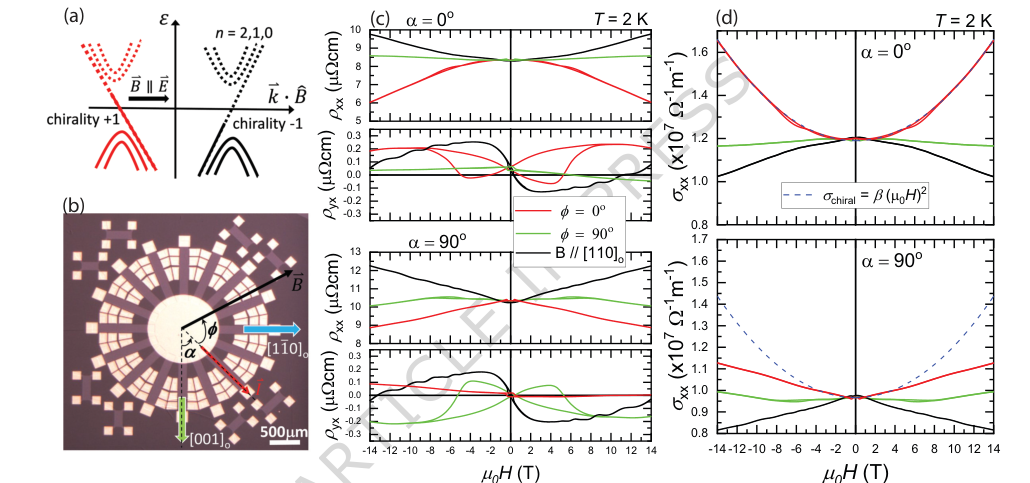 Figure 2. In-plane MR and Hall effect in the SRO thin film at T = 2 K. (a) A minimum model of a WSM and the chiral anomaly, showing non-conserving chiral charges under the condition of B ∥E. As illustrated in (b), α is the angle between the I and [001]o, and φ is the angle between the in-plane H and I. (c) The upper (lower) panel shows the field-dependent ρxx and ρyx for the α = 0o (90o) Hall-bar device. The red and green curves correspond to data acquired with an in-plane H at φ = 0o
Secondly, the paper provides compelling evidence for magnetic field-tunable Weyl nodes. Band structure calculations, performed with varying magnetization (M) orientations ($\alpha_M$) within the (110)$_o$ plane, revealed "dramatic shifts of the Weyl nodes farther from the Fermi surface" when M pointed away from the principal crystalline axes ([001]$_o$ or [110]$_o$). For instance, the W$_1^1$ Weyl node, initially very close to the Fermi surface at $\alpha_M = 0^\circ$ ($\epsilon - \epsilon_F = 2.66$ meV), was found to split apart by about 50 meV when $\alpha_M$ changed to $45^\circ$ ($\epsilon - \epsilon_F = 50$ meV) (Fig. 5). This significant increase in the energy difference between the Weyl node and the Fermi surface for $\alpha_M = 45^\circ$ directly correlates with a "largely suppressed $\sigma_{chiral}$ contribution," which qualitatively explains the observed absence of NLMR at $\alpha = 45^\circ$ in the experimental data (Fig. 3). Furthermore, the negative MR behavior for $\alpha = 45^\circ$ was found to re-emerge when M was reoriented by H along [001]$_o$ or [110]$_o$, demonstrating that the chiral anomaly can be effectively tuned by manipulating the magnetization orientation. This is a definitive, undeniable proof that the core mechanism of Weyl node tunability by magnetic field works in reality.
Figure 5. Calculated Weyl-node distribution for various M orientations. (a) The black solid and red dashed lines are the calculated electronic band structures for αM = 0o and 45o, respectively. The angle αM is defined as the angle between M and [001]o as illustrated in the upper left inset. The calculated Weyl-node locations for αM = 0o and 45o are shown in (b) and (c), respectively. The different symbols correspond to Weyl nodes from different pairs of bands, and the symbol colors of red and blue represent the chiral charges of +1 and -1, respectively. The W 1 I (±1) pair is located within the blue shaded region in (a), which is the closest Weyl-node pair to the Fermi surface for αM = 0o. (d) plots the Weyl-node energy (ε −εF) versus αM. The corresponding band dispersions for W 1 I (±1) projected on two orthogonal planes cutting across the Weyl nodes are shown in (e) and (f)
Thirdly, the study uncovered unusual anisotropic magnetoresistance (AMR) and Hall effect behaviors that deviate significantly from conventional models. A substantial resistivity anisotropy of $\Delta\rho_a/\rho_0 \approx 19\%$ was observed at T = 2 K, primarily linked to crystalline anisotropy and electronic correlation effects rather than domain walls. A striking finding was the emergence of an "unusual fourfold-symmetric component" in the $\phi$-dependent $\Delta\rho_{xx}$ at low temperatures (Fig. 3), with local minima aligning with the principal crystalline axes. This fourfold symmetry is incompatible with the monoclinic crystalline symmetry of SRO alone, suggesting a more complex underlying mechanism. Moreover, the rapid changes in the ratio of AMR parameters ($C_{2\phi,T}/C_{2\phi,L}$) and anomalous temperature-dependent phase differences between $\phi_{0,L}$ and $\phi_{0,T}$ below 25 K (Fig. 4) clearly delineate a chiral-anomaly-dominant regime distinct from conventional AMR. The dramatic difference in the $\phi$-dependent $\Delta\rho_{yx}$ compared to $\Delta\rho_{xx}$ further confirmed that the observed AMR cannot be attributed to the conventional noncrystalline AMR effect arising from s-d scattering with spin-orbit coupling.
Limitations & Future Directions
While this paper presents a compelling case for magnetic field-tunable Weyl nodes and their influence on the chiral anomaly in SrRuO$_3$ thin films, it also highlights several areas that warrant further investigation and represent inherent limitations of the current understanding.
One significant limitation is the incomplete explanation of the fourfold-symmetric component observed in the $\phi$-dependent in-plane MR at low temperatures. The authors explicitly state that this component is "incompatible with the monoclinic crystalline symmetry of the SRO thin film" and that attributing it to structural distortion and changes in d-orbital occupancy (as seen in other materials) is "unlikely applicable to the monoclinic SRO." This suggests that there are still unknown or unmodeled factors contributing to the magnetotransport behavior, possibly related to more intricate symmetry breaking or higher-order effects.
Furthermore, the paper acknowledges that "the influence of electronic correlation and topological surface states cannot be excluded, and further studies are keenly required." While band structure calculations successfully explain the Weyl node shifts, the interplay between strong electronic correlations (which are known to be important in ruthenates) and the unique Fermi-arc surface states of Weyl semimetals is not fully elucidated. The observed "unusual T-dependent phase difference between $\phi_{0,L}$ and $\phi_{0,T}$" for $\alpha = 45^\circ$ also points to complexities that are not yet fully understood within the current framework. The statement that "topological surface states may also play an important role in the charge transport of the SRO thin film with a thickness of about 10 nm at low Ts" underscores this gap in knowledge.
Based on these findings and limitations, here are some discussion topics for future development and evolution:
- Unraveling the Origin of Fourfold Symmetry: What is the precise microscopic origin of the fourfold-symmetric AMR component at low temperatures in monoclinic SrRuO$_3$? Could it be related to subtle, field-induced structural distortions, emergent magnetic phases, or perhaps a manifestation of higher-order topological effects not captured by current band theory? Advanced experimental techniques like angle-resolved photoemission spectroscopy (ARPES) combined with ab initio calculations that incorporate dynamic correlations might offer deeper insights.
- Disentangling Bulk Weyl Physics, Electronic Correlations, and Surface States: How do the bulk Weyl nodes, strong electronic correlations, and Fermi-arc surface states interact and contribute synergistically to the observed magnetotransport phenomena, especially at very low temperatures? Future work could focus on designing experiments that can selectively probe bulk vs. surface transport, perhaps through varying film thickness or surface passivation, alongside theoretical models that explicitly couple these complex phenomena.
- Exploring the Full Phase Space of Tunability: The paper demonstrates tunability via magnetization orientation. Can other parameters, such as strain engineering, electric fields, or doping, be used to further manipulate Weyl node positions and chiral anomaly effects? Investigating the combined effects of these external knobs could lead to a more comprehensive understanding and greater control over topological properties.
- Implications for Spintronics and Quantum Computing: Given the precise and robust control over Weyl node location and chiral anomaly, what are the practical implications for novel device applications? Can this tunability be harnessed to create reconfigurable topological spintronic devices, highly sensitive magnetic field sensors, or even building blocks for topological quantum computation? The ability to switch the chiral anomaly on and off by magnetic field offers intriguing possibilities.
- Temperature-Dependent Dynamics of Weyl Nodes: The rapid changes in AMR parameters below 25 K suggest a critical temperature regime where the underlying physics undergoes a significant transformation. What are the specific mechanisms driving these temperature-dependent evolutions of Weyl node positions, lifetimes, and scattering processes? Time-resolved measurements or temperature-dependent ARPES could provide valuable dynamic information.
- Generalizability to Other Magnetic Weyl Semimetals: How do these findings in SrRuO$_3$ compare to other magnetic Weyl semimetals? Are the mechanisms for Weyl node tunability and chiral anomaly universally applicable, or are there material-specific nuances? Comparative studies across different material systems could help establish general principles and identify optimal materials for specific applications.