
Balloon regime: Drop elasticity leads to complete rebound
New research shows tuning liquid & surface properties prevents splashing at high speeds.
Background & Academic Lineage
The Origin & Academic Lineage
The study of drop impact dynamics has captivated scientists and engineers for over a century, driven by its fundamental importance in natural phenomena and its wide-ranging applications in fields like surface printing, energy harvesting, and heat transfer. Historically, much of the early research focused on understanding how simple Newtonian liquids, like water, behave when they hit various surfaces. This foundational knowledge has been crucial for many industrial processes, but it also highlighted persistent challenges, such as unwanted splashing and potential surface damage during impact.
A particularly significant area of interest has been drop impact on superhydrophobic surfaces, which are designed to repel water effectively, offering benefits for self-cleaning, anti-icing, and drag reduction. While the behavior of Newtonian drops on these surfaces is relatively well understood, a critical gap in knowledge emerged concerning non-Newtonian viscoelastic drops, especially when impacting at high speeds. These complex liquids, often containing polymers, exhibit unique properties that make their impact dynamics far more intricate. The precise origin of the problem addressed in this paper stems from this lack of understanding: how do viscoelastic drops behave on superhydrophobic surfaces at high impact velocities, and how can we control their interaction to achieve desired outcomes?
The fundamental limitation or "pain point" of previous approaches was the inability to achieve simultaneous complete droplet rebound and effective suppression of breakup and splashing when non-Newtonian viscoelastic drops impacted surfaces at very high speeds. For Newtonian fluids, complete rebound is often possible, but for viscoelastic liquids, the added complexity of polymer interactions with surface microstructures often led to partial rebound, pinning, or significant splashing. This made it challenging to design surfaces that could effectively repel complex liquids under high impact forces without leaving behind satellite drops or causing surface damage. The authors were compelled to write this paper because polymer additives, which impart viscoelasticity, were observed to restore complete droplet rebound on superhydrophobic surfaces at high impact speeds—a phenomenonon previously not observed for non-Newtonian drops, thus opening a new avenue for control.
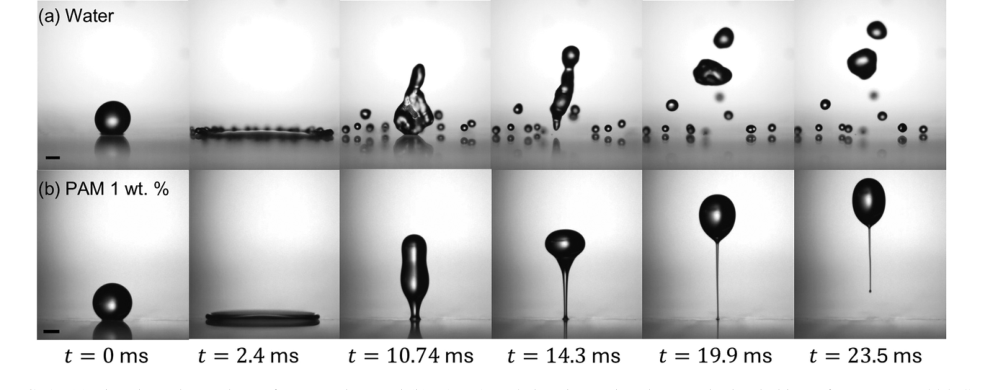 FIG. 1. (a) Time-lapsed snapshots of a water drop and (b) PAM 1 wt% drop impacting the superhydrophobic surface at We = 204. Scale bars represent 1 mm
Intuitive Domain Terms
To help a zero-base reader grasp the core concepts, here are some specialized terms from the paper, translated into everyday analogies:
- Superhydrophobic surface: Imagine a tiny, spiky bed of nails that water droplets can't really settle into. Instead, they just perch on the tips of the spikes, barely touching the surface, making them easy to roll off.
- Viscoelastic liquid: Think of a mixture that's both gooey like honey (viscous) and stretchy like rubber (elastic). When you pull it slowly, it stretches; when you hit it fast, it might bounce or resist deformation.
- Balloon regime: Picture a water balloon hitting the ground, but instead of bursting or just bouncing, a little "tail" shoots up, then puffs out like a small balloon, and finally, the whole thing lifts off cleanly without leaving a mess. This is the novel rebound mechanism discovered.
- Weber number ($We$): This is like a "splatter-o-meter" for a drop. A high Weber number means the drop is hitting so fast and hard that its own momentum (inertia) overwhelms the forces trying to hold it together (surface tension), making it likely to splash. A low Weber number means it's more likely to stay intact.
Notation Table
| Notation | Description | Type | Unit (if applicable) |
|---|---|---|---|
| $D_0$ | Initial drop diameter | Variable | mm |
| $v_0$ | Impact speed of the drop | Variable | m/s |
| $C_w$ | Polymer concentration (by mass) | Parameter | wt% |
| $We$ | Weber number (dimensionless) | Parameter | - |
| $De$ | Deborah number (dimensionless) | Parameter | - |
| $\rho$ | Fluid density | Parameter | kg/m$^3$ |
| $\sigma$ | Surface tension coefficient | Parameter | N/m |
| $L_{max}$ | Maximum ligament length | Variable | mm |
| $Y(t)$ | Height of the droplet centroid over time | Variable | mm |
Problem Definition & Constraints
Core Problem Formulation & The Dilemma
The central problem addressed by this paper is the long-standing challenge of achieving complete, splash-free rebound of liquid droplets from superhydrophobic surfaces, particularly at high impact speeds.
The Input/Current State is typically a droplet impacting a superhydrophobic surface. For Newtonian fluids, at high impact speeds (quantified by a high Weber number, We > 136), this often results in significant splashing and the formation of numerous satellite drops, indicating incomplete rebound and energy dissipation (as shown in Fig. 1a). For non-Newtonian, viscoelastic fluids, the behavior at high impact speeds has been poorly understood, and previous research often found that increasing polymer concentrations (which enhances elasticity) could actually suppress bouncing behavior, rather than improve it.
FIG. 1. (a) Time-lapsed snapshots of a water drop and (b) PAM 1 wt% drop impacting the superhydrophobic surface at We = 204. Scale bars represent 1 mm
The Output/Goal State is a complete and clean rebound of the droplet from the superhydrophobic surface, even at very high impact speeds, without any splashing or residual satellite drops. This implies a mechanism that effectively dissipates impact energy while maintaining droplet integrity and promoting full detachment.
The Missing Link or Mathematical Gap lies in understanding the precise interplay between the viscoelastic properties of the fluid (specifically, the role of polymer-induced elasticity), the micro-textured topography of the superhydrophobic surface, and the dynamic forces at play during high-speed impact. Previous models and understanding were insufficient to predict or engineer conditions for this desired outcome, especially for non-Newtonian fluids. The paper aims to bridge this gap by identifying a novel "balloon regime" where elasticity facilitates complete rebound under conditions previously thought to lead to breakup or pinning.
The Painfull Trade-off or Dilemma that has trapped previous researchers is the inherent conflict between high impact energy and droplet integrity. High impact speeds provide significant kinetic energy, which typically leads to droplet deformation, spreading, and subsequent breakup or splashing upon retraction, especially on surfaces designed for repellency. While superhydrophobic surfaces are designed to minimize adhesion and promote rebound, the sheer inertia at high We often overwhelms these effects, leading to fragmentation. For viscoelastic fluids, the dilemma was even more pronounced: how to leverage the beneficial properties of polymers (like elasticity, which can resist breakup) without simultaneously suppressing the overall rebound, a phenomenon observed in earlier studies. Achieving simultaneous complete rebound and suppression of breakup/splashing at very high impact speeds has proven elusive, representing the core of this dilemma.
Constraints & Failure Modes
The problem is insanely difficult to solve due to several harsh, realistic walls the authors hit:
- Physical Constraints:
- High Impact Speeds (High Weber Number): The primary challenge is the high kinetic energy associated with high impact velocities (We > 136, up to 408 in the experiements). This energy drives significant deformation and can easily lead to splashing and fragmentation, making complete rebound difficult.
- Surface Microstructure & Impalement: The superhydrophobic surface must possess specific microstructures that allow for initial liquid impalement and a Cassie-to-Wenzel transition. This impalement creates a "pinning/sticking point" which is crucial for the formation of the tail-like ligament. If the surface is too smooth (e.g., a smooth Teflon surface), impalement is improbable, and ligament formation is completely suppressed (Fig. 2a).
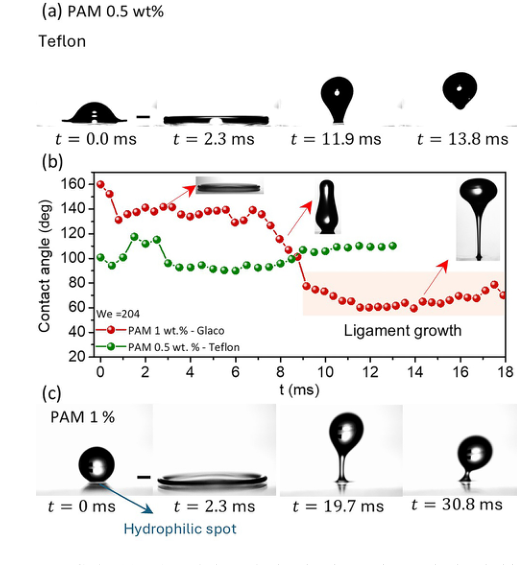 FIG. 2. (a) PAM 0.5 wt% droplet impacting a hydrophobic Teflon surface at We = 204. (b) Dynamic contact angle over time for the case shown in panel (a) (green dots, rebound without liga- ments) and in Fig. 1(b) (red dots, rebound with ligaments). (c) PAM 1 wt% droplet impacting on the superhydrophobic surface with a hydrophilic spot at We = 204. Scale bar represents 1 mm
*   **Viscoelastic Fluid Rheology:** The liquid's viscoelastic properties, imparted by polymer additives (e.g., polyacrylamide, PAM), are critical. The polymer concentration must be sufficient (e.g., Cw > 0.025%) to introduce enough elasticity to suppress splashing and enable ligament formation. However, the complex non-Newtonian behavior, including shear thinning, adds layers of complexity compared to simple Newtonian fluids.
*   **Balance of Forces for Detachment:** For complete rebound, the axial elastic forces ($F_e$) developed within the ligament must balance or overcome the adhesion forces ($F_a$) at the contact line ($F_e \gtrsim F_a$). If adhesion is too strong (e.g., due to a hydrophilic spot on the surface, Fig. 2c), the ligament remains pinned, and detachment is inhibited. This delicate balance is hard to achieve and maintain dynamically.
* **Gravity and Inertia:** While elastic forces are crucial for ligament integrity and detachment, the overall trajectory and growth of the ligament are still primarily governed by the rebound velocity and gravitational forces, which act as fundamental constraints on the system.
-
Computational Constraints:
- Complex Fluid-Structure Interaction: Simulating the dynamic interaction of a viscoelastic fluid with a micro-structured surface, including phase changes (air-liquid interface), impalement, and ligament formation/detachment, is computationally intensive. The paper mentions numerical simulations (e.g., Fig. S14) but does not detail specific computational limits encountered. However, robust simulations of viscoelastic flows at high Weissenberg numbers are generally known to be challenging (as implied by references like [48]).
-
Data-Driven Constraints:
- Measurement Resolution: Experimental observations rely on high-speed imaging. The resolution of these measurements (e.g., minimum ligament thickness $R_{min}$ and wetted radius $R_w$ being within 20 µm resolution) can limit the precision of quantifying micro-scale phenomena and forces.
- Force Estimation Accuracy: Estimating dynamic forces like axial elastic stress and adhesion force during impact involves models and assumptions (e.g., Young-Dupré equation for adhesion). The accuracy of these estimations is dependent on the validity of the models and the precision of input parameters, which can be difficult to obtain for transient, micro-scale events occuring at high speeds.
Why This Approach
The Inevitability of the Choice
The approach taken in this study, which combines meticulous experimental observation, theoretical modeling, and numerical simulations to characterize the "balloon regime," was not merely a choice but an inevitable necessity. The authors explicitly identify a significant gap in the existing scientific literature: "the behavior of non-Newtonian viscoelastic drops, especially at high impact speeds, remains poorly explored." Furthermore, they highlight that "achieving simultaneous droplet rebound and suppression of breakup and splashing at very high impact speeds has proven elusive [17,20-22]."
This statement marks the exact moment the authors realized that traditional "SOTA" methods—in this context, the established understanding and models for Newtonian fluid dynamics or even viscoelastic drops at lower impact speeds—were insufficient. Previous studies either observed splashing for water drops at high Weber numbers (e.g., Fig. 1(a)) or noted that increasing polymer concentrations suppressed bouncing altogether.
FIG. 1. (a) Time-lapsed snapshots of a water drop and (b) PAM 1 wt% drop impacting the superhydrophobic surface at We = 204. Scale bars represent 1 mm
The "balloon regime" itself is a newly observed phenomenon for non-Newtonian drops, characterized by complete rebound without splashing at high impact speeds, a feat previously unobserved. Therefore, a novel, multi-modal investigation was required to unravel the underlying physics of this unique behavior, rather than simply applying or refining existing models that demonstrably failed to predict or explain it. The problem demanded a fresh perspective and a comprehensive characterization of a previously unknown regime.
Comparative Superiority
The qualitative superiority of this approach lies in its ability to provide a fundamental understanding and a pathway for controlling a complex fluid dynamic phenomenon that was previously considered unattainable. Beyond simple performance metrics, this method offers a structural advantage by identifying the critical interplay of physical forces and material properties that enable complete rebound without splashing at high impact speeds.
The previous "gold standard" for high-speed drop impact often resulted in undesirable outcomes: Newtonian water drops would splash significantly (as shown in Fig. 1(a) for We > 136), leaving behind numerous satellite droplets.
FIG. 1. (a) Time-lapsed snapshots of a water drop and (b) PAM 1 wt% drop impacting the superhydrophobic surface at We = 204. Scale bars represent 1 mm
For viscoelastic drops, earlier studies often reported suppressed bouncing with increasing polymer concentrations. This study, however, demonstrates that by carefully tuning droplet rheology (polymer additives) and surface roughness, complete rebound without splashing is achievable even at very high impact speeds (up to We = 408).
The structural advantage is the elucidation of the "marriage" between liquid impalement into surface microstructures, contact line pinning, and the crucial role of elastic forces within the ligament. These elastic forces are shown to be essential for sustaining the ligament from breakup and enabling its complete detachment from the surface, overcoming adhesion. This detailed, mechanistic understanding allows for the design of conditions to retain liquid-repellent properties under harsh impact, a qualitative leap over previous understandings that either predicted splashing or suppressed rebound. The method doesn't reduce memory complexity in a computational sense, but rather simplifies the design space by identifying the key physical levers for control.
Alignment with Constraints
The chosen approach perfectly aligns with the inherent constraints of the problem, demonstrating a profound "marriage" between the harsh requirements and the solution's unique properties. The primary constraints, as inferred from the problem definition, include:
- High Impact Speeds: The problem specifically targets scenarios where drops impact surfaces at very high velocities. The balloon regime, as characterized, explicitly addresses this by demonstrating complete rebound for viscoelastic drops at Weber numbers up to 408, where Newtonian drops would typically splash.
- Non-Newtonian Viscoelastic Fluids: The study focuses entirely on these complex fluids, recognizing their unique rheological properties. The solution leverages the elasticity imparted by polymers as the key mechanism to prevent ligament breakup and facilitate detachment, a property absent in Newtonian fluids.
- Complete Droplet Rebound: This is a core requirement for applications like self-cleaning and anti-icing. The balloon regime is defined by the complete detachment of the ligament and subsequent rebound of the entire drop.
- Suppression of Breakup and Splashing: Undesired effects that the solution successfully mitigates. The elastic forces within the ligament are shown to be crucial in preventing its breakup and the formation of satellite drops, leading to a clean rebound.
- Interaction with Surface Microstructures: The paper highlights the critical role of liquid impalement into surface microstructures and subsequent contact line pinning as initial conditions for ligament formation. The solution thus integrates the surface properties directly into the mechanism of rebound.
The unique properties of the solution—the ability of elastic stresses ($F_e$) to balance or overcome adhesion forces ($F_a$) at the contact line, and the control offered by tuning droplet rheology and surface roughness—directly address and overcome these constraints. This approach provides a comprehensive framework for achieving the desired outcome under conditions previously deemed challenging or impossible.
Rejection of Alternatives
The paper provides clear reasoning for why alternative fluid types, which represent "popular approaches" in the broader context of drop impact studies, would have failed to achieve the desired outcome of complete rebound without splashing at high impact speeds.
- Newtonian Fluids (e.g., Water): The most straightforward alternative is to use simple water drops. However, the paper explicitly shows that for Weber numbers greater than 136, water drops exhibit significant splashing behavior, leaving numerous satellite drops behind [Fig. 1(a)].
FIG. 1. (a) Time-lapsed snapshots of a water drop and (b) PAM 1 wt% drop impacting the superhydrophobic surface at We = 204. Scale bars represent 1 mm
This directly contradicts the goal of complete rebound without breakup. The lack of elastic forces in water means it cannot form a stable ligament that resists breakup and detaches cleanly under high impact conditions.
- Purely Viscous Non-Newtonian Fluids (e.g., Water-Glycerol): To isolate the role of elasticity, the authors conducted experiments with water-glycerol droplets, which are viscous but lack elasticity. They found that these drops "consistently exhibited contact line pinning and droplet elongation, but only partial rebound with a satellite droplet remaining on the surface (see Sec. IX of the Supplemental Material [23])." This crucial finding demonstrates that viscosity alone is insufficient to achieve complete rebound. While viscosity can influence spreading and damping, it does not provide the tensile strength or elastic recovery needed for the ligament to fully detach and retract without leaving behind residual droplets. The elastic forces, as quantified by the comparison of $F_e$ and $F_a$ in Section VII, are the decisive factor for complete detachment, making purely viscous alternatives inadequate.
These comparisons effectively reject the use of simpler fluid models or compositions as viable alternatives for achieving the specific "balloon regime" behavior, underscoring the necessity of viscoelasticity and the detailed understanding of its role.
Mathematical & Logical Mechanism
The Master Equation
The core logical mechanism driving the complete rebound in the "balloon regime" is the balance, or rather the imbalance, between the upward-pulling elastic forces within the ligament and the downward-sticking adhesion forces at the contact line. The paper posits that for detachment and full rebound to occur, the elastic force must overcome the adhesion force. This critical condition is expressed as:
$$F_e \ge F_a$$
where $F_e$ is the axial elastic force within the ligament, and $F_a$ is the adhesion force at the contact line. These forces are mathematically defined as:
$$F_e = \tau_{p,zz} \pi R_{min}^2$$
and
$$F_a = 2\pi R_w \sigma (1 + \cos(\theta_r))$$
Term-by-Term Autopsy
Let's dissect each component of these equations to understand its mathematical definition, physical role, and the rationale behind its inclusion.
For the Elastic Force, $F_e = \tau_{p,zz} \pi R_{min}^2$:
-
$F_e$:
- Mathematical Definition: The total axial elastic force exerted by the viscoelastic liquid within the ligament.
- Physical/Logical Role: This term represents the "pull" that the stretched polymer solution exerts, attempting to retract the ligament from the surface. It's the active force that must overcome adhesion for a succesful rebound.
- Why multiplication: Elastic stress ($\tau_{p,zz}$) is a force per unit area. To obtain the total force, it is multiplied by the cross-sectional area ($\pi R_{min}^2$) over which this stress acts.
-
$\tau_{p,zz}$:
- Mathematical Definition: The axial component of the elastic stress tensor within the polymer solution ligament. It quantifies the internal tensile forces per unit area generated by the deformation of polymer chains.
- Physical/Logical Role: This term is the direct measure of the liquid's elasticity. When the ligament is stretched, polymers align and resist further extension, creating this internal stress. Higher polymer concentration and greater extensional deformation lead to higher $\tau_{p,zz}$, making the ligament more "springy" and capable of pulling itself away.
- Why it's a stress: It's a fundamental rheological property describing the material's internal resistance to deformation, specifically stretching along the ligament's axis.
-
$\pi$:
- Mathematical Definition: The mathematical constant, approximately 3.14159.
- Physical/Logical Role: It's a geometric constant used in calculating the area of a circle. Its presence here assumes a circular cross-section for the ligament.
- Why it's a constant: It's an inherent property of circular geometry.
-
$R_{min}$:
- Mathematical Definition: The minimum radius of the ligament.
- Physical/Logical Role: This term defines the narrowest cross-sectional area of the ligament. The elastic force is considered to act most critically at this point. A larger $R_{min}$ means a larger area for the elastic stress to act upon, thus increasing the total elastic force.
- Why squared: It's part of the standard formula for the area of a circle, $A = \pi r^2$.
For the Adhesion Force, $F_a = 2\pi R_w \sigma (1 + \cos(\theta_r))$:
-
$F_a$:
- Mathematical Definition: The total adhesion force acting at the contact line between the liquid ligament and the solid surface.
- Physical/Logical Role: This term represents the "sticking" force that resists the ligament's detachment. It's the barrier that the elastic force ($F_e$) must overcome. It's derived from the Young-Dupré equation, which links surface tension, contact angle, and the work of adhesion.
- Why multiplication: It's a product of the contact line length ($2\pi R_w$), the surface tension ($\sigma$), and a factor related to the surface's wettability ($1 + \cos(\theta_r)$).
-
$2\pi$:
- Mathematical Definition: The circumference factor for a circle.
- Physical/Logical Role: It's a geometric constant used in calculating the circumference of a circle. Its presence here assumes a circular contact line.
- Why it's a constant: It's an inherent property of circular geometry.
-
$R_w$:
- Mathematical Definition: The wetted radius, which is the radius of the contact line where the liquid meets the surface.
- Physical/Logical Role: This term determines the length of the contact line ($2\pi R_w$) over which the adhesion force acts. A larger $R_w$ implies a longer contact line and, consequently, a greater total adhesion force.
- Why it's a radius: It's a measure of the extent of the liquid's contact with the surface.
-
$\sigma$:
- Mathematical Definition: The surface tension coefficient of the liquid.
- Physical/Logical Role: This term quantifies the cohesive forces within the liquid and the interfacial energy between the liquid and the surrounding air. Higher surface tension generally leads to stronger adhesive interactions with the surface, making detachment more difficult.
- Why it's a coefficient: It's a material property representing the energy required to increase the surface area of a liquid, or the force per unit length along an interface.
-
$(1 + \cos(\theta_r))$:
- Mathematical Definition: A dimensionless term derived from the Young-Dupré equation, where $\theta_r$ is the receding contact angle.
- Physical/Logical Role: This term quantifies the wettability of the surface. For superhydrophobic surfaces, $\theta_r$ is typically large (approaching 180 degrees), making $\cos(\theta_r)$ close to -1. This results in the term approaching 0, indicating very low adhesion and easy detachment. Conversely, smaller $\theta_r$ (more wetting) increases this term, leading to higher adhesion.
- Why addition/cosine: This specific form arises from the thermodynamic definition of the work of adhesion, which relates surface tension and the contact angle. The cosine function naturally captures the angular dependence of the interfacial forces.
Step-by-Step Flow
Let's trace the journey of an abstract "point of contact" at the base of the ligament as the droplet attempts to rebound:
- Initial Impact and Spreading: A viscoelastic droplet hits a superhydrophobic surface at high speed. The liquid spreads radially outward, and due to surface microstructures, some liquid impalement occurs, creating a temporary pinning point.
- Recession and Ligament Formation: As the droplet begins to recoil, the contact line recedes. However, the initial pinning and the viscoelastic properties of the fluid cause a slender "ligament" to form, stretching vertically from the surface.
- Elastic Energy Accumulation: As the main droplet continues to move upward, the ligament elongates and thins. The polymer chains within the viscoelastic fluid are stretched and aligned, storing elastic potential energy. This stored energy manifests as an axial elastic stress, $\tau_{p,zz}$, particularly concentrated at the minimum radius, $R_{min}$, of the ligament.
- Elastic Force Exertion: The accumulated elastic stress $\tau_{p,zz}$ acts over the ligament's minimum cross-sectional area, $\pi R_{min}^2$, generating an upward-pulling elastic force, $F_e$. This force is the primary driver for detachment.
- Adhesion Force Resistance: Simultaneously, at the base of the ligament, a contact line with wetted radius $R_w$ exists. The liquid's surface tension $\sigma$ and the receding contact angle $\theta_r$ dictate the adhesive interaction with the surface. These parameters combine to generate a downward-sticking adhesion force, $F_a$, which resists the upward pull.
- Dynamic Force Balance: Throughout the receding phase, the system continuously evaluates the balance between $F_e$ and $F_a$.
- Initially, $F_a$ might be greater than $F_e$, keeping the ligament pinned.
- As the ligament thins (reducing $R_{min}$ but potentially increasing $\tau_{p,zz}$ due to higher strain rates) and the contact line recedes (reducing $R_w$ and potentially altering $\theta_r$), both $F_e$ and $F_a$ evolve.
- Critical Detachment: The moment of complete rebound occurs when $F_e$ becomes equal to or greater than $F_a$. At this point, the elastic forces are strong enough to overcome the adhesive forces, enabeling the ligament to break free from the surface.
- Post-Detachment Retraction: Once detached, the elastic forces continue to drive the rapid retraction of the ligament back into the main droplet, leading to a clean, complete rebound without any satellite drops. The "balloon-like" shape is a transient, stable configuration that facilitates this process.
Optimization Dynamics
The "optimization dynamics" in this context refers to the physical mechanisms by which the system achieves the desired outcome of complete droplet rebound in the balloon regime. It's not an iterative algorithm, but rather a dynamic interplay of forces that drives the system towards a stable, detached state.
- Energy Landscape and Force Gradients: The system can be conceptualized as navigating an energy landscape. The initial impact injects kinetic energy. As the ligament forms and stretches, elastic potential energy is stored. Adhesion acts as an energy barrier. The "optimization" is the physical process of the system finding a pathway to release this stored elastic energy by overcoming the adhesion barrier. The "gradients" are the rates of change of forces and energies that push the system towards or away from detachment.
- Elastic Stress Development: The viscoelastic nature of the fluid, particularly the polymer concentration, is a key "control parameter." Higher polymer concentrations lead to greater axial elastic stresses ($\tau_{p,zz}$) when the ligament is stretched. This effectively "steepens" the "gradient" of the elastic force, making it more potent in overcoming adhesion. The system "learns" to store more elastic energy with more polymers.
- Adhesion Minimization: The superhydrophobic surface design is another critical "control parameter." By minimizing liquid impalement and maintaining a large receding contact angle ($\theta_r$), the adhesion force ($F_a$) is kept low. This effectively "flattens" the adhesion barrier, making it easier for the elastic force to overcome. The surface "updates" its interaction by presenting a less adhesive interface.
- Dynamic Balance and Convergence: The system iteratively adjusts its geometry (ligament thinning, contact line recession) in response to the evolving forces. The ligament thins, potentially increasing $\tau_{p,zz}$ due to higher strain rates, while the wetted radius $R_w$ decreases. This dynamic evolution continues until the critical condition $F_e \ge F_a$ is met. This moment represents the "convergence" to the detached state, where the system finds a stable configuration for complete rebound.
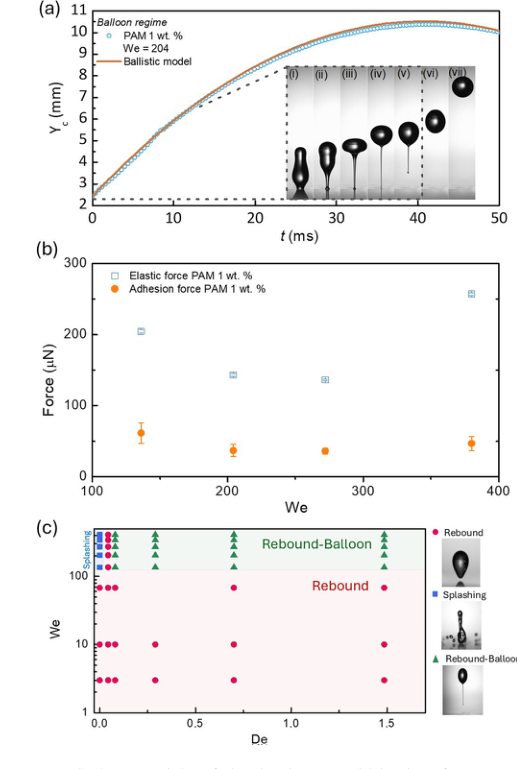 FIG. 4. (a) Height of the droplet centroid in time for PAM 1 wt%. Insets (i)–(vii) represent the time lapses of the ligament growth: t = 3, 7, 9, 13, 14, 19, and 43 ms, respectively. (b) Elastic and adhesion forces for PAM 1 wt% at different Weber numbers. (c) Phase diagram depicting the different droplet behavior based on the impact velocity (We) and elastic stress relaxation timescale of the liquid (De)
- Role of Ligament Stability: The elastic forces not only drive detachment but also stabilize the ligament, preventing its premature breakup. This stability is crucial for allowing enough elastic energy to accumulate and for the forces to balance correctly, leading to a clean, single detachment event rather than splashing or satellite drops. This ensures the "optimized" outcome of a full rebound. The "balloon-like" shape is a manifestation of this stable, elastic-driven process.
Results, Limitations & Conclusion
Experimental Design & Baselines
To rigorously validate their claims, the researchers meticulously designed a series of experiements comparing the impact dynamics of different liquid types on various surfaces, all captured with high-speed cameras. The primary subjects were viscoelastic aqueous drops, specifically polyacrylamide (PAM) solutions, with an initial diameter $D_0 = 2.5$ mm and impact speeds $v_0$ ranging from 0.23 to 3.4 m/s. These drops were characterized by varying PAM concentrations ($C_w$ from 0.025 to 1 wt%) and exhibited shear-thinning behavior.
The main "battleground" was a superhydrophobic surface, prepared by spray-coating glass slides with silanized silica nanoparticles (Glaco Soft99), resulting in a high static contact angle of approximately $167^\circ \pm 2^\circ$. This surface was chosen for its ability to repel liquids.
The "victims" or baseline models against which the viscoelastic drops were compared included:
1. Pure water drops: These served as the primary Newtonian fluid baseline. Water drops, when impacting the superhydrophobic surface, exhibited complete rebound at lower Weber numbers ($We < 136$) but transitioned to splashing with numerous satellite drops at higher Weber numbers ($We > 136$) [Fig. 1(a)].
FIG. 1. (a) Time-lapsed snapshots of a water drop and (b) PAM 1 wt% drop impacting the superhydrophobic surface at We = 204. Scale bars represent 1 mm
This contrasted sharply with the viscoelastic drops.
2. Viscous-only water-glycerol droplets: To isolate the effect of elasticity from mere viscosity, droplets containing 50% glycerol were tested. These drops were viscous but not elastic. When impacting Glaco-coated surfaces, they showed contact line pinning and elongation but only partial rebound, leaving satellite droplets behind. This was a cruical experiment to demonstrate that elasticity, not just viscosity, was the key factor for complete rebound.
3. Viscoelastic drops on a smooth hydrophobic Teflon surface: To prove that surface microstructures and liquid impalement were necessary for ligament formation, PAM drops were impacted on a smooth Teflon AF film (roughness $R_q \sim 5$ nm). This surface lacked the microstructures required for impalement.
4. Viscoelastic drops on a superhydrophobic surface with a hydrophilic spot: To investigate the role of contact line pinning, a localized hydrophilic spot (0.8 mm diameter) was intentionally created on the superhydrophobic surface. This allowed researchers to observe the impact dynamics when pinning was forced at a specific location.
The impact events were recorded from both side and bottom views using two high-speed cameras operating at up to 4900 frames per second, allowing for detailed temporal analysis of droplet deformation, ligament formation, and detachment.
What the Evidence Proves
The evidence gathered from these meticulously designed experiements definitively proved several core mathematical and physical claims:
- Complete Rebound without Splashing at High Impact Speeds: The most striking evidence was that viscoelastic drops (with $C_w > 0.025\%$) achieved complete rebound across the entire range of Weber numbers tested ($2 < We < 408$), even at speeds where water drops exhibited significant splashing [Fig. 1(b) vs. 1(a)].
FIG. 1. (a) Time-lapsed snapshots of a water drop and (b) PAM 1 wt% drop impacting the superhydrophobic surface at We = 204. Scale bars represent 1 mm
This directly contradicted previous findings where increasing polymer concentrations suppressed bouncing. The formation of a "balloon-like" ligament, a previously unreported phenomenon, was observed for PAM at 0.5 and 1 wt% just before complete detachment.
- Necessity of Liquid Impalement and Cassie-Wenzel Transition: The experiment on the smooth hydrophobic Teflon surface provided undeniable proof that liquid impalement into surface microstructures is a prerequisite for ligament formation. On this smooth surface, where impalement was improbable, ligament formation was completely suppressed for viscoelastic drops [Fig. 2(a)].
FIG. 2. (a) PAM 0.5 wt% droplet impacting a hydrophobic Teflon surface at We = 204. (b) Dynamic contact angle over time for the case shown in panel (a) (green dots, rebound without liga- ments) and in Fig. 1(b) (red dots, rebound with ligaments). (c) PAM 1 wt% droplet impacting on the superhydrophobic surface with a hydrophilic spot at We = 204. Scale bar represents 1 mm
This demonstrated that the transition from a Cassie-Baxter (non-wetting) to a Wenzel (wetting) state, driven by liquid penetration into surface microstructures, is a necessary condition.
- Crucial Role of Contact Line Pinning: The experiment with the hydrophilic spot on the superhydrophobic surface clearly showed that contact line pinning is another key condition for ligament generation. While a ligament did form, it remained pinned to the spot and did not detach [Fig. 2(c)].
FIG. 2. (a) PAM 0.5 wt% droplet impacting a hydrophobic Teflon surface at We = 204. (b) Dynamic contact angle over time for the case shown in panel (a) (green dots, rebound without liga- ments) and in Fig. 1(b) (red dots, rebound with ligaments). (c) PAM 1 wt% droplet impacting on the superhydrophobic surface with a hydrophilic spot at We = 204. Scale bar represents 1 mm
This confirmed that a localized pinning point, initiated by impalement, is essential for the subsequent elongation and eventual detachment of the ligament.
- Dominance of Elastic Forces in Ligament Detachment: The comparison between elastic and adhesion forces provided hard evidence for the mechanism of detachment.
- In cases of full ligament detachment (e.g., PAM 1 wt% at $We = 272$), the estimated elastic force ($F_e \in O(100) \mu N$) was significantly higher than the adhesion force ($F_a \in O(10) \mu N$) [Fig. 4(b)].
FIG. 4. (a) Height of the droplet centroid in time for PAM 1 wt%. Insets (i)–(vii) represent the time lapses of the ligament growth: t = 3, 7, 9, 13, 14, 19, and 43 ms, respectively. (b) Elastic and adhesion forces for PAM 1 wt% at different Weber numbers. (c) Phase diagram depicting the different droplet behavior based on the impact velocity (We) and elastic stress relaxation timescale of the liquid (De)
This substantial difference indicated that elastic stresses actively overcome adhesion.
* Conversely, for the hydrophilic spot case where detachment was inhibited, the adhesion force ($F_a \in O(100) \mu N$) was much greater than the elastic force ($F_e \in O(10) \mu N$), proving the elastic stress was insufficient for detachment.
* The water-glycerol droplet experiments further solidified this. Since these viscous-only drops failed to achieve complete rebound and left satellite droplets, it unequivocally demonstrated that elastic forces, not just high viscosity, are the definitive mechanism enabling the complete detachment of the ligament and thus the entire droplet. The observed increase in ligament retraction velocity with higher polymer concentration, consistent with the theoretical model $\sqrt{(\sigma/\rho R_{min}) + (t_{p,zz}/\rho)}$, further supported the role of elastic stress.
- Ligament Growth Dynamics: The maximum ligament length ($L_{max}$) scaled by the drop diameter ($L_{max}/D_0$) was shown to be directly proportional to fluid inertia (i.e., $L_{max} \propto We$) and increased with polymer concentration [Fig. 3(a), 3(b)]. The droplet centroid's vertical motion was well-described by a ballistic model, indicating that ligament growth is primarily governed by rebound velocity and gravitational forces, while elastic stresses are crucial for sustaining the ligament against breakup.
In essence, the researchers architected their experiments to isolate and quantify the contributions of surface properties, fluid rheology, and impact conditions, providing undeniable evidence that the interplay of liquid impalement, contact line pinning, and critically, the elastic forces within the polymer solution, enables the "balloon regime" and complete, splash-free rebound at high impact speeds.
Limitations & Future Directions
While this study brilliantly elucidates the "balloon regime" and the underlying mechanisms of viscoelastic drop rebound, it also presents inherent limitations and opens several exciting avenues for future research.
One acknowledged limitation lies in the estimation of forces. The authors note that their method for estimating elastic force ($F_e$) and adhesion force ($F_a$) might lead to an overestimation of $F_e$ and underestimation of $F_a$ at the anchored base, suggesting that immediate detachment might occur when $F_e \sim F_a$ rather than $F_e \gg F_a$. This implies that the local force balance at the contact line, especially considering the non-uniformity of elastic forces along the ligament and the additional adhesion from the impaled area, is more complex than the simplified model. Future work could focus on developing more refined, spatially resolved measurement techniques or advanced numerical simulations to precisely quantify these forces and their distribution at the microscale, particularly at the ligament's base.
Another limitation is the ballistic model's accuracy in fully capturing the main drop motion, as it was observed to overestimate $L_{max}$ in some cases. This suggests that while gravity and inertia are dominant, other subtle dissipative forces or rheological effects might play a more significant role than currently accounted for, especially during the later stages of ligament growth and detachment. Future studies could explore more sophisticated fluid-structure interaction models that incorporate viscoelastic effects more comprehensively throughout the entire droplet and ligament dynamics.
Looking forward, the findings offer a robust foundation for designing and optimizing textured surfaces and complex fluids for specific applications.
* Tailored Surface Design: How can we precisely engineer surface microstructures (e.g., pillar spacing, height, geometry) to control the degree of liquid impalement and contact line pinning? Can we create surfaces with tunable impalement properties that respond dynamically to different impact velocities or fluid rheologies? This could lead to "smart" surfaces that adapt their repellency.
* Rheological Engineering of Fluids: The study highlights the power of tuning droplet rheology. What is the optimal balance of elasticity, viscosity, and surface tension for different industrial applications? Can we develop new polymer additives or fluid formulations that exhibit even more robust rebound properties, perhaps with lower concentrations or under more extreme conditions (e.g., very high temperatures, corrosive liquids)? This could involve exploring shear-thickening fluids or fluids with different relaxation timescales.
* Applications in Industrial Processes: The paper mentions applications like printing of non-Newtonian fluids, agricultural spraying, and other industrial processes. For instance, in 3D printing or additive manufacturing, precise control over droplet impact and rebound is paramount to avoid defects and ensure material deposition accuracy. How can the "balloon regime" be leveraged to prevent nozzle clogging or improve print resolution when using viscoelastic inks? In agricultural spraying, minimizing satellite droplets and ensuring complete rebound from plant surfaces could reduce chemical waste and environmental impact. Can we design agricultural sprays that utilize this regime to maximize target adhesion while minimizing off-target contamination?
* Fundamental Understanding of Complex Fluids: The interplay between elasticity, inertia, surface tension, and adhesion in this regime provides a rich platform for fundamental research. How do different polymer architectures (e.g., branched vs. linear, varying molecular weights) influence the extensional rheology and subsequent impact dynamics? Can we develop a universal phase diagram that maps droplet behavior across a wider range of fluid properties and surface textures, moving beyond just Weber and Deborah numbers?
FIG. 4. (a) Height of the droplet centroid in time for PAM 1 wt%. Insets (i)–(vii) represent the time lapses of the ligament growth: t = 3, 7, 9, 13, 14, 19, and 43 ms, respectively. (b) Elastic and adhesion forces for PAM 1 wt% at different Weber numbers. (c) Phase diagram depicting the different droplet behavior based on the impact velocity (We) and elastic stress relaxation timescale of the liquid (De)
- Energy Harvesting and Self-Cleaning: The ability to achieve complete rebound without splashing at high impact speeds has implications for self-cleaning surfaces and potentially energy harvesting from impacting drops. Can we harness the kinetic energy of these rebounding viscoelastic drops more efficiently, perhaps by integrating piezoelectric materials or triboelectric nanogenerators into the superhydrophobic surfaces?
By addressing these questions, future research can not only refine our understanding of complex fluid dynamics but also unlock innovative solutions for a wide array of engineering challenges.