
Multi-dimensional frequency-bin entanglement-based quantum key distribution network
Quantum networks enhance quantum communication schemes and link multiple users over large areas.
Background & Academic Lineage
The Origin & Academic Lineage
The problem addressed in this paper stems from the continuous pursuit of more secure and efficient quantum communication, particularly within Quantum Key Distribution (QKD). Historically, QKD protocols like BB84 initially relied on polarization encoding, which, while simple and cost-effective, was inherently limited to two-dimensional quantum states (qubits) and prone to polarization shifts in optical fibers. These limitations made it challenging to scale up information capacity and maintain robustness in real-world quantum networks.
To overcome these "pain points," the academic field shifted towards exploring high-dimensional quantum states, known as qudits. Qudits offer greater information capacity and enhanced resilience to noise compared to qubits. Various encoding methods for qudits emerged, including time-bin, Orbital Angular Momentum (OAM), and frequency-bin encoding. Time-bin encoding, however, often necessitated complex interferometers for state measurements, adding to system complexity. OAM and path-encoding, while promising, faced challenges with dense single-mode fiber transmission, a crucial requirement for practical quantum networks.
Frequency-bin encoding, which leverages the frequency degree of freedom of single photons, presented a compelling alternative. It offered compatibility with standard telecom wavelengths and off-the-shelf fibered devices, resilience against polarization instabilities, and the potential for parallelizable operations. However, early frequency encoding QKD protocols, which used sidebands or sub-carrier generation, were found to be incompatible with entanglement-based protocols and, critically, lacked robust security proofs against general attacks [27]. This fundamental security gap was a significant limitation.
This paper builds upon the lineage of frequency-bin encoding that is compatible with entanglement-based protocols and high-dimensional qudits. Previous work in this specific area had largely focused on qubits (d=2) [40, 43, 44]. The precise origin of this problem, therefore, lies in the need to extend the proven benefits of entanglement-based frequency-bin QKD from qubits to higher-dimensional qudits (specifically d=3 qutrits) and to demonstrate a reconfigurable, multi-user network with enhanced secure key rates and communication ranges, addressing the limitations of prior qubit-only or less secure frequency encoding schemes. The authors were driven to write this paper to push the boundaries of dimensionality and network versatility in entanglement-based QKD using a silicon photonic platform.
The fundamental limitation or "pain point" of previous approaches that forced the authors to write this paper can be summarized as follows:
1. Limited Dimensionality and Information Capacity: Traditional polarization encoding is restricted to 2-dimensional qubits, offering lower information capacity and noise resilience compared to higher-dimensional qudits. Prior frequency-bin QKD demonstrations were also largely confined to qubits, limiting the potential for denser information transfer.
2. Vulnerability to Environmental Factors: Polarization encoding is prone to polarization shifts in optical fibers, requiring active compensation and reducing robustness. Other high-dimensional encoding methods like OAM and path-encoding struggle with dense single-mode fiber transmission, which is essential for practical, long-distance quantum networks.
3. Security Gaps in Early Frequency Encoding: Pioneer frequency encoding QKD protocols using sidebands or sub-carrier generation were incompatible with entanglement-based protocols and lacked comprehensive security proofs against general attacks, making them less reliable for secure communication.
4. Lack of Reconfigurability and Scalability: Existing frequency-bin QKD implementations were often limited in their ability to be reconfigured for different user needs or to support multiple users simultaneously across a network. The bandwidth of commercial Electro-Optic Modulators (EOMs) also limit the ability to efficiently mix widely separated frequency modes, which is crucial for scaling to even higher dimensions.
Intuitive Domain Terms
- Qudits (High-Dimensional Quantum States): Imagine a regular light switch that can only be either ON or OFF. That's like a qubit, which has two possible states. A qudit is like a super-advanced dimmer switch that can be set to many different, distinct brightness levels (e.g., 3 levels for a qutrit, 4 for a ququart, and so on). Each level represents a unique piece of information, allowing a single qudit to carry much more data than a qubit.
- Frequency-Bin Encoding: Think of a radio with many different, distinct channels. Instead of sending a secret message by just saying "yes" or "no" (like a qubit), you send it by choosing a specific radio channel (frequency) from a whole range of available channels. Each channel represents a different part of your secret message. This method uses the specific "color" or "pitch" of light to encode information.
- Entanglement-Based QKD (BBM92 Protocol): Imagine two friends, Alice and Bob, each have a magical coin. When Alice flips her coin, Bob's coin instantly shows the opposite side, no matter how far apart they are. They can use this magical connection (entanglement) to create a shared secret code. If an eavesdropper tries to peek at either coin, the magic connection breaks, and Alice and Bob immediately know their secret is compromised. BBM92 is a specific "rulebook" for how they use these magically linked coins to build a secure key.
- Microresonator (MR): Picture a tiny, perfectly tuned musical instrument, like a miniature bell or a tuning fork, made of silicon. When you "ring" it with a laser, it doesn't just make one sound; it creates a whole series of very specific, evenly spaced musical notes (frequencies). These notes are the "frequency bins" that carry the quantum information, acting like a precise, compact source of quantum signals.
- Secure Key Rate (SKR): This is like the "speed limit" for how fast Alice and Bob can securely exchange secret information. It tells them how many bits of truly secret code they can generate per second, even if an eavesdropper is trying their best to listen in. A higher SKR means faster, more efficient disstant secure communication.
Notation Table
| Notation | Description |
|---|---|
| $d$ | Qudit dimension (e.g., $d=2$ for qubits, $d=3$ for qutrits) |
| $| \Psi \rangle$ | Quantum state of the photon pair |
| $n$ | Frequency mode index |
| $\omega_p$ | Frequency of the pump laser |
| $FSR$ | Free Spectral Range of the microresonator |
| $P_c$ | Optical power on chip (pump power) |
| $\Delta t_{cc}$ | Coincidence window (temporal interval for detecting photon pairs) |
| $QBER$ | Quantum Bit Error Rate |
| $SKR$ | Secure Key Rate (bits per second) |
| $H_d(x)$ | Generalized binary entropy function for $d$-level systems |
| $R_{raw}^{dD}$ | Average raw coincidence rate for $d$-dimensional states |
| $e_Z, e_X$ | Quantum Bit Error Rates in the Z and X bases, respectively |
| $g^{(2)}(0)$ | Heralded second-order auto-correlation function (indicates multi-pair emissions) |
| $\alpha$ | Total attenuation applied to quantum channels (emulates fiber loss) |
Problem Definition & Constraints
Core Problem Formulation & The Dilemma
The core problem addressed by this paper is the development of a practical, scalable, and robust quantum key distribution (QKD) network capable of leveraging high-dimensional quantum states (qudits) for enhanced security and information capacity.
The current state of QKD implementations often relies on qubits (2-dimensional quantum states), which, while effective, offer limited information density and noise resilience compared to higher-dimensional counterparts. Existing high-dimensional encoding schemes, such as polarization, time-bin, and orbital angular momentum (OAM), face their own set of challenges. Polarization encoding is simple but inherently limited to $d=2$ and susceptible to environmental shifts. Time-bin encoding requires complex interferometers for state measurements, and OAM encoding struggles with compatibility in standard single-mode optical fibers. Previous frequency-bin QKD demonstrations were either incompatible with entanglement-based protocols (lacking security proofs) or limited to qubits, achieving modest secure key rates and communication ranges (e.g., [43] reported 9 bit/s over 51.5 dB attenuation, and [44] achieved 110 bit/s over 30 km).
The desired endpoint is a multi-dimensional frequency-bin entanglement-based QKD network that offers:
* Significantly higher information capacity and improved resilience to noise compared to qubit-based systems.
* Compatibility with off-the-shelf fibered devices and dense single-mode fiber transmission, making it suitable for quantum network applications.
* Reconfigurability to address specific user needs, allowing for the use of different qudit dimensions ($d=2$ and $d=3$ are demonstrated, with potential for higher $d$) on the same fibered hardware.
* Competitive secure key rates (SKR) and extended communication ranges.
* Stable operation over extended periods, laying the groundwork for metropolitan fiber links.
* The ability to support secure communication among multiple users simultaneously through frequency multiplexing.
The missing link or mathematical gap this paper attempts to bridge is the practical realization and optimization of a frequency-bin encoded entanglement-based QKD network that can reliably generate, distribute, and measure multi-dimensional entangled states (qudits) in a single, reconfigurable hardware setup. This involves precisely defining the quantum states, their manipulation, and the measurement processes to achieve secure key distribution. The paper aims to experimentally validate the theoretical advantages of high-dimensional frequency-bin encoding by demonstrating a proof-of-principle system that achieves high SKR and communication range while maintaining low Quantum Bit Error Rates (QBERs) for $d=2$ and $d=3$ qudits. The core mathematical framework for SKR and QBER in $d$-dimensional systems, as given by equations (4), (5), (6), and (7), needs to be translated into a robust experimental implementation.
The painful trade-off or dilemma that has trapped previous researchers, and which this paper navigates, is the inherent tension between increasing qudit dimension ($d$) and maintaining system performance (SKR, QBER, communication range, and hardware complexity). While higher $d$ theoretically offers greater information capacity and noise resilience, its practical implementation often introduces significant challenges:
* Dimensionality vs. QBER: As the qudit dimension $d$ increases, the number of orthogonal projections in the measurement basis grows as $d(d-1)$, leading to a higher ratio of accidental-to-total counts and consequently a higher QBER. The paper notes that $e^{3D}$ is about 1.8 times higher than $e^{2D}$ for the same signal-to-noise ratio. This means that while higher $d$ offers greater error tolerance, it also inherently generates more errors, requiring careful optimization.
* SKR vs. Communication Range: The paper explicitly states, "Both the SKR and the QBER increase with the dimension d, whereas the communication range decreases as d increases." This highlights a direct trade-off: optimizing for higher SKR with higher $d$ might limit the achievable distance, while lower $d$ (qubits) might offer longer ranges at the cost of lower SKR.
* Hardware Complexity vs. Measurement Efficiency: Achieving higher dimensions in frequency-bin encoding requires mixing frequency modes that are farther apart. This is limited by the bandwidth of Electro-Optic Modulators (EOMs). While the authors' PF-EOM-PF configuration allows for multi-dimensional states, it currently only permits the measurement of one projection in the superposition basis at a time, unlike time-bin conversion methods that allow simultaneous measurement. This is a significant limitation for higher $d$.
Constraints & Failure Modes
The problem of realizing a robust, multi-dimensional frequency-bin QKD network is made insanely difficult by several harsh, realistic walls the authors hit:
-
Physical & Hardware Constraints:
- EOM Bandwidth Limitation: The primary constraint for scaling to higher dimensions is the limited bandwidth of commercial Electro-Optic Modulators (EOMs), typically around 40 GHz. This restricts the ability to mix widely separated frequency modes, which is essential for encoding higher-dimensional qudits. For $d=4$ and $d=5$, the required second-order sideband generation is "highly inefficient" with the current setup, as the Bessel coefficients $|J_{>3}(\mu)|$ are less than 1% of the initial frequency mode intensity. This effectively caps the practical qudit dimension achievable with current EOM technology.
- Microresonator FSR and PF Resolution: The Free Spectral Range (FSR) of the silicon microresonator (21.23 GHz) defines the spacing of frequency modes. While a smaller FSR could increase the number of available channels, the resolution of Programmable Filters (PFs) imposes a lower bound of 10 GHz on the FSR, limiting how densely channels can be packed.
- Photon Pair Generation Saturation: At higher pump powers ($P_c \geq 500 \mu W$), competing effects like two-photon absorption [48] saturate the generation of photon pairs. This limits the brightness of the source, which in turn affects the achievable secure key rate.
- Optical Losses: The total loss budget from on-chip photon pair generation to the detectors is significant (17.5 dB per user, $\geq$ 20 dB for X basis). Chip-to-fiber coupling losses (3.95 dB) and insertion losses from NF, PF, and EOMs (1.5 dB, 4 dB, and 3 dB respectively) contribute substantially. An additional 3 dB of losses occur in the X basis due to the EOM creating sidebands outside the computational space. These losses directly reduce the signal-to-noise ratio and limit the communication range.
- Environmental Instabilities: While frequency encoding is resilient to polarization shifts, the system is susceptible to thermal and mechanical fluctuations in optical fibers. These can cause phase shifts, particularly affecting measurements in the superposition (X) basis for higher dimensions. The system's frequency stabilization feedback loop can only maintain stability for about 36 hours before requiring re-initialization, indicating a need for more robust active phase stabilization for field deployment.
-
Data-driven & Performance Constraints:
- QBER Thresholds for Security: Secure key generation is only possible if the QBER remains below specific thresholds, which are 15.9% for $d=3$ and 11% for $d=2$. Exceeding these thresholds leads to a failure mode where no secure key can be extracted.
- Baseline Background Noise: Uncorrelated multi-pair emission events, characterized by the heralded second-order auto-correlation function $g^{(2)}(0)$, constitute a significant source of baseline background noise. This sets a lower bound on the QBER in the natural basis ($e_Z = 1/\text{CAR} = 4.7\%$ for qubits), impacting the achievable SKR.
- Dark Counts: Dark counts from the Superconducting Nanowire Single Photon Detectors (SNSPDs) (on the order of 350 Hz per detector) become a limiting factor for high attenuation quantum links, directly restricting the maximum communication range.
- Finite Key Effects: In realistic scenarios, the final key string is composed of finite blocks of bits, which introduces statistical fluctuations and failure probabilities ($\epsilon_{EC} = 10^{-10}$ for error correction, $\epsilon_{sec} = 10^{-10}$ for privacy amplification). These finite-size effects necessitate additional key loss during post-processing, reducing the effective secure key rate compared to the asymptotic regime.
These constraints collectively make the problem of building a high-dimensional, frequency-bin entanglement-based QKD network a formidable engineering and scientific challenge, requiring careful optimization across multiple parameters and innovative hardware design.
Why This Approach
The Inevitability of the Choice
The authors' choice of multi-dimensional frequency-bin entanglement for their Quantum Key Distribution (QKD) network was not arbitrary but a direct consequense of the limitations inherent in other established and emerging encoding schemes when aiming for high-dimensional, scalable, and robust quantum communication. The paper implicitly highlights this inevitability by systematically outlining the shortcomings of alternatives.
The realization that traditional "SOTA" methods (interpreting "SOTA" as other common QKD encoding schemes) were insufficient arose from the core problem definition: the need for high-dimensional quantum states (qudits) to achieve greater information capacity and enhanced noise resilience compared to standard qubits [9].
- Polarization encoding, while simple and cost-effective for qubits, is fundamentally limited to two-dimensional quantum states and is highly susceptible to polarization shifts, making it unsuitable for the desired multi-dimensional approach [5-8].
- For high-dimensional encoding, time-bin, Orbital Angular Momentum (OAM), and path encoding are alternatives. However, time-bin encoding necessiates complex interferometers for state measurements [12-15]. Path encoding [16, 17] and OAM encoding [18-20] face significant challenges with dense single-mode fiber transmission, which is a practical requirement for quantum networks. OAM, in particular, has a limited communication range, typically less than 2 km [18-20, 60].
- Even within frequency encoding, pioneer protocols using sidebands or sub-carrier generation were deemed incompatible with entanglement-based protocols and lacked a security proof against general attacks [27].
Therefore, the frequency-bin encoding approach, which leverages the frequency degree of freedom to encode logical quantum states on single photons, emerged as the only viable solution capable of supporting high-dimensional qudits (up to d=8 demonstrated [28]) while being compatible with entanglement-based QKD and offering practical benefits for network applications.
Comparative Superiority
This frequency-bin entanglement approach demonstraits qualitative superiority over previous gold standards and other high-dimensional encoding methods through several structural and operational advantages.
Firstly, its fundamental compatibility with high-dimensional quantum states (qudits) directly translates to a denser transfer of information and increased robustness to noise compared to qubit-based systems [9]. This is a direct qualitative leap in information density per photon.
Secondly, the method levereges commercial off-the-shelf fibered devices for manipulation at telecom wavelengths, specifically Electro-Optic Modulators (EOMs) and Programmable Filters (PFs) [29-31]. This enables parallel and independent quantum gates [32], a structural advantage that simplifies implementation and offers flexibility. The ability to use frequency multiplexing, a mature technology from classical telecommunications, allows for the simultaneous support of multiple users and channels on the same hardware, as demonstrated by the coexistence of 21 QKD channels for d=2 and d=3 qudits.
Thirdly, the silicon platform for photon pair generation offers high scalability and quality-factor manufacturing due to its CMOS compatibility. The high $\chi^{(3)}$ non-linear component of silicon microresonators ($n_2 = 5 \cdot 10^{-18} \text{m}^{-2}\text{W}^{-1}$) enables efficient generation of biphotonic frequency combs via Spontaneous Four Wave Mixing (SFWM) at room temperature, which is a significant structural advantage over other material platforms like SiN ($n_2 = 3 \cdot 10^{-19} \text{m}^{-2}\text{W}^{-1}$) [40]. This inherent material property and manufacturing compatibility are key to its overwhelming superiority for integrated quantum photonics.
Finally, compared to other high-dimensional encoding schemes:
- It offers resilience against polarization instabilities, a major drawback of polarization encoding.
- It avoids the complex interferometers required for time-bin encoding.
- It is uniquely suited for dense single-mode fiber transmission, which path and OAM encoding struggle to accommodate [18-20]. The integration potential for frequency-bin encoding is also higher, as it requires fewer complex components like polarization beam splitters, multi-arm interferometers, or Spatial Light Modulators (SLMs) compared to polarization, time-bin, or OAM encoding, respectively.
The flexibility to reconfigure the system to operate with different qudit dimensions (d=2 or d=3, with potential for d=5) on the same hardware allows for optimization of Secure Key Rate (SKR) and communication range based on specific channel conditions, a qualitative advantage for adaptable quantum networks.
Alignment with Constraints
The chosen frequency-bin entanglement approach perfectly aligns with the implicit constraints of developing a practical, scalable, and robust multi-dimensional QKD network.
- High-dimensional Quantum States (Qudits): The core of the approach is frequency-bin encoding, which is inherently compatible with high-dimensional quantum states, or qudits, demonstrated up to d=8 [28]. This directly addresses the need for increased information capacity and noise resilience.
- Entanglement-based QKD: The paper explicitly implements a "frequency-bin encoded BBM92 entanglement-based QKD network," fulfilling the requirement for a trusted-node-free protocol with superior security and distance scaling compared to prepare-and-measure schemes [3, 4].
- Network Scalability & Multi-user Support: Frequency-bin encoding naturally supports frequency multiplexing, a technique well-established in classical telecommunications. This enables the simultaneous operation of multiple QKD channels (21 parallel two-user channels demonstrated) on shared hardware, facilitating network scalability and multi-user access [40].
- Practicality & Telecom Wavelengths: The system operates at telecom wavelengths (around 1550 nm) and utilizes commercial, off-the-shelf fibered devices like EOMs and PFs for qudit manipulation [29-31]. This ensures practical deployment within existing fiber infrastructure.
- Robustness to Noise & Instabilities: Frequency-bin encoding offers intrinsic resilience against polarization instabilities, a common issue in fiber-optic quantum communication, and allows for parallelizable operations, contributing to overall system stability [18-20]. The demonstrated stable operation over 21 hours further attests to this robustness.
- CMOS Compatibility & Integration: The use of a silicon microresonator, fabricated with CMOS-compatible technology, provides a pathway for high scalability and high-quality-factor manufacturing. This silicon platform is crucial for the efficient generation and manipulation of frequency-bin encoded photon pairs, aligning with the need for integrated quantum devices [40-42].
- Reconfigurability: The system is designed to be reconfigurable, allowing it to address specific user needs by switching between d=2 (qubits) and d=3 (qutrits) encodings on the same hardware. This flexibility enables optimization of secure key rates for different communication ranges, a key requirement for adaptable quantum networks.
Rejection of Alternatives
The paper provides clear reasoning for rejecting several alternative QKD encoding approaches, highlighting their fundamental limitations for the specific goals of this work: multi-dimensional, scalable, and robust entanglement-based QKD.
-
Polarization Encoding: This method, while widely used for high-performance QKD links due to its simplicity and cost-effectiveness, is explicitly rejected for high-dimensional applications because it is "prone to polarization shifts and can only implement two dimensional quantum states" [5-8]. The goal of leveraging qudits for increased information capacity and noise resilience immediately renders polarization encoding insufficient.
-
Time-bin Encoding: Although capable of high-dimensional states, time-bin encoding requires "complex interferometers for state measurements" [12-15]. This adds significant complexity to the hardware, making it less practical for scalable network deployment compared to the simpler frequency-bin approach.
-
Orbital Angular Momentum (OAM) and Path Encoding: These methods are noted to "cannot accommodate dense single-mode fiber transmission" [18-20]. This is a critical practical limitation for quantum networks designed to operate over existing fiber infrastructure. Furthermore, OAM encoding typically achieves "less than 2 km of communication range" [60], which is far below the desired ranges for metropolitan or intercity QKD. The paper also states that path encoding, despite silicon photonic maturity, has only been demonstrated for prepare-and-measure QKD protocols, with entanglement-based communications still largely unexplored [16, 17].
-
Pioneer Frequency Encoding (Sidebands/Sub-carrier Phase): The paper distinguishes its frequency-bin encoding from earlier frequency-based QKD protocols that used sidebands or sub-carrier generation. These pioneer methods "have been shown to be incompatible with entanglement based protocols, and are currently lacking a security proof against general attacks [27]." This fundamental incompatibility with entanglement-based QKD, a core requirement of the present work, led to their rejection.
In summary, the authors systematically rejected these alternatives due to their inherent limitations in dimensionality, hardware complexity, compatibility with standard fiber infrastructure, or fundamental incompatibility with entanglement-based protocols, thereby solidifying frequency-bin encoding as the most suitable choice.
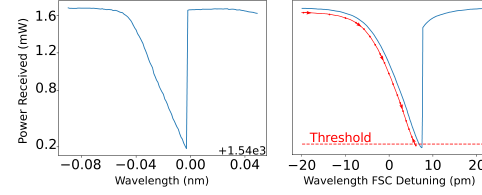 Figure 6. a) Power meter received power, filtered out by the notch filter versus the basic scan of the pump frequency, with steps of 1 pm, around the resonance mode near 1540 nm. b) Power meter received power versus the Fine Scan (FSC) of the pump frequency, with steps of 0.1 pm. The red horizontal dotted line shows the threshold above which the active fre- quency stabilization script will maintain the power. The red dotted line is an eye-guide on the part of the resonance that the active frequency stabilization tries to keep the frequency in
Mathematical & Logical Mechanism
The Master Equation
At the heart of this paper's quantum key distribution (QKD) mechanism are two fundamental equations. The first describes the entangled photon pairs that serve as the quantum information carriers, and the second quantifies the ultimate goal: the secure key rate.
The quantum state of the photon pair emitted within the frequency comb is given by:
$$|\Psi\rangle = \frac{1}{\sqrt{N}} \sum_{n=1}^{N} e^{i\phi_n} |I_n\rangle |S_n\rangle$$
The Secure Key Rate (SKR) for a d-dimensional state, which is the primary performance metric, is expressed as:
$$SKR_{dD} = \frac{1}{2} R_{raw}^{dD} [\log_2(d) - fH_d(e_Z) - H_d(e_X)]$$
Term-by-Term Autopsy
Let's dissect these equations to understand every component of this mathematical engine.
For the Quantum State Equation:
$$|\Psi\rangle = \frac{1}{\sqrt{N}} \sum_{n=1}^{N} e^{i\phi_n} |I_n\rangle |S_n\rangle$$
- $|\Psi\rangle$: This is the quantum state vector of the photon pair.
- Mathematical Definition: A vector in a Hilbert space representing the combined quantum state of two entangled photons.
- Physical/Logical Role: It represents the "raw material" of the QKD system – the entangled frequency-bin state generated by the silicon microresonator. This state is a coherent superposition, meaning the photons exist in multiple frequency modes simultaneously until measured.
- $N$: This is the number of available frequency modes.
- Mathematical Definition: An integer representing the upper limit of the summation.
- Physical/Logical Role: It defines the dimensionality of the frequency comb, which is practically limited by the bandwidth of the Programmable Filter (PF). A larger $N$ allows for higher-dimensional encoding, potentially increasing information capacity.
- $\frac{1}{\sqrt{N}}$: This is the normalization factor.
- Mathematical Definition: A scalar coefficient.
- Physical/Logical Role: In quantum mechanics, the total probability of finding a system in any possible state must be 1. This factor ensures that the quantum state $|\Psi\rangle$ is properly normalized.
- $\sum_{n=1}^{N}$: This is the summation operator.
- Mathematical Definition: It indicates a sum of terms from $n=1$ to $N$.
- Physical/Logical Role: It signifies that the photon pair exists in a superposition of different frequency mode pairs. This is the essence of entanglement in this context – the photons are correlated across these modes.
- Why summation: Entanglement is fundamentally about coherent superposition. A summation mathematically represents this combination of distinct, yet simultaneously existing, possibilities. It's not a classical mixture of probabilities, which might involve multiplication or weighted sums.
- $e^{i\phi_n}$: This is the phase factor for each mode.
- Mathematical Definition: A complex exponential, where $\phi_n$ is the residual spectral phase for the $n$-th mode.
- Physical/Logical Role: It accounts for any phase variations across the different frequency modes. These phases can arise from the photon generation process or propagation through the optical system. Ideally, for perfect entanglement, these phases would be uniform or precisely controllable.
- $|I_n\rangle$: This represents the idler photon state in frequency mode $n$.
- Mathematical Definition: A ket vector representing a single photon in a specific frequency mode (bin).
- Physical/Logical Role: It denotes one of the two entangled photons, the "idler," occupying a particular frequency bin $n$.
- $|S_n\rangle$: This represents the signal photon state in frequency mode $n$.
- Mathematical Definition: A ket vector representing a single photon in a specific frequency mode (bin).
- Physical/Logical Role: It denotes the other entangled photon, the "signal," occupying the same frequency bin $n$.
- Why implicit tensor product: The notation $|I_n\rangle |S_n\rangle$ implicitly represents a tensor product $|I_n\rangle \otimes |S_n\rangle$. This signifies that these are two distinct photons, each in its own quantum state, forming a joint state. They are correlated but remain separate entities.
For the Secure Key Rate Equation:
$$SKR_{dD} = \frac{1}{2} R_{raw}^{dD} [\log_2(d) - fH_d(e_Z) - H_d(e_X)]$$
- $SKR_{dD}$: This is the Secure Key Rate for d-dimensional states.
- Mathematical Definition: A scalar value, typically measured in bits per second (bit/s).
- Physical/Logical Role: This is the ultimate measure of the QKD system's success. It quantifies how many truly secure bits of information can be generated per unit time between Alice and Bob.
- $\frac{1}{2}$: This is the sifting ratio.
- Mathematical Definition: A scalar coefficient.
- Physical/Logical Role: In entanglement-based QKD protocols like BBM92, Alice and Bob must choose the same measurement basis for their results to be useful. Since they choose bases randomly and independently, on average, they will choose the same basis 50% of the time. This factor accounts for the discarded rounds.
- Why multiplication: It's a direct scaling factor that reduces the effective rate of useful events.
- $R_{raw}^{dD}$: This is the average raw coincidence rate for d-dimensional states.
- Mathematical Definition: A scalar value, typically in counts per second (Hz or kHz). It is defined by Equation (6) in the paper: $R_{raw}^{dD} = \sum_{i=0,j=0}^{d-1} (C_{ij}^Z + C_{ij}^X) / 2\tau$.
- Physical/Logical Role: This represents the rate at which Alice and Bob detect coincident photon pairs when they measure in the same basis. It's the raw data throughput before any security considerations or error correction.
- $[\dots]$: This bracketed term represents the net secure information content per detected pair.
- Mathematical Definition: A difference of logarithmic and entropy terms.
- Physical/Logical Role: This term quantifies how much secure information can be extracted from each successful coincidence event, after accounting for the inherent information capacity of the qudit, errors observed in the Z basis (for error correction), and potential information leaked to an eavesdropper (Eve) due to errors in the X basis (for privacy amplification).
- $\log_2(d)$: This is the information capacity per qudit.
- Mathematical Definition: The base-2 logarithm of the qudit dimension $d$.
- Physical/Logical Role: It represents the maximum theoretical amount of information (in bits) that can be encoded in a single $d$-dimensional quantum state (qudit). For a qubit ($d=2$), this is 1 bit. For a qutrit ($d=3$), it's $\log_2(3) \approx 1.58$ bits.
- Why logarithm: Information theory uses logarithms to quantify information content, as it directly relates to the number of distinguishable states.
- $f$: This is the post-processing efficiency factor.
- Mathematical Definition: A scalar factor, $f \ge 1$. The paper states $f=1.2$ for both qubit and qutrit implementations.
- Physical/Logical Role: It accounts for the overhead incurred during the error correction process. If $f=1$, error correction is perfectly efficient. If $f > 1$, it means more bits than strictly necessary are revealed during error correction, which reduces the final secure key length.
- $H_d(e_Z)$: This is the generalized binary entropy function for d-level systems, evaluated at the error rate $e_Z$.
- Mathematical Definition: A function defined by Equation (7) in the paper: $H_d(x) = -x \log_2((x/d - 1)) - (1 - x) \log_2(1 - x)$. (Note: As written, the term $(x/d - 1)$ would be negative for $x < d$, making $\log_2$ undefined. This is likely a typo in the paper, and typically should be $x/(d-1)$ as per the cited reference [46]).
- Physical/Logical Role: It quantifies the information that is revealed during the error correction process, some of which an eavesdropper (Eve) could potentially learn if she knows the error rate $e_Z$. This information must be subtracted from the total.
- Why subtraction: This term represents information that is effectively "lost" from the secure key because it had to be publicly discussed or is otherwise compromised during error correction.
- $e_Z$: This is the Quantum Bit Error Rate (QBER) in the Z basis.
- Mathematical Definition: A scalar value between 0 and 1. It is defined by Equation (4) in the paper: $QBER_M^{dD} = \frac{\sum_{a=0,b=0, a \neq b}^{d-1} C_{ab}^M}{\sum_{a=0,b=0}^{d-1} C_{ab}^M}$.
- Physical/Logical Role: It measures the error rate when Alice and Bob choose to measure their photons in the natural (Z) basis. This error rate is used to guide the error correction process.
- $H_d(e_X)$: This is the generalized binary entropy function for d-level systems, evaluated at the error rate $e_X$.
- Mathematical Definition: Same function as $H_d(e_Z)$, but with $e_X$ as the input.
- Physical/Logical Role: It quantifies the maximum information an eavesdropper (Eve) could potentially gain by performing measurements in the superposition (X) basis. This information must be "amplified away" through privacy amplification to ensure the final key's security.
- Why subtraction: This term represents information that must be "sacrificed" from the raw key during privacy amplification to guarantee that Eve has no useful information about the final secure key.
- $e_X$: This is the Quantum Bit Error Rate (QBER) in the X basis.
- Mathematical Definition: A scalar value between 0 and 1. Defined by Equation (4).
- Physical/Logical Role: It measures the error rate when Alice and Bob choose to measure their photons in the superposition (X) basis. This error rate is critical for estimating Eve's potential information gain and thus determining the amount of privacy amplification needed.
Step-by-Step Flow
Imagine a sophisticated assembly line for secure information. Here's how a single abstract data point – an entangled photon pair – moves through this QKD mechanism:
-
Entangled Pair Generation (The Foundry): The process begins in the silicon microresonator, acting as a quantum foundry. A continuous-wave pump laser injects energy. Through a process called Spontaneous Four Wave Mixing (SFWM), this energy is converted into a pair of entangled photons: a "signal" photon and an "idler" photon. This pair is the abstract "data point," represented by the quantum state $|\Psi\rangle = \frac{1}{\sqrt{N}} \sum_{n=1}^{N} e^{i\phi_n} |I_n\rangle |S_n\rangle$. Each pair is a superposition across $N$ frequency modes, meaning it's simultaneously in all these states, like a quantum coin spinning in the air. The $e^{i\phi_n}$ term accounts for any subtle phase variations inherent to its creation.
-
Spatial Separation and Distribution (The Conveyor Belt): A Programmable Filter (PF1) acts as a splitter, directing the signal photon to Alice and the idler photon to Bob. These photons then travel along separate quantum channels, which are optical fibers. Along this journey, they might encounter attenuation (simulated by $\alpha$) and environmental noise, like tiny bumps on the conveyor belt.
-
Random Basis Selection (The Measurement Stations): At their respective stations, Alice and Bob, independently and randomly, choose how to "look" at their photon. They can either choose the "natural basis" (Z-basis), which directly measures the photon's frequency mode, or the "superposition basis" (X-basis). For X-basis measurements, Electro-Optic Modulators (EOMs) and other PFs are engaged to mix the frequency modes and perform projections onto specific superposition states, applying precise phases (like $\phi$ for qubits or specific angles for qutrits).
-
Photon Detection and Coincidence Recording (The Quality Control): Superconducting Nanowire Single Photon Detectors (SNSPDs) are the "sensors" that detect the arrival of photons. A Time Tagger records the exact arrival time of each photon. If Alice and Bob detect their respective photons within a very narrow "coincidence window" ($\Delta t_{cc}$), a "coincidence count" ($C_{ab}^M$) is registered. These counts are accumulated over a specific integration time ($\tau$).
-
Basis Reconciliation (The Sorting Line): Alice and Bob then publicly compare notes on which basis they chose for each photon pair. If they chose different bases, that "data point" is discarded – it's like a product that doesn't match the order and is sent to the reject bin. This discarding process is why the $\frac{1}{2}$ sifting ratio appears in the $SKR_{dD}$ equation. Only pairs where they chose the same basis (Z-Z or X-X) proceed.
-
Error Rate Calculation (The Anomaly Detector): For the remaining "data points," Alice and Bob compare a small, randomly selected subset of their measurement outcomes. If their outcomes don't match (e.g., Alice measured '0' and Bob measured '1'), it's an "error." The Quantum Bit Error Rate ($QBER_M^{dD}$) is calculated using Equation (4) as the ratio of these "wrong" detections (accidental coincidences) to the total number of detections in that basis. A high QBER signals potential eavesdropping or excessive noise, much like an anomaly detector flagging a faulty product.
-
Secure Key Rate Finalization (The Secure Packaging): Finally, all these pieces of information are fed into the $SKR_{dD}$ equation (Equation (5)) to determine the final secure key rate.
- The average raw coincidence rate ($R_{raw}^{dD}$, from Equation (6)) provides the overall throughput of "good" events.
- The theoretical information capacity of each qudit ($\log_2(d)$) sets the maximum potential.
- Then, two crucial deductions are made:
- First, information revealed during error correction ($fH_d(e_Z)$), based on the Z-basis QBER ($e_Z$), is subtracted. This accounts for bits that had to be publicly discussed to fix errors.
- Second, information Eve might have gained ($H_d(e_X)$), estimated from the X-basis QBER ($e_X$), is subtracted. This ensures that even if Eve gained some partial knowledge, it's rendered useless through privacy amplification.
- The remaining value is the $SKR_{dD}$, the rate at which truly secret bits are packaged and delivered, representing the secure output of the entire assembly line.
Optimization Dynamics
This QKD system doesn't "learn" in the adaptive, iterative sense of a machine learning algorithm using gradients to navigate a loss landscape. Instead, its dynamics involve a combination of offline parameter optimization to find the best operating points and online stabilization mechanisms to maintain those optimal conditions.
- Parameter Optimization: Shaping the Performance Landscape
The core "learning" here is a search for optimal experimental parameters that maximize the Secure Key Rate (SKR). This is akin to an engineer meticulously tuning a complex machine.- The SKR Landscape: The authors explore a "performance landscape" where the "height" is the SKR, and the "terrain" is defined by parameters like the pump power on chip ($P_c$) and the coincidence window ($\Delta t_{cc}$).
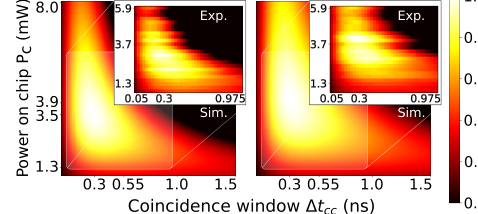 Figure 2. Simulated (Sim.) and experimental (Exp.) Secure Key Rate (SKR) as a function of coincidence window ∆tcc and power on chip Pc for d = 3 qudit in a) and for d = 2 qudits in b). The experimental SKR(∆tcc, Pc) represent the highlighted smaller area of the simulations. The optimal power on chip and coincidence window are P 3D op = 3.5 mW and ∆t3D op = 285 ps for d=3 qudits and P 2D op = 3.9 mW and ∆t2D op = 310 ps for d=2 qudits
Figure 2 vividly illustrates this landscape, showing peaks for SKR at specific combinations of $P_c$ and $\Delta t_{cc}$ for different qudit dimensions ($d=2, 3$).
* Searching for the Optimum: The process involves both simulations and experimental sweeps. For instance, increasing $P_c$ initially boosts the raw coincidence rate ($R_{raw}^{dD}$) by generating more photon pairs. However, beyond a certain point, higher $P_c$ leads to increased multi-photon emissions and two-photon absorption. These unwanted events contribute to "accidental" coincidences, which in turn inflate the Quantum Bit Error Rate (QBER). A higher QBER means more information is lost during error correction and privacy amplification, ultimately reducing the SKR. Similarly, the $\Delta t_{cc}$ must be wide enough to capture true entangled pairs but narrow enough to reject uncorrelated background noise.
* No Gradients, but a Search: While there are no formal "gradients" being computed and followed in the machine learning sense, the optimization process conceptually involves moving towards higher SKR values. If a change in $P_c$ or $\Delta t_{cc}$ increases SKR, that direction is favored. If it decreases, the opposite direction is explored. This is a systematic search for the global maximum in the SKR landscape.
* Strategic Dimension Choice: The qudit dimension $d$ itself is another parameter that is optimized, but not iteratively. For shorter quantum channels, a higher $d$ is beneficial because it increases the information capacity ($\log_2(d)$) per detected qudit, leading to a higher SKR. However, for longer, noisier channels, higher $d$ can be detrimental. This is because a higher $d$ means more possible outcomes, which can increase the QBER due to accidental counts and reduce the signal-to-noise ratio (SNR). Therefore, the optimal $d$ depends on the channel's attenuation, representing a strategic choice rather than a continuous update.
- System Stabilization: Maintaining the Optimal State
Once the optimal operating parameters are identified, the system employs active feedback loops to maintain these conditions against environmental fluctuations. This is about stability, not learning new optimal parameters.- Frequency Stabilization: The pump laser's frequency is crucial for efficient photon pair generation. The system actively stabilizes this frequency to the microresonator's resonance.
- Mechanism: A power meter continuously monitors the pump light transmitted through the resonator. The system's goal is to keep the pump frequency precisely on resonance, which corresponds to a minimum in the transmitted power (Figure 6b).
- Feedback Loop: If the measured power deviates from a predefined threshold, a control algorithm applies a small adjustment (detuning step) to the pump frequency. This continuous monitoring and adjustment counteract thermal drifts or mechanical vibrations that would otherwise shift the resonance frequency, ensuring the system operates at peak efficiency for photon generation. This is a classic control system, not a learning algorithm.
- Fiber Alignment: While not a continuous "learning" process during QKD operation, the system can also automatically align the optical fibers coupling light into and out of the resonator. This is a calibration procedure that maximizes optical transmission, ensuring that the generated photons reach Alice and Bob efficiently.
- Frequency Stabilization: The pump laser's frequency is crucial for efficient photon pair generation. The system actively stabilizes this frequency to the microresonator's resonance.
In essence, the "optimization dynamics" of this QKD system are characterized by a careful, often manual or simulated, search for optimal static operating parameters, followed by robust, real-time feedback control systems that maintain these parameters against environmental disturbances, ensuring consistent and high secure key rates over extended periods. There is no iterative "state update" in the sense of a machine learning model adjusting its internal weights based on a loss function.
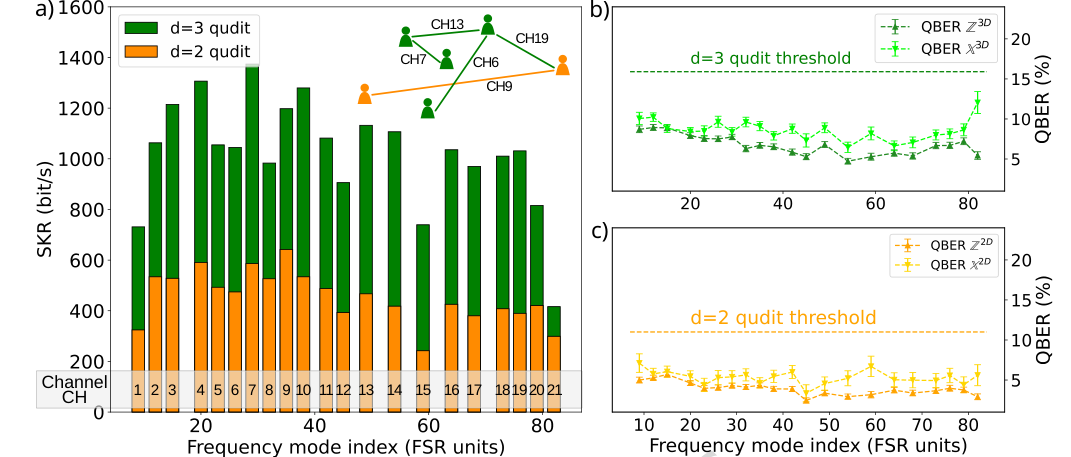 Figure 3. a) Experimental Secure Key Rate (SKR) of 21 QKD channels at 0 dB applied attenuation. We manually select the QKD channels and exclude the frequency modes with coincidence count rates below 1 kHz (cf. Fig. 1b). Each channel is 3 resonance-wide (63 GHz), and can be deployed with either d = 3 qudits or with d = 2 qudits. An example of a multi- dimensional quantum network architecture that operates quantum channels with qutrits and qubits in parallel is depicted in the inset. The associated QBERs for measurements in X (light colored) and Z (dark colored) basis are shown in b) for d = 3 and in c) for d = 2 qudit implementation. The horizontal dotted lines are the QBER thresholds for positive SKR, of 15.9% and 11% respectively [9]
Results, Limitations & Conclusion
Experimental Design & Baselines
The authors meticulously engineered their experimental setup to provide hard evidence for their claims regarding multi-dimensional frequency-bin entanglement-based Quantum Key Distribution (QKD). At the heart of their design was a low free spectral range (FSR) silicon microresonator, specifically a 3.54 mm long spiral resonator, fabricated on a 300 nm silicon layer over a 3 µm buried oxide layer. This silicon-on-insulator platform, chosen for its CMOS compatibility and high quality factor ($4.75 \times 10^5$), served as the source of entangled photon pairs via Spontaneous Four Wave Mixing (SFWM). A tunable laser continuously pumped this resonator, with the on-chip power ($P_c$) precisely controlled between 0 and 6 mW using an Erbium-Doped Fiber Amplifier (EDFA) and a Variable Optical Attenuator (VOA).
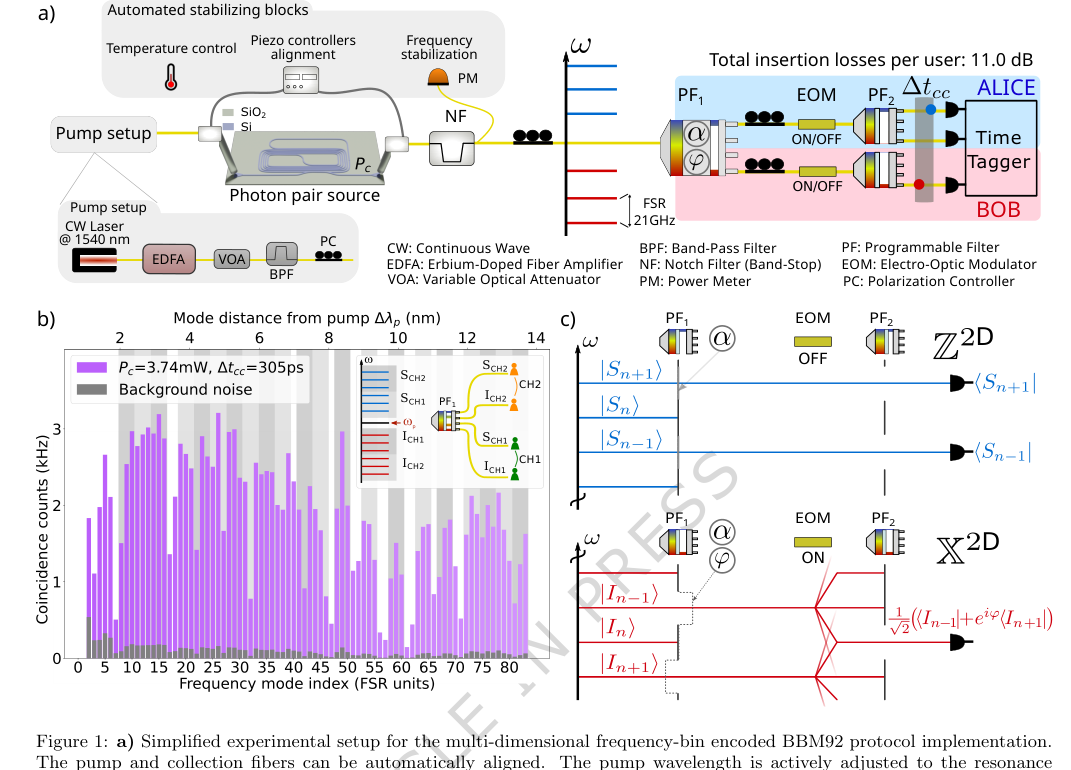 Figure 1. a) Simplified experimental setup for the multi-dimensional frequency-bin encoded BBM92 protocol implementation. The pump and collection fibers can be automatically aligned. The pump wavelength is actively adjusted to the resonance at ωp = 1539.970 nm of the silicon resonator. Details are given in Methods section IV. The signal (blue) and idler (red) entangled photons of the frequency comb generated by Spontaneous Four Wave Mixing (SFWM) are distributed to Alice and Bob respectively using PF1. The attenuation α and the phase φ on each frequency mode are applied by PF1 as well. The attenuation α is applied symmetrically on the signal and idler channels to emulate optical fiber losses for distance scaling measurements in Fig. 4. ON/OFF indicates the status of the EOMs. PF2 isolates the frequency components on a frequency channel for both bases, which are then detected using Superconducting Nanowire Single Photon Detectors (SNSPDs). The coincidence window ∆tcc represents the temporal interval within which detection events count as coincidences. b) Joint Spectral Intensity (JSI) of the photon pair source, including coincidence count rates for signal and idler pair indexed by the spectral separation from ωp, in Free Spectral Range (FSR) units. The frequency channels for idler ICH and signal SCH photons and their wavelength demultiplexing method using PF1 is illustrated in the inset. All quantum channels have a fixed bandwidth of 3 resonances (63 GHz) for both qubits and qutrits. The alternating gray background display the QKD channels used in Fig. 3. The variations in coincidence counts between different frequency modes come from fabrication imperfections. The coincidence count rates below 1 kHz are attributed to mode hybridisation between the fundamental waveguide mode and higher order modes, which locally degrades the quality factor of the resonator, reducing the photon extraction efficiency from the corresponding cavity mode. The JSI measurement was performed at a power on chip Pc = 3.74 mW and ∆tcc = 305 ps. c) Example sketch of the frequency-bin encoded BBM92 protocol measurements in Z2D and X2D basis for qubits. In the X basis, PF1 controls the state projections via φ and the EOM mixes the two frequency modes on a common frequency channel singled-out by PF2. Details about the qutrit implementation are given in the main text
To rigorously test their mathematical claims, the experiment was architected to generate and manipulate frequency-bin encoded Bell states of dimension $d=2$ (qubits) and $d=3$ (qutrits). The quantum state of the photon pair, $|\Psi\rangle = \frac{1}{\sqrt{N}} \sum_{n=1}^N e^{i\phi_n} |I_n S_n\rangle$, was characterized by its Joint Spectral Intensity (JSI) (Fig. 1b). For the BBM92 QKD protocol, the entangled signal and idler photons were spatially separated by a Programmable Filter (PF1) and distributed to two parties, Alice and Bob. Each party then measured their photon in one of two randomly selected Mutually Unbiased Bases (MUBs): the natural Z-basis or the superposition X-basis. Electro-Optic Modulators (EOMs) and a second PF (PF2) were used for state manipulation and basis projection, particularly for the X-basis where EOMs mixed frequency modes. Photon detection was performed using Superconducting Nanowire Single Photon Detectors (SNSPDs), and coincidence events were recorded within a defined time window ($\Delta t_{cc}$) by a TimeTagger 20.
The "victims" or baseline models in this study were primarily the performance metrics of their own system when configured for different qudit dimensions ($d=2$ vs. $d=3$) and under varying experimental conditions. The authors systematically optimized the on-chip pump power ($P_c$) and the coincidence time window ($\Delta t_{cc}$) to maximize the Secure Key Rate (SKR), simulating performance across a wide range of parameters and then experimentally validating the optimal regions. They also contextualized their results against existing literature on other QKD implementations (polarization, time-bin, and other frequency-bin approaches) to highlight the unique advantages and competitive performance of their multi-dimensional frequency-bin network.
What the Evidence Proves
The definitive, undeniable evidence that their core mechanism actually worked in reality is demonstrated through a series of robust experimental validations and performance metrics.
Firstly, the authors successfully generated and manipulated multi-dimensional frequency-bin entangled states, achieving secure key rates for both $d=2$ (qubits) and $d=3$ (qutrits). They meticulously optimized the system, finding optimal parameters for qutrits ($P_c^{\text{op}} = 3.5$ mW, $\Delta t_{cc}^{\text{op}} = 285$ ps) that resulted in Quantum Bit Error Rates (QBERs) of $e_X = 8.1\%$ and $e_Z = 7.7\%$. For qubits, optimal settings ($P_c^{\text{op}} = 3.9$ mW, $\Delta t_{cc}^{\text{op}} = 310$ ps) yielded QBERs of $e_X = 5.3\%$ and $e_Z = 4.4\%$. Crucially, all these experimentally measured QBERs were well below the theoretical thresholds for positive secure key generation (15.9% for $d=3$ and 11% for $d=2$), providing clear proof of secure communication.
The experimental results showcased an impressive average SKR of 1024 bit/s for $d=3$ qudits and 456 bit/s for $d=2$ qubits across 21 parallel QKD channels at 0 dB applied attenuation. The peak SKR reached 1374 bit/s for qutrits (channel CH6) and 642 bit/s for qubits (channel CH9). This directly validates the enhanced information capacity and higher communication rates offered by employing higher-dimensional qudits.
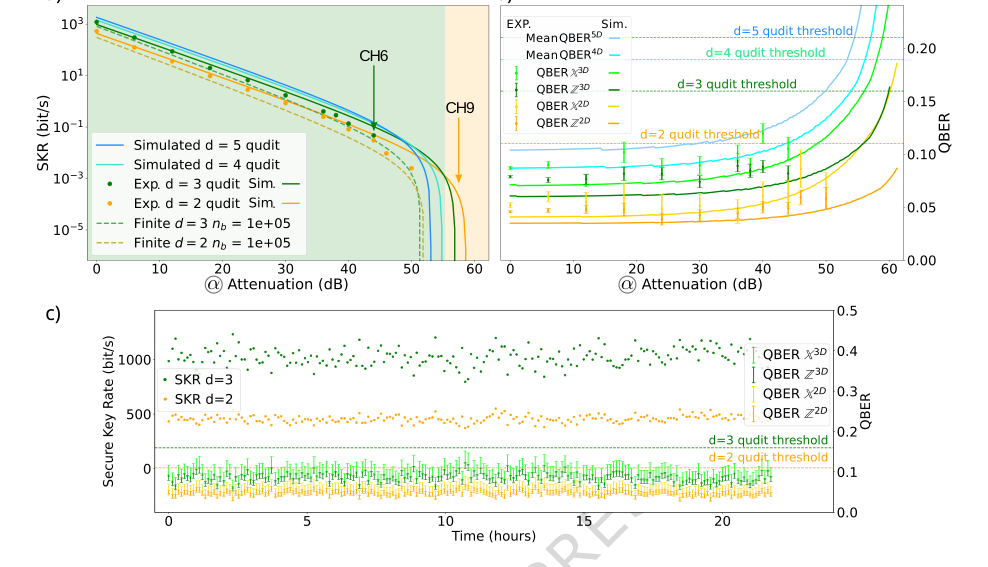 Figure 4. Experimental (dots) for d = 2 and d = 3 and simulated (plain line) for d = 2 to d = 5 of a) the asymptotic Secure Key Rate (SKR) and b) Quantum Bit Error Rate (QBER) scaling with total attenuation α on channel CH6. The simulated Finite size Secure Key Rates (FSKRs) are indicated in dashed lines. The green background indicates the region where SKR3D > SKR2D up to 55 dB of attenuation (275 km), and the orange background indicates SKR2D > SKR3D from 55 to 59 dB attenuation (295 km). For example, the shorter quantum channel CH6 can deploy 3-dimensional states, while the longer quantum channel CH9 can operate with 2-dimensional states in parallel, using the same PF-EOM-PF configuration as in Fig. 1. The horizontal dotted lines of panel b correspond to the QBER threshold below which a positive secret key rate can be extracted. For the simulated implementations of d = 4 and d = 5 qudits, the same measurement efficiency as for d = 2 and 3 qudits was considered. The step size is 0.25 dB and only positive SKR points are displayed c) SKR and QBER every 500 s, over 21 hours, for d = 3 and d = 2 qudit dimension, using only the active frequency stabilization feedback loop
Furthermore, the distance scaling measurements, particularly on channel CH6, demonstrated a maximum communication range of 295 km (corresponding to 59 dB of total attenuation, assuming 0.2 dB/km fiber loss) when operating with qubits. The evidence also definitively proved a strategic advantage: $d=3$ qudits provided a higher SKR for shorter distances (up to 275 km), while $d=2$ qubits maintained a positive SKR over longer distances (up to 295 km). This highlights the practical reconfigurability of their network to address user-specific needs, offering higher transmission rates with high-dimensional states for short links and extended communication ranges with two-dimensional states.
A significant, and often overlooked, piece of evidence was the system's stability. The authors demonstrated continuous and stable communication for over 21 hours (Fig. 4c). Although the resonance frequency eventually drifted after approximately 36 hours, requiring a brief re-initialization, this long-term stability is a strong indicator of the system's readiness for more practical, autonomous deployment. They also partially explored a 5-dimensional ($d=5$) protocol, achieving an SKR of approximately 300 bit/s up to 18 dB attenuation, further validating the scalability of their frequency-bin encoding approach, albeit with current technological limitations. The main source of QBER was identified as uncorrelated multi-pair emission events, characterized by the heralded second-order auto-correlation function $g^{(2)}(0)$, which at optimal parameters was $6.4\%$ for $d=3$ and $7.7\%$ for $d=2$. This intrinsic noise was effectively managed to maintain secure key rates.
Limitations & Future Directions
While this work represents a significant leap forward in multi-dimensional frequency-bin QKD, the authors candidly discuss several limitations and propose exciting avenues for future development.
A primary limitation for scaling to even higher dimensions (beyond the partially explored $d=5$) is the bandwidth of commercial Electro-Optic Modulators (EOMs), which is currently limited to 40 GHz. This constraint makes it challenging to efficiently mix frequency modes that are far apart, a requirement for generating the higher-order sidebands necessary for larger qudit dimensions. For instance, $d=4$ and $d=5$ already necessitate less efficient second-order sideband generation, and dimensions beyond $d=5$ become highly impractical with current EOM technology.
Another limitation is the current Secure Key Rate (SKR), which, while competitive for a multi-dimensional frequency-bin approach, is still modest when compared to state-of-the-art implementations using polarization or time-bin encoding (which can achieve $10^5 - 10^7$ bit/s). The authors attribute this primarily to system losses, with a total loss budget of 17.5 dB per user, encompassing chip-to-fiber coupling, notch filter, Programmable Filters (PFs), and EOMs. X-basis measurements incur an additional 3 dB loss.
Based on this paper, several discussion topics regarding future development and evolution emerge:
-
Advancements in EOM Technology: The most direct path to unlocking higher qudit dimensions is the development of EOMs with significantly higher modulation indices (e.g., $\mu=5$) and broader bandwidths (e.g., up to 119 GHz). This could enable the efficient generation of up to $d=12$ qudits, potentially increasing SKRs by an order of magnitude. Future research could explore novel electro-optic materials, resonant enhancement techniques, or integrated EOM designs to push these performance boundaries.
-
Full On-Chip Integration and Loss Mitigation: The paper strongly suggests that full on-chip integration of components like PFs and EOMs could drastically reduce insertion losses, potentially boosting SKR by "at least 2 orders of magnitude." This vision points towards fully integrated silicon photonic QKD systems. A critical discussion point is the engineering challenges and fabrication complexities involved in achieving this level of integration for all components—source, filters, modulators, and detectors—while maintaining high performance, low crosstalk, and cost-effectiveness.
-
Robust Active Phase Stabilization for Field Deployment: While the system demonstrated impressive stability over 21 hours, the authors acknowledge that "additional phase stability over long distance fibers" would be required for field deployment, especially for X-basis measurements. This highlights the need for robust, autonomous, and real-time active phase stabilization techniques, akin to those in mature polarization-encoded QKD systems. How can these be adapted and optimized for frequency-bin encoding over metropolitan fiber links, considering dynamic environmental and thermal fluctuations?
-
Dynamic Dimension Switching and Network Optimization: The observation that higher dimensions are optimal for shorter channels and lower dimensions for longer ones suggests a sophisticated, dynamic network management strategy. How can a QKD network intelligently and autonomously adapt the qudit dimension for each channel in real-time based on varying link conditions (e.g., attenuation, noise levels, user demand) to maximize overall network SKR and range? This could involve advanced machine learning algorithms or adaptive control systems that learn and respond to network dynamics.
-
Scalability to a Greater Number of Users and Channels: The demonstration of 21 parallel two-user links is a significant step towards multi-user quantum networks. The authors propose increasing to 38 channels by adjusting channel width. A deeper discussion could explore the ultimate limits to the number of parallel channels in frequency-bin encoding, considering spectral congestion, inter-channel crosstalk, and the complexity of managing numerous independent QKD links. Further research into lowering the FSR of the source and developing wider bandwidth PFs would be crucial here.
-
Hybrid Encoding Schemes and Cross-Platform Synergies: The paper briefly compares frequency-bin encoding with OAM and time-bin, noting their respective strengths and weaknesses. A more comprehensive and systematic comparison, perhaps exploring hybrid encoding schemes, could reveal optimal strategies for diverse network topologies and requirements. For instance, could a combination of frequency-bin and time-bin encoding offer a synergistic advantage in specific scenarios, or could frequency-bin encoding be combined with other degrees of freedom to create even richer quantum states?
These discussion points underscore that while frequency-bin entanglement-based QKD, particularly with its silicon compatibility and multiplexing capabilities, is a powerful and promising approach, continued innovation in component technology, system integration, and intelligent network management will be paramount for its widespread adoption and evolution into future quantum internet infrastructure.