
Fluxonium as a Control Qubit for Bosonic Quantum Information
Bosonic codes in superconducting resonators are a hardware-efficient avenue for quantum error correction and benefit from the inherent bias toward relaxation errors provided by long-lived cavities compared to typical...
Background & Academic Lineage
The Origin & Academic Lineage
The problem addressed in this paper originates from the critical need for robust quantum error correction in the burgeoning field of quantum computing, specifically utilizing bosonic codes stored in superconducing resonators. While these bosonic codes offer a hardware-efficient pathway to fault-tolerant quantum computers due to their inherently long storage times and biased error characteristics, their practical implementation faces a significant painpoint.
Historically, the control and readout of these bosonic modes have relied on coupling them to an ancillary control qubit. The most commonly employed ancillary qubit for this purpose has been the transmon qubit. However, the transmon, despite its widespread use, introduces several detrimental effects that undermine the inherent advantages of bosonic codes. These limitations include:
- Finite Lifetime: Transmon qubits have a limited coherence time, which directly restricts the duration and fidelity of cavity operations. This finite lifetime can induce excess decoherence in the coupled bosonic resonator.
- Undesired Nonlinearities: The transmon qubit inevitably induces a self-Kerr nonlinearity in the cavity. This unwanted self-interaction causes photon-number-dependent frequency shifts, leading to undesired state evolution and limiting the fidelity of quantum operations.
- New Error Channels: The coupling itself can introduce new error channels, such as Purcell decay or qubit-induced dephasing, further degrading circuit performance.
Previous attempts to mitigate these issues with transmons involved strategies like minimized or tunable qubit-cavity coupling or parametric control schemes. However, these approaches often came with trade-offs, such as reduced control speed or increased complexity in circuit design and operation. This fundamental limitation of existing transmon-based architectures—their tendency to "spoil" the high-quality bosonic cavity—forced researchers to seek alternative ancillary qubits that could provide fast, universal bosonic control while eliminating these inherited detrimental effects. This paper investigates the fluxonium qubit as a promising alternative, motivated by its long lifetime, flux tunability, and flexible Hamiltonain design, which allows for tailoring qubit-cavity interactions to minimize or eliminate undesirable nonlinearities.
Intuitive Domain Terms
- Bosonic codes: Imagine storing information not as a simple on/off switch, but as the exact number of marbles in a jar, or the precise height of water in a glass. Each marble or water level represents a quantum state, allowing for more complex information to be stored in a single "container."
- Superconducting resonator: Think of this as a perfectly smooth, super-efficient echo chamber or a very high-quality bell. Once you put sound (or in this case, microwave photons, which are like tiny packets of light) into it, the sound bounces around for a very, very long time without losing energy, making it an ideal place to store quantum information.
- Ancillary control qubit: This is like a specialized remote control or a skilled assistant. It doesn't store the main information itself, but it's used to precisely manipulate, read, and prepare the states of the main storage unit (the resonator) without directly touching it.
- Transmon qubit: This is a common type of "remote control" (ancillary qubit) that's been widely used. It's generally reliable, but it has a couple of flaws: it tends to "forget" its state relatively quickly (finite lifetime), and when it interacts with the storage unit, it can accidentally make the storage unit behave in unwanted, non-linear ways, like making the echo chamber distort sounds.
- Self-Kerr nonlinearity: This is like a flaw in our "echo chamber" (resonator) where the sound waves start to interfere with themselves in an undesirable way, causing distortion. Instead of each sound wave behaving independently, they start to affect each other, making it harder to precisely control the overall sound. It's an unwanted self-interaction that spoils the purity of the stored information.
Notation Table
| Notation | Description |
|---|---|
Problem Definition & Constraints
Core Problem Formulation & The Dilemma
The central problem this paper addresses is how to achieve robust quantum control of bosonic modes in superconducting resonators without compromising their inherent advantages for quantum error correction.
Input/Current State:
Bosonic codes, implemented in superconducting resonators, offer a hardware-efficient path to quantum error correction. These resonators boast long quantum state storage times and exhibit errors strongly biased towards relaxation, which simplifies error correction requirements. To achieve universal control of these bosonic modes, an ancillary control qubit is coupled to the resonator. Historically, the transmon qubit has been the go-to choice for this role.
Desired Endpoint/Goal State:
The ultimate goal is to realize a cavity-qubit coupling that provides both effective readout and universal control capabilities for the bosonic resonator. Crucially, this coupling must not introduce detrimental effects that "spoil" the cavity, meaning it should preserve the cavity's long coherence times and favorable error bias. Specifically, the desired outcome is a system that allows for a large dispersive shift ($\chi$) for fast control, while simultaneously eliminating or significantly suppressing the self-Kerr nonlinearity ($K$) and minimizing additional decoherence.
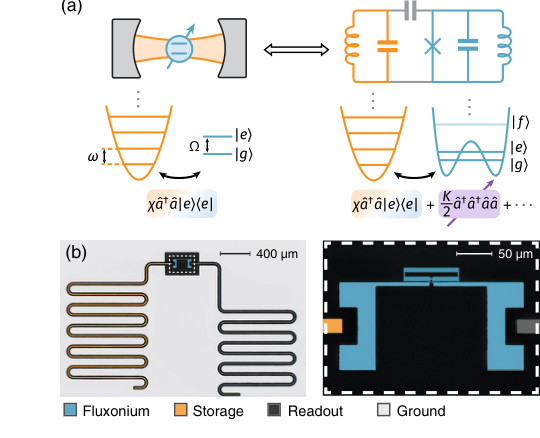 FIG. 1. Fluxonium-resonator system. (a) Schematic compar- ison of an idealized cavity quantum electrodynamics system versus a circuit implementation. Our target is a dispersive shift χ as the only interaction (left). In practice, a resonator coupled to an artificial atom implemented by a superconducting circuit also inherits (at least) a self-Kerr nonlinearity K arising from the qubit’s anharmonicity (right). With sufficient control over cir- cuit parameters, K can be tuned and potentially suppressed. (b) False-colored optical images of the fabricated device. A fluxo- nium qubit is capacitively coupled to storage and readout modes, implemented as coplanar waveguide resonators
Missing Link & Mathematical Gap:
The exact missing link is a control qubit architecture that can provide strong dispersive coupling ($\chi$) for fast, universal bosonic control while simultaneously suppressing or eliminating the self-Kerr nonlinearity ($K$) and minimizing decoherence. The transmon qubit, while providing control, inherently introduces a constrained trade-off between $\chi$ and $K$, where achieving a high $\chi$ often leads to a significant $K$ and vice-versa, or requires operating in regimes that compromise cavity coherence (strong hybridization). The mathematical gap is finding a system Hamiltonian (or a set of tunable parameters within a system) that allows for independent or favorable tuning of $\chi$ and $K$, specifically enabling a high $\chi/K$ ratio, ideally with $K \approx 0$. This paper attempts to bridge this gap by investigating the fluxonium qubit, whose design flexibility is hypothesized to allow for tailoring its Hamiltonian to achieve this.
The Dilemma:
The core dilemma that has trapped previous researchers is the painful trade-off between achieving strong, fast quantum control and preserving the quantum coherence and linearity of the bosonic cavity. When an ancillary qubit, such as the transmon, is coupled to a resonator for control, it typically introduces two major detrimental effects:
1. Excess Decoherence: The finite lifetime of the transmon qubit (which is generally shorter than the cavity's lifetime) acts as a new error channel, inducing decoherence in the coupled cavity and negating its long storage times.
2. Undesired Nonlinearities: The anharmonicity of the transmon qubit is inherited by the cavity, manifesting as a self-Kerr nonlinearity ($K$). This nonlinearity causes photon-number-dependent shifts in the cavity frequency, leading to undesired state evolution and limiting operation fidelities.
Previous attempts to mitigate these issues, such as using minimized or tuneable qubit-cavity coupling or parametric control schemes, often result in a reduced control speed or added complexity in circuit design and operation. The transmon system faces a fundamental constraint where $\chi$ and $K$ are approximately proportional to each other, making it difficult to achieve a high $\chi/K$ ratio without entering a regime of strong qubit-cavity hybridization, which itself is undesirable for preserving cavity coherence. This means improving control (higher $\chi$) often comes at the cost of increased nonlinearity ($K$) or reduced coherence, creating a persistent and difficult trade-off.
Constraints & Failure Modes
The problem of achieving high-fidelity, low-error bosonic quantum control is made insanely difficult by several harsh, realistic constraints:
-
Physical Constraints:
- Qubit Lifetime and Decoherence: The ancillary qubit's finite lifetime is a major constraint. Transmon qubits, with their relatively shorter lifetimes, induce excess decoherence in the coupled cavity, spoiling its long coherence benefits. The fluxonium is investigated precisely because of its reported millisecond lifetimes [36-38], which could minimize qubit-induced cavity decoherence.
- Cavity Lifetime: Even with an ideal qubit, the storage resonator itself has a finite energy relaxation time ($T_{1,s}$). In the planar prototype device used, the single-photon lifetime was measured at 12 µs. This relatively short lifetime significantly impacts the fidelity of state preparation and tomography, as the full experimental sequence can last a substantial fraction of this time. This is a practical limitation of the 2D on-chip architecture, though 3D implementations offer higher quality factors.
- Inherited Nonlinearities: The anharmonicity of the ancillary qubit inherently imparts a self-Kerr nonlinearity ($K$) onto the cavity. This is a fundamental physical property of the qubit design (e.g., transmon) that leads to photon-number-dependent frequency shifts and undesired state evolution. The goal is to engineer a system where this inherited nonlinearity is minimized or eliminated.
- Qubit-Cavity Hybridization: While strong coupling is desired for control, strong hybridization between the qubit and cavity states (e.g., when the qubit and cavity frequencies are too close) is generally undesirable as it can compromise the cavity's coherence and linearity. The system must operate in a regime of low hybridization.
- Flux Tunability: The ability to tune system parameters in situ via an external magnetic flux is a critical control knob. The fluxonium's flux tunability is a key advantage, allowing for dynamic reconfiguration of system properties, but it also introduces the need for precise flux control.
-
Computational Constraints:
- Complex Hamiltonian Modeling: Accurately predicting the behavior of the coupled qubit-resonator system requires numerically diagonalizing complex Hamiltonians (e.g., Eq. (1)) and simulating system dynamics using master equations (Eq. (C5)). This demands significant computational resources and sophisticated modeling tools (like scQubits and QuTiP).
- Parameter Tuning and Optimization: Achieving quantitative agreement between theoretical models and experimental data, and designing high-fidelity control gates (like SNAP gates), requires precise tuning of numerous circuit parameters and numerical optimization of pulse sequences. This can be computationally intensive and sensitive to initial conditions.
-
Data-Driven Constraints:
- Measurement Selectivity and Coherence: Away from flux sweet spots, the reduced coherence of the qubit limits the ability to perform photon-number-selective measurements, making displacement calibration and characterization of the cavity state more challenging. This affects the accuracy of extracted parameters like $\chi$ and $K$.
- Temporal Fluctuations from Two-Level Systems (TLSs): The presence of TLSs in the superconducting circuits can cause system parameters (e.g., qubit dispersive shift $\chi$, qubit $T_1$ and $T_2$) to fluctuate over time. These fluctuations, observed over timescales of days, can impact the stability and reliability of calibrations and measurements, making consistent high-fidelity operation a challenge.
- Qubit Initialization Inefficiency: Imperfect initialization of the ancillary qubit into its ground state (e.g., ~66% ground state population at thermal equilibrium) contributes to overall infidelity. This necessitates specific cooling and post-selection procedures, which add complexity and time to experiments.
- Readout Background and Crosstalk: Resonator crosstalk and qubit decay after measurement-based cooling can lead to skewed backgrounds in readout signals, requiring careful correction procedures to isolate the true qubit signal.
- Experimental Resolution Limits: The ability to resolve small values of Kerr nonlinearity ($K$) is limited by experimental noise, qubit coherence, and the required shift in Ramsey fringes. For example, the paper estimates a minimum resolvable $K/2\pi \approx 300$ Hz, meaning smaller nonlinearities are difficult to detect and characterize reliably with current methods. This limits the precision with which one can verify the suppression of $K$.
Why This Approach
The Inevitability of the Choice
The authors' decision to explore fluxonium as an ancillary qubit was not arbitrary but a direct consequence of the fundamental limitatons inherent in the widely adopted transmon qubit for bosonic quantum information processing. The paper explicitly states that the "typically employed transmon qubit... imposes limits on cavity operations due to its finite lifetime as well as the inevitably induced self-Kerr nonlinearity" (Page 1, Abstract). This realization highlights that traditional "state-of-the-art" (SOTA) methods, primarily transmon-based systems, were insufficient because they introduced "highly detrimental effects such as excess decoherence and undesired nonlinearities" (Page 1, Abstract) into the bosonic cavity. Specifically, the "uncontrolled nonlinearities are unavoidable when using the transmon" (Page 2, Introduction), leading to issues like reduced control speed or increased circuit complexity when attempting to mitigate them. The core problem was finding a qubit that could enable strong dispersive coupling for fast, universal bosonic control without these inherited detrimental effects. The fluxonium, with its distinct properties, emerged as the only viable candidate to overcome these critical shortcomings.
Comparative Superiority
The fluxonium qubit offers several qualitative and structural advantages that make it overwhelmingly superior to the transmon for this application. Firstly, fluxoniums have demonstrated "millisecond lifetimes [36-38]," which is crucial for minimizing qubit-induced cavity decoherence, a significant issue with transmons (Page 2). This directly translates to better preservation of the bosonic cavity's long storage times. Secondly, its "flux tunability enables in situ tuning of qubit-cavity coupling [39,40]" (Page 2), providing dynamic control over system properties that is less constrained than with transmons. Most importantly, the fluxonium's "rich energy level structure" and the ability to modify its Hamiltonian through various circuit parameters [41,42] allow for "tailoring the effective qubit-cavity Hamiltonian such that undesirable nonlinearities are minimized or eliminated" (Page 2). This is a profound structural advatage. The paper demonstrates that fluxonium-cavity systems can achieve "$\chi/K$ ratios that significantly exceed what is possible in transmon-cavity systems" (Page 5, Conclusion). A high $\chi$ (dispersive shift) is desirable for fast operations, while a low $K$ (self-Kerr nonlinearity) is essential to prevent photon-number-dependent dephasing, which degrades control fidelity. The ability to achieve a "vanishing K while still maintaining a large $\chi$ at half flux" (Page 6) is a key differentiator, enabling high-fidelity control that is simply not feasible with transmons due to their inherent constraints on the $\chi/K$ relationship (Fig. 5).
Alignment with Constraints
The chosen fluxonium approach perfectly aligns with the stringent constrains outlined for bosonic quantum information processing. The primary goal is to achieve universal quantum control of an oscillator while preserving the inherent benefits of bosonic codes, such as long storage times and biased error channels, and critically, without introducing detrimental effects from the ancillary qubit. The fluxonium's unique properties form a "marriage" with these requirements:
- Minimizing Decoherence: The constraint of preserving cavity coherence is met by the fluxonium's "long lifetime" (millisecond range), which directly reduces qubit-induced cavity decoherence (Page 2). This is a vast improvement over the finite lifetime limitations of transmons.
- Controlling Nonlinearities: A major constraint is the suppression of undesirable nonlinearities, particularly the self-Kerr effect, which leads to photon-number-dependent dephasing. The fluxonium's "design flexibility of its Hamiltonian" and "rich energy level structure" allow for "tailoring the effective qubit-cavity Hamiltonian such that undesirable nonlinearities are minimized or eliminated" (Page 2). This capability, especially the ability to achieve a vanishing Kerr nonlinearity while maintaining a large dispersive shift, directly addresses the problem of uncontrolled nonlinearities that plague transmon systems.
- Fast and Universal Control: The need for fast and universal bosonic control is supported by the fluxonium's capacity for "large dispersive coupling" (Page 2) and its superior $\chi/K$ ratios, which enable rapid gate operations with minimal dephasing. The flux tunability further enhances this by allowing in situ adjustment of coupling, optimizing for specific control protocols.
Rejection of Alternatives
The paper implicitly and explicitly rejects transmon qubits as the primary alternative for high-performance bosonic control. While transmons have been extensively used for bosonic code functionalities [19-26], the authors' core motivation stems from their inherent limitatons. The paper states that transmons "impose limits on cavity operations due to its finite lifetime as well as the inevitably induced self-Kerr nonlinearity" (Page 1, Abstract). These are fundamental issues that the fluxonium is designed to overcome.
Other approaches mentioned for transmon-based systems, such as "minimized or tuneable qubit-cavity coupling [9,12,29,30] or parametric control schemes [27,30–34]," are also considered insufficient. The paper notes that these alternatives "can lead to reduced control speed, or added complexity in circuit design or operation" (Page 2). This implies that while they might offer partial solutions to specific problems, they introduce new trade-offs that compromise the overall goal of fast, high-fidelity, and simple bosonic control. The fluxonium, in contrast, offers a more elegant and direct solution by fundamentally altering the qubit's properties to achieve superior performance without these added complexities or speed reductions. The paper does not discuss other popular quantum computing architectures like GANs or other qubit types (e.g., topological qubits) as direct alternatives for the ancillary qubit role in this specific cavity QED context, focusing instead on the direct comparison within superconducting circuits.
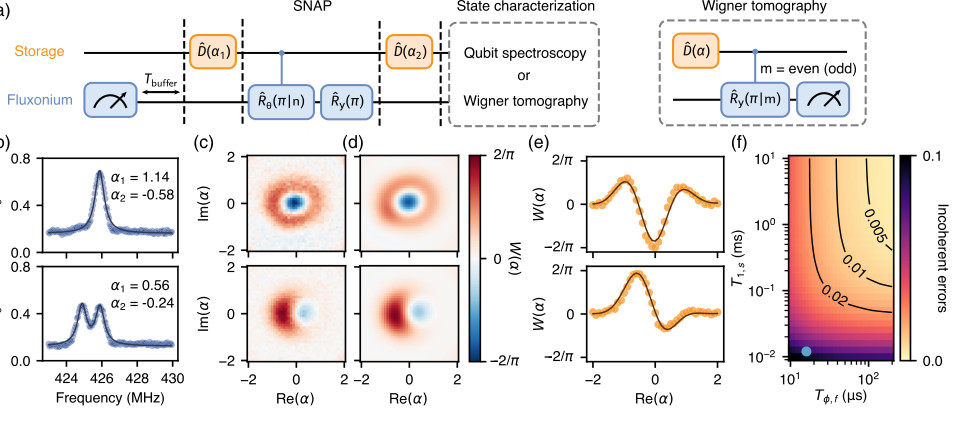 FIG. 4. Bosonic control using the fluxonium. (a) Pulse sequence for the preparation and characterization of Fock states in the storage resonator. A selective number-dependent arbitrary phase gate is used to prepare specific Fock states, which are characterized using either qubit spectroscopy or Wigner tomography. (b) Fluxonium spectroscopy with the storage resonator prepared in |1⟩(top) and 1 √
Mathematical & Logical Mechanism
The Master Equation
The absolute core equation that governs the system's dynamics, including both coherent evolution and decoherence, is the Lindblad master equation. This equation is essential for modeling open quantum systems, which are central to understanding the performance and limitations of the fluxonium-resonator system in this paper. Specifically, the paper refers to it as Equation (C5) in Appendix C:
$$ \frac{\partial \hat{\rho}}{\partial t} = -i[H_{\text{eff,rot}} + H_{\text{drive,rot}}, \hat{\rho}] + \sum_k [L_k \hat{\rho} L_k^\dagger - \frac{1}{2}\{L_k^\dagger L_k, \hat{\rho}\}] $$
Term-by-Term Autopsy
Let's dissect this equation, explaining each component's mathematical definition, physical/logical role, and the rationale behind its usage.
-
$\frac{\partial \hat{\rho}}{\partial t}$
- Mathematical Definition: This is the partial time derivative of the density operator $\hat{\rho}$.
- Physical/Logical Role: It represents the instantaneous rate of change of the quantum state of the system. In essence, it tells us how the system's quantum state is evolving over time.
- Why used: This is the standard mathematical expression for describing the time evolution of a quantum system, particularly when considering open quantum systems that interact with an environment.
-
$\hat{\rho}$
- Mathematical Definition: The density operator (or density matrix). It is a positive-semidefinite, Hermitian operator with a trace of 1.
- Physical/Logical Role: The density operator provides a complete statistical description of a quantum system's state. It can represent both pure quantum states (where the system is in a definite quantum state) and mixed states (where the system is in a classical probabilistic mixture of quantum states), which is crucial for modeling realistic systems subject to decoherence.
- Why used: For open quantum systems, the system is rarely in a pure state due to interactions with its environment. The density operator is the appropriate tool to describe these mixed states and their evolution.
-
$-i[H_{\text{eff,rot}} + H_{\text{drive,rot}}, \hat{\rho}]$
- Mathematical Definition: This is the commutator term, where $[A, B] = AB - BA$. Here, $H_{\text{total,rot}} = H_{\text{eff,rot}} + H_{\text{drive,rot}}$ is the total Hamiltonian in the rotating frame. So, the term is $-i(H_{\text{total,rot}}\hat{\rho} - \hat{\rho} H_{\text{total,rot}})$.
- Physical/Logical Role: This part of the equation describes the coherent, unitary, and reversible evolution of the quantum state. It dictates how the system's state changes due to its internal energy (Hamiltonian) and any external control fields applied. This is analogous to the Schrödinger equation for pure states.
- Why used: The commutator form ensures that the evolution is unitary, preserving the trace of the density matrix (total probability) and the purity of the state in the absence of dissipation. The imaginary unit $i$ is fundamental to quantum mechanics for describing time evolution.
-
$H_{\text{eff,rot}}$
- Mathematical Definition: The effective Hamiltonian in the rotating frame, given by $H_{\text{eff,rot}}/\hbar = \chi \hat{a}^\dagger \hat{a} |e\rangle \langle e| + \frac{K}{2} \hat{a}^\dagger \hat{a}^\dagger \hat{a} \hat{a}$.
- Physical/Logical Role: This Hamiltonian describes the intrinsic, static interaction between the fluxonium qubit (modeled as a two-level system) and the superconducting storage resonator in the dispersive regime. It captures the key physical phenomena of dispersive coupling and self-Kerr nonlinearity.
- Why used: This simplified form is valid under the strong-dispersive coupling conditions, allowing for a clear and intuitive understanding of the qubit-resonator interaction. The transformation to a rotating frame removes fast oscillating terms, simplifying the analysis.
-
$\chi \hat{a}^\dagger \hat{a} |e\rangle \langle e|$
- Mathematical Definition: The dispersive shift term. $\chi$ is the dispersive coupling strength, $\hat{a}^\dagger$ and $\hat{a}$ are the creation and annihilation operators for the resonator, and $|e\rangle \langle e|$ is the projector onto the excited state of the qubit.
- Physical/Logical Role: This term causes the resonant frequency of the storage resonator to shift when the qubit is in its excited state $|e\rangle$. Conversely, the qubit's transition frequency shifts depending on the number of photons in the resonator. This interaction is the cornerstone for qubit readout and for implementing quantum control over the bosonic resonator.
- Why used: This term naturally arises from the strong dispersive coupling between the qubit and resonator. It's an additive term in the Hamiltonian becuase it represents an energy shift to the system's total energy.
-
$\frac{K}{2} \hat{a}^\dagger \hat{a}^\dagger \hat{a} \hat{a}$
- Mathematical Definition: The self-Kerr nonlinearity term. $K$ is the Kerr coefficient, and $\hat{a}^\dagger \hat{a}^\dagger \hat{a} \hat{a}$ is an operator that can be rewritten as $\hat{n}(\hat{n}-1)$, where $\hat{n} = \hat{a}^\dagger \hat{a}$ is the photon number operator.
- Physical/Logical Role: This term introduces a nonlinearity where the resonator's frequency depends on the number of photons already present in the cavity. It causes different photon number states to accumulate phase at different rates, leading to undesired state evolution (e.g., squeezing of coherent states) and limiting the fidelity of quantum operations. The factor of $1/2$ is a conventional scaling for the Kerr term.
- Why used: This term captures the lowest-order nonlinearity that the resonator inherits from its interaction with the anharmonic fluxonium qubit. It's an additive term in the Hamiltonian as it represents an additional energy contribution to the system.
-
$H_{\text{drive,rot}}$
- Mathematical Definition: The drive Hamiltonian in the rotating frame, given by $H_{\text{drive,rot}}/\hbar = \sum_n e_n(t)e^{-i\delta_n t} |e\rangle \langle g| + \text{h.c.}$.
- Physical/Logical Role: This Hamiltonian describes the external microwave fields applied to actively control the fluxonium qubit. These drives are designed to induce transitions between the qubit's ground ($|g\rangle$) and excited ($|e\rangle$) states, enabling operations like Rabi oscillations and selective phase gates.
- Why used: External control is essential for manipulating quantum states. This term allows for the modeling of precisely shaped microwave pulses that drive the qubit, which in turn controls the dispersively coupled resonator.
-
$\sum_n e_n(t)e^{-i\delta_n t} |e\rangle \langle g| + \text{h.c.}$
- Mathematical Definition: This is a sum over $n$ of the complex amplitude $e_n(t)$ of the $n$-th microwave drive, multiplied by a rotating phase factor $e^{-i\delta_n t}$, and the qubit raising operator $|e\rangle \langle g|$. "h.c." stands for Hermitian conjugate, which includes the lowering operator $|g\rangle \langle e|$. $\delta_n = \omega_n - \Omega$ is the detuning of the $n$-th drive frequency $\omega_n$ from the qubit transition frequency $\Omega$.
- Physical/Logical Role: Each term in the summation represents a specific microwave drive applied to the qubit. $e_n(t)$ controls the pulse's strength and temporal shape, $e^{-i\delta_n t}$ accounts for the drive's phase evolution relative to the rotating frame, and $|e\rangle \langle g|$ induces transitions from the ground to the excited state (and its conjugate for excited to ground). This enables precise manipulation of the qubit state.
- Why used: The summation allows for the application of multiple, potentially distinct, drive tones. The exponential phase factor is a result of transforming to the rotating frame, making the drive effectively time-independent if on resonance ($\delta_n=0$).
-
$\sum_k [L_k \hat{\rho} L_k^\dagger - \frac{1}{2}\{L_k^\dagger L_k, \hat{\rho}\}]$
- Mathematical Definition: This is the Lindblad superoperator, representing the incoherent, dissipative evolution of the quantum system. $\{A, B\} = AB + BA$ is the anticommutator.
- Physical/Logical Role: This term accounts for decoherence and energy relaxation due to the system's irreversible interaction with its environment. Each $L_k$ is a collapse operator corresponding to a specific loss mechanism (e.g., photon loss, qubit relaxation, dephasing). It drives the system towards a mixed state and reduces quantum coherence.
- Why used: The Lindblad form is the most general way to describe Markovian, trace-preserving, completely positive evolution of an open quantum system. The summation includes all relevant independent loss channels, and the specific form ensures the density matrix remains physically valid.
-
$L_k$
- Mathematical Definition: Collapse operators. The paper specifies:
- Storage-mode energy decay: $L_1 = \sqrt{\kappa} \hat{a}$
- Fluxonium relaxation: $L_2 = \sqrt{\Gamma_1} |g\rangle \langle e|$
- Fluxonium excitation: $L_3 = \sqrt{\Gamma_1} |e\rangle \langle g|$
- Pure dephasing: $L_4 = \sqrt{\Gamma_\phi/2} (|e\rangle \langle e| - |g\rangle \langle g|)$
- Physical/Logical Role: Each $L_k$ describes a specific type of irreversible interaction with the environment. $\sqrt{\kappa} \hat{a}$ models photon loss from the resonator. $\sqrt{\Gamma_1} |g\rangle \langle e|$ represents the qubit relaxing from its excited to ground state. $\sqrt{\Gamma_1} |e\rangle \langle g|$ accounts for thermal excitation of the qubit. $\sqrt{\Gamma_\phi/2} (|e\rangle \langle e| - |g\rangle \langle g|)$ models pure dephasing, where phase information is lost without energy exchange.
- Why used: These operators are chosen to accurately model the dominant physical loss mechanisms observed in superconducting quantum circuits. The square root factors ensure the correct rates for these dissipative processes.
- Mathematical Definition: Collapse operators. The paper specifies:
Step-by-Step Flow
Let's trace the exact lifecycle of a single abstract data point, represented by the density matrix $\hat{\rho}$, as it passes through this mathematical engine.
- Initial State Injection: The process begins with an initial density matrix $\hat{\rho}(0)$, representing the quantum state of the fluxonium-resonator system at time $t=0$. This might be a ground state, a coherent state, or a mixed state due to imperfect initialization.
- Coherent Evolution Assembly Line:
- As time progresses, the coherent part of the master equation, $-i[H_{\text{eff,rot}} + H_{\text{drive,rot}}, \hat{\rho}]$, acts on $\hat{\rho}$.
- Intrinsic Interaction: First, the static effective Hamiltonian $H_{\text{eff,rot}}$ starts to shape $\hat{\rho}$. The dispersive shift term, $\chi \hat{a}^\dagger \hat{a} |e\rangle \langle e|$, causes the resonator's frequency to "rotate" differently depending on whether the fluxonium qubit is in its ground or excited state. This creates a state-dependent frequency shift.
- Nonlinear Phase Accumulation: Simultaneously, the self-Kerr nonlinearity, $\frac{K}{2} \hat{a}^\dagger \hat{a}^\dagger \hat{a} \hat{a}$, induces a photon-number-dependent phase shift within the resonator. If $\hat{\rho}$ represents a coherent state, this term will cause it to "shear" or distort in phase space, as different photon number components evolve at different rates.
- External Control Input: Then, external microwave pulses, described by $H_{\text{drive,rot}}$, are applied. These pulses are precisely timed and shaped to drive transitions in the fluxonium qubit (e.g., $|g\rangle \leftrightarrow |e\rangle$). By manipulating the qubit, the dispersively coupled resonator's state can be indirectly controlled, for instance, by imparting specific phase shifts or performing state transfers.
- These coherent operations unitarily transform $\hat{\rho}$, rotating its components in the Hilbert space in a predictable, reversible manner.
- Incoherent Decay and Dephasing Station:
- Concurrently with the coherent evolution, the incoherent part of the master equation, $\sum_k [L_k \hat{\rho} L_k^\dagger - \frac{1}{2}\{L_k^\dagger L_k, \hat{\rho}\}]$, continuously processes $\hat{\rho}$.
- Photon Loss: The resonator's collapse operator, $\sqrt{\kappa} \hat{a}$, models photons escaping the cavity. This causes the total photon number in the resonator to decrease, and the quantum state to lose energy irreversibly.
- Qubit Relaxation/Excitation: The qubit's collapse operators, $\sqrt{\Gamma_1} |g\rangle \langle e|$ and $\sqrt{\Gamma_1} |e\rangle \langle g|$, describe the qubit losing energy to its environment (relaxation) or gaining energy (thermal excitation). These processes lead to the qubit's state decaying towards a thermal equilibrium.
- Pure Dephasing: The pure dephasing operator, $\sqrt{\Gamma_\phi/2} (|e\rangle \langle e| - |g\rangle \langle g|)$, causes the qubit to lose its quantum phase information without any energy exchange. This destroys superpositions and drives the qubit towards a mixed state.
- These incoherent processes cause $\hat{\rho}$ to become more "mixed" over time, reducing the off-diagonal elements (coherence) and driving the system towards a classical statistical mixture.
- Output State: After a certain evolution time $t$, the master equation yields the final density matrix $\hat{\rho}(t)$. This $\hat{\rho}(t)$ represents the system's quantum state, having undergone both the intended coherent transformations and the unavoidable incoherent degradation. From this final density matrix, observable quantities like qubit population probabilities, Wigner functions, or fidelity metrics can be calculated to characterize the system's performance.
Optimization Dynamics
The mechanism described by the Lindblad master equation is not a "learning" algorithm in the typical machine learning sense, but rather a powerful tool for characterization, control, and optimization of quantum system performance. The "optimization" here refers to finding optimal system parameters or control pulse sequences to achieve desired quantum states or minimize errors.
-
Parameter Extraction and Loss Landscape Mapping:
- The primary use of this mechanism is to simulate the system's dynamics. By comparing these simulations with experimental data (e.g., qubit spectroscopy, Ramsey interferometry, Wigner tomography), the authors extract critical physical paramters like the dispersive shift $\chi$, the Kerr nonlinearity $K$, and various decay rates ($\kappa$, $\Gamma_1$, $\Gamma_\phi$).
- This involves a fitting process: the simulated results are adjusted by varying model parameters until they best match the measured data. In this context, the "loss landscape" is not a training loss function but rather the landscape of how well the model's predictions align with experimental observations. The goal is to find the parameter values that minimize the discrepancy, often using least-squares or similar fitting algorithms.
- The paper explicitly mentions fitting Ramsey fringes using the master equation to account for system losses, and extracting $\chi$ and $K$ from experimental data by fitting to theoretical models.
- The fluxonium's unique flux tunability allows for dynamic control over $\chi$ and $K$. By mapping these parameters as a function of external flux (Fig. 3), the authors can identify "sweet spots" where, for example, the Kerr nonlinearity $K$ is suppressed while maintaining a large dispersive shift $\chi$. This is a crucial optimization goal for high-fidelity bosonic control.
-
Control Pulse Optimization:
- For specific quantum control tasks, such as preparing resonator Fock states or superpositions using the Selective Number-dependent Arbitrary Phase (SNAP) gate, precise control pulse sequences are required. These pulses are defined by the time-dependent amplitudes $e_n(t)$ and detunings $\delta_n$ in the drive Hamiltonian $H_{\text{drive,rot}}$.
- The paper states that the "amplitudes and phases of the selective $\pi$ pulses were numerically optimized to suppress coherent errors." This optimization process involves iteratively running the master equation (C5) forward with different pulse paramters. For each set of parameters, the fidelity of the resulting quantum state (how close it is to the target state) is calculated.
- The "loss landscape" in this scenario is the infidelity (1 - fidelity) as a function of the pulse parameters. Numerical optimization algorithms (e.g., gradient descent, evolutionary algorithms, or optimal control methods) are employed to navigate this landscape and find the pulse parameters that maximize the fidelity of the desired quantum operation.
- Simulations of incoherent errors (Fig. 4(f)) also guide this optimization by showing how system lifetimes ($T_{1,s}$, $T_{\phi,f}$) impact gate fidelity, informing future device design and experimental protocols.
-
Iterative State Update:
- At its core, the master equation itself describes the continuous, iterative update of the density matrix $\hat{\rho}$ over infinitesimal time steps $dt$. In numerical simulations, this is typically solved using time-stepping methods (e.g., Runge-Kutta). At each step, $\hat{\rho}(t+dt)$ is calculated from $\hat{\rho}(t)$ by applying the combined coherent and incoherent evolution operators. This iterative process allows for tracing the full lifecycle of the quantum state under various experimental conditions and control pulses, forming the basis for both characterization and optimization.
Results, Limitations & Conclusion
Experimental Design & Baselines
Our experimental setup was meticulously designed to validate the fluxonium's capabilities as a control qubit for bosonic quantum information. We constructed a minimal circuit comprising a superconducting storage resonator and a fluxonium qubit, augmented by an additional readout resonator for qubit state measurement (detailed in Appendix A 3). For this proof-of-principle work, we opted for a two-dimensional (2D) on-chip architecture, which afforded us precise control over the fluxonium and resonator circuit parameters, even with the acknowledged trade-off in resonator quality factor compared to three-dimensional (3D) implementations.
The most advantageous operating point for the fluxonium was identified at half-flux, a regime where its lifetime and coherence are maximized. At this point, we characterized the qubit's intrinsic properties, measuring a relaxation time ($T_1$) of 123 µs and a Hahn echo coherence time ($T_2$) of 90 µs for device A (Table I). Qubit initialization was achieved through a measurement-based cooling and post-selection procedure, consistently yielding over 90% ground-state population (Appendix B 1).
To characterize the qubit-resonator interaction, we prepared a coherent state with amplitude $\alpha$ in the storage mode using a displacement pulse and then measured the fluxonium's spectrum (Fig. 2(a)). The clear observation of number-split qubit resonances, with a peak separation of $\chi/2\pi = 1.0$ MHz, served as definitive evidence of strong-dispersive coupling. This strong coupling is fundamental for Fock-state selective qubit rotations, which underpin bosonic state control and readout. We further measured the resonator's relaxation rate by monitoring the probability of it returning to the vacuum state after a displacement, extracting a single-photon lifetime of 12 µs (Fig. 2(b)), a value primarily limited by the internal quality factor of our fabricated 2D device.
A central objective was to extract the inherited self-Kerr nonlinearity ($K$) of the storage mode. We achieved this using a "cavity Ramsey" interferometry experiment, which involved a sequence of resonator displacements and number-selective measurements (Fig. 2(c)). The observed shift in Ramsey fringes at larger displacement amplitudes directly indicated a photon-number-dependent detuning, from which we extracted a self-Kerr coefficient of $K/2\pi = 3.6$ kHz.
Crucially, we investigated the flux dependence of $\chi$ and $K$. We measured the fluxonium spectrum across a range of external flux values and used the extracted circuit parameters to numerically compute the expected flux dependence of $\chi$ and $K$. This characterization was performed on two distinct devices (A and B), each featuring a different storage resonator frequency (Fig. 3).
Finally, we demonstrated bosonic control by preparing and characterizing resonator Fock states and their superpositions. This was accomplished using resonator displacement operations and the Selective Number-dependent Arbitrary Phase (SNAP) gate (Fig. 4(a)). The prepared states were then characterized using both qubit spectroscopy and Wigner tomography (Figs. 4(b), 4(c)). Our primary baseline for comparison throughout this work was the transmon qubit, a widely used ancillary qubit in superconducting circuits. We aimed to rigorously demonstrate that fluxonium-cavity systems could achieve superior $\chi/K$ ratios compared to transmon-based architectures, for which a theoretical bound on $\chi^2/|K|$ was established as $|K|/2\pi \ge (\chi/2\pi)^2 / (2.12 \text{ GHz})$ (Appendix C3). We also referenced numerous literature values for transmon $\chi$ and $K$ (Table II) to contextualize our findings.
What the Evidence Proves
The experimental evidence we gathered provides compelling proof for the fluxonium's potential as a high-performance bosonic control qubit, particularly its ability to overcome limitations inherent in transmon-based systems.
Firstly, the observation of clear number-split qubit resonances, with a dispersive shift $\chi/2\pi = 1.0$ MHz (Fig. 2(a)), unequivocally demonstrates strong-dispersive coupling. This is the bedrock upon which our bosonic control mechanism rests, enabling the precise, Fock-state selective qubit rotations necessary for manipulating quantum states in the resonator. The measured single-photon lifetime of 12 µs (Fig. 2(b)) for the storage resonator, while limited by our 2D prototype, confirms its ability to store quantum information for a meaningful duration.
Secondly, our "cavity Ramsey" interferometry experiments provided definitive, undeniable evidence of the resonator's self-Kerr nonlinearity. The amplitude-dependent shifts in the Ramsey fringes (Fig. 2(d)) directly revealed the Kerr effect, allowing us to extract $K/2\pi = 3.6$ kHz. The quantitative agreement between our experimental data and Lindblad master equation simulations (Fig. 2(e)) is a critical piece of evidence. It proves that we possess a robust, mathematical understanding of the interplay between nonlinearity and loss in our system, allowing us to credibly predict device parameters for low-error bosonic control.
Thirdly, the fluxonium's unique tunability was ruthlessly proven. Our measurements of $\chi$ and $K$ as a function of external flux (Figs. 3(c), 3(e) for device A; Figs. 3(d), 3(f) for device B) showed a remarkably wide variation, in excellent agreement with numerical predictions. Most importantly, the data revealed that $K$ can change sign and cross zero at specific flux bias points (Fig. 3(e)). This tunability is a game-changer, demonstrating the ability to dynamically suppress Kerr-induced state evolution, a capability largely inaccessible to standard transmon qubits.
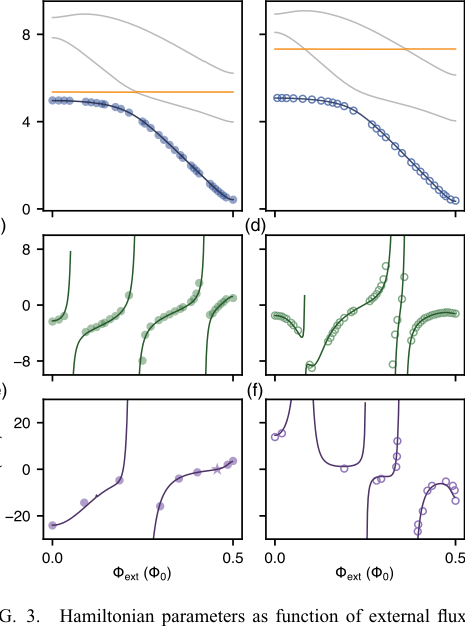 FIG. 3. Hamiltonian parameters as function of external flux. (a) and (b) Fluxonium spectra of device A (left; solid circles) and device B (right; open circles), fit to the |g⟩→|e⟩transition. The higher transitions |g⟩→|f ⟩and |g⟩→|h⟩are shown in gray. The storage resonator level (orange) crosses different higher fluxonium levels in each device. This results in distinct flux dependence of the dispersive shift χ shown in (c) and (d), and the self-Kerr nonlinearity K shown in (e) and (f). K can change sign and cross zero at specific flux bias points (star; see Appendix D 1 for raw data). Solid lines are expected parameters based on the fit to the fluxonium spectrum. All simulations are performed numer- ically and show good agreement with the measurements. Error bars are smaller than the marker size (Appendix A 5)
Fourthly, we successfully demonstrated quantum control of the resonator's state. By employing resonator displacement and the SNAP gate, we prepared and characterized both the single-photon Fock state $|1\rangle$ and the superposition state $(|0\rangle - |1\rangle)/\sqrt{2}$. The experimentally measured Wigner functions (Fig. 4(c)) clearly show the successful preparation of these states. The strong quantitative agreement between these measured Wigner functions and our master equation simulations (Figs. 4(d), 4(e)) further validates our understanding of the system's dynamics and error model, including the impact of incoherent errors.
Finally, and perhaps most significantly, the evidence proves that fluxonium-cavity systems can achieve superior performance compared to transmons in a critical metric. Our analysis, particularly the figure of merit $\chi^2/|K|$ versus flux (Fig. 5(d)), shows that the fluxonium can exceed the simulated transmon bound across several flux regions. For device B, two measured points (at $\Phi_{\text{ext}} \approx 0.1919\Phi_0$ and $\Phi_{\text{ext}} \approx 0.3358\Phi_0$) clearly fall above the transmon bound, with $\chi/2\pi = \{-1.83, -3.31\}$ MHz and $K/2\pi = \{0.31, 1.04\}$ kHz, respectively. This is definitive, undeniable evidence that the fluxonium's core mechanism allows for a more favorable balance between dispersive coupling and Kerr nonlinearity, a key advantage for high-fidelity bosonic quantum information processing. The simulated example of a fluxonium circuit achieving vanishing $K$ with a large $\chi$ at half-flux (Fig. 5(b)) further reinforces this potential.
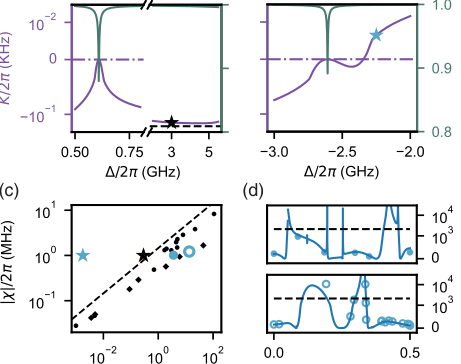 FIG. 5. Relation of χ and K for the fluxonium and trans- mon. (a) K (purple line) and overlap between bare and dressed states (green line) as a function of for a (hypothetical) transmon-resonator system with parameters EC/2π = 530 MHz and EJ/2π = 26.5 GHz for fixed |χ|/2π = 1 MHz. Although K reaches zero near EC ≈ , the qubit and resonator states become strongly hybridized at this point. The black star shows example transmon parameters for the bound (black dashed line) on χ/K discussed in the main text. (b) The same quanti- ties as in (a), shown for a fluxonium-resonator system at half flux with EC/2π = 1.19 GHz, EL/2π = 556 MHz, EJ/2π = 3.04 GHz. Blue star indicates a set of fluxonium parameters that beat the transmon bound, chosen with a detuning of 100 MHz from the K = 0 case, to illustrate that no unrealistic fine-tuning is required for small Kerr nonlinearity. (c) Our derived χ/K bound (dashed black line) plotted with values from the literature [9,23–25,44,45,48–53] for transmons (black circles are measured data; black diamonds have measured χ and simulated K), and devices A (blue circle) and B (open blue circle) of this work (at half-flux). (d) The figure of merit χ2/K vs flux. The ratio is plotted for measured data (blue circles) and fit to simula- tion (blue line) for device A (device B) in the top (bottom) panel. The black dashed lines are the transmon bound. For device B, two measured points fall above the transmon bound, with χ/2π = {−1.83, −3.31} MHz and K/2π = {0.31, 1.04} kHz at ?ext ≈{0.1919, 0.3358}?0 (see Appendix D 3 for details)
Limitations & Future Directions
While our work establishes the fluxonium as a promising candidate for bosonic quantum information processing, several limitations in our current prototype device constrain the achievable fidelities and point towards exciting avenues for future development.
A primary limitation is the relatively low cavity lifetime of our 2D resonator, measured at 12 µs. The full experimental sequence for Wigner tomography, lasting approximately 3.5 µs, represents a significant fraction (>25%) of this relaxation time. Consequently, the preparation fidelities for Fock state $|1\rangle$ (79%) and the superposition state $(|0\rangle - |1\rangle)/\sqrt{2}$ (91%) are currently limited by this short cavity lifetime and qubit initialization inefficiency (Table III). To achieve the high fidelities required for fault-tolerant quantum computation, significant improvements in system coherence times are essential.
From an engineering perspective, integrating fluxonium qubits with high-Q cavities, such as those used in 3D architectures, remains a substantial challenge. While our 2D platform was excellent for proof-of-concept, scaling to higher-Q systems will require further advances in fabrication processes to reliably target circuit parameters and produce highly coherent fluxonium qubits.
Another area for future exploration involves higher-order nonlinearities. Our current bosonic control experiments primarily operate with a few cavity photons, where the leading-order Kerr nonlinearity ($K_2$) is dominant. However, as bosonic codes evolve to utilize larger photon numbers, higher-order Kerr coefficients ($K_p$ for $p > 2$) will become increasingly relevant. Our simulations indicate that for devices A and B, these higher-order corrections become significant after approximately 10 photons (Fig. 14(c)). Future work will need to address how to mitigate or exploit these higher-order terms for robust control.
Looking ahead, the fluxonium's inherent flux tunability of $\chi$ and $K$ offers a powerful knob for dynamic reconfiguration of system properties. This could be leveraged to suppress Kerr-induced state evolution during idle periods or to dynamically optimize parameters for specific quantum protocols. The ability to engineer distinct $K/\chi$ ratios, as demonstrated, opens up possibilities for designing novel control schemes that balance fast operation with minimal nonlinearity.
The ultimate goal is to realize "Kerr-free bosonic control," where the fluxonium can be coupled to a cavity in the strong-dispersive regime while practically eliminating the self-Kerr nonlinearity, particularly at half flux. Our simulations predict this is achievable, and its experimental realization is a critical next step. This would involve further advances in high-Q cavity integration and refined fabrication processes to achieve the predicted Hamiltonian parameters.
Beyond the immediate improvements, the established control techniques are directly transferable to more advanced architectures incorporating high-Q cavities, paving the way for the realization of Kerr-free bosonic control. Furthermore, addressing current error sources, such as improving active reset methods for qubit initialization and developing better-cohering qubit and resonator systems, will be crucial for mitigating incoherent loss.
The fluxonium's unique design freedom, stemming from its rich energy level structure and flux tunability, presents unparalleled opportunities for tailoring qubit-photon interactions that are not accessible in traditional cavity QED systems. This suggests that future research could explore novel bosonic control schemes beyond the SNAP protocol, potentially leading to new gate designs, error correction strategies, or even entirely new paradigms for quantum information processing that fully exploit the fluxonium's versatility. This broad perspective, free from the biases of existing qubit technologies, will stimulate critical thinking and drive the evolution of bosonic quantum computing.
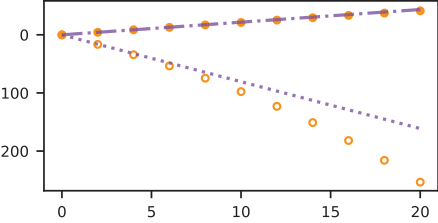 FIG. 14. Higher-order Kerr in the fluxonium devices. (a) Sim- ulated pth order shift Kp as a function of detuning for the same fluxonium as presented in Fig. 5 for p = 2 (purple), 3 (blue), 4 (orange), and 5 (green). At each , g is tuned such that |χ| = 1 MHz. The blue star at /2π = −2.25 MHz is the same example point as in Fig. 5. (b) At the blue star point of sub-figure a, the simulated deviation ω (orange stars) of the cavity fre- quency is plotted for different photon numbers. The deviation only due to K2/2π = 1.76 Hz is plotted for comparison (dashed purple line). (c) The simulated deviation ω for devices A and B (closed and open circles, respectively). The deviations only due to K2 are plotted as dash-dotted and dotted lines, respectively